
Outdoor plant
Boston Ivy
Parthenocissus tricuspidata
Also known as Japanese Creeper
Practical guidance for growing Boston ivy, Parthenocissus tricuspidata, including self-clinging adhesive pads, autumn colour, wall damage risk, Japanese beetle, and mild berry toxicity.
At a glance
- Difficulty
- Easy
- Water
- Regular watering while establishing, then drought-tolerant
- Light
- Full sun to full shade; autumn colour is best with some direct sun
- Temperature
- Very hardy; tolerates severe winter cold once established
- Hardiness
- USDA 4-8, RHS H5, hardy to -12 C
- Type
- Deciduous woody climber
- Height
- 12 m or more
- Native to
- eastern Asia
Cold is rarely the limiting factor for this vine. Boston ivy survives winters far harder than most gardens experience, and the zone range mostly marks where the growing season is long and warm enough for it to put on the vigorous growth it is grown for, rather than where it stops surviving. It has no dry-season requirement and no chill threshold to speak of; a temperate climate with a real winter and a warm enough summer suits it almost anywhere.
Hardiness zones describe winter cold alone. Summer heat, humidity, rainfall and the length of the growing season decide as much, so treat the range as the outer limit rather than as a recommendation.
Harmful if eaten
- Do not eat
- Berries, which contain irritant calcium oxalate crystals
- Harm from
- Eating it
- Affects
- People
Boston ivy does not appear on the ASPCA's toxic plant database for dogs, cats or horses, and no strong record ties the species to serious pet poisoning. The small blue-black berries do contain calcium oxalate crystals, the same kind of irritant found in many houseplants such as dieffenbachia, and biting into one causes an immediate burning sensation in the mouth along with swelling that makes eating more uncomfortable rather than dangerous. A child who tries one berry generally stops there, since the reaction is unpleasant enough to discourage a second bite. Birds eat the berries through autumn and winter without apparent harm, and the leaves and stems carry far less of the irritant than the fruit does.
Sources: ASPCA toxic and non-toxic plants, RHS potentially harmful garden plants
About
Boston ivy covers a wall on its own, gripping brick, stone and concrete with small adhesive pads rather than the twining stems or aerial roots other climbers rely on. It needs no wires, no trellis and no tying in, and a single plant can cover the entire face of a building within a decade.
Despite the name, it has nothing to do with true ivy. It belongs to the grape family, drops its leaves every winter, and is best known for turning a wall scarlet and crimson for a few weeks each autumn before it does. The vine most associated with old university buildings in photographs is usually this species rather than English ivy, and the informal use of “ivy” to describe those campuses traces back to it.
Appearance and character
Leaves vary noticeably by age. On a young plant they are often three-lobed and shallowly toothed, close in outline to a small maple leaf, while a mature plant produces leaves divided into three separate leaflets on the same stem, a shift that can confuse anyone expecting one consistent leaf shape throughout.
Small greenish flowers appear in early summer, easy to miss against the foliage, followed by clusters of small blue-black berries that ripen in autumn and persist into winter as a food source for birds.
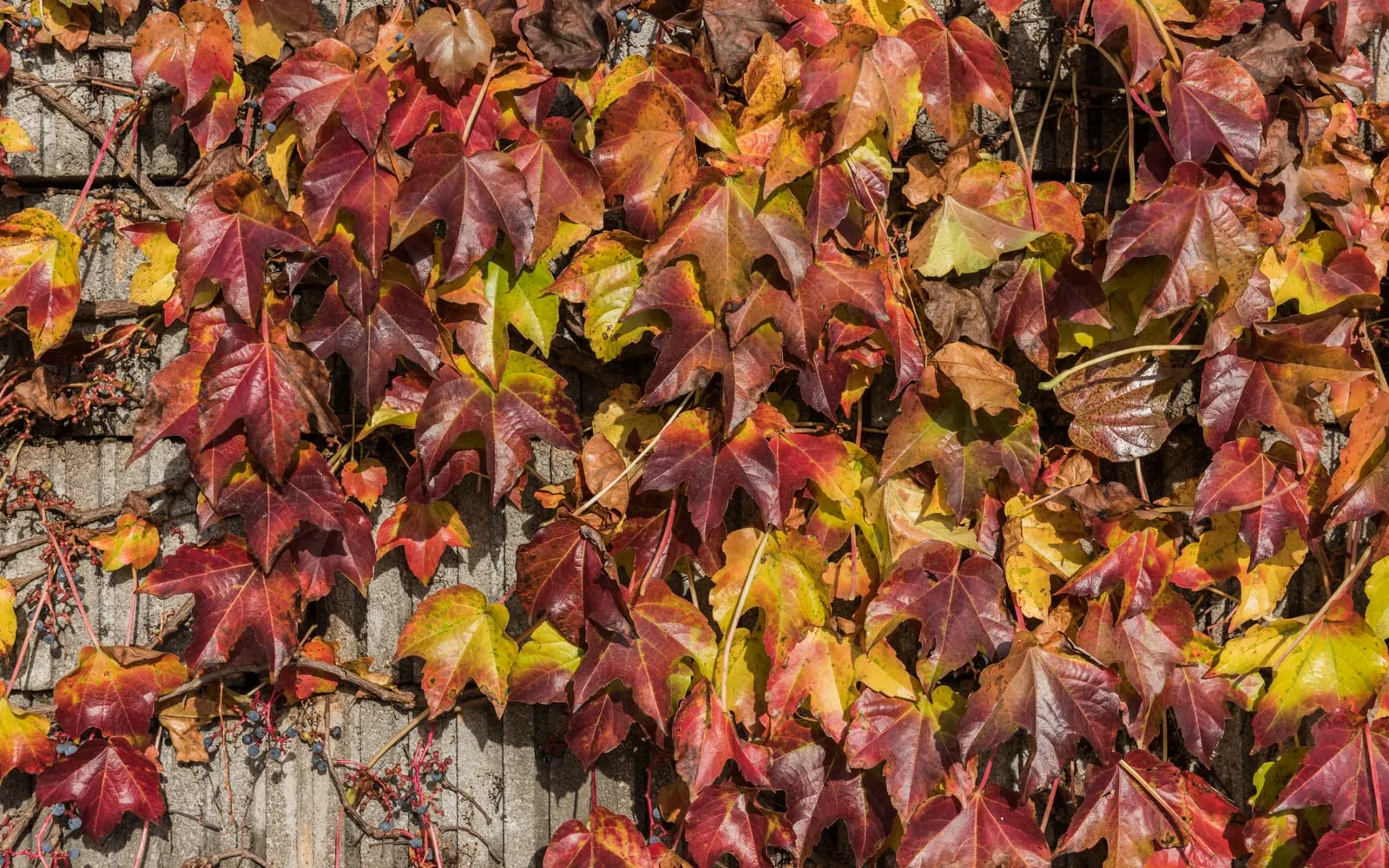
Autumn colour is the plant’s defining feature, turning through yellow, orange, scarlet and deep crimson over a few weeks, often unevenly across a single wall depending on how much direct sun each section receives.
The adhesive pads that let it climb are small, disc-shaped structures at the tips of branched tendrils, gripping tightly enough that removing an established vine from a wall can pull away loose paint, old mortar or soft render along with it.
Where it is from
Parthenocissus tricuspidata is native to China, Japan and Korea, climbing trees, rock faces and cliffs in woodland edges and mountain valleys across a range with cold winters and hot, humid summers.
That native habit of scaling a vertical surface without any external support is exactly what makes it so effective, and so occasionally troublesome, on a building. A cliff face does not mind adhesive pads gripping into every crevice; old, soft mortar between bricks minds a great deal, and that mismatch is the main practical caution attached to growing it against a house.
How it grows
Plant in any reasonably drained soil in sun or shade; it tolerates a wide range of conditions and needs no support structure against a solid wall, fence or rock face.
Check the condition of the surface before planting against a building. Sound, modern brick and stone generally tolerate the adhesive pads well, but old, soft or crumbling mortar, painted wood, and rendered or stuccoed walls can be damaged both by the pads gripping in and by the vine being removed later. Grow it on a freestanding trellis rather than a wall where the surface is in doubt.
Prune in late winter while the vine is leafless and its structure is easy to see, cutting it back hard from windows, gutters, roof edges and any woodwork it has started to climb onto. It regrows quickly from old wood and tolerates hard pruning.
Young plants establish slowly for the first season while they build a root system, then grow rapidly once settled, easily covering several metres of wall a year on a mature plant.
Through the seasons
Spring brings vigorous new growth from the base and along every established stem.
Summer is the main growing season, with small flowers opening inconspicuously and the vine at its most active.
Autumn turns the whole plant scarlet and crimson over a few weeks, its best display of the year, as the berries ripen alongside the colour change.
Winter is bare, structural growth, and the best time to prune hard and keep the vine off windows, gutters and roof edges before spring growth resumes.
Care difficulty
Easy, and largely a matter of managing vigour rather than coaxing growth. It establishes readily in almost any soil, tolerates both sun and shade, and needs no feeding on reasonable ground. The one task that matters is an annual check and prune to keep it away from windows, roofing and any woodwork it might damage as it thickens, since left entirely alone it will climb wherever there is a surface to grip.
Watering
Water regularly through the first growing season while the roots establish, then rely on rainfall in most climates. An established plant is notably drought-tolerant and rarely needs supplementary watering outside a prolonged dry spell.
A plant grown in a restricted bed against a building, where rain runoff is limited, may need more attention in its first year or two than one planted in open ground.
Warning signs, diseases and pests
Japanese beetle adults feed on the leaves through summer in regions where the insect is established, skeletonising foliage between the veins and leaving a lace-like pattern behind on a bad infestation. Handpicking into soapy water controls a light attack; a heavy one may need a targeted treatment.
Powdery mildew coats leaves in a pale film, most often where the vine grows in shade with poor air circulation. It is mostly cosmetic on an established plant.
Leaf spot appears as small dark blotches in prolonged wet weather and rarely needs treatment on a vine this vigorous.
Scale insects sometimes settle on older woody stems, feeding on sap and leaving a sticky residue behind them. Treat a heavy infestation with horticultural oil.
Growing environment
Full sun to full shade both suit it, an unusually wide tolerance for a climber, though the richest autumn colour develops where the foliage gets some direct sun through the growing season.
Almost any soil works, including poor or compacted urban ground, which is part of why it is so widely planted against city buildings.
The surface it climbs matters more than the soil it grows in. Sound masonry tolerates it well; soft or painted surfaces are better served by a freestanding support instead.
Feeding
Little to none is usually needed. This is a vine that grows vigorously on average soil, and additional fertility mostly means more pruning rather than a healthier plant.
Where growth is weak on very poor ground, a light application of balanced fertiliser in spring is enough to correct it.
Troubleshooting
Will it damage my brick wall? Sound, modern brick and mortar generally tolerate it well, and the vine itself does not dig into intact masonry the way roots or ivy’s clinging roots sometimes can. The greater risk is to old, soft or crumbling mortar, and to the wall’s surface when a mature vine is eventually pulled off.
The leaves have turned lacy and skeletal in summer. Japanese beetle feeding, if the damage appeared over a few weeks in midsummer with visible metallic green beetles present. Handpick them into soapy water in the morning, when they are most sluggish.
Can I grow it without a wall to climb? Yes, given a freestanding trellis, fence or other rough surface for the adhesive pads to grip. It does not climb a smooth pole or wire the way a twining vine does.
How do I stop it reaching my gutters and roof? Prune hard in late winter, cutting it back well below the roofline, and check again during the growing season, since a vigorous plant can regrow several metres in a single summer.
Are the berries dangerous to my dog? Not the way a seriously toxic plant would be. They are not on the standard toxic plant lists for pets, though the oxalate crystals inside can cause a moment of mouth irritation if bitten into, which is usually enough to stop a dog from eating more than one or two.