
Outdoor plant
Cape Honeysuckle
Tecoma capensis
Also known as Tecomaria capensis, Cape Trumpet Flower
How to grow Cape honeysuckle, Tecoma capensis. Why it is not a honeysuckle at all despite the name, deciding early whether to train it as a shrub or a climber, and why a plant cut to the ground by frost usually is not dead.
At a glance
- Difficulty
- Easy
- Water
- Regularly while establishing, then occasionally in dry spells
- Light
- Full sun for the heaviest flowering, tolerating partial shade
- Temperature
- Frost-tender; root-hardy in a mild climate where top growth is cut back
- Hardiness
- USDA 9-11, RHS H2, hardy to -4 C
- Type
- Evergreen scrambling shrub
- Height
- 2-3 m as a shrub, to 4-7 m trained on a support
- Native to
- southern Africa
The zone range covers a plant that dies back rather than dies outright at its cold margin. Where winters occasionally dip below freezing, the top growth is commonly cut to the ground by frost, and the plant regrows from the root the following spring provided the roots themselves stayed above about -6 to -9 deg C. Treated that way it behaves like a die-back perennial rather than the reliably evergreen shrub it is where frost never visits at all.
Hardiness zones describe winter cold alone. Summer heat, humidity, rainfall and the length of the growing season decide as much, so treat the range as the outer limit rather than as a recommendation.
Not known to be toxic
Tecoma capensis is not listed as toxic on the RHS potentially harmful plants index or the ASPCA toxic and non-toxic plants list, and no reliable poisoning source documents a toxic principle in the foliage or flowers. A dog or cat that chews a mouthful of the tough, leathery leaves may vomit from the bulk of the fibre rather than from any toxin, much as with many garden shrubs eaten in quantity. Despite the common name, this plant is not a true honeysuckle at all: it belongs to the trumpet vine family, Bignoniaceae, rather than to Lonicera, so the toxicity notes written for honeysuckle proper have no bearing on it either way.
Sources: RHS potentially harmful garden plants, ASPCA toxic and non-toxic plants
About
Cape honeysuckle is not a honeysuckle at all. It shares nothing with Lonicera beyond a superficial resemblance in the shape of its flower and a common name applied loosely by early settlers reminded of the plant back home. Tecoma capensis belongs instead to the trumpet vine family, related to jacaranda and the true trumpet creeper, and its flowers are the giveaway once you know what to look for.
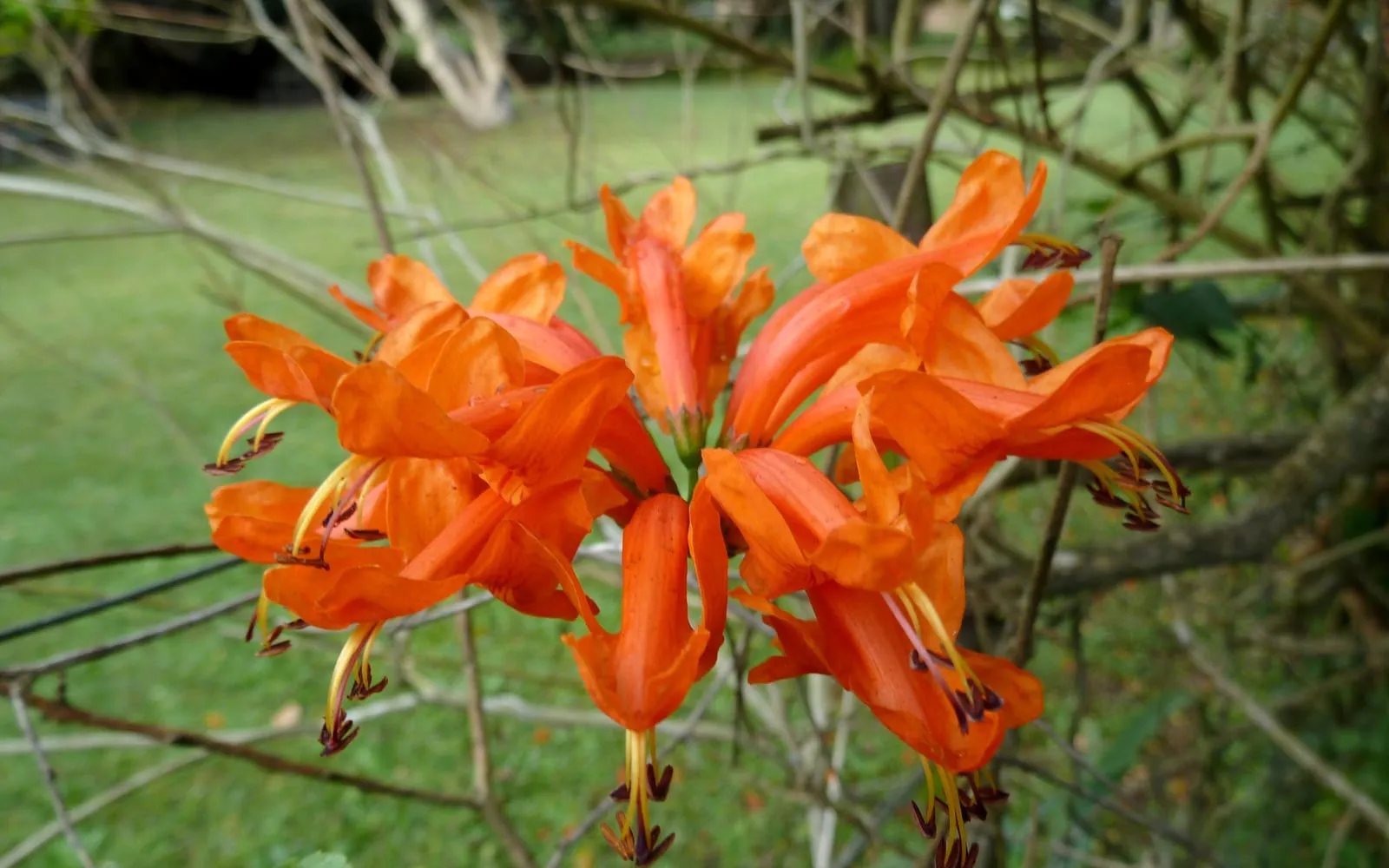
Those flowers are tubular, bright orange-red in the most widely grown form, and open in loose clusters at the shoot tips for most of the year in a reliably warm climate. In its native southern Africa they are a crucial winter nectar source for sunbirds when little else is in flower, a role hummingbirds have taken over wherever the plant has been introduced to the Americas.
Left alone it forms a dense, rounded shrub. Given something to grip, its long arching stems hook over a support and it becomes a loose, informal climber, so deciding early which habit you want shapes how you plant and train it from the start.
Appearance and character
Leaves are pinnately compound, made up of five to nine glossy, dark green leaflets with a toothed edge, carried in opposite pairs along the stem. The foliage alone is handsome enough to justify a spot in the garden even between flushes of flower.
Flowers open in loose clusters at the ends of the shoots, each bloom a narrow, curved tube around 5 cm long flaring into five lobes at the mouth, in a vivid orange-red in the species and in yellow or salmon-pink in some selected forms. A well-grown plant can carry flowers on and off for most of the year where winters stay mild, with a particularly heavy flush through autumn and into winter in many gardens.
Stems are long, arching and only semi-woody when young, gripping a support less by twining than by hooking and leaning against it, which is why a plant grown as a climber needs tying in rather than left to find its own way up.
Growth is fast, and a young plant fills its allotted space within a season or two given reasonable conditions, which is part of what makes it such a popular quick screen or informal hedge in a warm climate.
Where it is from
Tecoma capensis grows wild across southern Africa, through South Africa’s Eastern Cape and KwaZulu-Natal, into Eswatini and southern Mozambique, typically scrambling through coastal bush and along forest margins where it can reach up into the light.
In that native range it flowers most heavily through the southern hemisphere winter, filling a gap in nectar supply for sunbirds at a time of year when most other flowering plants are dormant. Gardens in the northern hemisphere where it has been widely introduced, including California, Florida and parts of the Mediterranean, often see the same pattern reversed only by season, with a strong flush of bloom through autumn and into winter rather than in high summer.
Its ease of cultivation and rapid growth have carried it well beyond southern Africa as a garden plant, and in a few warm, humid regions outside its native range it has naturalised from old plantings into disturbed ground nearby. Check local guidance before planting it at scale.
How it grows
Plant in ordinary, well-drained soil in full sun for the heaviest flowering, though it tolerates a fair amount of shade, flowering somewhat less there instead.
Decide early whether you want a shrub or a climber. Left unsupported and lightly pruned, it forms a rounded mound; given a trellis, wall wires or a fence to lean against, and tied in as it grows, the same plant becomes a loose, informal climber reaching well above head height.
Prune hard in early spring, cutting back by up to half, both to keep a shrub compact and to encourage the strong new growth that carries most of the season’s flowers. A climbing plant benefits from the same treatment, thinned and tied in rather than left to tangle.
Where winters bring an occasional frost, treat any frost-blackened top growth as material to cut away in spring rather than a sign the plant has died, since new shoots commonly appear from the base once the ground warms.
Through the seasons
Spring is for the hard prune, cutting away winter-damaged growth and shaping the plant before the main flush of new stems begins.
Summer brings steady growth and scattered flowering in many gardens, building toward the heavier display to come.
Autumn is often the peak flowering period, a long run of tubular orange blooms that continues into early winter in a mild climate.
Winter in a reliably frost-free garden can still carry flowers; anywhere colder, frost cuts the soft top growth back, with regrowth from the base once the following spring warms up.
Care difficulty
Easy in a warm climate, and considerably more work in one where frost is a regular winter visitor, since the plant then needs treating as a die-back perennial rather than a permanent evergreen shrub.
Fast growth is its main demand on a gardener’s time: an annual hard prune keeps it shapely and flowering well, and a plant left entirely unpruned for several years becomes sprawling and woody at the base with flowers increasingly confined to the shoot tips.
Deciding on support at planting time avoids the awkward retrofit of trying to train an established, already-sprawling plant onto a trellis added later.
Watering
Water regularly through the first year while the root system establishes, giving a deep soak rather than frequent light watering.
Once established, it is reasonably drought-tolerant and needs watering only in an extended dry spell, though regular moisture through the growing season supports the strongest, most continuous flowering.
Warning signs, diseases and pests
Aphids cluster on soft new shoot tips, distorting young growth and leaving it sticky with honeydew. A strong jet of water or an insecticidal soap controls a light infestation.
Whitefly clouds up from the underside of the leaves when the plant is disturbed, feeding in the same way as aphids and leaving the same sticky residue behind. Yellow sticky traps and regular checks help catch a build-up early.
Spider mite thrives in hot, dry conditions, particularly on a plant grown against a sun-baked, sheltered wall, showing as fine pale speckling on the leaves with faint webbing in a bad case. Occasional misting or hosing down the foliage helps prevent it taking hold.
Scale insects appear as small, flat, brownish bumps along older woody stems, sapping the plant and encouraging sooty mould on the honeydew they leave behind. Treat the same way as for aphids and whitefly, or scrape off a light infestation by hand.
Growing environment
Full sun brings the strongest, most continuous flowering, though the plant tolerates partial shade with somewhat fewer blooms.
Ordinary, well-drained soil suits it well, and it tolerates poor, sandy ground, coastal exposure and salt spray, making it a reliable choice for a difficult coastal garden.
A wall, fence or trellis helps it perform as an informal climber. Provide support from the outset if that habit is wanted, since retrofitting support onto an established sprawling plant is considerably harder than starting with one in place.
In a marginal climate, a sheltered spot against a warm wall meaningfully improves its chances of surviving winter with less dieback.
Feeding
Feed with a balanced, general-purpose fertiliser a couple of times through spring and summer, following the product’s guidance for a flowering shrub.
An annual mulch of garden compost around the root zone in spring supports steady growth through the season without the need for heavier feeding.
Avoid feeding late in the growing season in a marginal climate, since soft, late growth is the most vulnerable to the first autumn frost.
Troubleshooting
Is Cape honeysuckle related to the honeysuckle in my garden? No. Despite the shared common name, it belongs to the trumpet vine family, Bignoniaceae, rather than to Lonicera, and the resemblance is only in the general shape of the flower.
My plant was cut to the ground by frost. Is it dead? Probably not, if the roots stayed above about -6 to -9 deg C. Cut away the blackened top growth in spring and wait; new shoots commonly appear from the base once the soil warms.
Should I grow it as a shrub or a climber? Either works, but decide early. Left unsupported it forms a rounded mound; given a wall, fence or trellis and tied in as it grows, it becomes a loose informal climber to several metres.
Why has flowering slowed down in summer? A heavier flush through autumn and into winter is normal for this species in many climates, echoing the winter-flowering pattern it shows in its native southern African range.
How hard can I prune it? Hard, and it responds well. Cutting back by up to half in early spring keeps a shrub compact and encourages the strong new growth that carries most of the flowers.