
Houseplant
Brahmi
Bacopa monnieri
Also known as Water hyssop, Moneywort, Bacopa
How to grow Bacopa monnieri, the creeping marsh herb sold as brahmi. Growing it in an aquarium or a wet pot indoors, and the two different plants that share the name.
At a glance
- Difficulty
- Easy
- Water
- Constantly. It cannot dry out at any point
- Light
- Bright light, and it takes direct sun where the roots are wet
- Temperature
- Tender. Keep above 10 deg C and it prefers 20 to 30
- Humidity
- High, or roots standing in water
- Hardiness
- USDA 8-11, RHS H1c, hardy to 5 C
- Type
- Tender creeping perennial, aquatic or marginal
- Height
- 10-20 cm, spreading indefinitely
- Native to
- wetlands across India, southern Asia, Africa, Australia and the Americas
Wetlands across the tropics and subtropics of both hemispheres, growing in mud and shallow water. It is one of the few plants here that cannot be overwatered, and standing it in a saucer of water is the correct treatment. Outdoors year round in USDA 8 and warmer, where it can become weedy in wet ground.
Hardiness zones describe winter cold alone. Summer heat, humidity, rainfall and the length of the growing season decide as much, so treat the range as the outer limit rather than as a recommendation.
Edible, with limits
- Safe to eat
- The leaves and stems, which are eaten as a vegetable in parts of India
- Harm from
- Eating it
- Affects
- People
Bacopa monnieri is eaten. The whole herb goes into dishes in Kerala and Tamil Nadu, and it is sold widely as a food supplement. NC State Extension lists the species with no toxicity section, and the plant does not appear on the RHS list of potentially harmful garden plants or on the ASPCA list of plants toxic to dogs, cats or horses. LiverTox, the United States National Library of Medicine reference on drug-induced liver injury, carries a monograph on Bacopa monnieri and records that it has not been convincingly linked to liver injury, which is a more useful statement than silence. Two practical notes. The commonest reported effect of taking the herb is digestive upset, and it is documented as slowing gut motility, so anyone on prescribed medication should mention it to their GP. And the plant grows in still fresh water, so material collected from the wild carries whatever the water carried.
Sources: NC State Extension, Bacopa monnieri, LiverTox, Bacopa monnieri, RHS potentially harmful garden plants, ASPCA toxic and non-toxic plants, NHS on herbal medicines
About
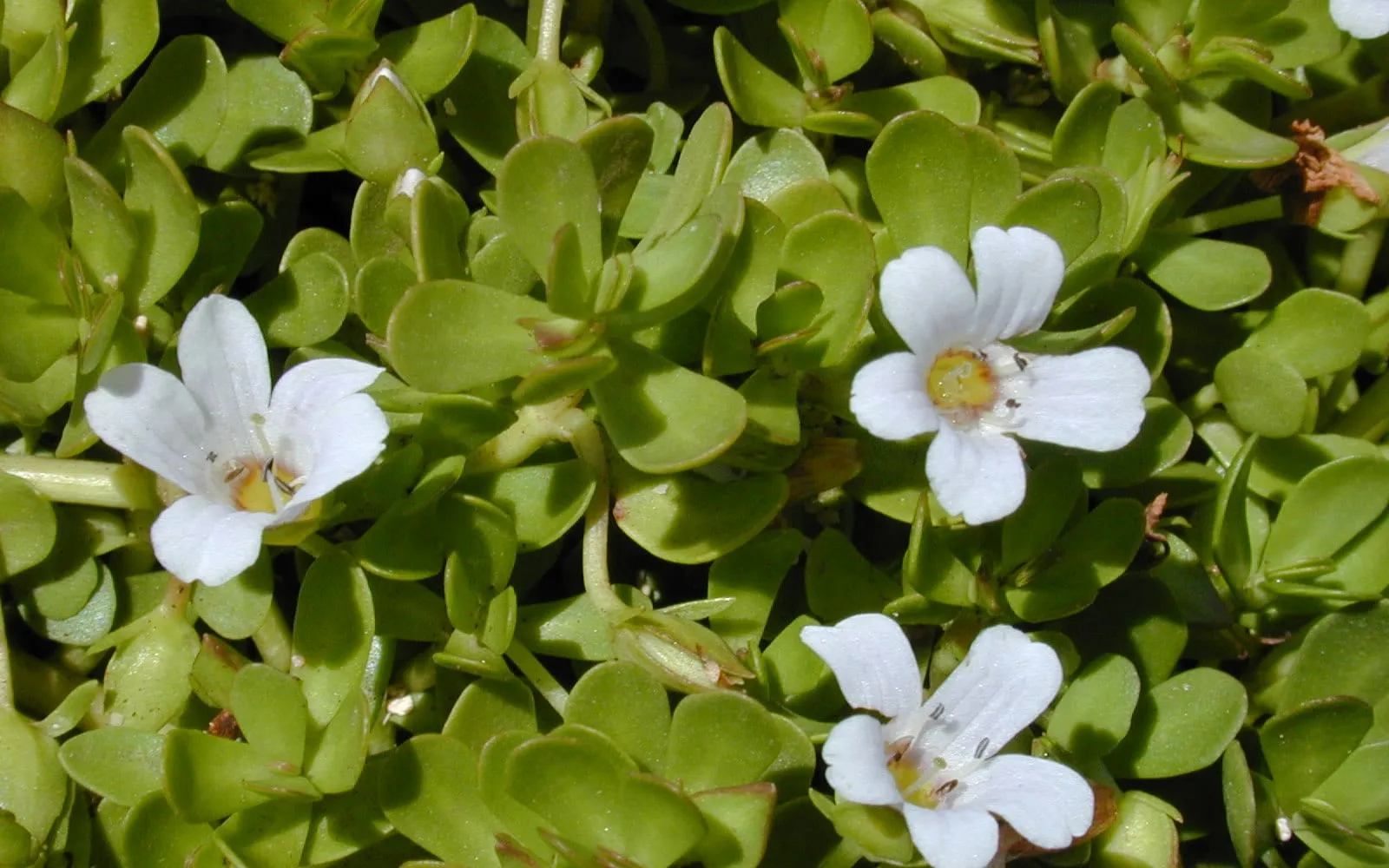
Two plants are sold as brahmi in India and they are not related. This one, Bacopa monnieri, is a creeping succulent herb of wet mud and shallow water, with small paddle-shaped leaves and white flowers. The other is Centella asiatica, a pennywort with round scalloped leaves, which most English-speaking suppliers call gotu kola. Ayurvedic practice in different regions applies brahmi to each, and a packet labelled brahmi could be either.
Bacopa is a small unassuming plant with a large reputation. Ayurvedic texts describe it as a remedy for memory, and it has been studied more than most herbs for that reason. It is also one of the most common aquarium plants in the world, sold under the name moneywort, and many people growing it in a fish tank have no idea it is the same species.
Outside the tropics it is a houseplant with one strict condition: it cannot dry out. Grow it in a pot standing in water on a bright windowsill, in a heated propagator, or submerged in an aquarium, and it grows fast and roots from every node. Let the pot dry once and it is gone.
Appearance and character
The stems creep along wet mud and root at every node, forming a dense mat that climbs over itself as it thickens. Each stem is soft, succulent and pale green, and breaks easily, which is how the plant propagates in the wild.
Leaves are opposite, unstalked, oblong to spoon-shaped, 8 to 20 mm long, thick and slightly fleshy with a smooth margin and no scent. Held up to the light they show faint translucent dots. Underwater growth is longer and softer than emergent growth, which catches out aquarium keepers who move a plant from a tank to a pot.
Flowers are small and pretty at close range, about 1 cm across, white with pale blue or violet veining, in the shape of a five-lobed tube, held singly on short stalks from the leaf axils. In a warm summer a mat in a wide pot flowers over several weeks.
Where it is from
Bacopa monnieri is one of a small number of flowering plants with a pantropical distribution, growing wild in wetlands across India and southern Asia, much of Africa, northern Australia, Florida, the Caribbean and South America. Botanists disagree about how much of that range is native and how much followed human movement.
Everywhere it grows it occupies the same ground. Shallow fresh water, muddy pond margins, the edges of rice paddies and ditches, and land that floods seasonally. It tolerates brackish water and grows in full sun with its roots submerged.
The plant is a weed of rice fields in parts of Asia and is collected from the wild in quantity for the herb trade, mostly in India. Cultivation on flooded beds has grown as demand has risen, which reduces the pressure on wild stands and the uncertainty about what the material was growing in.
How it grows
Growth is fast and horizontal. A single stem laid on wet compost roots within a fortnight at 25 deg C and produces branches from most nodes, so one plant fills a wide pot in a season.
The plant grows submerged, emergent or in saturated mud, and changes its leaf form accordingly. Submerged growth is lax and pale, emergent growth is compact and darker, and the two look different enough to be mistaken for separate species.
There is no dormancy, which suits an indoor grower. Given warmth and light it keeps going through a cool winter, though growth slows sharply as the days shorten. Below about 8 deg C the stems collapse and the plant does not recover.
Through the seasons
Start in spring from a cutting or a bought aquarium plant. Push several stems into wet aquatic compost or a loam-based compost, stand the pot in a saucer or bowl kept topped up, and put it somewhere bright and warm.
Growth runs hard from May to September on a windowsill, and flowering follows in a warm summer. Pinch the tips to thicken the mat, and use the pieces you remove as new plants.
From October, reduce feeding and keep the plant warm rather than trying to push it. A conservatory that drops below 10 deg C at night is not the place for it in January. Harvest leafy stems at any point by cutting rather than pulling, since pulling lifts the whole mat.
Care difficulty
Easy, with one condition that no amount of other care will substitute for. The plant is a marsh species and needs permanently wet roots. Standard houseplant watering habits kill it inside a week.
The second condition is warmth. It grows through a cool temperate summer on a windowsill and needs a heated room in winter. An unheated greenhouse or a conservatory that goes cold will finish it.
Beyond those two the plant is undemanding. It roots from cuttings without any hormone, tolerates hard water, needs no repotting discipline and has almost no pests indoors.
Watering
Never let it dry. Stand the pot permanently in a saucer, a bowl or a tray of water, topped up so the compost stays saturated. This is one of the few plants where waterlogging is the target rather than the hazard.
Rainwater is preferable to hard tap water, though the plant tolerates both. Change the water in the saucer every couple of weeks to stop it going stagnant and to reduce mosquito larvae in summer.
In an aquarium the question does not arise. The plant grows fully submerged and takes what it needs from the water column, given reasonable light.
Warning signs, diseases and pests
Yellowing and thinning growth usually means light rather than food. Bacopa wants bright conditions, and in a dim room it stretches, loses leaves from the base and becomes a straggle of bare stems.
Aphids and whitefly find emergent growth in a warm conservatory. Both are dealt with by rinsing the plant under a tap, which it tolerates better than most houseplants. Fungus gnats breed in the permanently wet compost and are a nuisance rather than a threat.
In an aquarium the problem is algae, which coats the leaves in a bright tank with still water and low plant density. More flow, more plants and less light reduce it. Snails graze it off.
Growing environment
Bright light, including direct sun as long as the roots are in water. This is a plant of open sunny wetlands rather than a shade species, and a dark corner produces the drawn growth described above.
Temperature should stay above 10 deg C at all times and ideally between 20 and 30. Growth stops below 15 and the plant deteriorates below 8.
The growing medium can be aquatic compost, a loam-based compost, or nothing at all in an aquarium. What matters is that it stays saturated. Add a layer of gravel on top of compost in an open bowl to stop it clouding the water.
Feeding
A dilute balanced liquid feed once a month through spring and summer is plenty. The plant grows fast and responds to feeding, and it also grows perfectly well in plain pond water.
In an aquarium use a liquid plant fertiliser designed for the purpose, since ordinary houseplant feed at aquarium doses risks the fish and encourages algae.
Stop feeding from October. A plant growing slowly in low winter light cannot use it, and unused fertiliser in standing water grows algae instead.
Troubleshooting
Is brahmi the same as gotu kola? No, though the names overlap. Brahmi is applied in India to both Bacopa monnieri and Centella asiatica, which are unrelated plants. Bacopa has small oblong fleshy leaves, and Centella has round scalloped ones on long stalks.
Can I grow it in a normal pot? Yes, if the pot stands permanently in water. Ordinary drainage-and-dry-out watering kills it, because it evolved in mud that never dries.
Will it grow outdoors in a cool climate? Only as a summer plant in a container pond, and it will not survive the winter outside. It collapses below about 8 deg C.
My aquarium plant has gone leggy since I potted it up. Submerged leaves and emergent leaves are different shapes, and the plant takes a few weeks to convert. Cut the drawn stems back and let the new emergent growth take over.
How do I propagate it? Cut a stem into pieces with two or three nodes each and push them into wet compost. They root within a fortnight in warmth with no further intervention.
Is it safe to eat? The whole herb is eaten as a vegetable in southern India and NC State Extension records no toxicity for the species. The commonest reported effect of taking it in supplement form is stomach upset. Do not eat plants collected from the wild, since the water they grow in is unknown.
The leaves are pale and the stems are stretching. Not enough light. Move it to the brightest windowsill you have, or add a grow light in winter.
Brahmi problem guides
Not sure what is wrong? See the common houseplant pests guide.