
Houseplant
Whisk Fern
Psilotum nudum
Also known as Skeleton fork fern, Fork fern
How to grow whisk fern, Psilotum nudum. A rootless, leafless relict lineage instead of a true fern, and its long history as a Japanese bonsai companion plant.
At a glance
- Difficulty
- Easy
- Water
- Allow the top of the growing medium to dry between waterings
- Light
- Bright indirect light. Tolerates medium light well
- Temperature
- 15-27 deg C. Protect from cold
- Humidity
- Average room humidity is fine. Not a demanding houseplant
- Hardiness
- USDA 9-11, RHS H1c, hardy to 5 C
- Type
- Evergreen perennial psilophyte, not a true fern
- Height
- 15-45 cm
- Native to
- Pantropical, across the Americas, Africa, Asia and Australasia, with a small outlying population in southern Spain
A subtropical to tropical species with no meaningful cold tolerance, grown outdoors year round only in the mildest, frost-free gardens. Almost everywhere else it is a houseplant, greenhouse subject or terrarium specimen, and indoors the ordinary warmth of a living room matters more than any hardiness figure.
Hardiness zones describe winter cold alone. Summer heat, humidity, rainfall and the length of the growing season decide as much, so treat the range as the outer limit rather than as a recommendation.
Not known to be toxic
Non-toxic. Psilotum nudum does not appear on the RHS list of potentially harmful garden plants, and there is no ASPCA record of it as toxic to cats, dogs or horses. No irritant sap or toxin is documented for the genus. Its name resembles psilocybin, the compound in certain hallucinogenic fungi, purely by coincidence of Greek roots, and the two are unrelated. This plant produces no psychoactive compound and carries no recreational or medicinal reputation of that kind.
Sources: RHS potentially harmful garden plants, ASPCA toxic and non-toxic plants
About
This plant has no leaves and no roots, and it is not a fern.
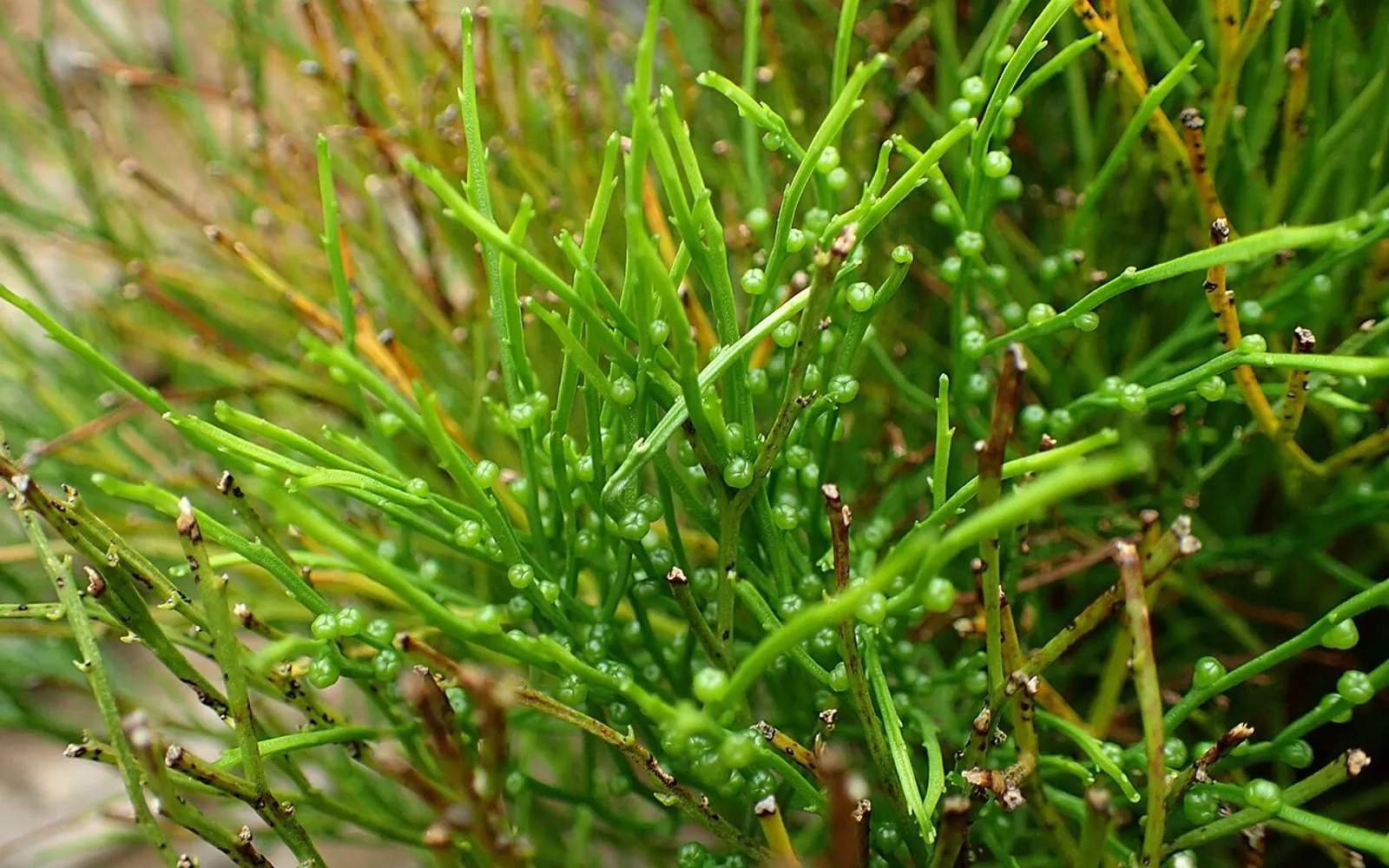
What grows from the compost is a clump of slender green stems that photosynthesise in place of leaves, forking evenly in two at every branch point, with small yellow spore-bearing capsules studding the stem surface instead of sitting under a frond. It was long held up as the closest living plant to the very earliest land plants, on the strength of looking almost exactly like fossils of the first vascular plants to grow on dry land over 400 million years ago. Modern DNA evidence has revised that story. Psilotum sits within the fern lineage itself, closely related to the equally odd adder’s-tongue ferns, and its lack of roots and leaves turns out to be a loss instead of an original absence, lost by a distant ancestor that once had both.
Whatever the deeper story, gardeners in Edo-period Japan valued the plant long before anyone knew its evolutionary position. It became a collector’s plant from the 1600s onward, with named cultivars bred for stem colour, branching pattern and variegation, and a dedicated book on its cultivation, A Careful Selection of Whisk Ferns, published in 1837. It remains a traditional companion plant in bonsai display today, tucked into the pot alongside a tree to add contrasting texture at ground level.
Appearance and character
An evergreen perennial forming upright to slightly arching clumps of bright to yellow-green stems, 15 to 45 cm tall depending on the growing conditions and the particular clone.
Stems are round to slightly angled in cross-section, branching by even forks instead of the alternating or opposite pattern typical of true branches, giving the whole plant a distinctive skeletal, geometric look that is the source of one of its common names.
Small yellow to cream capsules called synangia, each fused from three spore cases, stud the stems at intervals along the upper branches. These open to release spores and are the plant’s only reproductive structure visible above ground.
There are no leaves at all in the ordinary sense, only tiny scale-like outgrowths too small to photosynthesise meaningfully, so the green stems do all the work leaves would normally do.
Below the surface, the plant has no true roots either. Instead it produces a horizontal underground stem, or rhizome, covered in absorptive hair-like outgrowths and dependent on a partnership with soil fungi to take up water and nutrients, since it has no root system of its own to do the job.
Where it is from
A pantropical and subtropical distribution spanning the Americas, Africa, Asia and Australasia, one of the widest natural ranges of any vascular plant, growing as an epiphyte on trees, on rocks, or rooted in leaf litter and crevices on the forest floor.
A small, isolated and legally protected population also survives in southern Spain, its only known site in mainland Europe, an outlying population this far from the tropical core of its range.
The dependence on fungal partners in the wild explains why the species is often found growing in old leaf litter, rotten wood or moss, all of which support the fungal networks its underground rhizome relies on.
Its long popularity in Japan is separate from its wild ecology, a horticultural story of collectors selecting and naming forms for their appearance instead of for anything to do with the plant’s natural habitat.
How it grows
Pot it into a very open, free-draining mix, similar to what an orchid or an epiphytic cactus would use. Chunky bark, perlite and a little standard compost in roughly equal parts works well.
Alternatively mount it, as its epiphytic habit in the wild suggests, onto a piece of bark or driftwood with a little sphagnum moss packed around the base, watering by occasional soaking.
Give it bright indirect light. It tolerates medium light well and is a forgiving houseplant for a spot that is not directly in a window.
Keep it warm, ideally between 15 and 27 deg C, and well away from cold draughts or an unheated room in winter, since it has no frost tolerance at all.
Water when the surface of the growing medium has dried, then soak thoroughly and let it drain. The stems store some water, giving the plant a degree of drought tolerance unusual among plants sold as ferns.
Propagate by division, separating a clump of stems with a portion of the underground rhizome attached, or by removing an offset rhizome section that has produced its own stems.
Feed sparingly. This is not a heavy feeder, and the fungal partnership in its roots does much of the nutritional work a conventional root system would otherwise need feeding to support.
Through the seasons
Spring brings the strongest new stem growth of the year. Resume feeding, and this is the best time to divide a crowded clump if more plants are wanted.
Summer is steady growth. Water a little more often in warm weather, and keep the plant out of intense direct sun through a south-facing window, which can scorch the stems.
Autumn slows growth naturally. Reduce feeding toward the end of the season.
Winter is a rest period indoors, needing less frequent watering and no feeding, and above all, warmth. A cold windowsill or an unheated porch through winter is the most common way this plant is lost.
Care difficulty
Easy, and unusually forgiving for a plant with such an unfamiliar biology.
Its succulent-like stems tolerate a missed watering far better than most houseplant ferns, and its tolerance of medium light means it copes with positions that would disappoint a typical fern.
The main risk is the opposite of drought. Kept permanently sodden in a heavy compost, the rootless rhizome rots, since it has none of the usual root defences against waterlogging.
Beyond avoiding that one mistake, it needs little from a grower, which is part of why it survived centuries as a low-maintenance companion plant in traditional Japanese collections.
Watering
Allow the surface of the growing medium to dry before watering again, then water thoroughly and let any excess drain away completely.
The stems act as a modest water store, so this plant tolerates being slightly underwatered far better than being kept constantly wet.
Reduce watering in winter, when growth slows and the risk of rot in cool, damp compost rises.
A mounted specimen needs the same dry-between-waterings routine as a potted one.
Use tepid water where possible, and avoid letting water sit around the base of the stems for extended periods.
Warning signs, diseases and pests
Blackened, mushy stems at the base mean rot, almost always from being kept too wet for too long. Cut away the affected stems, let the medium dry out fully, and reduce future watering.
Small brown limpet-like bumps along the stems are scale insects, wiped off with a cloth dipped in dilute alcohol or soapy water, repeated over several weeks to catch any missed insects.
White cottony fluff at stem joints indicates mealybugs, treated the same way as scale.
Yellowing stems in a very bright, hot position suggest too much direct sun. Move the plant to a slightly shadier spot.
Slow or stalled growth over a long period, with no other symptoms, often means the plant is resting, since growth in this species is naturally slower than in many houseplant ferns even at the best of times.
Growing environment
Bright indirect light suits it best, with medium light tolerated well and strong midday sun best avoided, particularly through glass.
Warm room temperatures between 15 and 27 deg C, with no tolerance for frost and little enthusiasm for prolonged cold below about 10 deg C.
Very free-draining growing medium, whether a bark-based epiphyte mix, a gritty terrestrial blend, or a bare mount with sphagnum moss.
Average household humidity is adequate, making this one of the less demanding plants for a terrarium or an ordinary shelf alike.
It suits a terrarium, a bonsai display pot as a traditional companion planting, or a simple pot on a bright windowsill, and its bare branching form works well as a single specimen instead of mixed among softer foliage.
Feeding
A weak liquid orchid or houseplant feed, applied monthly through spring and summer, is enough.
Feeding needs are low, partly because the fungal partnership at the roots supplies some of what a conventional root system would otherwise need feeding to provide.
Stop feeding through autumn and winter, when growth slows or stops entirely.
Overfeeding shows as unusually soft, pale stem growth prone to collapse, and is easier to avoid than to correct, so lean toward underfeeding rather than the reverse.
Troubleshooting
Is this really a fern? No, not in the strict sense. It belongs to a separate ancient lineage, the psilophytes, though modern classification places that lineage within the wider fern group. It has no true roots or leaves, unlike any actual fern.
Why does it have no leaves? It photosynthesises through its green stems instead. What look like leaves are tiny scale-like structures too small to do the job, so the stem tissue does all the work.
How does it take up water and nutrients without roots? Through an underground rhizome covered in absorptive hairs, working in partnership with soil fungi instead of a conventional root system.
The base of the plant has gone soft and dark. Rot, almost always from overwatering. Cut away the affected stems, let the growing medium dry completely, and water less often going forward.
Is it related to psilocybin mushrooms? No. The similar-sounding name comes from shared Greek roots and nothing more. This plant produces no psychoactive compound.
Can I grow it outdoors? Only in a frost-free, essentially tropical or subtropical climate. Everywhere else it needs to come indoors or into a heated greenhouse before the first frost.
How do I make more plants? Divide an established clump, keeping a section of the underground rhizome attached to each new portion, and pot it into the same free-draining mix as the parent.
Whisk Fern problem guides
Not sure what is wrong? See the common houseplant pests guide.