
Houseplant
Living stones
Lithops lesliei
Also known as Lithops, Pebble plant, Stone plant
How to grow living stones, Lithops lesliei. The strict watering calendar, why you must not water while it splits, and the annual leaf change.
At a glance
- Difficulty
- Difficult
- Water
- Only at specific points in the year, and none at all for months
- Light
- Full sun, and four to five hours of direct light daily
- Temperature
- 15 to 27 deg C in growth, and it tolerates a dry 5 deg C in winter
- Hardiness
- USDA 10-11, RHS H1c, hardy to 5 C
- Type
- Evergreen succulent, very long lived and replacing its leaves annually
- Height
- 2-5 cm
- Native to
- South Africa and Namibia, in arid grassland and stony desert
- Best month
- September in the Northern Hemisphere, March in the Southern Hemisphere
The Karoo and the high veld of South Africa, where rain falls in summer and the winter is dry. It survives cold far better than damp, and the watering year matters more than the zone. Water in late summer and autumn, and keep it bone dry from midwinter until the old leaves have been absorbed, or the plant splits.
Hardiness zones describe winter cold alone. Summer heat, humidity, rainfall and the length of the growing season decide as much, so treat the range as the outer limit rather than as a recommendation.
Every month named in this guide is for the temperate Northern Hemisphere. If you garden in the Southern Hemisphere, shift each one by six months, so September becomes March. Closer to the equator the wet and dry seasons matter more than the calendar, and the shift stops being a useful guide.
Not known to be toxic
Living stones are not listed by the RHS as a potentially harmful garden plant and are not recorded by the ASPCA as toxic to cats, dogs or horses. No part of them is a recognised poisoning hazard. They belong to Aizoaceae, a family with no significant record of toxicity, and some relatives including Carpobrotus produce edible fruit. Where a plant is unlisted by both sources rather than positively assessed, read that as no hazard recorded rather than a hazard ruled out, so there is no reason to encourage anybody to eat them. In their native range the plants are grazed by animals during drought, which is one of the pressures behind the camouflage that makes them look like stones. The genuine concern attached to Lithops is conservation rather than safety. Several species are threatened by habitat loss and by illegal collection from the wild, and the trade in wild-collected succulents from southern Africa is a live problem, so buy nursery-propagated plants from a reputable specialist.
Sources: RHS potentially harmful garden plants, ASPCA toxic and non-toxic plants
About
Almost every living stone that dies indoors has been watered too often, and the ones that die fastest were watered in spring.
Lithops follow a strict annual cycle, and watering has to follow it rather than the other way round. Get the calendar right and the plant lives for fifty years in a small pot. Water it whenever it looks dry and it bursts, rots and collapses within a season.
In the Northern Hemisphere the cycle runs roughly like this. The plant grows and flowers in autumn, rests through the winter, and in spring a new pair of leaves grows inside the old pair, drawing all its water and nutrients from them. The old leaves shrivel to papery husks and are absorbed.
During that spring leaf change, from about February to May, the plant must not be watered at all. Watering then gives it water it does not need, the old leaves fail to shrivel, the plant ends up with two pairs of leaves, and it usually splits and rots.
That is the whole difficulty. Everything else about Lithops is easy, since they want full sun, gritty compost and to be left alone.
The camouflage is worth appreciating. In the South African veld they sit flush with the soil surface among pebbles they closely resemble, with only a translucent window on the top surface admitting light to the photosynthetic tissue below.
Appearance and character
An evergreen succulent reaching 2 to 5 cm, sitting almost flush with the soil.
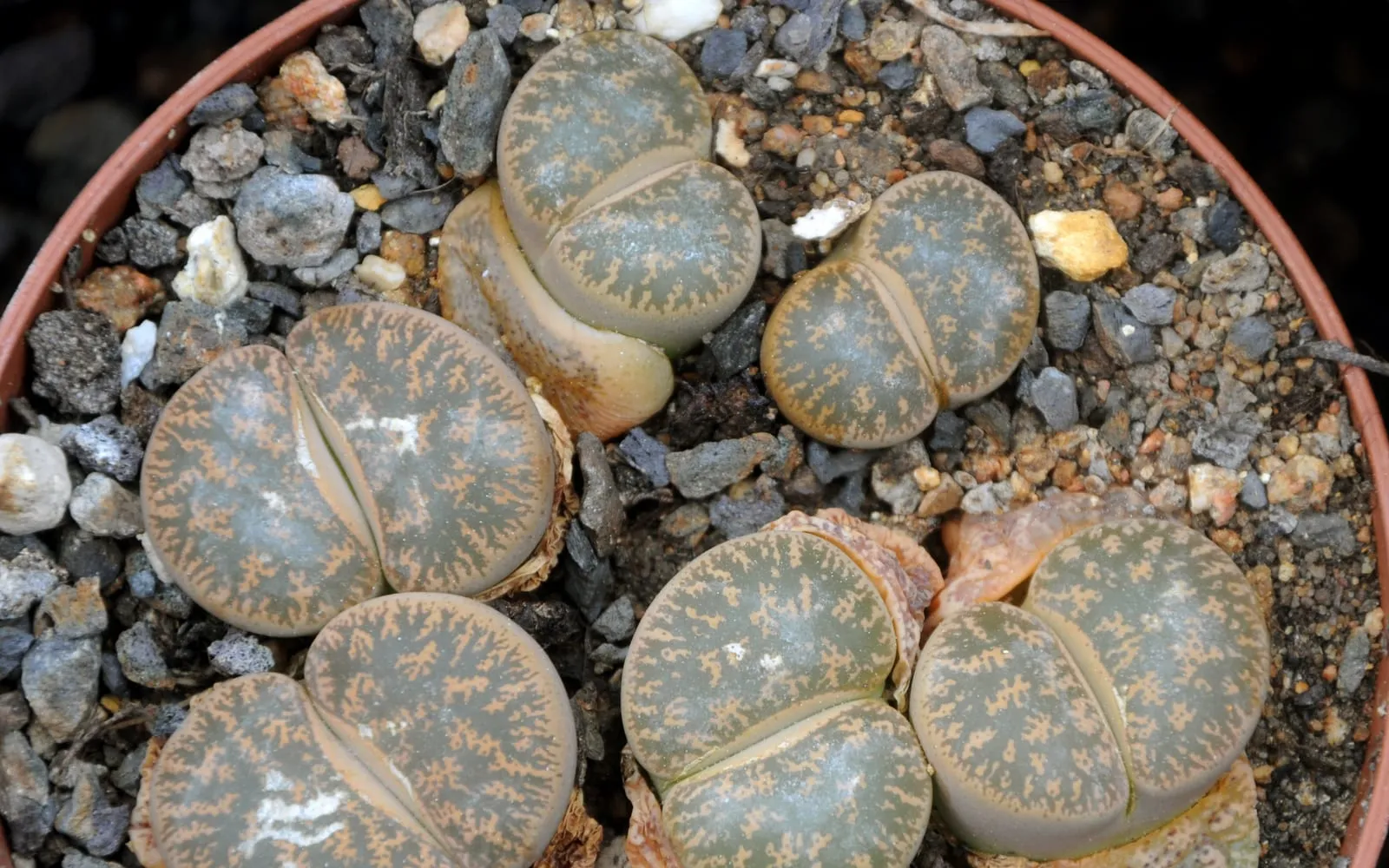
The plant is a single pair of fused fleshy leaves forming a rounded body with a fissure across the top, so it looks like a pebble split in half.
The top surface is a translucent window, patterned with dots, lines, marbling and islands in grey, brown, buff, green, rust and pink, and the pattern is species and population specific.
Almost the whole plant is below ground in the wild, with only the window at the surface, and in cultivation it usually sits a little higher.
Flowers emerge from the fissure in autumn, daisy-like, 2 to 4 cm across, in white or yellow, and they are often larger than the plant.
Each plant produces one new pair of leaves a year, growing inside the old pair and consuming them.
Clumps form slowly over many years as plants divide into two heads.
Lithops lesliei is one of the commoner and easier species, with a brownish patterned top and yellow flowers.
Growth is extremely slow, and a plant reaches full size in three or four years and then stays that way for decades.
Where it is from
South Africa and Namibia, growing in arid grassland, stony desert and quartz fields, often in areas with under 200 mm of rain a year.
The camouflage is anti-grazing. The plants sit flush with the soil among stones they resemble, and animals looking for moisture in drought do not find them.
The translucent window is a solution to being buried. Photosynthetic tissue is inside the leaf body, and light enters through the window at the surface, so the plant can sit almost entirely underground and still function.
Rainfall in their habitat is highly seasonal, and the whole growth cycle follows it, which is what the watering calendar reproduces.
They were first described in 1811 and became a collectors’ plant in Europe from the early twentieth century.
Around forty species are recognised, many restricted to small areas and to specific rock types, and several are threatened by habitat loss and by illegal collection.
Lithops means stone-like, from Greek.
Conophytum, Pleiospilos and Fenestraria are related mesembs grown the same way, and Pleiospilos in particular is often sold alongside Lithops.
How it grows
Follow the calendar rather than the plant’s appearance. This is the whole of Lithops growing.
Autumn, September to November. The plant grows and flowers. Water thoroughly once the old leaves have completely shrivelled away, then again only when the compost is bone dry, roughly every two to four weeks. Three or four waterings across the season is typical.
Winter, December to January. The plant rests. No water at all, and keep it cool, dry and bright.
Spring, February to May. The leaf change. No water at all. The new pair of leaves is drawing everything it needs from the old pair, and watering now prevents the old leaves shrivelling and usually kills the plant.
Summer, June to August. The plant is dormant in the heat. Give a very light watering once or twice if the plant body starts to wrinkle noticeably, and otherwise nothing.
Use a very gritty mineral compost, at least half grit, pumice or coarse sand with a small proportion of loam, and top-dress with gravel.
Grow it in a small pot with generous drainage, deeper than it is wide, since Lithops have a long taproot.
Place it in full sun. Four to five hours of direct light daily is what it needs, and a south facing windowsill is the usual position.
Keep it above 5 deg C in winter, dry, and it tolerates cool conditions well when dry.
Ventilate well. Still humid air causes rot.
Do not feed, or give a very weak low-nitrogen cactus feed once in autumn at most.
Repot rarely, every four or five years at most, in autumn, and it dislikes disturbance.
Remove the shrivelled old leaf husks only once they are completely dry and papery, and never pull them off while they still have substance.
Sow seed in autumn on a gritty surface if you want to raise them, and expect three to four years to reach flowering size.
Buy nursery-propagated plants from a specialist, since wild collection is a real conservation problem.
Through the seasons
Winter is a complete rest. No water, cool, dry and as bright as possible.
Spring is the leaf change, from February to May, with no water at all while the new pair absorbs the old.
Summer is heat dormancy, with a very light watering only if the body wrinkles.
Autumn is the growing and flowering season, from September to November, with thorough watering only when the compost is completely dry.
Care difficulty
Difficult, and specifically difficult because everything you know about houseplants works against you.
The plant looks shrivelled and dry at exactly the moments when watering it is fatal, and resisting that is the whole skill.
Once the calendar is understood, Lithops need almost nothing. Full sun, gritty compost, a small pot, no feeding, and repotting once every five years.
They live for fifty years or more, and a well-grown specimen slowly forms a clump.
Insufficient light is the other common failure, producing stretched disfigured plants that never recover their shape.
Watering
Follow the calendar, not the appearance of the plant.
No water from December to May. This is the rule that matters most, and the spring leaf change is where plants are lost.
Water thoroughly from September to November, only when the compost is completely dry, roughly three or four times across the season.
Give one or two very light waterings in high summer only if the body wrinkles noticeably.
Water the compost rather than over the plant, and never into the fissure.
Let the compost dry out completely between waterings at any time of year.
Never let it stand in water.
A plant that has been overwatered swells, splits its skin and rots, and there is no recovery.
Warning signs, diseases and pests
The plant splitting open, going translucent and collapsing is overwatering. There is no recovery. It is nearly always the result of watering during the spring leaf change.
Two pairs of leaves on one plant, with the old pair still fleshy, is watering during the leaf change. Stop watering completely and hope the old pair shrivels.
A stretched, elongated, pale plant standing well above the soil is insufficient light. Move it into full sun. The stretching does not reverse, and the next year’s leaves will be normal if the light is corrected.
A wrinkled shrunken body in summer is normal dormancy, and it needs a very light watering only if it becomes severe.
Old leaves shrivelling to papery husks in spring is the normal leaf change. Leave them until completely dry, then remove them.
Failure to flower is usually a plant that is not yet mature, or too little light, or too much water in autumn.
White cottony masses in the fissure or among the roots is mealybug, which is the main pest. Wipe them out with a cotton bud dipped in alcohol and check the roots when repotting.
Orange-brown patches on the window is sunburn on a plant moved suddenly into strong light. Increase the light gradually.
Growing environment
Full sun, with four to five hours of direct light daily. A south-facing windowsill or a greenhouse bench.
A very gritty mineral compost, at least half grit, pumice or coarse sand, with a gravel top dressing.
A small pot, deeper than it is wide to accommodate the taproot, with generous drainage.
15 to 27 deg C in growth, and it tolerates 5 deg C in winter provided it is completely dry.
Good ventilation. Still humid air is what causes rot.
Allow only the size of the plant, which is a few centimetres, and Lithops suit a small pot or a shallow pan of several plants.
It suits a sunny windowsill, a greenhouse, a conservatory shelf or a small collection pan.
Grow it with the other mesembs and small succulents that want the same treatment. Conophytum, Pleiospilos, Faucaria and Titanopsis all share the light and the gritty compost, and each has its own seasonal watering pattern worth checking.
Do not grow it in a mixed pot with plants that want regular watering, since the watering calendar is the whole point.
Feeding
None needed. Lithops grow in mineral soil with almost nothing in it.
Give a very weak low-nitrogen cactus feed once in autumn at most, at quarter strength.
Do not feed at any other time of year.
Nitrogen produces soft swollen growth that splits, which is the opposite of what you want.
Repot into fresh gritty compost every four or five years rather than feeding.
Troubleshooting
When should I water it? Only in autumn, roughly September to November, when the compost is completely dry, and very lightly once or twice in high summer if the body wrinkles. No water at all from December to May.
Why no water in spring? The plant is producing a new pair of leaves inside the old pair, drawing all its water and nutrients from them. Watering then stops the old leaves shrivelling, the plant ends up with two pairs, and it usually splits and rots.
It has two pairs of leaves. It was watered during the leaf change. Stop watering completely and hope the old pair shrivels away.
It split open and collapsed. Overwatering. There is no recovery, and it is nearly always from watering in spring.
It looks shrivelled. Should I water it? In spring, no, under any circumstances. In high summer, a very light watering if the wrinkling is severe. In autumn, yes, once the compost is completely dry.
It has stretched and gone pale. Not enough light. Move it into full sun. The stretching does not reverse, and next year’s leaves will be normal shape if the light is corrected.
What compost should I use? A very gritty mineral mix, at least half grit, pumice or coarse sand with only a little loam, topped with gravel, in a pot deeper than it is wide.
Should I feed it? Barely. A very weak low-nitrogen cactus feed once in autumn at most. Nitrogen makes them swell and split.
How long do they live? Fifty years or more in a small pot, replacing their leaves once a year and very slowly forming a clump.
Living stones problem guides
Not sure what is wrong? See the common houseplant pests guide.