
Outdoor plant
Blue Flag Iris
Iris versicolor
Also known as Harlequin Blue Flag, Poison Flag
How to grow blue flag iris, Iris versicolor. Why this is the one iris that needs wet feet, planting it at a pond margin, dividing congested rhizomes, and the sap that can irritate skin and cause vomiting in pets if chewed.
At a glance
- Difficulty
- Easy
- Water
- Keep it standing in water or in permanently saturated soil
- Light
- Full sun to light part shade
- Temperature
- Fully hardy
- Hardiness
- USDA 3-9, RHS H7, hardy to -30 C
- Type
- Rhizomatous perennial, growing naturally at the water's edge
- Height
- 60-90 cm
- Native to
- eastern North America
Native as far north as the boreal wetlands of eastern Canada, it takes a severe winter without protection, and cold is never the factor that limits where it grows. Standing water and permanently wet soil through the growing season matter far more than the winter minimum: a border that drains well between waterings, the condition most irises want, leaves this species stunted and short-lived, however mild the climate is otherwise.
Hardiness zones describe winter cold alone. Summer heat, humidity, rainfall and the length of the growing season decide as much, so treat the range as the outer limit rather than as a recommendation.
Toxic if eaten
- Do not eat
- The rhizome most of all, and the sap generally
- Harm from
- Eating it and handling it
- Affects
- People, cats, dogs and horses
Every part of Iris versicolor contains irisin, a glycoside concentrated most heavily in the rhizome, and the ASPCA lists the genus as toxic to cats, dogs and horses, causing drooling, vomiting and diarrhoea if eaten. The sap can irritate skin and the mouth on contact, so handling a divided rhizome with bare hands for any length of time is worth avoiding. In people, chewing or swallowing plant material, especially the rhizome, causes nausea and stomach upset, occasionally with mouth and throat irritation from the sap. Serious poisoning is uncommon because the plant tastes unpleasant enough that most animals and children stop after one bite, but keep newly divided rhizomes away from pets while they are out of the ground and wear gloves when dividing a clump yourself.
Sources: ASPCA (Iris), RHS potentially harmful garden plants
About
Blue flag iris grows with its roots in water, which sets it apart from most of the genus. Where a bearded iris rots if its rhizome sits anywhere damp, this one is a true wetland plant, at home in the shallows of a pond, a slow stream or a boggy patch of ground that never dries out.
It carries the classic iris flower shape, three upright petals and three drooping ones marked with a bold splash of yellow and white, in a violet- blue that gave the genus its name, after the rainbow goddess of Greek myth. Left in the right spot it spreads steadily by rhizome into a dense stand that needs almost no attention beyond an occasional thinning.
Appearance and character
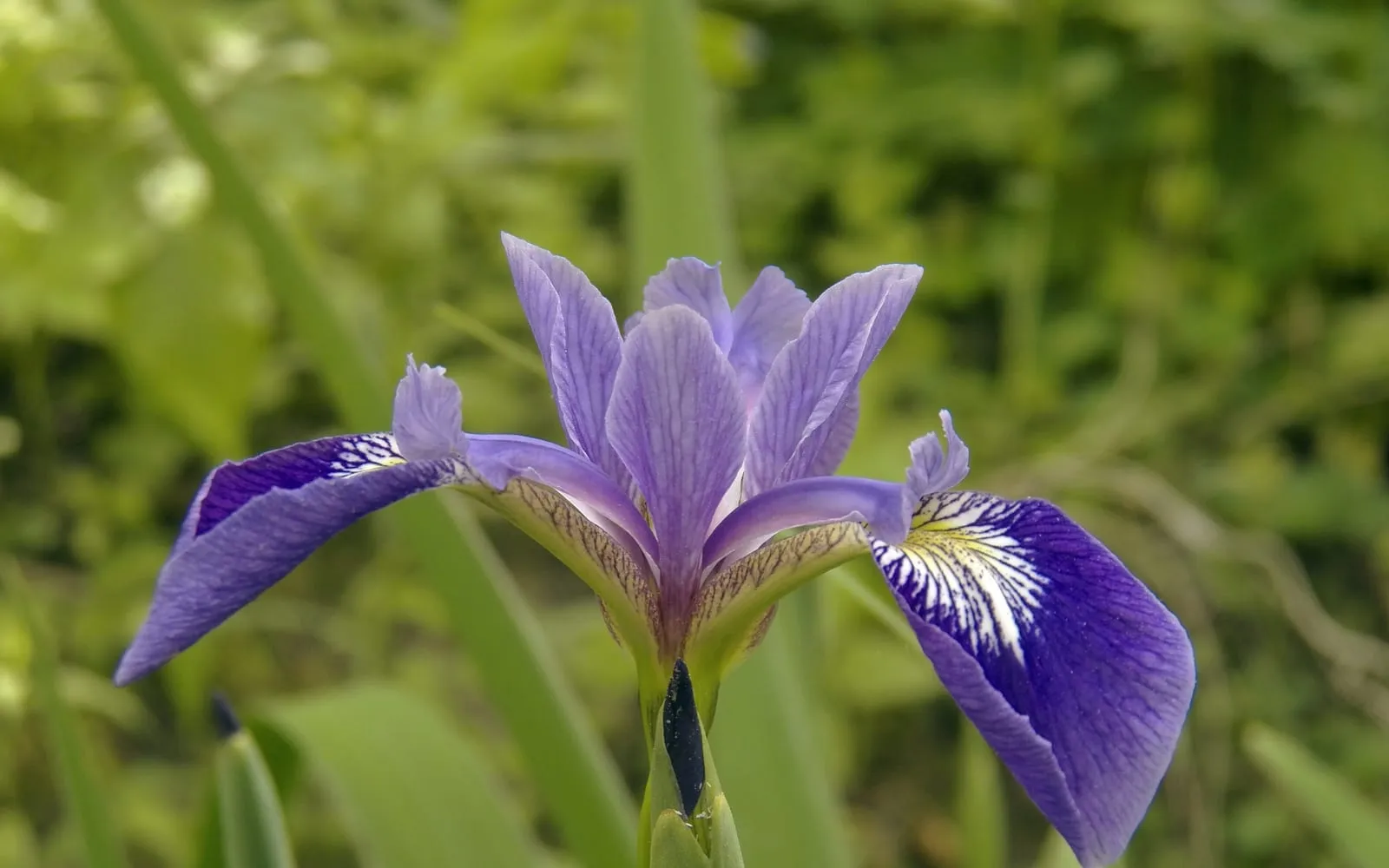
Flowers are violet-blue, 6 to 8 cm across, with three upright inner petals, called standards, and three larger, drooping outer petals, called falls. Each fall carries a patch of yellow at the base surrounded by white, veined through with darker purple, which guides pollinating insects towards the nectar. There is no fuzzy beard on the falls, the feature that gives bearded iris its name; this is a beardless species, and the flower reads as smoother and simpler for it.
Leaves are flat, sword-shaped and blue-green, arranged in overlapping fans that rise straight from the rhizome and persist well after flowering finishes.
The rhizome is thick, branching and shallow-rooted, creeping just below the surface of wet soil or shallow water and sending up a new fan of leaves at each growing point as the clump spreads outward over a few seasons.
Where it is from
Iris versicolor grows across eastern North America, from the Canadian Maritimes and the Great Lakes down through the north-eastern United States, in marshes, wet meadows, ditches and along the margins of ponds and slow streams.
That wetland origin is the whole story of how to grow it well. The plant tolerates its roots sitting in several centimetres of standing water for months at a time, a condition that would rot almost any other iris rhizome, and it struggles rather than merely underperforms in soil that drains freely between rains.
It is the floral emblem of the Canadian province of Quebec, chosen in part for growing wild across the province’s wetlands, and it has long been used in traditional medicine by several Indigenous nations of the region, though the same compounds that gave it medicinal use are what make raw plant material unsafe to eat.
How it grows
Plant rhizomes shallowly, just below the soil surface or the water line, directly into the margin of a pond, a bog garden, or any consistently wet bed. A planting basket of aquatic compost topped with grit works well where the rhizome needs to sit in open water rather than wet soil.
Choose full sun for the best flowering, though it tolerates some shade, particularly where the water it grows in stays cool through summer.
Divide an established clump every three to four years in late summer after flowering, lifting sections of rhizome with a healthy fan of leaves attached and replanting them promptly so the roots do not dry out.
Cut back old, damaged or yellowing leaves at the base in autumn, and remove spent flower stems once seed set is not wanted, to keep the clump tidy without disturbing the rhizome itself.
Through the seasons
Winter is dormant beneath the water or wet soil, and the rhizome takes hard freezing without harm provided it stays wet.
Spring brings new leaf fans and, from late spring, the flower spikes.
Summer is the main flowering and growing period; keep the site permanently wet throughout.
Autumn is the best time to divide a congested clump and to tidy old foliage before winter.
Care difficulty
Easy, on the single condition that the site is wet. Planted at a pond margin or in a bog bed, it needs almost no ongoing care beyond occasional division, and pests and diseases trouble it far less than they trouble bearded iris grown in a conventional dry border. Planted in an ordinary flower bed that drains between waterings, by contrast, it struggles from the start regardless of any other care, which is the one mistake that accounts for most failures with this species.
Watering
Keep the root zone permanently wet, ideally with the rhizome sitting in shallow standing water or saturated soil at all times through the growing season.
Unlike almost every other iris grown in gardens, there is no risk of overwatering this species in open ground; the risk runs entirely the other way, towards a bed that dries out and stresses the plant.
A container or planting basket in a pond needs no separate watering at all beyond keeping the water level topped up, which makes this one of the simplest irises to manage once it is correctly sited.
Warning signs, diseases and pests
Bacterial soft rot turns part of the rhizome soft, mushy and foul-smelling, usually starting at a wound or a point of damage. Cut away and destroy affected tissue back to clean, firm rhizome, and let the cut surface dry before replanting.
Leaf spot shows as small brown blotches on the leaves that enlarge and merge in wet, humid weather. Remove badly affected leaves and improve air movement around a crowded clump.
Rust appears as small orange pustules on the underside of the leaves, usually in a wet season. It rarely kills the plant but weakens it over successive years if left unchecked; remove and destroy affected foliage.
Iris borer caterpillars tunnel into leaves in spring and work their way down into the rhizome by summer, hollowing it out and opening the door to bacterial soft rot behind them. Crush eggs and young larvae on the leaves where you find them, and remove badly tunnelled rhizomes.
Slugs and snails graze on soft new shoots in spring, leaving ragged holes in emerging leaves. Protect young growth if slug pressure is high in a boggy bed.
Growing environment
Full sun gives the strongest flowering, though light shade is tolerated, particularly where summers run hot.
Permanently wet to boggy soil, or shallow standing water, is essential rather than merely preferred. This is one of the few garden plants that needs its roots submerged for extended periods.
Fully hardy to around minus 30 degrees C or lower, and untroubled by freezing solid in ice at a pond margin, provided the rhizome stays wet through the thaw as well as the freeze.
Feeding
Feed once in spring as new growth begins, with a low-nitrogen aquatic plant fertiliser if grown in a pond, or a balanced general feed if grown in a bog bed.
Avoid heavy or repeated feeding. Wetland soils are naturally low in available nutrients and this species is adapted to that, so excess fertiliser mainly encourages algae in nearby water rather than improving the plant.
Troubleshooting
Can I grow this in an ordinary border? Not successfully for long. It needs permanently wet soil or shallow water, and a border that drains between waterings, however well tended otherwise, will leave it stunted and short-lived.
The rhizome has gone soft and smells bad. Bacterial soft rot. Cut away the affected tissue back to firm, healthy rhizome, let the cut surface dry in the air, and replant once it has callused over.
Orange spots have appeared on the leaves. Rust, more common in a wet season. Remove and destroy affected foliage and improve air circulation around the clump.
Is it dangerous to pets that drink from the pond it grows in? The water itself poses no risk; the toxin sits in the plant tissue rather than dissolving into surrounding water in any meaningful amount. The rhizome and leaves are what to keep pets from chewing.
When should I divide a large clump? Every three to four years, in late summer once flowering has finished, lifting sections with a healthy leaf fan attached and replanting them straight away so the roots do not dry out.