
Outdoor plant
Lawson Cypress
Chamaecyparis lawsoniana
Also known as Port Orford cedar, Oregon cedar
How to grow Lawson cypress, Chamaecyparis lawsoniana. Choosing among hundreds of dwarf and golden cultivars, and recognising the root disease that has devastated the species.
At a glance
- Difficulty
- Moderate
- Water
- Regular watering while establishing; consistent moisture afterwards without ever waterlogging the roots
- Light
- Full sun for the best foliage colour on golden and blue cultivars; tolerates part shade
- Temperature
- Cool, humid, maritime climates suit it best
- Humidity
- Prefers reliable moisture and humid air; poor tolerance of hot, dry conditions
- Hardiness
- USDA 5-7, RHS H6-H7, hardy to -25 C
- Type
- Hardy evergreen conifer
- Height
- 35-60 m in its native range, exceptionally taller. The huge number of dwarf and slow-growing golden cultivars bred from it, which dominate the garden trade, range from pot-sized dwarfs under 1 m to slow-growing forms of 3-8 m
- Native to
- Pacific Northwest of North America, a narrow coastal strip of southwest Oregon and northwest California
Cold tolerance is not the limiting factor for this species almost anywhere it is planted. What decides whether it thrives is summer humidity and soil drainage: it wants the cool, damp, maritime conditions of its native Pacific coast and performs poorly in a hot, dry continental summer or in soil that is ever waterlogged, the latter being the condition under which Phytophthora root disease does most of its damage.
Hardiness zones describe winter cold alone. Summer heat, humidity, rainfall and the length of the growing season decide as much, so treat the range as the outer limit rather than as a recommendation.
Harmful if eaten
- Do not eat
- Foliage and sap
- Harm from
- Eating it and handling it
- Affects
- People, cats and dogs
Lawson cypress foliage contains aromatic essential oils typical of the Cupressaceae family, and while it carries no reputation as a serious poison, chewing a quantity of the scale-like leaves can cause mouth and stomach irritation, drooling and mild vomiting in a cat or dog. Handling the foliage during pruning or hedge trimming has been reported to cause contact dermatitis in sensitive people, a known issue across several cypress and false-cypress species and one worth a pair of gloves for anyone doing a large amount of clipping. Neither the ASPCA nor the RHS lists this species among the more seriously toxic garden plants, and the greater practical risk it carries is horticultural rather than medical: the root disease described below has killed named cultivars far more often than the foliage has poisoned anything.
Sources: RHS potentially harmful garden plants, ASPCA toxic and non-toxic plants
About
Lawson cypress has produced more distinct garden cultivars than almost any other conifer species, somewhere in the region of two hundred named forms bred from a single wild population confined to a narrow strip of the Pacific Northwest coast. Gold, blue, silver-variegated, weeping, dwarf and dense columnar forms all trace back to the same tree, first collected for cultivation in the 1850s and propagated on an industrial scale ever since.
That popularity has come at a cost to the species in the wild. A root disease introduced to Pacific Northwest nurseries in the 1920s has since spread through native stands of the tree under its other common name, Port Orford cedar, and killed a significant share of the wild population. The garden conifer sold worldwide and the endangered forest tree of southwest Oregon are, unusually, the same organism.
Appearance and character
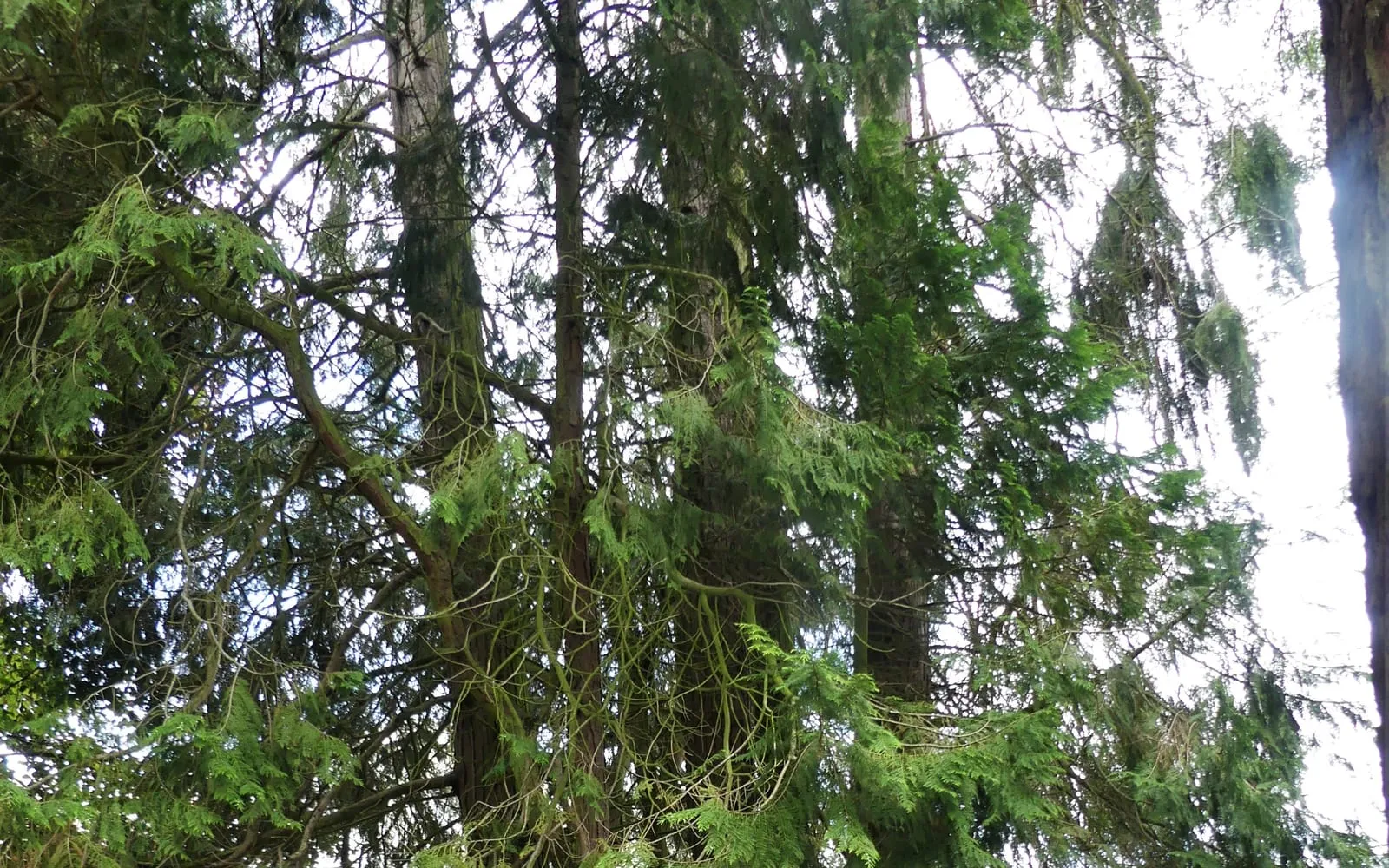
Foliage grows in flattened, drooping sprays of tiny scale leaves, typically with a whitish X-shaped marking visible on the underside where the scales overlap, a useful identification feature against the similar-looking Thuja and Cupressus foliage. The overall texture is fine and feathery, and the drooping tips of the branches give even a formal clipped specimen a slightly soft, weeping silhouette that other columnar conifers lack.
Colour varies enormously by cultivar, from the near-black green of some hedging forms through silvery blue-grey to bright gold, and this range is most of the reason the species is planted as an ornamental accent rather than purely as a screen.
The natural habit is a narrow, densely conical tree with a slightly nodding leading shoot, a detail visible on tall specimen trees and one of the surer ways to tell the species apart from a similarly narrow Italian cypress or Leyland cypress at a distance.
Small round cones, only about eight millimetres across, ripen from green through reddish-brown, scattered inconspicuously through the foliage.
Where it is from
Chamaecyparis lawsoniana occupies a narrow native range confined to southwestern Oregon and northwestern California, mostly within about eighty kilometres of the Pacific coast, where fog and heavy winter rainfall keep the air and soil consistently moist through most of the year. It grows in mixed conifer forest alongside Douglas fir and coast redwood, often on serpentine or other unusual soils that few other tree species tolerate well.
That narrow, wet, foggy native range explains both the tree’s enormous ultimate size in habitat, where old trees have been recorded well over sixty metres tall, and its relative fussiness in cultivation outside a similarly cool, humid climate.
Commercially, the timber, sold as Port Orford cedar, is prized in North America and particularly in Japan, where it is used as a substitute for the increasingly scarce native hinoki cypress in temple building and other traditional joinery, a trade that has itself contributed to the spread of the root disease through soil moved with logging equipment.
How it grows
Plant in autumn or spring into moist, well-drained, slightly acidic soil, choosing a site with reliable rainfall or irrigation over one prone to drying out in summer, since this species tolerates neither prolonged drought nor waterlogging well.
Buy from a reputable nursery and inspect roots before planting where possible, since Phytophthora root disease spreads readily on infected nursery stock and in water running off contaminated soil, and prevention at the point of planting is more reliable than any treatment afterwards.
Choose a cultivar to match the space available rather than the straight species, which grows far larger than almost any garden can accommodate. The enormous range of named forms means a dwarf, slow-growing option exists for nearly any position, from a large architectural specimen tree to a small container plant.
Trim hedging forms once or twice a season into the current year’s soft growth, since like most conifers here it does not reliably regrow from bare wood cut back into the older, leafless part of the plant.
Through the seasons
Spring brings a flush of soft, brighter new growth at the tips of the sprays, and it is a good season to plant, giving roots the whole growing season to establish before the drier stretches of summer.
Summer tests the species’ tolerance for heat and dry soil, and this is when root disease symptoms, where present, often become visible as sudden wilting or browning of individual branches or the whole crown.
Autumn is the other main planting window, with cooler, wetter weather reducing the stress of establishment, closer to the conditions of the species’ native coastal climate than a dry midsummer planting would be.
Winter rarely troubles an established, healthy tree in most of the climates it is planted in, since cold tolerance is not this species’ limiting factor. Wet, waterlogged soil through a mild, rainy winter is a greater risk than frost, since it is exactly the condition the root disease exploits.
Care difficulty
Moderate, and the difficulty sits almost entirely with disease risk rather than routine care. Given the right site, cool and humid with reliably drained, non-waterlogged soil, Lawson cypress asks little beyond occasional trimming. The root disease that has devastated wild populations of the species is present in cultivated soil in many regions too, and a tree planted where drainage is poor or where infected material has previously grown is at real risk regardless of how well it is otherwise cared for.
Watering
Water new plants regularly through their first two to three growing seasons, aiming for consistently moist soil that never sits wet for extended periods. Standing water around the roots is the greatest risk factor for Phytophthora root disease.
Established trees in a suitable climate need little supplemental watering beyond normal rainfall, though a prolonged summer drought, more of a concern in a continental climate than in the tree’s native coastal fog belt, causes browning and stress that a drought-tolerant conifer would shrug off.
Avoid overhead irrigation that keeps foliage wet for long periods, since damp, still conditions around the crown encourage coryneum canker and other fungal foliage problems alongside the more serious root pathogen.
Warning signs, diseases and pests
Phytophthora root disease is the defining threat to this species. Caused by a water-mould pathogen first recorded on nursery stock in Seattle in the 1920s and now established through much of the Pacific Northwest and in scattered locations wherever the species and its close relatives are grown, it spreads in surface water and on contaminated soil, roots and nursery tools. Infected trees show sudden wilting and browning of the foliage, often starting on one side of the crown, with a reddish-brown stain visible in the inner bark at the root collar when cut into. There is no cure once a tree is infected; the practical response is prevention through good drainage, avoiding movement of soil or water from known infected sites, and removing and destroying an infected tree promptly rather than replanting the same species in the same spot.
Honey fungus, a separate and unrelated root pathogen, also attacks this species, showing as white fungal sheets under the bark at the base and, often, honey-coloured toadstools at the base in autumn.
Spider mites cause fine speckling on the foliage in hot, dry weather, most often on trees already stressed by drought or poor drainage.
Coryneum canker causes localised dieback of individual shoots, appearing as sunken, resinous lesions on the bark; pruning out affected wood promptly usually contains it on an otherwise healthy tree.
Aphids colonise soft new growth in spring, rarely causing lasting harm on an established plant.
Growing environment
Full sun brings out the strongest colour on golden and blue-foliage cultivars, though the species tolerates a reasonable amount of shade, particularly in a hot climate where some afternoon shade reduces stress.
Moist, well-drained, slightly acidic soil is the target, and drainage matters more here than for almost any other species in this group, given how directly poor drainage is linked to fatal root disease.
A cool, humid climate with reliable rainfall suits it far better than a hot, dry one, reflecting its narrow native range in the foggy Pacific Northwest, and this matters more to long-term success than the USDA zone number alone suggests.
Avoid siting where water from a known infected planting, or from a neighbouring nursery bed, drains toward the roots, since the root disease travels readily in surface water.
Feeding
A balanced, slow-release fertiliser applied once in spring supports young plants and newly trimmed hedges through their establishment years.
Established trees on reasonable soil need little additional feeding, and heavy nitrogen feeding is best avoided, since it produces soft growth more vulnerable to the fungal problems this species is already prone to.
A tree showing poor colour or thin growth despite adequate feeding is worth checking for root disease or waterlogging before assuming a nutrient deficiency, since both are far more common causes of decline in this species than a genuine feeding shortfall.
Troubleshooting
One side of my tree has suddenly wilted and turned brown. This is a classic symptom of Phytophthora root disease, a serious and often fatal water-mould pathogen that has devastated the species both in cultivation and in its native forests. There is no cure once a tree is infected; remove and destroy affected material and avoid replanting the same species in the same spot.
How do I choose from the huge range of cultivars available? Match the cultivar’s expected mature size and colour to the space and effect wanted rather than buying the straight species, which grows far larger than almost any garden needs. Named dwarf and slow-growing forms cover nearly every situation from a large specimen tree to a small container plant.
The foliage has a faint whitish marking underneath. Is that a problem? No, this is a normal identification feature of the species, a whitish X or butterfly-shaped mark where the scale leaves overlap, and it distinguishes Lawson cypress foliage from similar-looking Thuja and true cypress.
Handling the hedge trimmings has irritated my skin. Contact dermatitis from cypress and false-cypress foliage is a documented, if uncommon, reaction. Wear gloves and long sleeves for large pruning jobs if you have sensitive skin.
Is it safe to plant where a previous conifer died suddenly? Treat a sudden, unexplained conifer death on the site with caution, since it may indicate Phytophthora root disease already present in the soil, and choosing a different, less susceptible species for that spot is the safer option.
My tree is thin and pale despite regular feeding. Check drainage before assuming a nutrient problem. Poor drainage and early-stage root disease are both far more common causes of general decline in this species than a genuine feeding shortfall.
Why does my tree struggle every summer despite being described as hardy? Cold hardiness and heat or drought tolerance are different things. This species is very cold-hardy but comes from a cool, humid, foggy coastal climate, and it performs poorly in a hot, dry summer regardless of what the winter zone number suggests.