
Outdoor plant
Dwarf iris
Iris reticulata
Also known as Iris reticulata, Netted iris, Reticulated iris
How to grow Iris reticulata. Planting deep enough to stop the bulbs splitting, keeping them dry in summer, and why a brilliant first year is so often followed by grass.
At a glance
- Difficulty
- Moderate
- Water
- None in the ground, and sparingly in a pot while growing
- Light
- Full sun
- Temperature
- Very hardy, to -20 deg C
- Hardiness
- USDA 5-9, RHS H5, hardy to -15 C
- Type
- Bulbous perennial, dormant from early summer to autumn
- Height
- 10-15 cm in flower, and leaves to 40 cm afterwards
- Native to
- Turkey, Iraq, Iran and the Caucasus
- Best month
- February in the Northern Hemisphere, August in the Southern Hemisphere
A hot dry summer bake is the requirement, and a bulb sitting in damp soil through July is why so many flower once and then produce only leaves. Plant deep, at 10 to 12 cm, which slows the splitting into non-flowering bulblets, or lift and dry them. A raised bed, a gravel garden or a pot emptied and stored dry all beat an ordinary damp border.
Hardiness zones describe winter cold alone. Summer heat, humidity, rainfall and the length of the growing season decide as much, so treat the range as the outer limit rather than as a recommendation.
Every month named in this guide is for the temperate Northern Hemisphere. If you garden in the Southern Hemisphere, shift each one by six months, so February becomes August. Closer to the equator the wet and dry seasons matter more than the calendar, and the shift stops being a useful guide.
Toxic if eaten
- Do not eat
- The bulb above all, and the leaves and flowers to a lesser degree
- Harm from
- Eating it and handling it
- Affects
- People, cats, dogs and horses
Irises are poisonous and the bulb is the dangerous part. The ASPCA lists Iris species as toxic to cats, dogs and horses, and the RHS lists iris among plants that are harmful if eaten and that may cause skin irritation. The active compounds include irisin and a group of pentacyclic terpenoids concentrated in the bulbs and rhizomes. Eating them causes drooling, vomiting, abdominal pain and diarrhoea, and a dog that digs up and eats several bulbs can become seriously unwell. The sap causes contact dermatitis in some people, so wear gloves when handling bulbs in quantity and wash your hands afterwards. The practical risk with dwarf iris is autumn planting, when freshly buried bulbs attract dogs and squirrels alike. Cover new plantings with netting or wire mesh until the soil settles, and store bulbs somewhere a pet cannot reach. Flowers and leaves are far less concentrated and a nibbled leaf is not a cause for alarm.
Sources: ASPCA (Iris), RHS potentially harmful garden plants
About
Dwarf irises flower in February, sitting almost on the soil surface, and at that point in the year a pot of them by a door is worth more than most things twice their size.
Their reputation is for a spectacular first spring followed by disappointment. The second year brings a mass of narrow leaves and few flowers or none, and the third brings grass. What has happened is that each bulb has split into a cluster of small offsets, none of which is large enough to flower.
Two things reduce it. Plant deep, at 10 to 12 cm rather than the 8 cm often recommended, and keep the bulbs dry through summer. Neither is a complete cure, which is why many gardeners treat them as a two-year plant and top up.
Appearance and character
A small bulbous perennial, flowering at 10 to 15 cm and holding the bloom close to the ground.
The bulb has a coarse netted fibrous tunic, which is what reticulata describes and what distinguishes the group.
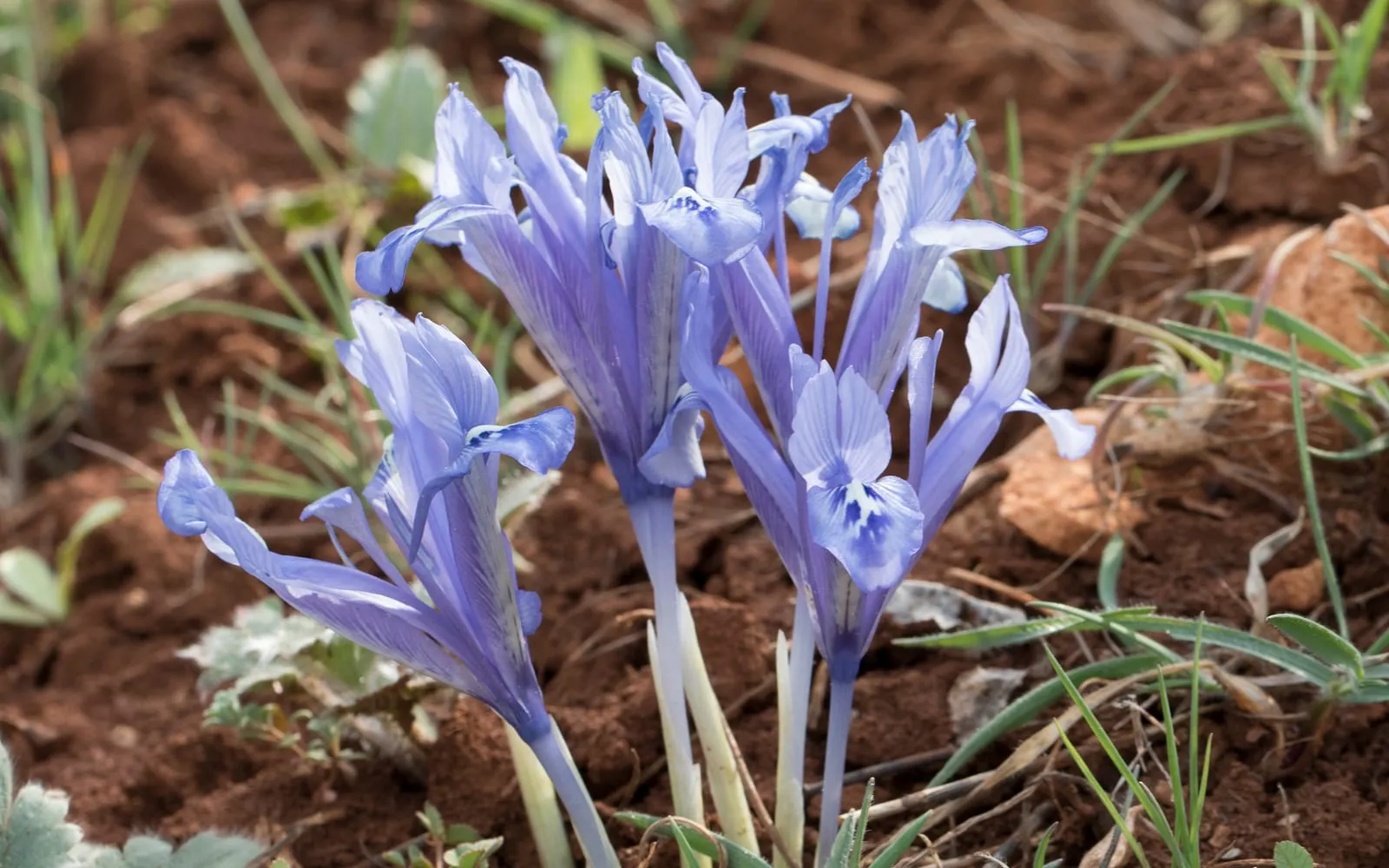
Flowers open in February and early March, 5 to 7 cm across, in violet, deep purple, sky blue and near-white depending on variety. Each has three upright standards and three spreading falls.
The falls carry the markings that make the flower. A yellow or orange central ridge runs down each one, usually flanked by white flecking and darker blue or purple veining.
Scent is present and easily missed, faint and sweet, and it needs a warm day and a low nose.
Leaves are the giveaway to the plant’s habits. They are short and inconspicuous at flowering, then lengthen dramatically afterwards into narrow four-sided spikes 30 to 40 cm long, which persist until early summer.
Named varieties are worth choosing between. ‘Harmony’ is deep sky blue, ‘Katharine Hodgkin’ is a pale greenish-cream netted in blue and is the most persistent of all, ‘J.S. Dijt’ is reddish-purple, and ‘Pauline’ is dark violet.
Where it is from
Turkey, Iraq, Iran, the Caucasus and neighbouring parts of central Asia, where it grows on stony mountain slopes and in open scrub between 600 and 2,700 m.
Those mountains have cold wet winters, a brief spring, and a hot dry summer in which the ground bakes. The bulb grows and flowers in the short window and then sits dry underground for months.
Summer drought is therefore a requirement rather than a hardship. A temperate border watered through July gives these bulbs conditions they never meet in the wild, and that is the direct cause of the rotting and splitting.
The plant reached temperate gardens in the nineteenth century and has been crossed extensively with the related Iris histrioides and Iris winogradowii to produce the named varieties.
‘Katharine Hodgkin’, raised by E.B. Anderson and named after the wife of the botanist Eliot Hodgkin, is the cross that behaves most like a permanent garden plant.
How it grows
Plant bulbs in September or October, and plant them deep. Ten to twelve centimetres is better than the eight often printed on the packet, since depth is what discourages splitting.
Space them 8 to 10 cm apart in groups, and plant plenty. They are small and need numbers.
Choose the sharpest drainage in the garden. Add grit generously to the planting hole on anything heavier than a sandy loam.
Feed once with a high-potassium or low-nitrogen bulb fertiliser as the flowers fade, which builds the bulb rather than the leaf.
Let the leaves grow on and die back naturally. They lengthen considerably after flowering and feed the bulb through spring.
Keep the ground dry through summer. A position at the base of a sunny wall, in a raised bed, in gravel, or in a pot moved under cover all achieve this.
Lift and dry the bulbs in early summer if the border cannot be kept dry, storing them somewhere warm and airy until autumn planting.
Accept the alternative. Many gardeners plant fresh bulbs each autumn in pots, enjoy one excellent season, and plant the split bulbs out into grass afterwards where they may recover over several years.
Through the seasons
Autumn is planting. Get bulbs in during September or October, deep and with plenty of grit.
Winter brings the shoots through in January and the flowers from early February. Watch for slug damage on the opening blooms.
Spring is when the bulb is rebuilt. Feed as the flowers fade, and let the leaves lengthen and stay.
Early summer is die-back and drying. The foliage yellows in June. Keep the ground dry, or lift and store the bulbs.
Care difficulty
Moderate, and the difficulty is entirely in getting a second good year.
Bulb splitting is the characteristic failure. Deep planting, a summer bake and a potassium feed after flowering all reduce it, and none of them prevents it completely.
Drainage is the other requirement. These are mountain bulbs and they rot in soil that stays damp through summer.
The flowering itself is easy and reliable in the first year from good bulbs.
Treating them as a short-lived pleasure rather than a permanent planting is a reasonable approach and saves a good deal of frustration.
Watering
Dwarf irises in the ground need no watering at any point.
Water container plantings sparingly while in growth, and stop once the flowers finish and the leaves begin to yellow.
Keep them dry through summer dormancy. Summer moisture is the main cause of both rotting and splitting.
Move pots under an overhang, into a cold frame or against a dry wall for the summer.
Never plant them where a border is irrigated through July and August.
Warning signs, diseases and pests
Grassy leaves and no flowers in the second or third year is the classic outcome. The original bulb has divided into a cluster of small offsets, and each needs two or three years of growing to reach flowering size. Plant deeper next time, feed with potassium after flowering, keep the summer dry, and either lift and grow the offsets on or replace the planting each autumn.
Iris ink disease shows as black or dark brown ink-like stains and streaks on the bulb tunic, spreading into the flesh, and it produces stunted yellowing leaves. There is no cure. Destroy affected bulbs, do not compost them, and avoid replanting irises in the same soil.
Bulb rot follows a wet summer, leaving soft brown bulbs. Improve the drainage or lift and store.
Slugs and snails eat the flowers as they open, and the damage is severe because the blooms sit at ground level. Use whatever control you prefer from January.
Birds peck at the flowers in some gardens, particularly the yellow markings.
Leaves that flop and yellow very early usually mean the bulbs are rotting below.
Growing environment
Full sun, and as much of it as the garden offers. These bulbs need the summer bake.
Sharply drained gritty soil, neutral to alkaline. Add grit generously to anything that holds water.
A raised bed, a rock garden, a gravel garden or the foot of a sunny wall are the best positions in the ground.
Containers suit them very well, and a wide shallow pan of them by a door in February is the way most people grow them. Use a gritty compost and move the pot somewhere dry for the summer.
Plant them where the flowers can be seen at close range. At 12 cm tall, they are lost in the middle of a border.
Avoid heavy clay, shaded corners and irrigated beds.
Grass is a possible home for the split bulbs after their first year, since they sometimes recover and flower again over several seasons in undisturbed turf.
Feeding
Feed once with a high-potassium fertiliser, such as a tomato feed or sulphate of potash, as the flowers fade. This builds the bulb for next year.
Avoid nitrogen, which encourages leaf and soft growth.
A general bulb fertiliser at planting is worthwhile on poor soil.
Container plantings need fresh gritty compost each year.
Feeding will not rescue a bulb that has already split, since the offsets need time rather than nutrients.
Troubleshooting
It flowered beautifully the first year and then just made grass. The bulb has split into small offsets that are too small to flower. Plant deeper at 10 to 12 cm, feed with potassium after flowering, keep the summer dry, or replant fresh bulbs each autumn.
How deep should I plant them? Ten to twelve centimetres, which is deeper than most packets say and helps considerably with splitting.
Black ink-like marks on the bulbs. Iris ink disease. There is no cure. Destroy the bulbs, do not compost them, and do not replant irises in that soil.
The flowers were eaten as they opened. Slugs and snails. The blooms sit at ground level, so protect them from January.
Can I leave them in the border? Only where the ground stays dry through summer. An irrigated border rots or splits them. A raised bed, gravel or a pot works better.
Should I cut the leaves off after flowering? No. They lengthen after the flowers and feed the bulb. Let them die back naturally in June.
Which variety comes back most reliably? ‘Katharine Hodgkin’ is the most persistent by a clear margin, and it is worth paying more for.
Are they poisonous? Yes, particularly the bulbs, to people, cats, dogs and horses. Protect autumn plantings from digging dogs and wear gloves when handling them.