
Outdoor plant
Yellow Flag Iris
Iris pseudacorus
Also known as Yellow flag, Water flag
How to grow yellow flag iris, Iris pseudacorus, at a pond margin. Planting depth, why it spreads so fast, and the rash its sap can raise.
At a glance
- Difficulty
- Easy
- Water
- Constantly wet soil or shallow standing water
- Light
- Full sun to light shade
- Hardiness
- USDA 4-9, RHS H7, hardy to -30 C
- Type
- Hardy aquatic perennial
- Height
- 90-150 cm
- Native to
- Europe, Western Asia, North Africa
Fully hardy and untroubled by frozen ground, since the rhizome sits below the waterline or deep in wet mud where the cold rarely reaches it. It grows equally well as a marginal pond plant or as a border perennial in soil that stays consistently damp, and spreads by rhizome fast enough in either setting to need active management within a few years.
Hardiness zones describe winter cold alone. Summer heat, humidity, rainfall and the length of the growing season decide as much, so treat the range as the outer limit rather than as a recommendation.
Harmful if eaten
- Do not eat
- The rhizome most of all, and the whole plant to a lesser degree
- Harm from
- Eating it and handling it
- Affects
- People, cats, dogs and horses
The rhizome contains irritant glycosides that cause vomiting and diarrhoea if eaten, and handling a freshly cut rhizome can raise a rash or blistering on sensitive skin, a reaction gardeners sometimes call iris dermatitis. The ASPCA lists the whole Iris genus as toxic to cats and dogs for the same reason. Poisoning from grazing is rare because livestock generally avoid the bitter leaves, and the RHS includes it on its list of plants that can cause skin irritation rather than its more serious harm categories. Wear gloves when dividing a clump.
About
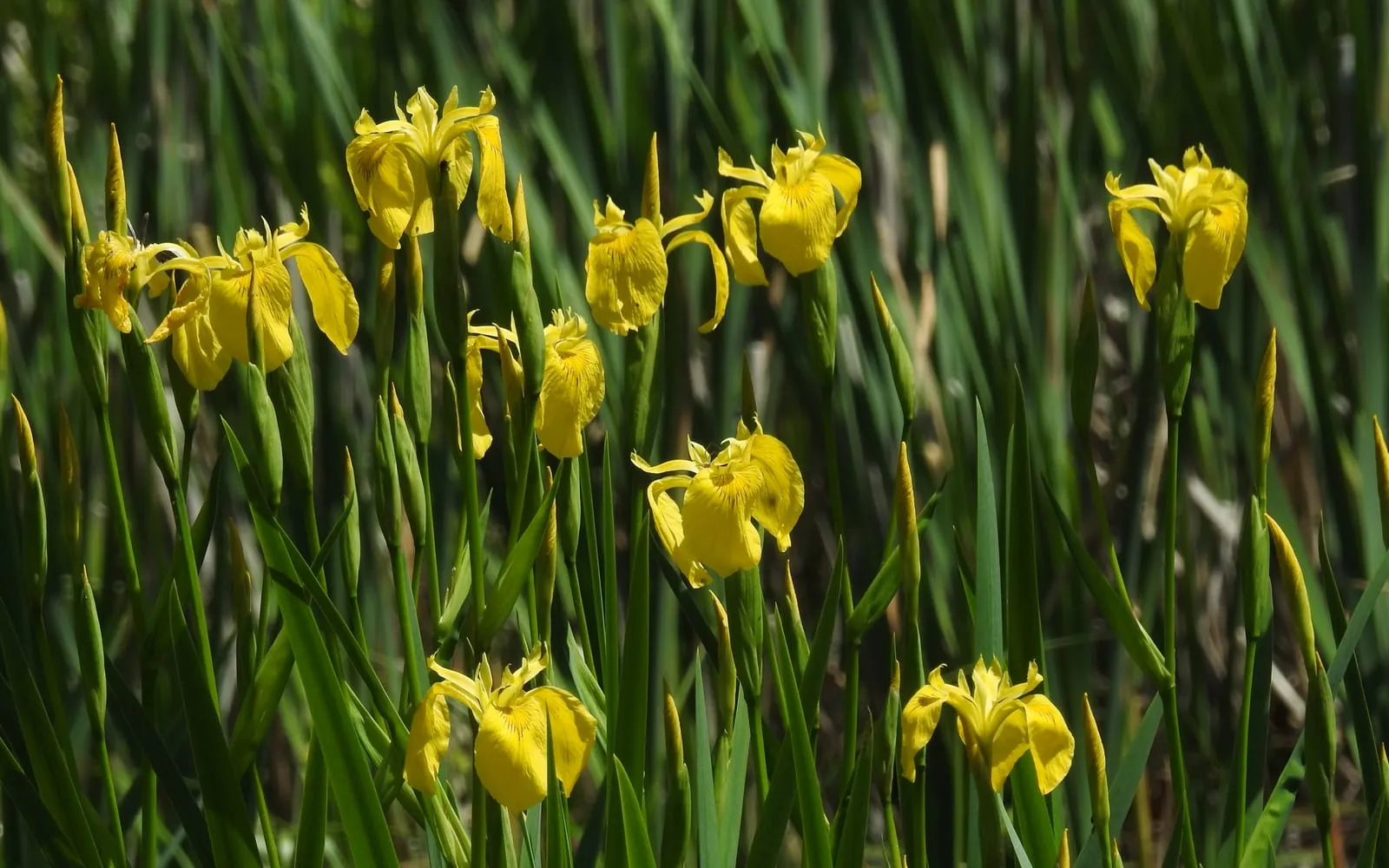
Yellow flag is the tall iris that lines canals, ditches and pond margins across Europe with sword-shaped leaves and bright yellow flowers each early summer. It is one of only two iris species native to Britain, and it is also one of the most vigorous plants a gardener can put at the edge of a pond. Plant it only if you can contain it.
Outside its native range it has become a serious problem. Introduced to North America, Australia and New Zealand as an ornamental, it escapes into wetlands and outcompetes native marginal plants, and several US states now restrict its sale. Check local rules before planting it if you garden outside Europe or western Asia.
Appearance and character
Sword-shaped grey-green leaves rise in flat, overlapping fans from a thick creeping rhizome, reaching 60-100 cm. Flower stems stand taller still, holding two or three bright yellow flowers each with the flat, drooping falls and upright standards typical of iris.
Each flower lasts only a few days, but a well-established clump produces a long succession of buds through May and June. Seed pods that follow are fat and three-sided, splitting to release flat brown seeds that float and disperse on moving water, which is the main way the plant colonises new ground downstream.
Where it is from
Wet ground across Europe, western Asia and North Africa. It grows at pond and lake margins, in ditches, across wet meadows and along slow river banks, and it tolerates both permanently waterlogged mud and shallow standing water, which is unusual versatility for a marginal plant.
That tolerance is why it spreads so readily wherever it is introduced. A rhizome fragment broken off and carried downstream roots wherever it lodges, and a single planted clump can populate a long stretch of watercourse within a decade.
How it grows
A hardy perennial spreading by a thick, branching rhizome that creeps sideways just below the mud or water surface, sending up new leaf fans along its length. Growth is vigorous from the start: a small division reaches flowering size within two years and keeps expanding outward indefinitely unless something contains it.
In a garden pond that containment usually has to be a planting basket, since an unchecked clump in open mud will eventually crowd out everything else at the water’s edge.
Through the seasons
Spring: New leaves grow quickly as the water warms, followed by flower buds from April. Feed once growth is well underway.
Summer is the flowering season, running through May and June, followed by seed pod formation. Deadhead spent flower stems if you want to slow its spread by seed, though the rhizome will keep expanding regardless.
Autumn growth slows and the outer leaves begin to yellow and die back.
Winter the clump is dormant, with the rhizome unaffected by frost so long as it stays wet or submerged.
Care difficulty
Easy, but it needs containment. Wet ground and sun are enough to keep it growing; the main task is limiting where it spreads.
A planting basket at the pond margin is the standard way to keep a clump in bounds. Left in open mud, expect to be lifting and discarding excess rhizome every few years.
Watering
Constantly wet is the rule. At a pond margin, plant with the crown sitting in 0-15 cm of water; in a border, choose ground that never dries out, such as beside a stream or in a low spot that collects rainwater.
It does not need the careful water-depth management that a deep-water lily does. The main risk is the opposite direction: a border planting that dries out in a hot summer will survive but flower poorly the following year.
Warning signs, diseases and pests
Iris sawfly larvae strip the soft green tissue from leaves in early summer, leaving pale skeletonised strips, and are usually numerous enough to pick off by hand once spotted. Iris borer caterpillars are a more serious pest in North America, tunnelling down inside a leaf fan from a small entry hole near the tip; a fan showing a ragged vertical slit and soft, wet tissue at the base should be pulled and destroyed before the larva reaches the rhizome.
Rhizomes sitting in stagnant, oxygen-poor mud can rot, showing as a soft, foul-smelling section that separates easily from healthy tissue. Cut back to firm rhizome and improve water movement if this recurs.
Flowering drops off sharply in a clump that has become congested after many years, which calls for lifting and dividing rather than treatment.
Growing environment
Full sun gives the best flowering, though it tolerates light shade at the cost of fewer flowers. Wet is the constant requirement, whether that is shallow pond water, permanently boggy ground, or a border that never fully dries.
It is untroubled by exposure or wind, which is part of why it does so well on open canal banks and lake shores with nothing to shelter it.
Feeding
A light annual feed in spring is enough: an aquatic plant tablet pushed into the basket at a pond margin, or a balanced granular feed scratched into the soil surface for a border planting. This is a plant that grows vigorously with no feeding at all, so more is rarely useful.
Troubleshooting
The clump has spread far beyond where it was planted. Expected behaviour rather than a fault. Lift and discard the excess rhizome in spring, keeping only what fits the space, and consider a planting basket to slow future spread.
Leaves are pale and skeletonised in patches. Check for iris sawfly larvae on the underside of leaves and remove them by hand.
A leaf fan has a vertical split with soft tissue inside. Suspect iris borer. Pull and destroy the whole fan before the larva reaches the rhizome and spreads to its neighbours.
Skin irritation after handling the plant. The rhizome sap is an irritant for some people. Wear gloves when dividing clumps, and wash any exposed skin promptly.
Few flowers on an old, dense clump. It has become congested. Lift in spring, divide into smaller sections, and replant only the vigorous outer pieces, discarding the exhausted centre.