
Outdoor plant
Bearded Iris
Iris germanica
Also known as German Iris
How to grow bearded iris, Iris germanica. Why the rhizome needs a hot, dry summer to flower well and rots readily where summers stay humid, planting it sitting on the soil surface rather than buried, and the sap that raises a rash during division.
At a glance
- Difficulty
- Easy
- Water
- Sparingly once established; water a newly planted rhizome to settle it in
- Light
- Full sun
- Temperature
- Fully hardy
- Hardiness
- USDA 3-9, RHS H6, hardy to -30 C
- Type
- Rhizomatous perennial, living many years if divided regularly
- Height
- 60-100 cm in flower
- Native to
- of garden hybrid origin
Extremely cold-hardy in the rhizome, surviving winters far more severe than most garden perennials tolerate. The harder condition to satisfy is not winter cold but summer wet: the rhizome needs a hot, dry baking through summer to flower well the following year, and it rots readily in a humid climate with wet summers regardless of how comfortably the winter temperature sits within its range.
Hardiness zones describe winter cold alone. Summer heat, humidity, rainfall and the length of the growing season decide as much, so treat the range as the outer limit rather than as a recommendation.
Toxic if eaten
- Do not eat
- Every part, and the rhizome most of all
- Harm from
- Eating it and handling it
- Affects
- People, cats and dogs
Iris keeps its irritants concentrated in the rhizome, and that is where nearly all the trouble comes from. It holds resinous compounds and glycosides, and eating a piece causes a burning mouth, drooling, vomiting, stomach pain and diarrhoea. Dogs that dig up and chew rhizomes are the usual cases, and the amount present in an ordinary clump is enough to make a dog quite unwell for a day or two. Leaves and flowers carry far less, and a nibbled petal is unlikely to matter. Serious poisoning in people is rare, since a child who bites into a rhizome spits it out, discouraged by the burning taste. The sap raises a rash on the hands of anyone who lifts and divides clumps regularly, a familiar nuisance among gardeners who grow a lot of iris. Wear gloves to divide them, bag lifted rhizomes rather than leaving them in a heap where a dog will find them, and see a vet if a dog that has eaten one cannot keep water down.
Sources: ASPCA (Iris, Iris spp), RHS potentially harmful garden plants
About
Bearded iris grows from a thick rhizome that should sit on or just above the soil surface. If the rhizome is buried too deeply, it stays too cool and damp, and flowering is poor. Full sun and sharp drainage are more important than rich soil.
The common name comes from the flower structure. Each of the three drooping lower petals, called falls, carries a fuzzy ridge of fine hairs near its base. Bearded iris is a complex garden hybrid rather than a single wild species, with named cultivars in almost every flower colour.
Appearance and character
Leaves are broad, flattened and sword-shaped, grey-green, arranged in a fan from the rhizome, 30 to 45 cm long, providing structural interest in the border even outside the flowering season.
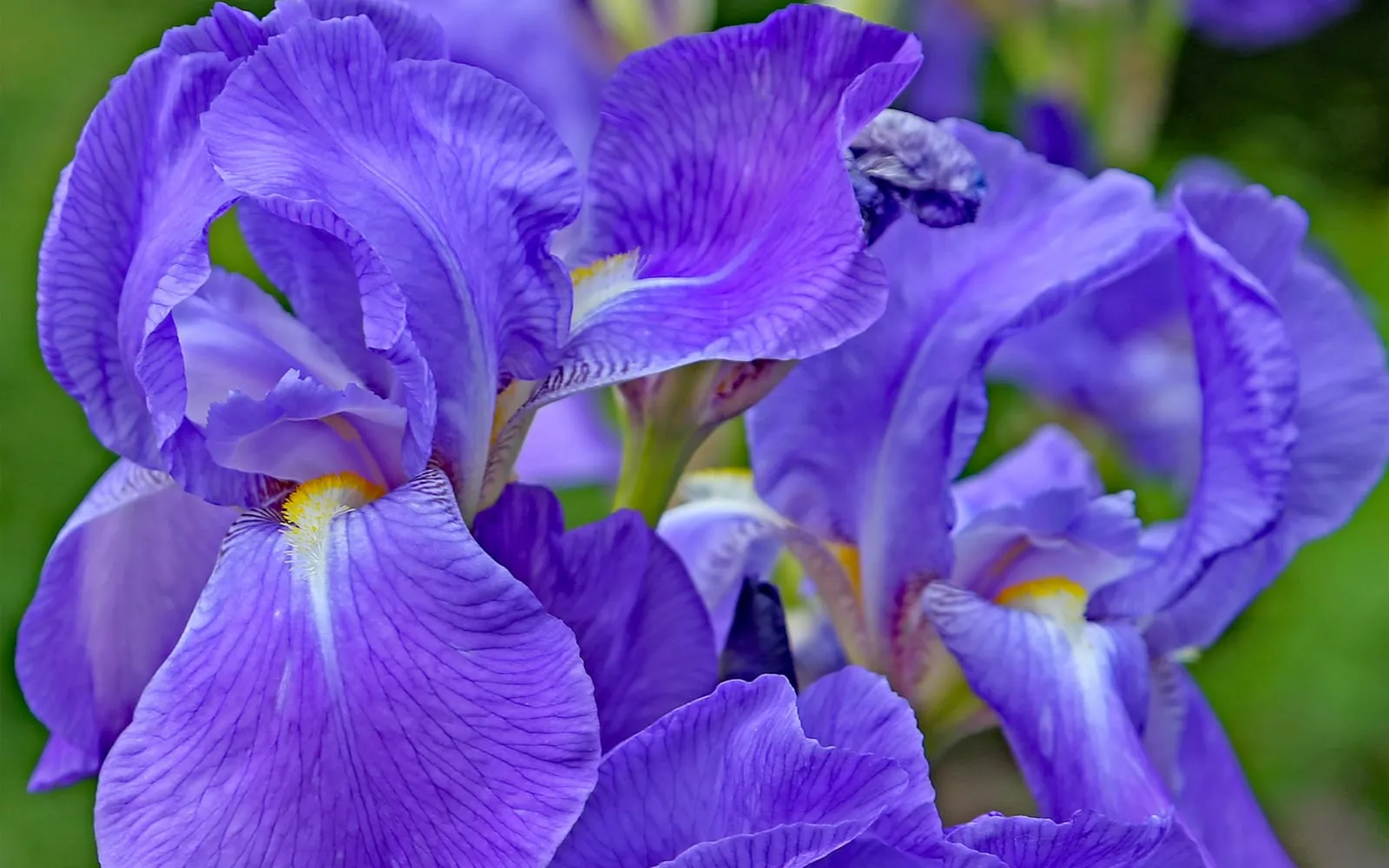
Flowers are large and showy, 10 cm or more across, with three upright petals called standards and three drooping falls below them, each fall marked with the characteristic fuzzy beard. Colour ranges across almost the whole spectrum, frequently combining two or more shades in a single bloom, and many modern cultivars are also reliably fragrant.
Growth spreads from a thick, fleshy rhizome that creeps along just below or at the soil surface, sending up new fans of leaves at its growing tip each year while the oldest part of the rhizome, furthest from the growing point, gradually becomes unproductive and eventually needs removing.
Where it is from
Bearded iris as grown in gardens today is a complex hybrid group derived from several wild Iris species, with Iris germanica among the most significant historical parents, rather than a single wild species with one native range.
Breeding has continued for centuries, accelerating dramatically over the last hundred years or so with organised societies and competitive registries producing thousands of named cultivars, so the modern bearded iris owes more to sustained horticultural selection than to any single wild ancestor’s natural distribution.
How it grows
Plant rhizomes in mid to late summer, the traditional planting season for this group, in well-drained soil in full sun. Set the rhizome with its top surface exposed or barely covered, angled to face the sun, with the roots spread out and buried below it.
Space rhizomes 30 to 45 cm apart, since crowded plants flower poorly and divide back down sooner than well-spaced ones.
Divide clumps every three to four years, generally after flowering in summer, lifting the whole clump and discarding the old, woody centre sections while replanting the vigorous, younger rhizomes from the outer edge. A clump left undivided for too long becomes congested and flowers less freely each year.
Remove spent flower stems at the base once flowering finishes, and cut back any leaves that yellow or brown through the season, both to tidy the plant and to reduce places for pests to overwinter.
Through the seasons
Spring brings the emergence of new leaf growth followed by the main flowering display, typically peaking in late spring or early summer depending on cultivar and climate.
Summer is when the rhizome bakes and ripens in the sun, the process that sets next year’s flower buds, and is also the traditional season for lifting, dividing and replanting overcrowded clumps.
Autumn is a quieter period of root establishment for any newly divided or planted rhizomes.
Winter is dormant. The rhizome is fully hardy and needs no protection in a suitable climate, though foliage may die back partly in a hard winter and regrow the following spring.
Care difficulty
Easy in a climate that suits it, and considerably harder in one that does not. Given full sun, well-drained soil and a summer dry enough to bake the rhizome, bearded iris needs little beyond periodic division. In a humid climate with wet summers, rot becomes a persistent problem regardless of how well everything else is managed, since the rhizome has little tolerance for prolonged summer moisture.
Watering
Water a newly planted rhizome to help it settle in, then reduce watering sharply. An established clump needs comparatively little water through summer, since the rhizome needs to dry out and bake in the sun to flower well the following year.
Avoid watering over the rhizome itself at any time of year, and avoid mulch that sits directly against it, both of which encourage the rot this plant is most prone to.
Warning signs, diseases and pests
Iris borer tunnels into the rhizome from the leaf tips downward, weakening it and often opening the way for bacterial soft rot to follow. Remove and destroy affected foliage and rhizome sections promptly, and clear old leaf debris in autumn, since the pest overwinters as eggs on dead foliage.
Bacterial soft rot causes a rhizome to collapse into a foul-smelling, mushy mass, usually following damage from a borer, overly wet conditions, or burial too deep. Cut away and discard affected tissue back to firm, healthy rhizome, and let the cut surfaces dry in the sun before replanting.
Leaf spot shows as small, brown, oval lesions on the foliage, worse in wet or humid conditions. Remove badly affected leaves and improve air circulation around the clump.
Slugs and snails feed on soft young foliage in spring, leaving ragged holes. Standard slug and snail controls apply.
Growing environment
Full sun is close to essential. A bearded iris grown in shade produces leaves but flowers poorly, since the rhizome needs direct summer sun to ripen properly.
Well-drained soil is critical, more so than for most perennials, since the rhizome is highly prone to rot in ground that holds moisture. Raised beds or slightly mounded planting help on heavier soils.
Neutral to slightly alkaline soil suits it best, though it tolerates a wider range reasonably well provided drainage is good.
Avoid mulching over the rhizome and avoid planting it where taller neighbouring plants shade or crowd it, both of which recreate the damp, shaded conditions that invite rot.
Feeding
Apply a low-nitrogen, balanced fertiliser once in early spring as growth resumes. Excess nitrogen produces soft, lush leaf growth at the expense of flowering and can make the rhizome more prone to rot.
Avoid feeding at planting time or through summer, when the rhizome should be baking dry rather than being encouraged into soft new growth.
A light application of bonemeal at planting time supports root establishment without the nitrogen risk of a general fertiliser.
Troubleshooting
The clump has stopped flowering well. Almost always overcrowding. Lift and divide the clump, discarding the old, woody centre and replanting only the vigorous younger rhizomes from the outer edge, spaced well apart.
A rhizome has gone soft, mushy and foul-smelling. Bacterial soft rot. Cut away all affected tissue back to firm, healthy rhizome, let the cut surface dry in full sun for a day, and replant, or discard the rhizome entirely if little healthy tissue remains.
I planted the rhizome and it has not flowered. Check the planting depth first. A rhizome buried too deep, rather than sitting on or just below the surface, is a common and easily corrected cause of poor flowering.
Leaves have tunnels or ragged notches with soft rot following. Iris borer is the likely cause. Remove and destroy affected foliage promptly and clear old leaf debris each autumn to reduce overwintering eggs.
Can I grow bearded iris in a humid, wet-summer climate? With real difficulty, since the rhizome is prone to rot without a dry summer baking. Raised beds with sharp drainage, wide spacing for airflow, and strict avoidance of mulch over the rhizome all help, though results tend to be less reliable than in a drier climate.