
Outdoor plant
Sisal
Agave sisalana
Also known as Sisal hemp, Henequen relative, Sisalana, Mexican sisal
How to grow sisal, Agave sisalana. The leaf fibre that made the world's rope, the pole that appears once and kills the plant, and the spine at eye height.
At a glance
- Difficulty
- Easy
- Water
- Every two or three weeks in summer, nothing in winter
- Light
- Full sun, as much as it can get
- Temperature
- Damaged below about 5 deg C, and killed by hard frost
- Hardiness
- USDA 9-11, RHS H2, hardy to 5 C
- Type
- Monocarpic perennial. It flowers once after years, then dies
- Height
- 1.5-2 m tall, with a flower pole to 6 m
- Native to
- southern Mexico, the Yucatan
- Best month
- June in the Northern Hemisphere, December in the Southern Hemisphere
A desert agave that wants heat, sun and sharp drainage, and winter wet at the crown kills it long before cold does. It takes seven to twelve years to reach cutting size in the tropics, flowers once on a pole up to six metres and then dies, leaving bulbils and suckers. Tanzania, Brazil, Kenya and China grow almost all of it. The leaf tips carry a sharp spine and the sap irritates skin.
Hardiness zones describe winter cold alone. Summer heat, humidity, rainfall and the length of the growing season decide as much, so treat the range as the outer limit rather than as a recommendation.
Every month named in this guide is for the temperate Northern Hemisphere. If you garden in the Southern Hemisphere, shift each one by six months, so June becomes December. Closer to the equator the wet and dry seasons matter more than the calendar, and the shift stops being a useful guide.
Toxic if eaten
- Do not eat
- The sap in every leaf, and the terminal spine
- Harm from
- Handling it, sap in the eyes and eating it
- Affects
- People, cats and dogs
Sisal is not food and the sap is an irritant. Agave sap contains calcium oxalate needles alongside saponins, and contact produces a burning dermatitis that can blister and take weeks to settle, sometimes appearing a day or two after handling. In the eye it causes severe pain and needs immediate irrigation and medical attention. Cutting leaves for fibre is work for gloves, long sleeves and eye protection, and the sap that runs from a cut leaf is the worst of it. The spine at the tip of each leaf is stiff, needle-sharp, and set at eye height on a mature plant, and puncture wounds from agave spines are slow to heal and prone to infection. Clipping the spine tips is the usual answer where a plant stands beside a path. The RHS lists Agave as a severe skin and eye irritant and the ASPCA lists Agave americana as toxic to cats and dogs.
Sources: RHS potentially harmful garden plants, ASPCA toxic and non-toxic plants
About
Sisal made the world’s rope. Before synthetic fibre took over, agricultural twine, ship’s cordage, sacking and matting across half the world came from the leaves of this plant, and Tanzania, Kenya and Brazil built export industries on it. Brazil still leads production, and sisal remains the standard fibre for agricultural baler twine, dartboards and carpet backing.
The name comes from the Mexican port of Sisal in the Yucatan, which shipped the fibre out. The plant itself is probably not from there and is more likely a Mexican selection whose wild parentage nobody has settled.
Fibre comes from the leaf rather than the stem, which separates it from jute, flax and hemp. Each leaf is crushed and scraped to strip away the flesh, leaving long white strands, a process called decortication that produces a great deal of waste and a fibre roughly four per cent of the leaf’s weight.
As a garden plant in Britain it is an architectural succulent for a hot dry corner or a large pot, handsome and dangerous in equal measure.
Appearance and character
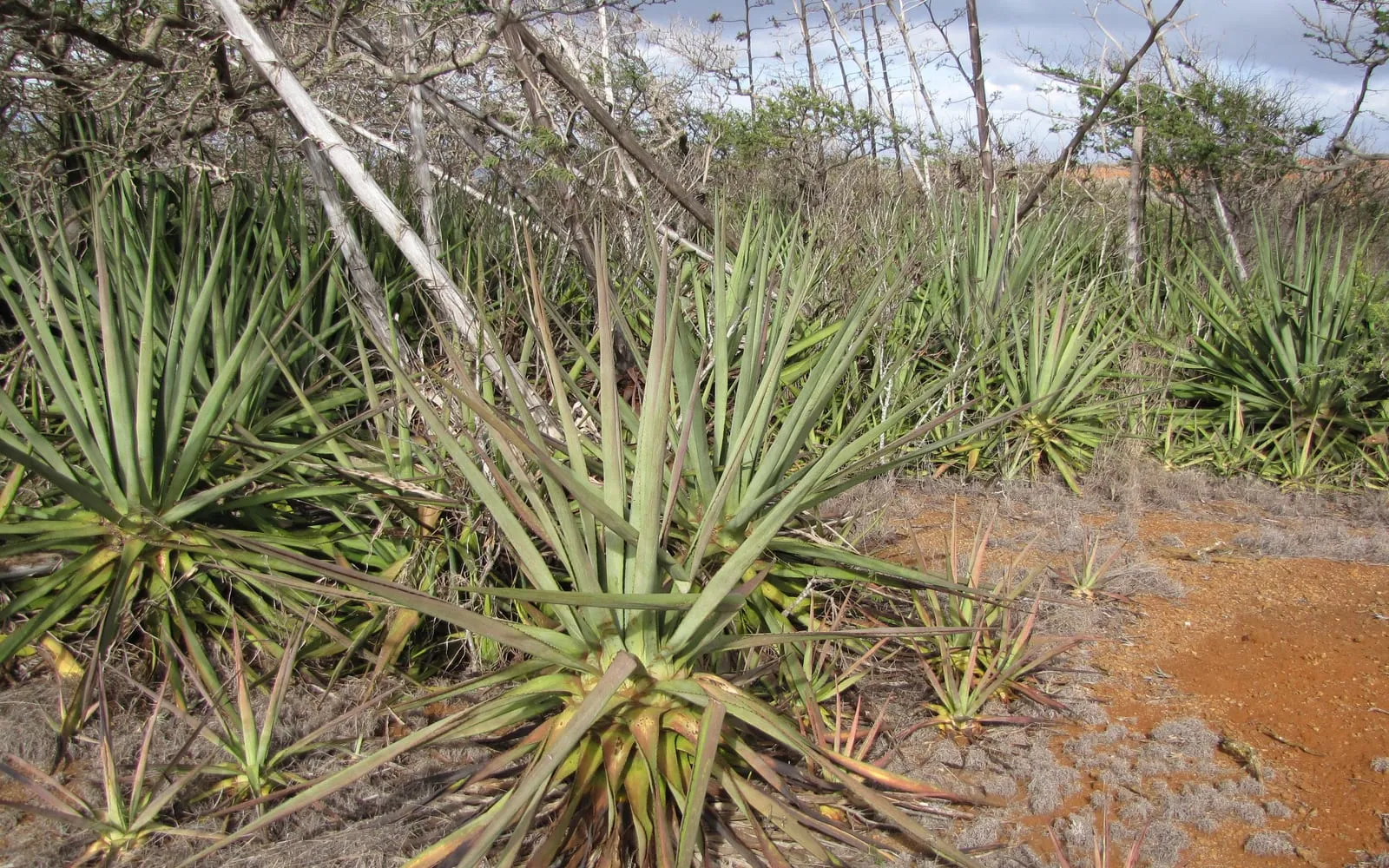
A large stiff rosette of sword-shaped leaves on a short thick trunk, reaching 1.5 to 2 m tall and as much across.
Leaves are 90 to 130 cm long and 10 to 15 cm wide, rigid, fleshy, dull grey-green to blue-green, tapering to a hard dark terminal spine.
Leaf margins on Agave sisalana are usually smooth or almost so, which separates it from most agaves and made it easier to handle in the field.
The plant is monocarpic. It grows for seven to ten years, then throws a single enormous flower pole and dies.
That pole is 5 to 6 m tall, branched at the top like a candelabra, carrying greenish yellow flowers.
Sisal rarely sets viable seed. Instead the flower pole produces thousands of bulbils, small complete plantlets that drop and root, and that is how the crop is propagated.
Suckers also come up around the base of an established plant and can be detached and grown on.
Cut a leaf and the flesh weeps a clear sap that irritates skin and eyes.
Where it is from
Agave sisalana comes from southern Mexico, most likely the Yucatan peninsula and Chiapas, and no wild population is known, which suggests it is a long-cultivated selection or a hybrid.
Mesoamerican peoples used agave fibre for cordage, nets and cloth for thousands of years, and the Yucatan henequen industry preceded the sisal one.
Plants were taken out of Mexico in the nineteenth century. Bulbils reached Florida, then German East Africa in the 1890s, and Tanzania became the world’s largest producer through the first half of the twentieth century.
Kenya, Brazil, Madagascar and China followed. Synthetic twine cut demand sharply from the 1960s and the industry contracted.
Brazil is now the leading producer, largely from smallholdings in the north east, and sisal has found new markets in composites, geotextiles and biodegradable packaging.
How it grows
Start from a bulbil or a sucker rather than seed, since sisal rarely sets viable seed.
Pot bulbils into gritty free-draining compost and keep them barely damp until they root.
Grow in a large container in Britain, in gritty compost with plenty of added grit or perlite.
Give full sun and as much heat as possible in summer.
Stand it outside from late May to September, in the hottest driest spot you have.
Water every two or three weeks in summer and stop entirely from October.
Keep it dry and frost free through winter. A cold greenhouse, a porch or a shed window all work, and wet cold is what kills it rather than cold alone.
Feed almost nothing.
Repot every three or four years into a slightly larger container.
Clip the terminal spines with secateurs if the plant stands where anyone will walk past it.
Expect a flower pole after seven to ten years in the tropics, and probably never in a temperate climate. If it comes, the plant will die afterwards and leave bulbils behind.
Through the seasons
Spring is for repotting, removing suckers and starting to water again.
Late May is when the pot can go outside.
Summer is the growing season, with a soak every two or three weeks and full sun.
September is when to reduce watering.
Early October is the point to bring it under cover, before the autumn rain starts.
Winter is a cold dry rest, with no water at all and no feeding.
Any year from the seventh onwards may bring the flower pole, which is the end of that plant and the start of its bulbils.
Care difficulty
Easy, provided winter wet is kept off it.
Full sun and sharp drainage are the whole requirement.
Cold alone does little harm down to about 5 deg C, and cold plus wet kills.
The spines are the practical difficulty, since a mature plant is dangerous to stand beside.
The sap is an irritant and any cutting is work for gloves and eye protection.
It grows slowly and needs almost nothing, which makes it a good plant for someone who forgets.
Watering
Water every two or three weeks through summer.
Soak the compost thoroughly, then let it dry out completely before watering again.
Stop watering entirely from October.
Give nothing at all through winter.
Keep rain off the crown in winter, since water sitting between the leaf bases is what starts crown rot.
Resume watering in April as growth restarts.
Warning signs, diseases and pests
Soft brown tissue at the centre of the rosette is crown rot from winter wet, and it is usually fatal.
Leaves that wrinkle and pucker lengthwise in summer mean the plant is short of water, which takes a long time to happen.
White waxy fluff at the leaf bases is mealybug.
Brown limpets on the older leaves are scale.
Black spotting on the leaves after a cold wet spell is cold damage.
A flower pole appearing means the plant is finishing, and the bulbils it produces are the next generation.
Puncture wounds from the terminal spines are slow to heal and worth taking seriously.
A rash appearing a day or two after cutting leaves is the sap rather than a delayed allergy to something else.
Coconut rhinoceros beetle also attacks sisal where it occurs. Native to Africa and tropical Asia, it has spread through much of the Pacific and continues gaining ground; clearing rotting plant debris nearby, where it breeds, is the main defence.
Growing environment
A large container that spends summer outdoors and winter under cover, or a sharply drained bed in the mildest coastal gardens.
Full sun.
Gritty free-draining compost with added grit or perlite.
Minimum about 5 deg C, kept dry.
Shelter from winter rain above all else.
Space away from paths, since the spines sit at eye height.
Gloves and eye protection to hand whenever it needs cutting.
Feeding
Feed a low-nitrogen cactus feed once or twice over the summer, or nothing at all.
Skip general fertiliser, which produces soft growth that rots.
Skip manure entirely.
Top dress with grit rather than compost.
Feed nothing from September to April.
Repot into fresh gritty compost every three or four years instead of feeding heavily.
Troubleshooting
Is sisal related to hemp? No. Sisal is an agave, a monocot succulent from Mexico. Hemp is Cannabis sativa. The old trade name sisal hemp records that both made rope, and nothing else.
Where does the fibre come from? The leaves, unlike jute, flax and hemp, which give fibre from the stem. Leaves are crushed and scraped to strip the flesh away, leaving long white strands.
Why did my plant flower and then die? That is what it does. Sisal is monocarpic, flowering once after seven to ten years and dying afterwards. The bulbils on the flower pole are the replacement.
What are the little plantlets on the flower stem? Bulbils. Sisal rarely sets viable seed and propagates from these instead. Pot them up and they will root.
Will it survive my winter? Only where winters stay frost-free. It takes about 5 deg C if kept dry and hard frost kills it, and winter wet kills it faster than cold does, so a mild damp region is no safer than a cold dry one.
Are the spines dangerous? The terminal spine is stiff, needle-sharp and at eye height on a mature plant. Clip the tips with secateurs if it stands anywhere near a path.
My skin blistered after cutting a leaf. The sap. It contains oxalate needles and saponins, and the reaction can appear a day or two later. Wear gloves, long sleeves and eye protection when cutting.
How is the fibre extracted? By decortication, crushing and scraping the leaf to remove the flesh. It is heavy work and it produces a great deal of waste for a small weight of fibre.
Can I grow it in the ground? In a very sharply drained bed in a mild coastal garden, possibly. Everywhere else in Britain it wants a pot that can come under cover for winter.
Sisal problem guides
Not sure what is wrong? See the common vegetable pests guide.