
Outdoor plant
Plumed Cockscomb
Celosia argentea
Also known as Celosia, Lagos Spinach, Silver Cockscomb, Quail Grass
How to grow plumed cockscomb, Celosia argentea, with feathery flame-coloured plumes and edible young leaves eaten in West Africa as Lagos spinach.
At a glance
- Difficulty
- Moderate
- Water
- Keep the soil evenly moist while in growth
- Light
- Full sun
- Temperature
- Frost-tender, and needs steady warmth to grow well
- Hardiness
- USDA 10-11, RHS H2, hardy to 4 C
- Type
- Tender annual, and a short-lived perennial only where winters are frost-free
- Height
- Up to 1 m
- Native to
- Tropical Africa, Tropical Asia
A tropical plant grown as a summer annual wherever the winter frosts. It survives outdoors year-round only in zones 10 and 11, and everywhere colder it is sown fresh each spring and discarded at the first frost. The winter matters less than the summer. It needs a long, warm growing season to build good plumes, and a cold check in a wet spring, or a spell below about 10 deg C, stalls it into a hard, stunted plant that rarely catches up.
Hardiness zones describe winter cold alone. Summer heat, humidity, rainfall and the length of the growing season decide as much, so treat the range as the outer limit rather than as a recommendation.
Not known to be toxic
- Safe to eat
- Young leaves and shoots, cooked as a green
Celosia is not listed as toxic by the ASPCA or the RHS. Across West Africa and parts of Asia the young leaves and shoots are a common cooked vegetable, known as Lagos spinach or soko, and the seed has a history of use in herbal medicine. Treat the ornamental plumes as you would any bedding plant, and if you grow it to eat, pick the young leaves instead of the flower heads.
Sources: RHS potentially harmful garden plants, ASPCA toxic and non-toxic plants
About
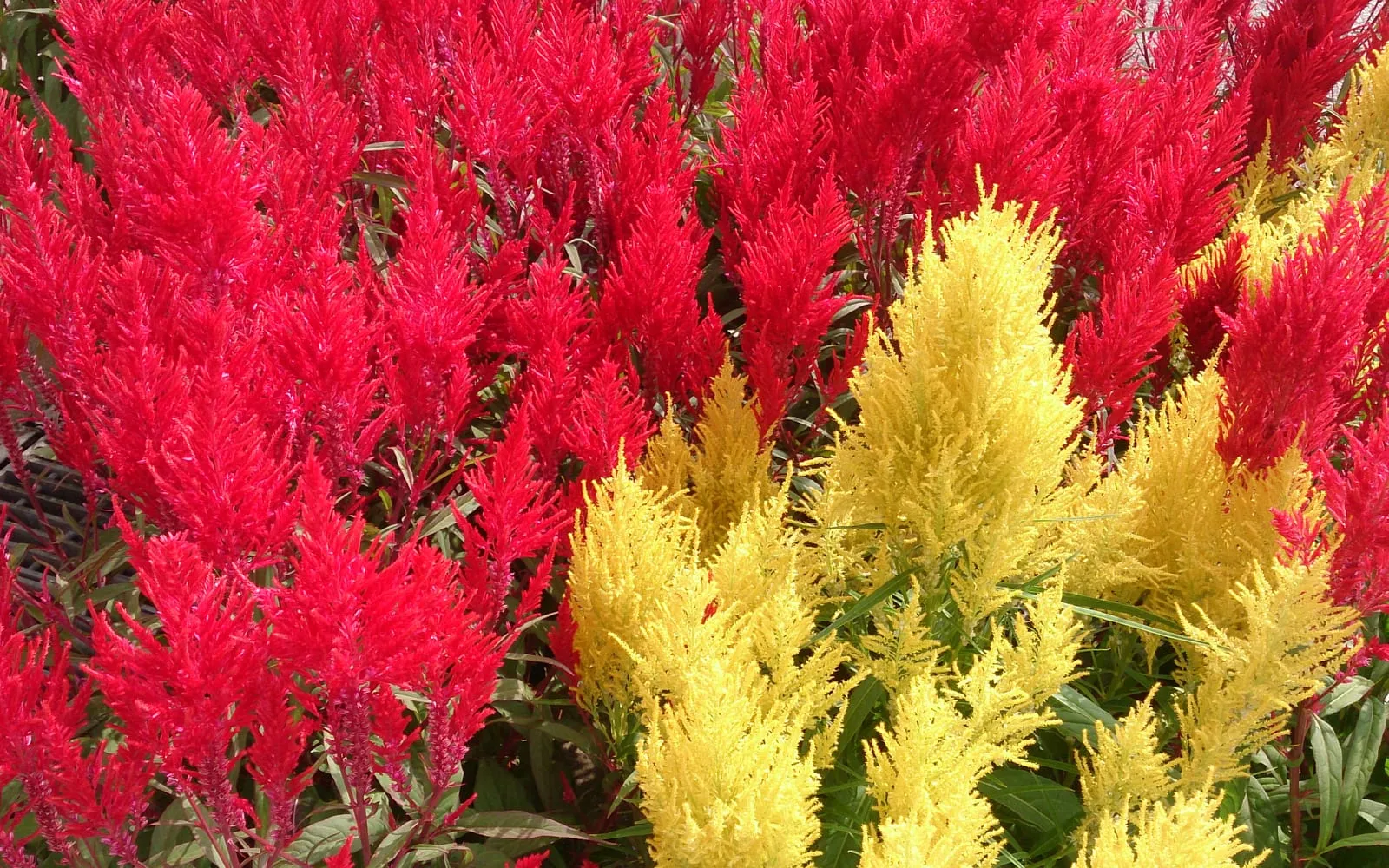
Plumed cockscomb is grown for tall, soft plumes in bright scarlet, orange, gold and cerise. They hold on the plant for weeks of high summer and dry well for winter arrangements. The wild plant is a slim silvery-pink spike; the garden forms are the result of long selection for size and colour.
It comes in two very different shapes from the same species. The Plumosa group carries the feathery plumes most people picture. The Cristata group carries the crested “cockscomb” head, a dense, folded, brain-like comb that people either love or dislike. Both are Celosia argentea, bred along separate lines.
The same species is also grown as a leaf vegetable. In West Africa it is a staple green called Lagos spinach or soko, grown for its young leaves rather than its flowers, and it is one of the more heat-tolerant greens a hot-climate kitchen garden can rely on.
Appearance and character
In the Plumosa group, the plumes are soft, branched, feathery spires ten to twenty centimetres tall, in saturated reds, oranges, yellows and pinks, the colour running down into the stems and often the foliage too.
The crested forms replace the plume with a solid, wavy comb, heavily folded and velvety, on top of the stem.
Leaves are lance-shaped and mid green, often flushed red or bronze in the brighter cultivars, carried up a fleshy, upright stem. The whole plant is bushy and stiff.
Height ranges widely by cultivar, from compact bedding types of twenty centimetres to border and cut-flower forms approaching a metre. Check the seed packet, because a 20 cm bedding plant and a 1 m cut-flower type need different positions.
Where it is from
Celosia argentea grows wild across tropical Africa and tropical Asia, in open, disturbed and cultivated ground, as a fast annual of the warm, bright rainy season. In cultivation, it needs heat, strong light, and a soil that is fertile and moist but never cold and sodden.
Its two uses developed in different parts of that range. The ornamental plumes were selected largely in Asia and the West, while the leaf-vegetable tradition is common in Nigeria and neighbouring countries, where the plant is valued for cropping in heat that wilts many other greens.
How it grows
Sow seed in warmth in spring, around 18 to 24 deg C, on the surface of moist compost, since the fine seed needs light to germinate and only a dusting of vermiculite over it. Do not sow cold. Seedlings that sit chilly and wet damp off or check badly.
Grow the young plants on without a setback. Any cold snap, root disturbance or spell of dryness while they are small can cause early, stunted flowering on a plant that never bulks up, which is the commonest disappointment with celosia.
Plant out only once the nights are reliably warm and all frost has passed, spacing them by height, in the sunniest, most sheltered bed you have. In a cool summer they are better under glass or in pots that can be moved into warmth.
Pinch the growing tip of plume types early if you want a bushier plant with more, smaller heads, or leave it for one large central plume. Deadhead spent plumes to keep the plant tidy and prolong the display, or leave a few to cut and dry.
Through the seasons
Spring is for sowing under warm cover and growing the plants on steadily, never letting them chill or dry out.
Early summer is planting-out time, once frost is past and the soil has warmed, into full sun.
High summer is the main display, with the plumes colouring up and holding for weeks in the heat. This is when the plant is strongest and most drought-resilient.
Autumn ends it. The first frost kills the plant outright, so cut plumes to dry before then and clear the spent plants, sowing fresh next year.
Care difficulty
Straightforward once it is warm, and easy to get wrong before then. There is nothing difficult about a well-grown celosia in summer heat: it is drought- tolerant, long-flowering and usually trouble-free. The early weeks need the most care. Keep the seedlings warm, evenly moist and growing steadily, because a checked plant flowers small and stops.
Watering
Keep the soil or compost evenly moist while the plants are growing and flowering, watering regularly in warm weather without letting the roots stand wet. An established plant in the ground copes with short dry spells better than most bedding, but pots dry fast in summer sun and need daily attention in a heat wave.
Water in the morning and aim at the soil instead of the plumes, which can spot or rot if they stay wet in still, humid air.
Warning signs, diseases and pests
Aphids gather on the soft growing tips, particularly on plants raised under glass, distorting new growth and leaving sticky honeydew. Dislodge light infestations with water or a soft cloth and encourage the ladybirds and hoverflies that feed on them outdoors.
Red spider mite is a glasshouse problem in hot, dry air, stippling the leaves pale and spinning fine webbing on the undersides. Raising the humidity and improving ventilation discourages it.
Damping off flattens seedlings that were sown too cold, too wet or too thickly, the stems collapsing at soil level. Sow thinly in warmth, use fresh compost and water from below to prevent it, since there is no cure once a seedling collapses.
Root rot follows cold, waterlogged soil, which this plant will not tolerate. Improve drainage, and never plant out into cold, wet spring ground.
Growing environment
Give it full sun all day. In shade the plumes are sparse, the colours dull and the stems weak and leaning.
Warmth matters as much as light. It performs best where summers are hot, and in a cool maritime summer it is more reliable in a greenhouse, a polytunnel or a pot on a warm patio than in an open border.
The soil should be fertile and hold moisture yet drain freely. Dig in compost before planting, and avoid heavy, cold clay that stays wet in spring.
Shelter from strong wind keeps the brittle, top-heavy stems upright and stops the plumes shredding.
Feeding
Feed every two to three weeks through summer with a balanced liquid fertiliser, easing off the nitrogen once the plants are established. Too much nitrogen builds lush leaf at the expense of the plumes and leaves the plant more prone to pests.
A tomato feed or another high-potassium fertiliser once the flower heads start to form supports strong, well-coloured plumes. Plants in pots need feeding more often than those in the ground, since watering washes nutrients through the limited compost.
Where the plant is grown for leaves instead, use a nitrogen-richer general feed, and pick young leaves regularly to keep fresh growth coming.
Troubleshooting
It flowered tiny and then stopped growing. A cold or dry check while young, almost always. Celosia that is chilled, dried out or disturbed as a seedling can flower early, stay stunted and rarely recover. Sow later into reliable warmth and grow the plants on without any setback.
The seedlings collapsed at the base. Damping off, from sowing too cold, too wet or too crowded. Start again with fresh compost, sow thinly in warmth, and water from below.
The stems are floppy and the colour is poor. Not enough sun. This is a full-sun plant, and in shade it grows weak, pale and leaning. Move it to the brightest spot you have.
Can I eat it? Yes. The young leaves and shoots are a cooked green across West Africa and Asia. Pick them young and tender from a plant you have grown without pesticides, and cook them as you would spinach instead of eating them raw.
Can I keep it over winter? Only where it never frosts. Everywhere else it is an annual, killed by the first frost, so save or buy fresh seed and start again each spring. It is closely related to the leafy Chinese spinach, another warm-season annual grown the same way.