
Outdoor plant
Chusan Palm
Trachycarpus fortunei
Also known as Windmill Palm, Chinese Windmill Palm
Practical guidance for growing chusan palm, Trachycarpus fortunei, including exceptional cold hardiness, fan fronds, hairy fibrous trunk, red palm weevil, and slow early establishment.
At a glance
- Difficulty
- Easy
- Water
- Regularly while young and rooting in, then tolerant of both drought and rain once established
- Light
- Full sun to light shade
- Temperature
- The hardiest palm in general cultivation; established trunks take brief hard frost
- Hardiness
- USDA 7-11, RHS H4-H5, hardy to -15 C
- Type
- Evergreen fan palm, slow while young and then steady
- Height
- 6-12 m, occasionally more with great age
- Native to
- eastern Asia
Cold hardiness this far beyond every other widely grown palm comes from its origin in mountain country rather than the tropical lowlands most palms grow in, so the zone number carries real weight here rather than the usual caveat. A hot, humid summer still helps a young trunk fill out faster, and a cool maritime summer only slows growth rather than threatening the plant the way winter cold does for most other palm species.
Hardiness zones describe winter cold alone. Summer heat, humidity, rainfall and the length of the growing season decide as much, so treat the range as the outer limit rather than as a recommendation.
Not known to be toxic
Chusan palm does not appear on the RHS potentially harmful plants index or the ASPCA toxic plant database, and no toxic compound is documented in its fronds, fruit or fibrous trunk covering. The small blue-black fruit that follows flowering is not eaten by people but is not documented as harmful either, and the coarse trunk fibre is a handling nuisance rather than a chemical hazard. This is a palm you can grow without factoring pets or small children into the decision.
Sources: RHS potentially harmful garden plants, ASPCA toxic and non-toxic plants
About
Chusan palm is the palm that made a real palm tree possible in gardens far outside the tropics, hardy enough to survive winters that kill almost every other species in the family outright. A mature specimen carries a trunk wrapped in coarse brown fibre and a crown of stiff, rounded fan fronds that look tropical in a temperate garden.
Establishment is the slow part. A young plant spends its first years building a root system and a trunk base below or close to ground level before height gain becomes obvious, and gardeners new to the species often assume a plant has stalled when it has not yet started the visible part of its growth at all.
Appearance and character
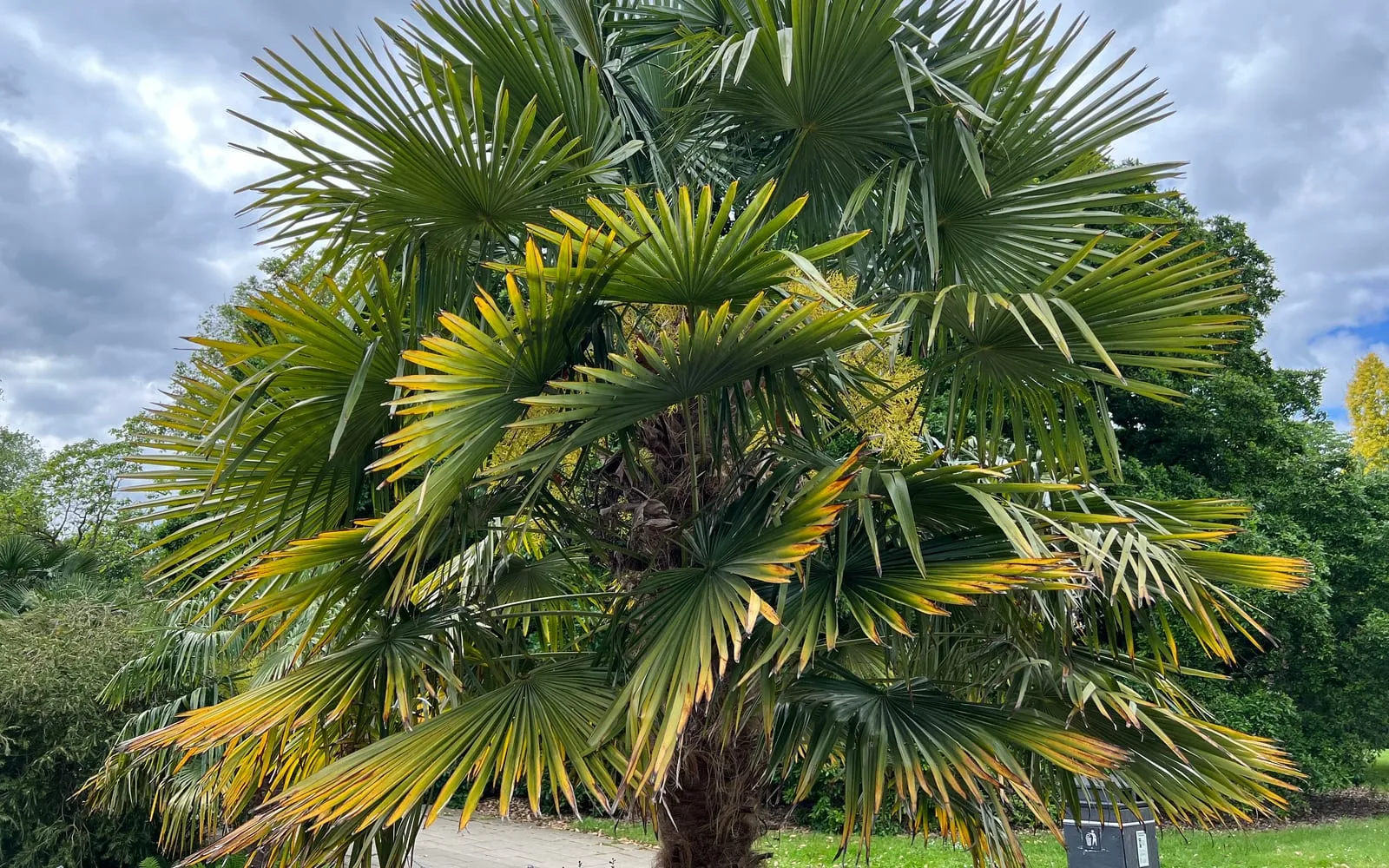
The fronds are deeply divided fans, stiff and rounded, dark green above and somewhat greyer beneath, held on long, toothed petioles that arch out from the crown in a full circle.
The trunk is the plant’s most distinctive feature, densely wrapped in a thick layer of coarse, hairy black-brown fibre, the remains of old leaf bases, that thins and reveals a smoother grey trunk lower down on very old specimens. Small, cream-yellow flower clusters appear among the fronds in spring, followed on female plants by clusters of small blue-black fruit.
Where it is from
Trachycarpus fortunei is native to mountainous parts of central and southern China, including the Zhoushan archipelago from which the common name Chusan derives, and neighbouring parts of Myanmar, growing at elevations up to around 2,400 m where winters carry real cold and snow.
That montane origin explains the palm’s unusual cold tolerance. Most palm species evolved in warm, frost-free lowlands, but this one grows where snow is a regular winter feature, and the trunk fibre and compact growing point both help it tolerate cold that would kill a tropical palm outright.
How it grows
Plant in any reasonably fertile, well-drained soil in full sun or light shade, watering regularly through the first two or three years while the root system and trunk base establish below ground.
Growth above ground is slow at first and speeds up once a visible trunk begins to form, typically after several years, at which point a well-sited plant can gain 15 to 30 cm of trunk height a year in a favourable climate.
Remove dead fronds by cutting close to the trunk rather than pulling, which can tear living tissue. Leaving some of the fibrous leaf-base covering on the trunk is fine and does no harm, though some gardeners trim it for a tidier look.
Through the seasons
Spring brings new frond growth and, on a mature plant, small flower clusters among the crown.
Summer is the main growing season, with heat and humidity encouraging the fastest trunk gain of the year.
Autumn is a reasonable time to plant, giving roots a season to settle before winter cold arrives.
Winter brings the palm’s real test in a cold climate. Established trunks tolerate hard frost, though a young plant benefits from a dry mulch around its base and, in the coldest gardens, some protection for the crown on the harshest nights.
Care difficulty
Easy, and largely a matter of patience during the slow early years rather than any ongoing labour. Once a trunk has begun to form, this is one of the lowest-maintenance palms available in a temperate garden, tolerant of a wide range of soils and weather that would trouble most other palm species.
The main risks are waterlogged winter soil around the roots and, in regions where it has become established, red palm weevil, which is a far more serious threat to a mature trunk than the cold ever is.
Watering
Water regularly through the first few growing seasons while the root system establishes, particularly in dry weather.
An established chusan palm tolerates both summer drought and a wet climate reasonably well, provided the soil drains adequately over winter. Consistently waterlogged ground around the roots in cold, wet weather is more likely to cause problems than either drought or frost.
Warning signs, diseases and pests
Red palm weevil is a serious and spreading pest of Trachycarpus in parts of southern Europe and the Mediterranean, boring into the crown and often going unnoticed until the growing point collapses. There is no reliable cure once a trunk is badly infested, and local advisory bodies should be consulted for management where the pest is known to be present.
Scale insects appear as small bumps on the fronds and among the trunk fibre, sapping vigour over time. Horticultural oil during the growing season controls a light infestation.
Spider mite thrives in hot, dry conditions, showing as fine speckling on the fronds. Raising humidity around the crown and hosing the foliage down helps prevent it.
Root rot follows waterlogged soil, particularly in winter, showing as yellowing fronds and a soft, collapsing crown. Improving drainage is the only real prevention, since there is little that can be done once it has taken hold.
Growing environment
Full sun brings the fastest, sturdiest growth, though the species tolerates light shade reasonably well, particularly while young.
Almost any reasonably drained soil suits it, from sandy ground to clay loam, provided winter waterlogging is avoided. It also tolerates urban pollution and some coastal exposure well.
Shelter from the coldest winter wind helps a young plant through its first few winters, though a mature, established trunk needs comparatively little protection even in a cold climate.
Feeding
Feed with a balanced palm fertiliser, ideally one formulated with added magnesium and manganese, once or twice during the growing season.
A palm deficient in magnesium or manganese shows characteristic yellowing or banding on older fronds, and a proper palm feed corrects this far more reliably than a general garden fertiliser, which is often poorly balanced for a palm’s particular nutrient needs.
Troubleshooting
The plant has not gained any visible height in several years. This is normal in the early establishment phase, when the plant is building a root system and trunk base below or close to ground level. Visible height gain usually begins once that base is established.
Fronds are yellowing and the crown looks soft. Check for waterlogged soil first, particularly after a wet winter, since root rot is the most common cause. If the crown itself feels soft or collapses, red palm weevil is a possibility that needs urgent investigation in regions where it occurs.
Older fronds have yellow or orange banding. This usually points to a magnesium or manganese deficiency rather than disease. Switch to a balanced palm fertiliser with both nutrients included.
Can it survive snow? Established trees regularly do, provided the crown is not physically weighed down and torn by heavy, wet snow. Knock heavy snow off the fronds where it is safe to do so rather than leaving it to bend and split them.
How cold can it take? Established trunks have survived briefly well below minus 15 C in documented cases, though damage to the fronds is likely at the lower end of that range even where the trunk itself survives. A young, newly planted palm is considerably less cold-tolerant than an established one.