
Outdoor plant
Chinese Ephedra
Ephedra sinica
Also known as Ma huang, Chinese joint fir, Ephedra
How to recognise Ephedra sinica, the gymnosperm behind ephedrine. Jointed green stems and no real leaves, the regulatory position in Britain, and why the supplements were banned.
At a glance
- Difficulty
- Moderate
- Water
- Rarely. It is a desert plant
- Light
- Full sun
- Temperature
- Fully hardy, to about minus 25 deg C
- Hardiness
- USDA 4-8, RHS H6, hardy to -25 C
- Type
- Hardy evergreen shrub, gymnosperm rather than flowering plant
- Height
- 20-50 cm
- Native to
- Mongolia, Inner Mongolia, northern China
Dry cold continental conditions are what it wants, with sharp drainage and a winter that stays dry, and it rots in a wet mild one. The legal position matters more than the horticultural one. Ephedrine-containing supplements are banned or restricted across the United States, Britain, the EU and Australia, so growing it is one thing and using it is another.
Hardiness zones describe winter cold alone. Summer heat, humidity, rainfall and the length of the growing season decide as much, so treat the range as the outer limit rather than as a recommendation.
Poisonous if eaten
- Do not eat
- The green stems, which carry the alkaloids
- Harm from
- Eating it
- Affects
- People
Ephedra sinica contains ephedrine and pseudoephedrine, both pharmacologically powerful stimulants that raise blood pressure and heart rate. LiverTox, the United States National Library of Medicine reference on drug-induced liver injury, carries a monograph on ephedra recording both liver injury and the wider safety record. The United States Food and Drug Administration banned dietary supplements containing ephedrine alkaloids in 2004 after reports of heart attack, stroke, seizure and death, most of them in people using the products for weight loss or athletic performance. In Britain the alkaloids are regulated as medicines rather than sold freely. Ephedrine and pseudoephedrine are controlled as drug precursors, pharmacy sales of pseudoephedrine products are restricted by quantity, and ephedra herb is not something that can be sold as an unlicensed herbal remedy. Ephedrine is also prohibited in competitive sport above a threshold concentration. Nobody should be preparing stems from a rock garden plant. Growing the shrub carries no risk in itself.
Sources: LiverTox, Ephedra, Controlled drugs list, RHS potentially harmful garden plants, ASPCA toxic and non-toxic plants, NHS on herbal medicines
About
Ephedra is not a flowering plant. It is a gymnosperm, in the same broad group as conifers and cycads, and it belongs to a small ancient lineage of three genera that sit on their own branch of the plant family tree. The green stems do the photosynthesis, the leaves are reduced to tiny scales at each joint, and the reproductive structures are cones rather than flowers.
Ma huang has been in Chinese medicine for two thousand years and is one of the plants that produced a modern drug directly. Ephedrine was isolated from it by Nagai Nagayoshi in 1885 and became a mainstay of asthma treatment before selective inhaled drugs replaced it, and pseudoephedrine remains in decongestants sold today.
The plant itself is a tough low desert shrub that grows well in a rock garden given sharp drainage and full sun. This guide is written for identification and for growing it as the curious ancient plant it is, since its chemistry is regulated and nobody should be experimenting with the stems.
Appearance and character
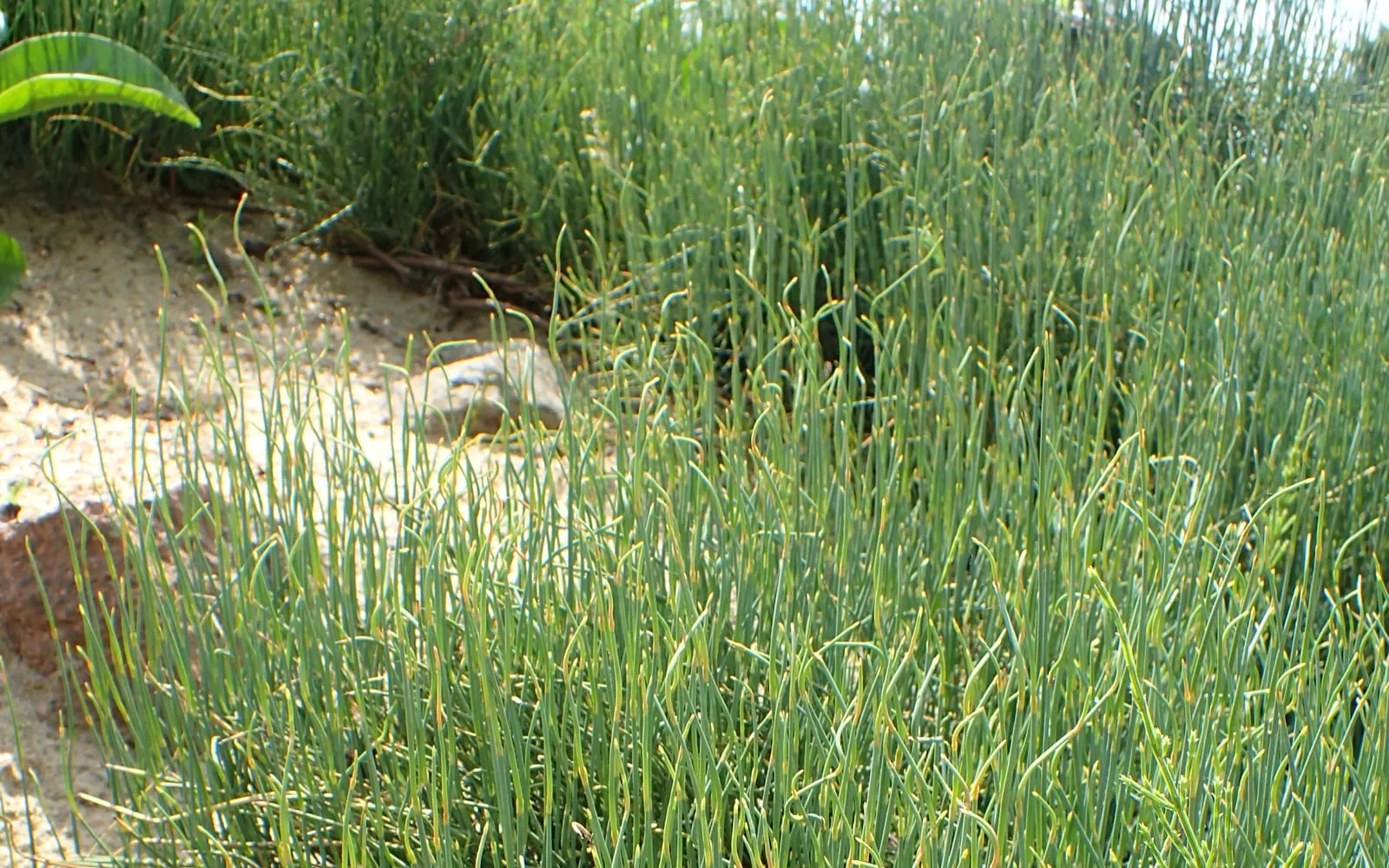
The plant makes a dense tuft of slender green stems, 1 to 2 mm thick, ridged lengthwise, jointed at intervals of 2 to 4 cm, growing upright from a woody base. The overall effect is of a stiff green broom or a clump of horsetail, and the two are often confused.
Leaves are reduced to tiny brown scales in opposite pairs at each joint, easy to miss and diagnostic when found. The plant photosynthesises entirely through its stems, which is the desert adaptation.
Reproduction is by cones rather than flowers, with male and female on separate plants. Male cones are small and yellowish, and female cones ripen into fleshy red structures about 6 to 10 mm long that look like small berries and contain one or two seeds.
Where it is from
Ephedra sinica grows in the dry steppe and semi-desert of Mongolia, Inner Mongolia and northern China, on sandy and stony ground, often on dunes, at altitudes from 700 to 1600 m.
The climate is extreme in both directions, with hot dry summers and winters well below minus 20 deg C, and almost no summer rain. The plant is adapted to that combination, which is why it is hardy in a cold climate and why it dies in wet soil.
Wild collection for the herb trade has been heavy enough that harvest is restricted in China and Mongolia, where the plant is also valued for stabilising sand. The genus is widespread, with species in the Mediterranean, the Americas and central Asia, and their alkaloid content varies enormously.
How it grows
Growth is slow and steady. The plant makes a low clump that widens over years, spreading a little by underground stems, and it is long-lived once settled.
New green shoots appear from the base and from the joints of older stems in spring, extending through the summer. The older stems become woody and brown at the base and stay as a framework.
Propagation is by seed, which germinates without pretreatment in warm gritty compost, or by division of an established clump in spring. Neither is fast, and plants take several years to reach any size.
Through the seasons
Green shoots extend from April through the summer, and the plant looks much the same all year since it is evergreen and has no real leaves to lose.
Cones appear in spring on mature plants, with male and female on separate individuals, and red fleshy female cones ripen through the summer where both sexes are present.
The plant must be kept dry at the root through the winter, which in a wet climate means a gravel bed, a raised bed, a crevice or a pot under cover. Wet soil in January kills more ephedras than any frost.
Care difficulty
Moderate, and everything hinges on drainage. Ephedra sinica is hardy to about minus 25 deg C and it rots in ordinary garden soil over a wet winter.
The right home is a gravel garden, a scree bed, a crevice garden or an alpine house. Coarse grit, a slope, and no mulch around the crown. It also does well in a deep pot of gritty compost kept under an open-sided cover in winter.
The plant is otherwise undemanding. It needs no feeding, no pruning and no watering once established, and it has almost no pests.
Watering
Almost none. Water a new plant occasionally through its first summer to settle it, then leave it alone.
An established plant in a gravel bed needs nothing in a temperate climate. It comes from a place with almost no summer rain and it is better adapted to drought than to anything else in this collection.
Keep it dry in winter. A pane of glass over an alpine specimen from November to March is a standard technique and it works.
Warning signs, diseases and pests
Root rot is the disease that kills it, and the sign is stems that yellow and then brown from the base upward through a wet spell. By then the roots have gone.
Slugs graze soft new spring growth and rarely matter on an established clump. Nothing else takes much interest.
The other thing worth watching is identification. Several ornamental Ephedra species are sold for rock gardens, they look similar, and their alkaloid contents differ enormously, with some species carrying almost none. A plant bought as ephedra is not necessarily this one.
Growing environment
Full sun in the most open position available. This is a desert plant and it needs light and air movement.
Soil should be sharply drained sand or gravel, poor and preferably alkaline. Add coarse grit generously, plant on a slope or in a raised bed, and top-dress with gravel rather than with organic mulch.
Cold is not a concern. The plant survives minus 25 deg C in dry ground. The combination of cold and wet is what kills it.
Feeding
None. The plant grows on sand in semi-desert and feeding produces soft growth that rots.
Organic mulches are a mistake around the crown, since they hold moisture exactly where the plant does not want it. Gravel is the correct top dressing.
If a plant is struggling, fix drainage before nutrition.
Troubleshooting
Is it legal to grow? In Britain, yes. There is no restriction on growing the plant. The regulation applies to the alkaloids and to what can be sold, so ephedrine and pseudoephedrine are controlled as medicines and precursors, and ephedra herb cannot be sold as an unlicensed herbal remedy. Other countries draw the line in different places, and some restrict the plant itself rather than only what is extracted from it, so check with your own national medicines regulator before growing or selling it.
Why were the supplements banned in America? After reports of heart attack, stroke, seizure and death among people taking ephedrine-alkaloid supplements for weight loss and athletic performance, the Food and Drug Administration banned them in 2004.
Is it a conifer? Not quite, though it is a gymnosperm, in the same broad group as conifers and cycads. Ephedra sits in its own small ancient lineage, the Gnetales, and reproduces by cones rather than flowers.
Is it the same as horsetail? No, though they look alike. Horsetail is Equisetum, a spore-bearing plant with no seeds at all, and it has whorls of tiny teeth at each joint. Ephedra is a seed plant with paired brown scale leaves.
Why did my plant die over winter? Wet soil almost certainly. It survives minus 25 deg C in dry ground and rots at zero in wet. A gravel bed, a raised bed or a pane of glass overhead all solve it.
Are all ephedras the same? No. Alkaloid content varies enormously across the genus, and several species sold for rock gardens contain very little. A plant labelled ephedra is not necessarily Ephedra sinica.
Can I make tea from the stems? No. The alkaloids are powerful stimulants with a documented record of cardiac harm, the concentration in a garden plant is unknown, and their sale as a herbal remedy is restricted in Britain for those reasons.