
Outdoor plant
Winter Daphne
Daphne odora
Also known as Fragrant Daphne
Practical guidance for growing winter daphne, Daphne odora, including its severe toxicity, sudden root rot collapse, planting depth, winter scent, and shade requirements.
At a glance
- Difficulty
- Moderate
- Water
- Moderate and even, letting the surface dry between waterings
- Light
- Partial shade, sheltered from midday sun and cold wind
- Temperature
- Hardy to about -10 deg C once established; young plants need frost protection
- Hardiness
- USDA 7-9, RHS H4, hardy to -10 C
- Type
- Evergreen shrub
- Height
- 1-1.5 m
- Native to
- China, Japan
The zone range describes what an established plant survives rather than what it enjoys. Daphne odora comes from a climate with mild, wet winters and warm, humid summers, and it dislikes both a hard freeze that follows a sudden thaw and a baking, dry summer more than the raw cold number suggests. Reliable drainage through the wettest months of the year does more for its survival than the zone rating on its own.
Hardiness zones describe winter cold alone. Summer heat, humidity, rainfall and the length of the growing season decide as much, so treat the range as the outer limit rather than as a recommendation.
Poisonous if eaten
- Do not eat
- Every part, and the sap, bark and berries most of all
- Harm from
- Eating it, handling it and sap in the eyes
- Affects
- People, cats, dogs and horses
Daphne odora carries daphnetoxin and mezerein, diterpene esters present throughout the plant and concentrated in the sap, bark and small orange-red berries. A handful of berries has caused fatal poisoning in a small child, and the RHS lists the whole Daphne genus as toxic if eaten and a skin irritant serious enough to warrant gloves and other protective equipment when pruning. Eating any part causes burning and blistering of the mouth and throat, vomiting, abdominal pain and diarrhoea that can turn bloody in a bad case, and a large dose affects the heart and nervous system. Sap on skin raises blisters within hours, and a splash in the eye causes severe irritation that needs rinsing and medical attention. The ASPCA lists daphne as toxic to dogs, cats and horses with the same blistering and gastrointestinal effects. Site it away from a path where a toddler plays and out of reach of a dog that eats fallen berries, and prune it in gloves and covered sleeves rather than bare skin.
Sources: RHS potentially harmful garden plants, ASPCA toxic and non-toxic plants
About
Winter daphne flowers when almost nothing else in the garden does, opening small waxy clusters from midwinter into early spring and filling the air around it with a scent that carries for metres on a still day. Gardeners plant it by a door or along a path they walk in winter for that reason alone.
It is also one of the more temperamental shrubs sold at a garden centre. A plant that looked perfectly healthy in autumn can collapse and die within days the following spring, almost always because its roots sat in wet soil over winter. Getting the drainage right on the day it goes into the ground does more for its long-term survival than anything done afterwards.
Every part of it is poisonous, more so than most shrubs commonly sold for a garden border, and that risk sits alongside the scent as something to plan around before buying rather than discover afterwards.
Appearance and character
Leaves are leathery, glossy and dark green, oval and 5 to 8 cm long, held densely on the stems all year. Several variegated cultivars carry a narrow cream margin around each leaf, which brightens the shrub through the months it is not in flower and, in most growers’ experience, also grows a little faster and tolerates more sun than the plain green form.
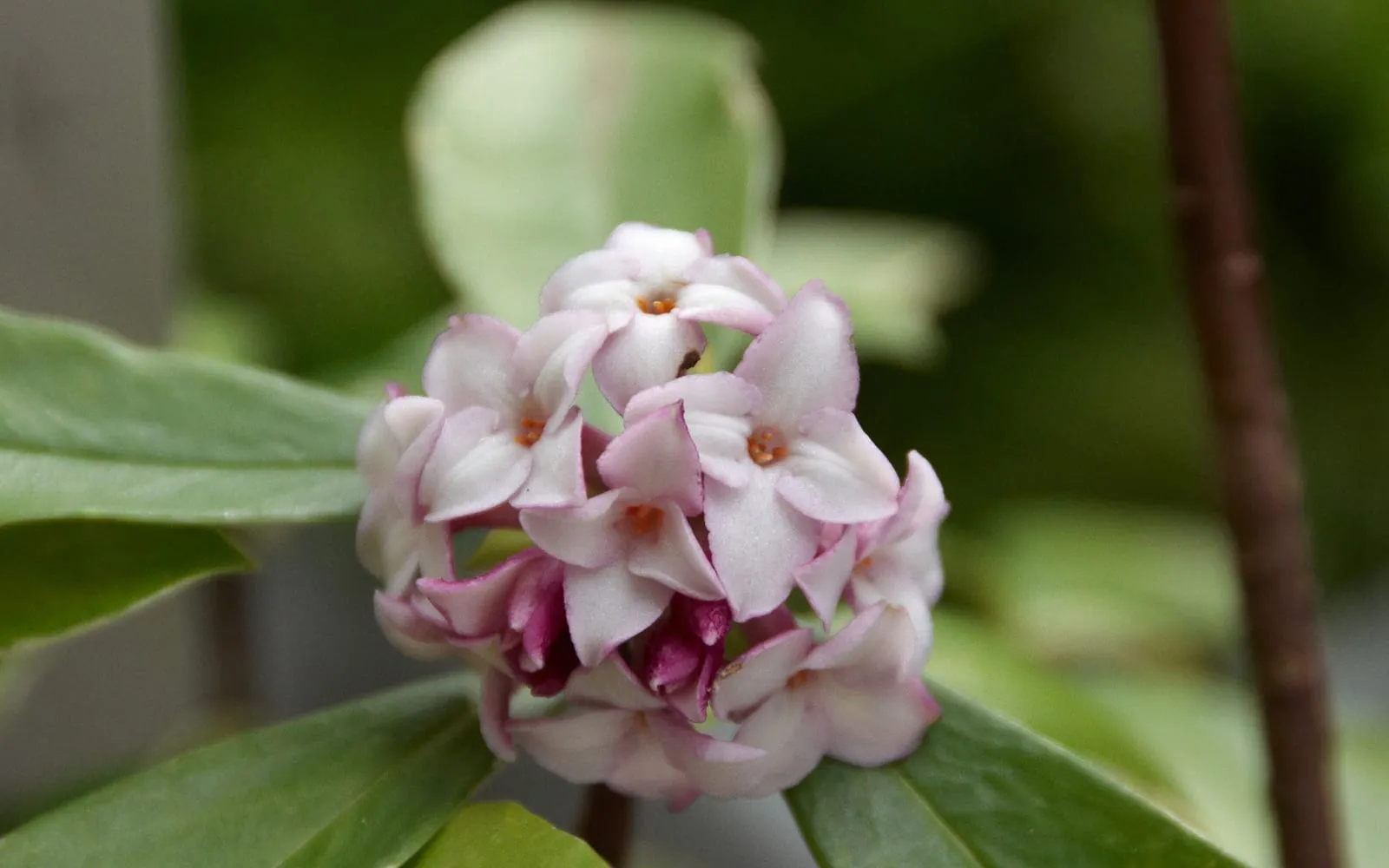
Flowers open in tight clusters of ten to thirty tiny tubular blooms, pink to purple on the outside and white within, with a thick, waxy texture that holds up through frost and rain alike. The scent is disproportionate to the size of the flower, sweet and carrying, and strongest on a still, damp day.
Small orange-red berries can follow flowering, though many of the named cultivars sold in garden centres set fruit rarely or not at all. Where berries do form, they are the most concentrated source of the plant’s toxins. Remove them if children or pets have access to the shrub.
Where it is from
Daphne odora is native to woodland in China and has been cultivated in Japanese gardens for so long that some populations there are now treated as naturalised. Wild plants grow in the dappled shade of a forest understorey, rooting into leaf-littered, humus-rich soil that drains fast after rain and never sits wet for long.
Its woodland habitat points to the two requirements that trip gardeners up. Light shade suits it far better than open sun, which scorches the leaves and dries the shallow root system too quickly. Drainage has to be sharp even where the soil is otherwise fertile, because standing water rots the roots.
How it grows
Choose a site in partial shade, sheltered from cold, drying wind and from the full force of the midday sun, and work grit or coarse organic matter into heavy soil before planting. Set the rootball at the same depth it sat in its pot; planting a daphne even a few centimetres too deep is a common and often fatal mistake, since buried stem tissue rots faster than roots recover.
Water it in well and then let it settle without further disturbance. Growth is slow and the plant resents having its roots interfered with once established, so buying a specimen close to the size you want, rather than a young plant to grow on and move later, avoids a setback few daphnes tolerate off easily.
Mulch around the base every spring with well-rotted leaf mould or compost, kept clear of the stems, to keep the roots cool and to feed the soil without disturbing them directly.
Through the seasons
Winter is the flowering season, from December into February depending on climate, and the best time to enjoy the scent close to a path or door.
Spring brings the flowers to an end and the start of new growth. Any light shaping, kept to a minimum, is best done just after flowering finishes.
Summer is quiet growth. Watch the balance between drought stress and waterlogging, since this is the season a badly drained site shows its problems most clearly.
Autumn is a good time to plant a new specimen, while the soil is still warm enough for roots to establish before winter.
Care difficulty
Moderate, mainly because planting has to be right. A daphne set at the right depth in soil that drains fast needs little routine attention afterwards. It needs no hard pruning, no repeated feeding and no training. Sudden collapse from wet roots is the main risk, and planting controls most of that risk.
Watering
Water moderately and evenly while the plant establishes over its first two seasons, giving it a deep soak rather than frequent light watering, and letting the surface dry before watering again.
Once established, a daphne in a well-drained bed rarely needs supplementary water outside an extended dry spell. The greater risk by far is too much water rather than too little, particularly through a wet winter when the plant is not actively growing and cannot use what the soil holds.
Warning signs, diseases and pests
Root rot is the shrub’s best-known failure, striking with little visible warning beyond a sudden wilting and browning of the whole plant, usually following a wet winter or a spell of poor drainage. There is no reliable cure once it takes hold; prevention through sharp drainage at planting is the only dependable defence.
Waterlogging is the underlying condition that lets root rot take hold, so treat standing water around the base after heavy rain as an early warning rather than something to wait out.
Scale insects appear as small, flattened brown bumps along the stems and on the underside of leaves, feeding on sap and leaving a sticky residue behind them. Wipe them off by hand on a small plant, or treat with horticultural oil on a larger infestation.
Aphids sometimes cluster on the soft tips of new growth in spring. They rarely do lasting harm on an established shrub and wash off with a strong jet of water.
Growing environment
Partial shade suits it best, whether dappled shade under taller trees or the shaded side of a building, with shelter from cold wind and from the harshest midday sun.
Soil needs to be humus-rich and moisture-retentive without ever becoming waterlogged. On heavy clay, plant in a raised bed or mound and work in plenty of grit rather than fighting the native drainage.
Mulch the root zone every year, both to feed the soil and to buffer the shallow roots against temperature swings, keeping the mulch clear of the stems themselves.
Feeding
Apply a balanced, slow-release fertiliser, or one formulated for acid-loving shrubs, once in spring as growth resumes.
This is not a hungry plant, and an annual mulch of leaf mould or compost supplies most of the fertility it needs beyond that single spring application.
Avoid high-nitrogen feeds, which push soft, sappy growth that is both more vulnerable to frost damage and, on a plant already inclined to fail suddenly, an added strain on a root system that would rather grow slowly.
Troubleshooting
My daphne died suddenly with no warning. Root rot from wet soil is by far the likeliest cause, especially after a wet winter or on heavy ground. There is no recovery once the roots have gone; improve the drainage before replacing it, ideally by planting the new one in a raised, gritty bed.
Why has it never flowered? Most often a plant that is still young, or one that is getting too much shade and too much nitrogen-rich feed, both of which favour leafy growth over flower buds. Patience and a lighter feeding hand usually resolve it within a season or two.
Is it safe to grow where a dog chews things in the garden? Treat it as a genuine hazard rather than a minor one. Every part is toxic enough to cause real harm, and a dog that regularly chews fallen leaves or berries is a real risk. Fence the base or choose a different shrub for that spot.
Can I move it once it is established? Better not to. Daphnes resent root disturbance more than most shrubs, and a mature plant moved to a new spot often fails outright rather than merely sulking. Starting a new plant in the right place gives a more reliable result than transplanting an old one.
The leaves are yellowing and dropping. Check watering first, since both drought and waterlogging show up this way, then check planting depth if the plant is young. A daphne set too deep often struggles for a season or two before the underlying problem becomes obvious.