
Outdoor plant
Creeping Phlox
Phlox subulata
Also known as Moss phlox, Moss pink, Mountain phlox
How to grow creeping phlox, Phlox subulata. Its needle-like winter foliage from a species name that means awl-shaped, the mildew risk of a woodland-edge native in a still garden corner, and shearing after bloom.
At a glance
- Difficulty
- Easy
- Water
- Regular watering while establishing; moderate drought tolerance once mature
- Light
- Full sun
- Temperature
- Cool to warm temperate; tolerates hot summers better than most alpine cushion plants
- Humidity
- Prefers moving air; humid, still conditions favour powdery mildew
- Hardiness
- USDA 3-9, RHS H6, hardy to -20 C
- Type
- Hardy evergreen perennial
- Height
- 10-15 cm
- Native to
- North America
Hardy across almost the full range of temperate North American winters, reflecting a native range that runs from rocky outcrops in the Appalachians to sandy plains further west. The zone number says nothing about the humid, still summer air common in much of its own native range, which is the condition that brings on powdery mildew far more reliably than any winter cold does.
Hardiness zones describe winter cold alone. Summer heat, humidity, rainfall and the length of the growing season decide as much, so treat the range as the outer limit rather than as a recommendation.
Not known to be toxic
Creeping phlox carries no toxicity listing from the RHS or the ASPCA and has no recorded history of causing digestive upset or skin irritation in people or common pets. It is frequently planted at path edges and in beds with unrestricted access for children and animals.
About
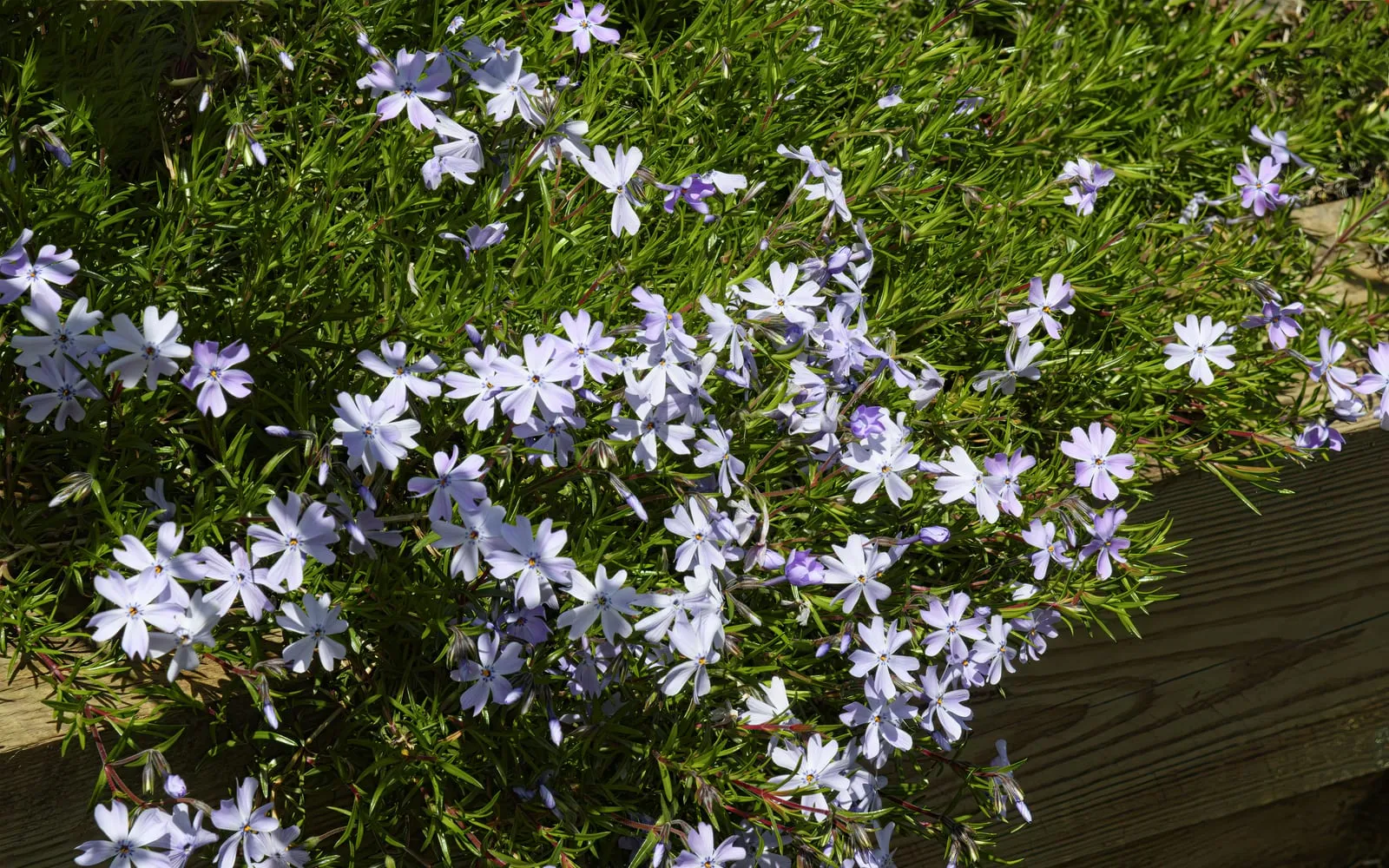
Creeping phlox forms a dense, needle-leaved evergreen mat that all but disappears under a solid sheet of small five-petalled flowers for several weeks each spring, in shades from white through pink to violet-blue depending on the cultivar. The species name, subulata, means awl-shaped, a direct reference to the narrow, pointed leaves that give the foliage its sharp, moss-like texture and stay green through winter, providing structure in a rockery long after the flowers have finished.
Unlike a number of true alpines on this site, which come from exposed mountain scree and struggle in ordinary humid summer air, creeping phlox is a woodland-edge and rocky-outcrop native of the eastern and central United States, a habitat that gets real summer rainfall and humidity. That background makes it more tolerant of average garden conditions than a classic scree specialist, but it also carries a specific vulnerability of its own. Powdery mildew thrives in exactly the humid, still air the plant’s native range regularly provides.
Appearance and character
Fine, needle-like leaves, rarely more than a centimetre long, grow densely along low, spreading stems that root as they touch soil, building a tight evergreen carpet 10 to 15 cm tall and considerably wider. In winter this foliage often takes on a bronze or purplish tinge in colder climates, a common trait among evergreen alpines that protects the leaf tissue from photodamage on bright, frozen days rather than a sign of stress.
The spring flower display is dense enough to obscure the foliage almost entirely for two to three weeks, each flower a simple, flat, five-lobed disc typically notched at the tip of each petal. A single established mat in full bloom reads from a distance as a solid sheet of colour rather than as individual flowers, which is the effect most gardeners plant it for, whether cascading over a wall or carpeting a sunny rockery slope.
Where it is from
Phlox subulata is native to a broad stretch of the eastern and central United States, growing on rocky outcrops, sandy barrens, open woodland edges and dry, thin-soiled slopes from the Appalachian region west into the Great Plains states. That range includes real summer rainfall and humid air, unlike the drier mountain habitats many European and Asian rockery alpines come from, and it explains why creeping phlox tolerates ordinary garden soil with more organic matter than a scree-adapted plant would accept.
The same native range explains its vulnerability to powdery mildew, since the fungus that causes it is well adapted to exactly the warm, humid, still-air conditions common through the plant’s own summer habitat. Good air movement around a planting, something the species gets naturally on an open rocky outcrop but often loses in a sheltered garden corner, often separates a healthy patch from a mildew-prone one.
How it grows
Growth spreads outward from the original planting as low stems root where they touch the ground, gradually building a continuous mat that can cover a metre or more across within a few years given good conditions. This rooting-as-it-spreads habit is similar to aubrieta’s, though creeping phlox stays lower and denser and its evergreen, needle-leaved foliage gives it a different texture and a stronger winter presence in the rockery.
Individual sections of an older mat can thin with age, particularly where shade from nearby plants reduces light to part of the patch, and a mat left unpruned for many years develops a woodier, less floriferous character similar to the legginess seen in aubrieta and basket-of-gold, though creeping phlox tolerates neglect for longer before the effect becomes obvious.
Through the seasons
Spring is the season creeping phlox is grown for, with the main flower flush usually running through April and into May depending on climate. As soon as flowering finishes, shearing the mat back lightly, by roughly a third, tidies the plant, encourages denser new growth and reduces the risk of the mat opening up in the centre over subsequent years.
Summer brings steady foliage growth following the post-flowering trim, and this is the season when powdery mildew is most likely to appear, particularly during warm, humid, still spells. Watering at the base rather than over the foliage, and avoiding evening watering that leaves damp overnight, both reduce the risk considerably.
Autumn is a good time for planting new creeping phlox or dividing an overgrown mat, giving new sections a full season to establish roots before winter sets in.
Winter is handled easily by established plants down to around minus 20 deg C, and the evergreen, needle-like foliage provides useful winter structure in a rockery when many other plants have died back completely, sometimes taking on a bronze winter colour that fades back to green in spring.
Care difficulty
Creeping phlox is an easy, forgiving plant for most gardens, more tolerant of ordinary garden soil and moderate humidity than a true scree alpine. It needs little beyond a light post-flowering trim and reasonable air circulation. Its main demand, good airflow to discourage powdery mildew, is easily met by avoiding tightly packed plantings and dense overhead shade rather than by any special technique.
Gardeners transplanting phlox lore from tall, upright garden phlox varieties should note that creeping phlox flowers earlier, on a much shorter, mat-forming plant, and the two are cared for quite differently despite sharing a genus.
Watering
Water new plantings regularly through the first growing season to support root establishment, then reduce to occasional deep watering during extended dry spells once the mat is established. The species tolerates moderate drought reasonably well thanks to its native rocky outcrop habitat, though it performs better with some supplemental water in a hot, dry summer than a strict scree alpine would need.
Direct watering at soil level rather than over the top of the foliage matters more for this species than for most others in this collection, since damp foliage overnight is a direct trigger for powdery mildew in warm weather.
Warning signs, diseases and pests
Powdery mildew is the defining problem for this species, showing as a white or grey powdery coating across the leaves, usually beginning in warm, humid weather with poor air circulation. Thinning nearby planting, avoiding evening watering onto the foliage and choosing an open, breezy position all reduce the risk substantially, and several newer cultivars have been bred with improved resistance.
Spider mites can build up in hot, dry conditions, causing a fine stippled or bronzed appearance on the foliage, and the phlox plant bug occasionally causes small yellow spotting on leaves in some regions. Root-knot nematodes affect phlox in some soils, causing stunted, poorly performing growth without an obvious above-ground cause, and are best avoided by rotating planting positions if a patch fails to thrive repeatedly in the same spot.
Growing environment
Full sun produces the densest flowering and the tightest, healthiest mat; in shade, creeping phlox grows sparser and is considerably more prone to powdery mildew due to reduced air movement and slower drying after rain or watering. An open rockery slope or the top of a wall with good exposure to sun and moving air suits it well.
Soil should drain freely but can carry more organic matter than a true scree mix without harming the plant, reflecting its native woodland-edge and outcrop habitat rather than a fully exposed alpine scree. Average garden soil, provided it does not stay waterlogged, generally suits creeping phlox better than a lean, purely mineral grit mix.
Feeding
Creeping phlox performs well on average soil with little or no supplemental feeding, and excessive nitrogen tends to produce soft, lush growth that is both less floriferous and more susceptible to powdery mildew. A single light application of a balanced fertiliser in early spring, before flowering begins, is sufficient on soil that is poor.
Avoid feeding after the post-flowering trim, since the fresh, soft growth that follows a hard prune is already the most vulnerable tissue to fungal disease, and additional nitrogen at that point increases the risk rather than helping the plant recover.
Troubleshooting
A white or grey powdery coating has appeared across the leaves. This is powdery mildew, favoured by warm, humid, still air. Remove the worst-affected growth, improve air circulation by thinning nearby planting, and switch to watering at soil level rather than overhead if that has been the routine.
The centre of an established mat has thinned or gone bare. Older mats left untrimmed for several years can develop a woody, sparse centre similar to aubrieta’s failure mode, though it develops more slowly. Shear the whole mat back hard in late summer to encourage fresh growth from lower down the stems.
Flowering was noticeably sparse this spring. The most common causes are insufficient direct sun, an overdue post-flowering trim from the previous year, or a mildew infection the previous summer that weakened the plant. Address whichever applies and expect recovery the following season.
Foliage looks stippled, dull or bronzed during a hot, dry spell. This points to spider mite activity, which thrives in hot, dry conditions with low humidity around the foliage. Increasing humidity locally with regular watering at the base and checking the underside of leaves for fine webbing confirms the diagnosis.
Small yellow spots have appeared scattered across the leaves. This is consistent with phlox plant bug feeding, generally cosmetic rather than seriously damaging on an established plant. Removing heavily affected leaves and maintaining general plant vigour is usually enough.
A patch has performed poorly for two seasons running despite good light and watering. Root-knot nematodes in the soil are worth considering if pests and disease have been ruled out, particularly in warmer climates where nematode populations are more active. Moving the planting to a different bed the following season often resolves it.
The mat has become woody and gappy after several years without attention. This is the expected result of skipping the annual post-flowering trim. Cut the whole mat back hard immediately after the next flowering, and repeat every year afterwards to keep the plant dense and long-lived.