
Houseplant
Flamingo Lily
Anthurium scherzerianum
Also known as Pigtail Anthurium
How to grow flamingo lily, Anthurium scherzerianum. Why its calcium oxalate crystals cause an immediate burning bite rather than a slow poisoning, the curled spadix that sets it apart from Anthurium andraeanum, and the fluoride-sensitive browning mistaken for underwatering.
At a glance
- Difficulty
- Easy
- Water
- When the top third of the mix has dried, roughly weekly in summer
- Light
- Bright, indirect light; tolerates light shade but flowers less
- Temperature
- Above 13 deg C; chilled by anything colder for long
- Humidity
- High, 60 percent or more
- Hardiness
- USDA 10b-12, RHS H1b, hardy to 10 C
- Type
- Evergreen tropical perennial
- Height
- 30-50 cm
- Native to
- Costa Rica
As a cloud forest understory plant rather than a true tropical lowland one, it needs warmth but not high heat. It survives outdoors only where frost never reaches, and even there it prefers the buffered, humid air under other planting to open sun. Everywhere else it is a houseplant year round.
Hardiness zones describe winter cold alone. Summer heat, humidity, rainfall and the length of the growing season decide as much, so treat the range as the outer limit rather than as a recommendation.
Toxic if eaten
- Do not eat
- Every part, and the leaves and stems most of all
- Harm from
- Eating it
- Affects
- People, cats and dogs
Anthurium tissue is loaded with needle-shaped calcium oxalate crystals, and biting into a leaf or stem bursts the cells holding them, driving the needles into the lining of the mouth while a sap enzyme deepens the sting. The reaction is immediate: burning lips and tongue, a rush of saliva, and a cat or dog pawing at its mouth and refusing food. Vomiting sometimes follows. Almost nothing keeps eating past the first bite, which is why serious poisoning is rare, and most cases settle within a day on cold water or something cold to eat. Watch for swelling around the mouth or trouble swallowing or breathing, which is uncommon and is when this stops being a matter for home care. The glossy red spathe sits at exactly toddler eye height on a side table, which is reason enough to keep a flowering plant out of small reach rather than trust supervision.
Sources: RHS potentially harmful garden plants, ASPCA toxic and non-toxic plants
About
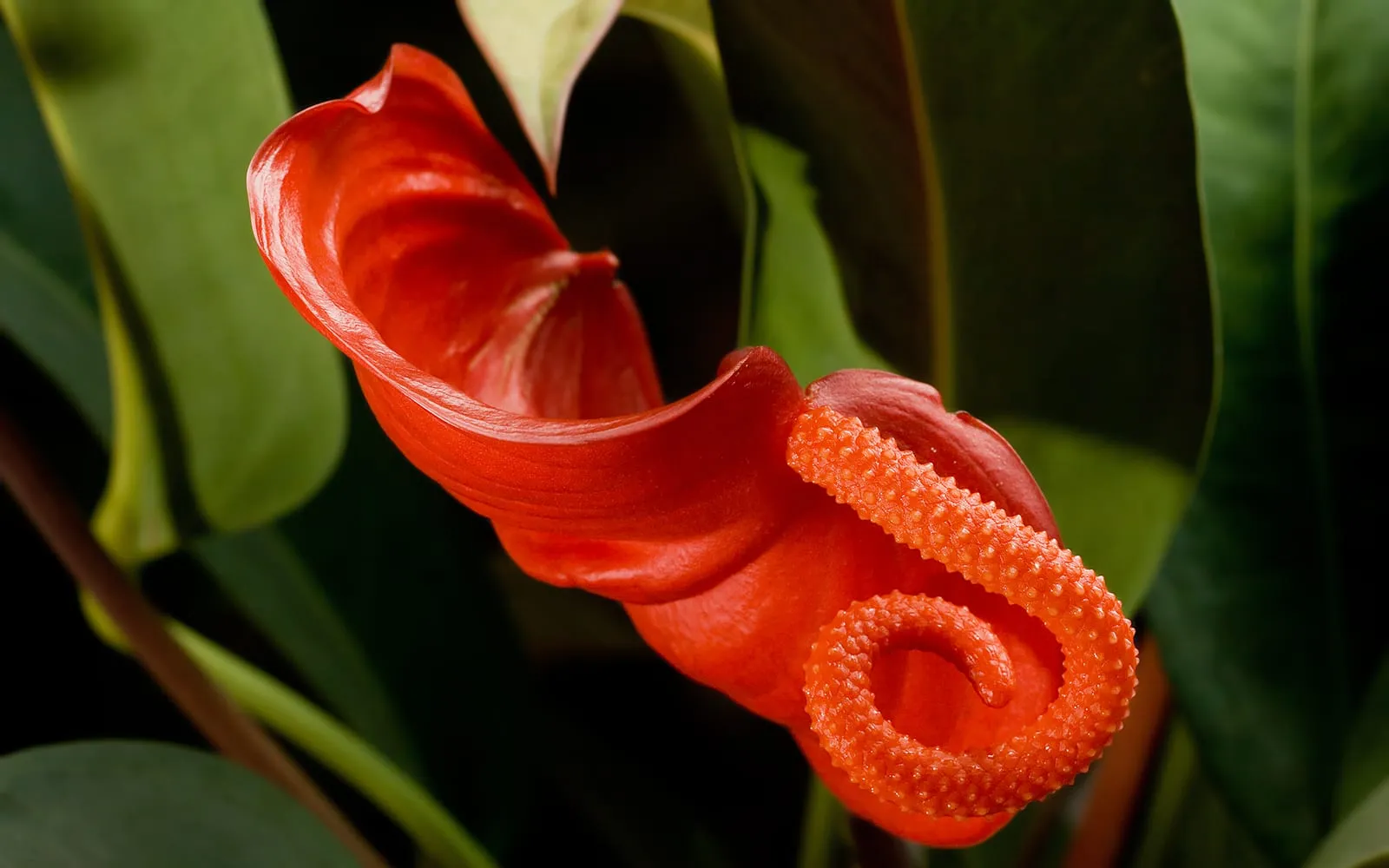
Flamingo lily is a compact anthurium grown for its red spathes and curled orange spadix. The red part is a modified leaf, while the true flowers sit on the spadix. In Anthurium scherzerianum that spadix curls, which helps separate it from the larger, heart-leaved Anthurium andraeanum.
It flowers for much of the year in bright indirect light. It needs warmth, high humidity and a chunky free-draining mix, but it should not sit wet. Like other anthuriums, it contains calcium oxalate crystals and should be kept away from chewing pets and small children.
Appearance and character
Leaves are narrow and lance-shaped rather than the broad heart shape of the showier anthuriums, 15 to 25 cm long, leathery, and matte rather than glossy. Check that dull surface if you are buying one labelled generically as “anthurium”. A shiny, heart-shaped leaf means you have andraeanum, a different plant with different proportions.
Growth is a low, compact clump rather than a climbing or trailing habit, each new leaf and flower stalk rising from a short central crown. A well-grown plant tops out around 30 to 50 cm and stays that size for years, making it one of the smaller aroids sold as a houseplant.
The spathe itself is glossy, waxy and slightly puckered rather than flat, most often a saturated red, though pink and white forms are sold. The spadix curls tightly at the tip, a shape unique enough in the genus that growers use it as the identifying feature over flower colour, which varies by cultivar.
Where it is from
Anthurium scherzerianum comes from the cloud forests of Costa Rica, growing on the forest floor and on mossy banks under a closed canopy rather than high up as an epiphyte. Light there is filtered and constant rather than bright, and humidity rarely drops, which is the pairing a houseplant grower is trying to recreate: gentle light and damp air together, not one substituting for the other.
It was introduced to European glasshouse cultivation in the nineteenth century and bred into named cultivars for the cut-flower and pot-plant trade well before the houseplant boom reached it, so most plants sold today are cultivars selected for compact size and reliable flowering rather than the wild species itself.
How it grows
Pot it in a chunky, open mix built for aroids rather than an ordinary houseplant compost: equal parts bark, perlite and coir drains fast and lets air reach the roots, which matters more to this plant than most, since its roots resent sitting wet.
Repot every two years or when roots crowd the pot, moving up only one pot size at a time. Spring is the best time, while new growth is starting.
Propagate by division at repotting, splitting the crown into sections that each carry roots and at least one growing point, or by removing offsets that form at the base of an established clump.
Give it bright, indirect light, such as a few feet back from an east or west window. Direct midday sun scorches the leaves; too little light stops flowering without harming the plant otherwise, so a flowerless anthurium is almost always asking for a brighter spot before anything else.
Through the seasons
Spring is repotting and division time, as new growth resumes after the slower winter months.
Summer is the main flowering and growing season. Water and feed on the regular schedule and watch humidity, since summer heating or air conditioning both dry the air.
Autumn slows growth gradually. Taper feeding off towards the end of the season.
Winter is a rest rather than a dormancy. The plant stays evergreen and may still flower lightly, but growth slows, so water less often and stop feeding until spring.
Care difficulty
Easy, and forgiving of the ordinary mistakes a windowsill plant survives. The two things that harm it are a mix that stays soggy, which rots the roots within weeks, and consistently dry air, which browns the leaf tips without necessarily killing anything. Both are simple to fix once you know to look for them, and neither develops quickly enough to catch you by surprise.
Watering
Water when the top third of the mix has dried out, which in an open aroid mix is usually weekly through summer and closer to every ten days to two weeks in winter. Water thoroughly until it runs from the drainage holes, then let the pot drain completely and never let it stand in a saucer of water.
Use rainwater or filtered water where you can. Anthurium is sensitive to the fluoride present in some tap water supplies, and it shows as brown, dead tips on otherwise healthy leaves, a symptom gardeners commonly mistake for underwatering or low humidity and treat the wrong way. If tips keep browning despite good watering and humidity, the water itself is the more likely cause.
Warning signs, diseases and pests
Scale insects show as small, still, brown bumps along the stems and leaf undersides, sapping the plant and leaving a sticky residue. Wipe them off with a damp cloth or treat with horticultural soap.
Mealybug hides in the leaf axils and around the crown as white, cottony tufts, and is treated the same way.
Root rot follows a mix that has stayed wet, and shows first as a wilting, unhappy plant despite moist compost, since the roots responsible for taking up water have already failed. Unpot it, cut away any soft brown roots, and repot into fresh, dry mix.
Bacterial leaf blight, caused by a Xanthomonas bacterium, is a serious problem in commercial anthurium production but rare in a single home plant; it shows as water-soaked, yellow-margined patches that enlarge and blacken. Remove and destroy affected leaves and avoid overhead watering, which spreads bacterial diseases between leaves.
Growing environment
Bright, indirect light suits it best: a few feet from an unobstructed east or west window, or further back from a south-facing one. Direct sun through glass scorches the leaves.
Warmth matters more than most houseplants tolerate comfortably. Keep it above 13 deg C, and treat anything close to that as a minimum to be avoided rather than a target. Growth slows and flowering drops before visible cold damage appears.
High humidity is the single biggest factor in how well it grows. A bathroom with a bright window, a pebble tray, or a spot among other plants all raise the air moisture around it; dry, centrally heated air is the commonest reason a flamingo lily disappoints indoors.
Keep it away from cold draughts from doors and windows, and away from the direct blast of a heating vent, both of which stress it in different directions at once.
Feeding
Feed with a balanced liquid houseplant fertiliser diluted to half the strength on the label, every four to six weeks through spring and summer.
Stop feeding entirely in autumn and winter, when growth has slowed and unused fertiliser salts build up in the mix rather than being taken up, eventually showing as browned leaf edges much like fluoride damage does.
Flush the pot with plain water every few months to clear any accumulated salts, particularly if your water is hard.
Troubleshooting
It has not flowered in months. Almost always light. Move it somewhere brighter, short of direct sun, and be patient; a new flower stalk can take several weeks to appear after conditions improve.
The leaf tips are brown and dry. Check your water source first. Fluoride in some tap supplies causes exactly this pattern even with good watering habits. Switch to rainwater or filtered water and the new growth should come in clean, though existing brown tips will not recover.
The leaves are yellowing and the plant looks unhappy. Overwatering and early root rot are the likely cause. Check the roots; if they are brown and mushy rather than white and firm, repot into fresh, dry mix and water less often afterwards.
Leaves are drooping and curling. Usually underwatering, cold, or a draught, in roughly that order of likelihood. Check the mix for dryness first, then think about where the pot is sitting.
Can I grow it in a bathroom? Often very well, if the bathroom has a bright window. The humidity from showers and baths suits it better than most rooms in the house, and it is one of the few flowering houseplants that thrives on bathroom conditions rather than merely tolerating them.
Flamingo Lily problem guides
Not sure what is wrong? See the common houseplant pests guide.