
Houseplant
Blushing Bromeliad
Neoregelia carolinae
Also known as Crimson Cup, Marbled Fingernail, Neoregelia
How to grow Neoregelia carolinae. The centre that blushes red before flowering, bright light for colour, the cup as its main water source.
At a glance
- Difficulty
- Easy
- Water
- Keep the flat central cup filled with a shallow layer of water, flushed every two weeks
- Light
- Bright light, including some direct sun, for the strongest colour
- Temperature
- 16-27 deg C. Never below 7 deg C
- Humidity
- Moderate. More tolerant of average room humidity than most tank bromeliads
- Hardiness
- USDA 10-11, RHS H1b, hardy to 10 C
- Type
- Tender evergreen perennial, flowering once and then producing offsets
- Height
- 20-30 cm tall, 30-40 cm across
- Native to
- Brazil, Atlantic Forest
Subtropical Atlantic Forest with a mild dry season, warmer and slightly less saturated than the rainforest most tank bromeliads come from. The zone number covers the winter minimum only; the strong colouring this species is grown for depends on light, which no hardiness rating measures.
Hardiness zones describe winter cold alone. Summer heat, humidity, rainfall and the length of the growing season decide as much, so treat the range as the outer limit rather than as a recommendation.
Not known to be toxic
Non-toxic. The ASPCA carries a dedicated entry for the Blushing Bromeliad, listing it as non-toxic to cats, dogs and horses under its trade names Crimson Cup, Marbled Fingernail and Ossifragi Vase. The RHS list of potentially harmful garden plants does not include Neoregelia either. The leaf margins on some cultivars carry small, soft teeth rather than true spines, mild enough that they rarely break skin, and the flat, saucer-like cup at the centre of the rosette is the only real point of caution: it holds standing water at a height a toddler or a curious cat can reach, and that water should be changed regularly rather than left to sit for months.
Sources: ASPCA (Blushing Bromeliad, Neoregelia carolinae), RHS potentially harmful garden plants
About
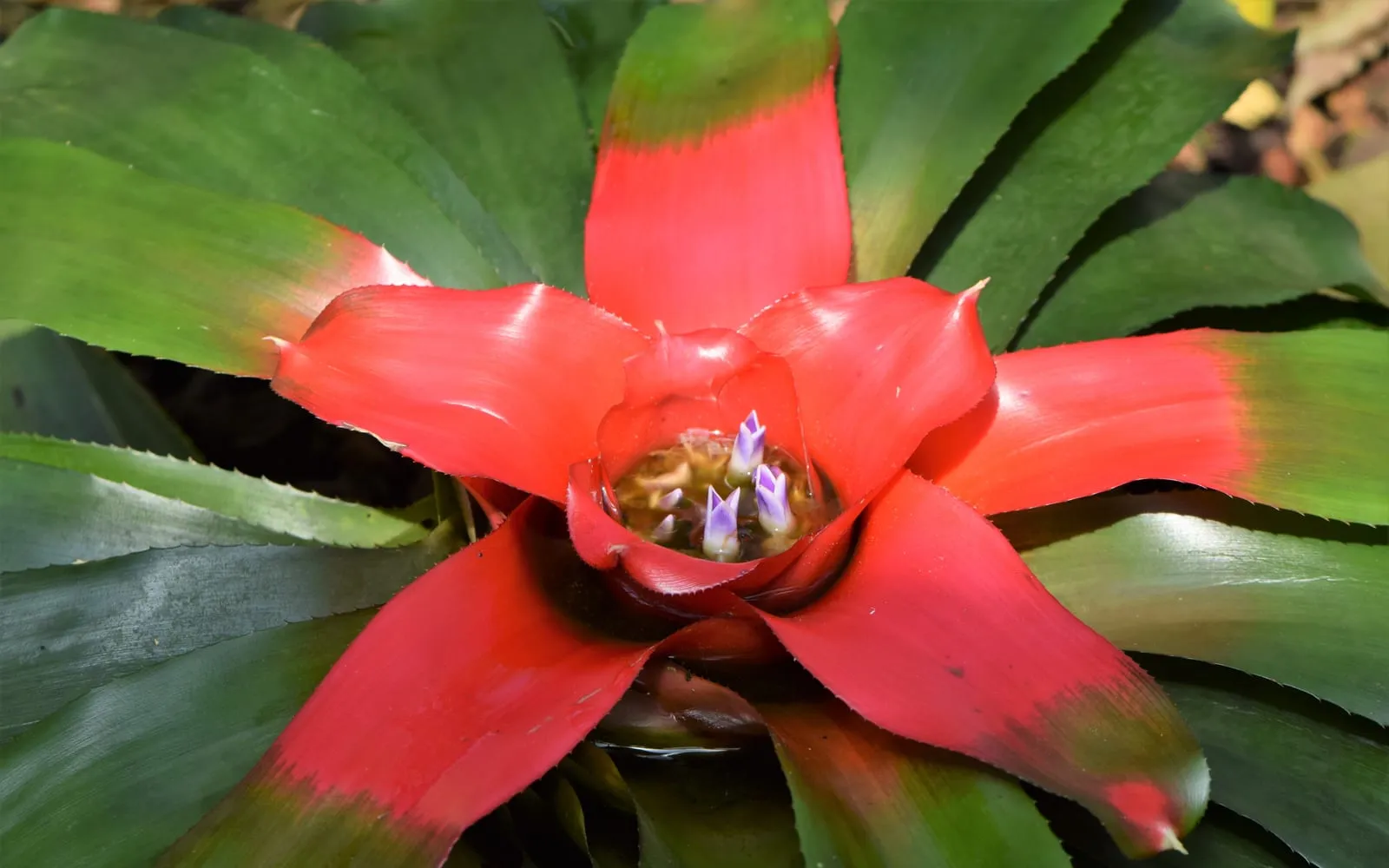
A Blushing Bromeliad announces its flowering months before any flower appears. As the plant nears maturity the inner leaves surrounding the cup flush from green to a deep pink or red, a colour change that has nothing to do with the actual flowers and everything to do with drawing attention to them. The true flowers are tiny, sit low in the water-filled cup, and would be almost invisible to a passing pollinator without the coloured leaves signalling where to look.
Neoregelia carolinae grows as a broad, flat rosette rather than the taller vase shape of a Guzmania or Vriesea, and the whole plant is built around that shallow central cup, which functions as its main water reservoir the way it does in most of its bromeliad relatives.
It is one of the more forgiving tank bromeliads for an indoor grower, tolerant of the drier air an ordinary room supplies and rewarding bright light with colour that a shadier spot never quite produces.
Appearance and character
A flat, open rosette 20 to 30 cm tall and 30 to 40 cm across, made up of broad, strap-shaped leaves arranged in a low spiral rather than an upright funnel.
Leaves are glossy and typically mid-green with fine mottling, though named cultivars extend into pink, purple and near-black variegation across the whole leaf rather than only at the centre.
The leaf bases overlap into a wide, shallow cup at the middle of the rosette, broader and flatter than the deep vase a Vriesea holds, which means it evaporates faster and needs checking more often even though it holds less water at any one time.
As the plant approaches flowering, the leaves immediately surrounding the cup blush from green to red, pink or occasionally near-white, a shift driven by pigments called anthocyanins that mask the green chlorophyll underneath. The effect can last for months.
The true flowers are small, three-petalled and violet-blue, opening directly in the water of the cup a few at a time rather than on any raised spike. They are easy to overlook entirely against the blush of colour around them, and many owners never notice they are there.
Like its relatives, Neoregelia carolinae is monocarpic. The rosette that flowers does not flower again, and it declines gradually over the following year while pups form in a ring around its base.
Where it is from
Neoregelia carolinae is native to the Atlantic Forest of eastern Brazil, a band of coastal and near-coastal forest running roughly parallel to the Brazilian coastline.
It grows as an epiphyte on tree trunks and branches and also, less strictly than many tank bromeliads, directly on rocky or leaf-littered ground in more open forest, which is part of why it tolerates drier conditions indoors better than a strictly epiphytic species does.
The Atlantic Forest carries a milder, more seasonal climate than the equatorial rainforest that produces species such as Aechmea chantinii, with a defined, if mild, dry season and somewhat lower average humidity. That difference in origin is the reason Neoregelia is markedly more forgiving of ordinary room air than many of its tank-forming relatives.
Bright, often broken sunlight reaches the forest floor and lower canopy where it grows, which is also why the species colours up strongly with more light than most tank bromeliads would tolerate without scorching.
How it grows
Pot it in an open, free-draining mix, either a specialist bromeliad or orchid blend or an ordinary houseplant compost cut generously with bark and perlite, since the roots need air around them even though they tolerate more moisture than an epiphytic Vriesea would.
Keep the flat central cup filled with about a centimetre of water. Because the cup is shallow and wide, it evaporates faster than a deeper vase does and needs checking every few days rather than weekly.
Flush the cup completely every two weeks, tipping out the old water and refilling with fresh, rather than only adding to what is already there. A wide, shallow reservoir left unflushed collects dust and algae faster than a narrow deep one, because more of its surface is exposed to the air.
Give it more light than most other tank bromeliads tolerate, including an hour or two of gentle direct sun. Strong light produces the deepest colouring in both the foliage and the blush around the cup. A spot too shaded produces a plain green plant that never quite lives up to its name.
Feed lightly and only during the growing season, since Neoregelia is not a demanding feeder and excess fertiliser dulls colour rather than intensifying it.
Watch for the blush to develop at the centre of a maturing rosette, usually two to three years after potting on an offset, and expect the small violet flowers to appear low in the cup not long after.
Once the parent rosette finishes flowering and starts to fade, separate offsets once they are roughly a third of the parent’s size with their own roots established, and pot each individually.
Through the seasons
Spring restarts active growth. Resume light feeding every four to six weeks, check the cup more often as evaporation speeds up with longer days, and increase light gradually if the plant has spent winter further from a window.
Summer is peak growing and, on a maturing rosette, the season the central blush often intensifies. Flush the cup every two weeks, keep watering the compost lightly, and give the plant as much bright light as the spot allows short of scorching.
Autumn often brings the small violet flowers on a plant that blushed over summer. Ease off feeding, and keep the cup topped up as evaporation slows with shorter, cooler days.
Winter is the resting period. Stop feeding, reduce watering of the compost, and keep the cup shallower rather than brimming, since a wide reservoir left full in a cool room takes far longer to need replacing.
Care difficulty
Easy, and more tolerant of ordinary indoor conditions than most tank bromeliads.
It copes with the average humidity of a living room noticeably better than a Vriesea or an Aechmea, and its light requirements point towards a brighter spot rather than a shadier one, which suits most windowsills without any special arrangement.
The one thing that catches new owners out is a shallow cup left unchecked. Because it holds less water than a deep vase, it can run dry between waterings faster than expected, and a cup left empty for long stretches weakens the plant even though the compost below may still be moist.
Understanding that the red blush signals flowering rather than distress saves a good deal of unnecessary worry, since it is easy to mistake the colour change for a sign something is wrong.
Watering
Keep the flat central cup filled with about a centimetre of water, checking every few days since it evaporates faster than a deep vase does.
Flush the cup completely every two weeks, emptying the old water out before refilling, rather than continually adding fresh water on top of what is already sitting there.
Water the compost lightly whenever the top inch has dried, and let it dry out somewhat between waterings rather than keeping it constantly damp.
Use rainwater or filtered water where the tap supply is hard, since mineral deposits show as a pale crust on the leaves closest to the cup, which are usually the most colourful part of the plant and the ones a crust shows up on most visibly.
Signs of an empty cup are a slight dulling of the central colour and leaves that feel less turgid than usual. Signs of a cup left stagnant too long are a musty smell and algae visible in the water.
Warning signs, diseases and pests
A soft, discoloured base with leaves that come away easily is rot, from either compost kept too wet or a cup left stagnant for an extended period. Trim the affected tissue, repot into fresher, more open mix, and flush the cup more regularly.
Pale, washed-out leaves with no colour development usually mean not enough light. Move the plant somewhere brighter, introducing extra sun gradually to avoid scorching a plant that has adapted to shade.
Bleached or brown patches on leaves that were recently moved into strong sun are scorch rather than disease. Move the plant back slightly and let it re-acclimatise over a couple of weeks.
Scale insects appear as small, flat, brownish bumps, usually along the undersides of the outer leaves. Wipe them away with a cloth dipped in dilute soapy water or treat with horticultural oil.
Mealybugs cluster as small white tufts in the leaf axils near the cup, which is a sheltered, humid spot they favour. A cotton bud dipped in isopropyl alcohol removes them, and a follow-up check after a week catches any missed.
A rosette that stops growing new leaves after flowering is not failing. That decline is normal, and the plant’s energy has already shifted to the offsets developing around its base.
Growing environment
Bright light, including some direct morning or evening sun, which produces the strongest colouring in both the leaves and the central blush.
Warmth between 16 and 27 deg C, tolerating brief dips towards 7 deg C better than most tank bromeliads, though sustained cold below that damages the foliage.
Moderate humidity. Ordinary room conditions suit it reasonably well, though it still benefits from a slightly humid spot over a consistently dry, heated one.
An open, free-draining mix, either specialist bromeliad compost or an ordinary houseplant mix cut with bark and perlite.
Reasonable air movement, which helps prevent the fungal problems that still-standing humid air around dense foliage can encourage, even in a species this tolerant.
Away from the coldest draughts in winter, since a sustained chill below about 7 deg C will damage leaves even on an otherwise hardy specimen.
Feeding
Feed every four to six weeks from spring to early autumn with a balanced liquid fertiliser at a quarter of the strength recommended on the label, or a specialist bromeliad formula at label strength.
Add the feed to the cup water rather than the compost, since the leaf bases take up nutrients directly through absorbing scales in the same way other tank bromeliads do.
Use fertiliser sparingly. Overfeeding tends to dull the colour intensity this species is grown for rather than improving growth, which is the opposite of what most owners expect when a plant looks pale.
Stop feeding over winter, when growth slows and any unused fertiliser is more likely to accumulate as salts in the cup.
A Neoregelia grown without any feeding at all will still colour up and flower, given enough light, though a light feeding routine through the growing season tends to produce a fuller, faster-maturing rosette.
Troubleshooting
The centre of the rosette has turned bright red. Is something wrong? No, that is the plant blushing ahead of flowering, a normal colour change driven by pigments that mask the green in the leaves. Small violet flowers usually follow within a few weeks, low down in the cup.
I can’t see any flowers even though the centre has coloured up. Look closely into the water of the cup itself. The true flowers are small, three-petalled and sit low in the water rather than on a raised spike, and they are easy to miss against the surrounding colour.
My plant stays plain green and never blushes. It most likely needs more light. Move it somewhere brighter, introducing extra sun gradually over a couple of weeks so the leaves do not scorch.
The cup keeps running dry between waterings. That is normal for this species, since its cup is shallower and wider than a Vriesea’s or a Guzmania’s and evaporates faster. Check it every few days rather than weekly.
The base has gone soft and mushy. That is rot, usually from compost kept too wet or a cup left stagnant too long. Trim away the affected tissue, repot into a more open mix, and flush the cup every two weeks going forward.
Can I grow it in a shadier spot like other bromeliads? You can, but expect a plainer green plant with little or no blush. This species colours up with more light than most of its tank-forming relatives tolerate.
When should I remove the offsets? Once a pup reaches roughly a third of the parent rosette’s size and has its own roots, separate it with a clean cut and pot it into fresh, open mix rather than leaving it attached indefinitely.
Blushing Bromeliad problem guides
Not sure what is wrong? See the common houseplant pests guide.