
Houseplant
Velvet Cardboard Anthurium
Anthurium clarinervium
How to grow velvet cardboard anthurium, Anthurium clarinervium. Why its flower barely registers next to the velvety, vein-patterned leaves, and the chunky aroid mix that keeps the roots from rotting.
At a glance
- Difficulty
- Moderate
- Water
- When the top few centimetres of mix have dried, typically every one to two weeks
- Light
- Bright indirect light. Direct sun bleaches and scorches the leaves
- Temperature
- 18-27 deg C. Below 15 deg C stalls growth
- Humidity
- 60% or higher. Dry air browns the leaf edges
- Hardiness
- USDA 10b-11, RHS H1b, hardy to 12 C
- Type
- Evergreen tropical perennial
- Height
- 40-60 cm
- Native to
- Mexico
A limestone forest species from Chiapas, growing in shallow leaf litter over rock rather than deep soil, in warm, humid, filtered shade year round. It has no dormancy and no frost tolerance, and the thick, leathery texture of its leaves is a genuine adaptation to the free-draining, occasionally dry conditions of a rocky forest floor rather than a sign the plant tolerates neglect the way a true desert succulent would.
Hardiness zones describe winter cold alone. Summer heat, humidity, rainfall and the length of the growing season decide as much, so treat the range as the outer limit rather than as a recommendation.
Harmful if eaten
- Do not eat
- Every part, the leaves and stalks most of all
- Harm from
- Eating it and handling it
- Affects
- People, cats and dogs
Like every anthurium, this species carries insoluble calcium oxalate crystals throughout its tissue. The ASPCA lists the genus as toxic to cats and dogs, causing oral irritation, drooling, and difficulty swallowing if a leaf is chewed, and people handling or biting into the foliage react the same way, sometimes with skin irritation from the sap on contact. The sharp burning sensation starts within seconds of a bite, which is usually enough to stop an animal or a curious toddler taking more than one mouthful. Because the leaves are thick and stiffly upright rather than trailing within easy reach, this species is somewhat less exposed to casual chewing than a bushier houseplant, though it is still worth keeping away from a pet that persistently targets foliage.
Sources: ASPCA (Flamingo Flower, Anthurium andraeanum), RHS potentially harmful garden plants
About
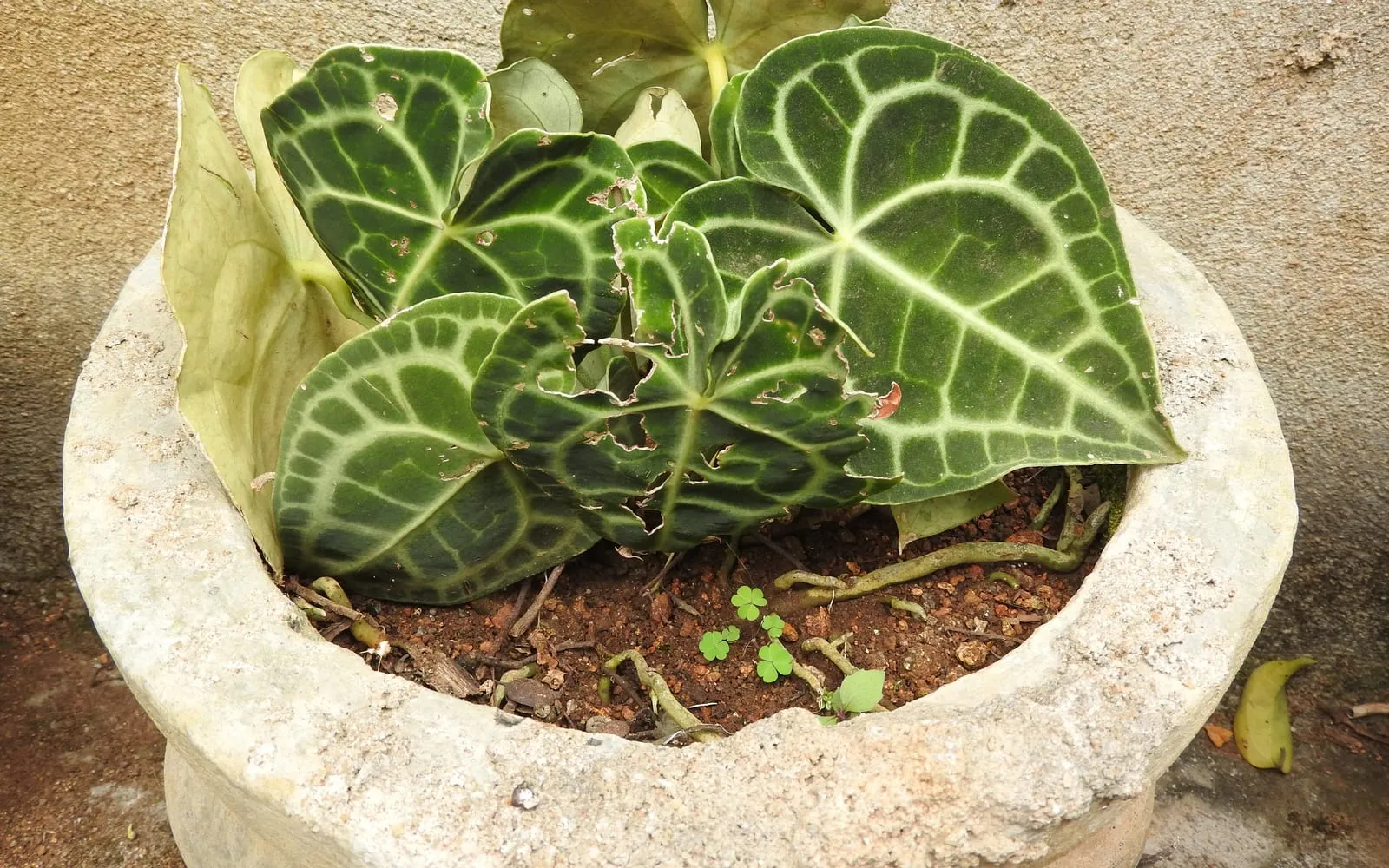
Velvet cardboard anthurium is grown for its leaves rather than for any flower. Each one is broad, heart-shaped and thick enough to feel closer to stiff card than to ordinary foliage, with a dark, matte, velvety surface crossed by pale ivory veins that stand out sharply against the near-black green background.
The inflorescence this species produces, a slim green spike behind a narrow green hood, is easy to miss and never why gardeners grow it, which sets it apart from the anthuriums grown for their glossy coloured spathes. This is a foliage plant through and through, closer in spirit to an ornamental philodendron than to a florist’s anthurium.
Appearance and character
Leaves are broadly heart-shaped, 20 to 35 cm long on a mature plant, with a deeply notched base and a texture that is velvety to the touch, a soft matte finish rather than the glossy shine typical of most anthuriums. Colour is a deep, near-black green, sometimes with a faint bronze or purple cast in strong light.
Pale, ivory to silvery-white veins radiate out from the leaf base in a striking network, standing in sharp contrast to the dark background and giving the plant its common name as much as the leaf’s stiff, cardboard-like feel does. Each new leaf tends to show a slightly bolder pattern than the last as the plant matures.
New leaves unfurl from a tight, upright bud at the centre of the plant, often tinged reddish-bronze before they expand and darken. The inflorescence, when it appears, is a slender green spadix in front of a narrow, similarly green spathe, both easily overlooked next to the foliage.
Where it is from
Anthurium clarinervium grows in the limestone forests of Chiapas, in southern Mexico, rooted in shallow leaf litter over rock rather than in deep soil, often on slopes and outcrops where drainage is sharp and rapid after rain.
That rocky habitat explains the leaf’s thick, leathery texture, an adaptation that reduces water loss between the frequent but short-lived downpours typical of the region, rather than a trait that signals genuine drought tolerance the way a desert plant’s would. Filtered light under the forest canopy is bright but rarely direct, which is close to what the plant needs on an indoor windowsill.
Humidity in that forest stays high year round, and the gap between that condition and an average heated room is the main challenge in growing this species well away from its native range.
How it grows
Pot it in a chunky, free-draining aroid mix, bark, perlite and a little compost in roughly equal parts, which mimics the fast-draining leaf litter and rock the plant roots into in the wild far better than dense, ordinary potting compost does.
Growth is slow and deliberate, with a mature plant typically producing a handful of new leaves each year rather than the rapid flush some tropical foliage plants put on. Each new leaf tends to be larger and more strongly patterned than the one before it as the plant settles in and matures.
Repot every two to three years, moving up one pot size at a time, once roots visibly fill the current container. This species dislikes being disturbed more often than necessary and settles best left undisturbed for a while after each repot.
Propagate by division at repotting time if the plant has produced offsets at its base, each with its own roots and at least one leaf, rather than by leaf cuttings, since a leaf alone will not root into a new plant.
Through the seasons
Spring brings the start of the year’s new growth. Repot if the roots have filled the pot, and begin monthly feeding.
Summer is the main growing season. Water as the mix dries, keep humidity up, and watch for spider mite in hot, dry spells.
Autumn slows growth gradually. Reduce feeding towards the end of the season.
Winter is a quiet period. Water a little less often, keep the plant away from cold glass and draughts, and hold off on feeding until spring.
Care difficulty
Moderate. The compost and the humidity around the plant decide most outcomes, and both are set once and then mostly maintained rather than fussed over daily.
A dense, ordinary potting compost holds too much water around roots built for sharp drainage, and root rot follows within weeks of persistent overwatering in the wrong mix. Humidity is the slower problem: a plant kept in dry air survives but browns steadily at the leaf margins and grows more slowly than one given real humidity, a gradual decline rather than a sudden crisis.
Watering
Water when the top few centimetres of the mix have dried, typically every one to two weeks, checking with a finger rather than by the calendar since the interval shifts with light, temperature and pot size.
Water thoroughly until it runs from the drainage holes, then let the mix approach dryness again before the next watering. The chunky aroid mix this plant needs drains quickly, and roots that sit constantly wet in it are far more likely to rot than roots left to dry out slightly between waterings.
A leaf that droops slightly and feels a little soft is more often a sign of an overly dry mix than a serious problem, and recovers within a day or two of watering. Persistent yellowing lower leaves point to the opposite issue, a mix that is staying too wet.
Warning signs, diseases and pests
Mealybug gathers in the leaf crown and along young, unfolding stalks, showing as small white, cottony tufts. Remove them with a cotton bud dipped in diluted alcohol.
Scale insects appear as small, flat brown discs on the undersides of older leaves. Treat the same way as mealybug and check the plant regularly, since scale can build up unnoticed for weeks.
Spider mite favours warm, dry indoor air and shows as fine pale speckling on the leaves, sometimes with faint webbing in advanced cases. Raising humidity helps prevent it as much as treat it.
Root rot follows a dense mix that stays wet, showing as yellowing lower leaves and a plant that generally looks unwell despite regular watering. Repot into a properly chunky, free-draining mix and cut back on watering if it has already taken hold.
Growing environment
Bright indirect light suits it best. Direct sun, especially through glass, bleaches the dark leaf colour and can scorch the surface outright.
Keep the room between about 18 and 27 deg C. Growth stalls below 15 deg C, and the plant has no meaningful tolerance for cold at any point in its cycle.
Humidity of 60% or higher keeps the leaf margins from browning and supports steadier growth. A pebble tray, a humidifier, or grouping the plant with other humidity-loving species all help more than occasional misting.
A chunky, free-draining aroid mix suits the roots best. Bark, perlite and a little houseplant compost in roughly equal parts gives the drainage this species needs while still holding enough moisture between waterings.
Feeding
Feed monthly through spring and summer with a balanced liquid houseplant fertiliser diluted to half strength, enough to support the plant’s naturally slow, steady leaf production without pushing soft, oversized growth.
Stop feeding entirely from autumn through winter, when growth slows and unused fertiliser builds up as salts in the mix rather than being taken up.
Flush the mix with plain water every couple of months to clear accumulated salts, which matter more in a bark-based mix than in ordinary compost.
Troubleshooting
The leaves are losing their velvety texture and going glossy. Too much direct light is the likely cause, along with possible leaf scorch. Move the plant back from direct sun into bright indirect light.
New leaves are coming in smaller than the older ones. Usually not enough light or a mix that has broken down and needs refreshing. Check both before assuming anything more serious is wrong.
The leaf margins are browning steadily. Dry air is the most common cause. Raise humidity around the plant with a pebble tray or humidifier, and check it is not sitting near a heating vent.
Lower leaves are yellowing even though I water regularly. Likely a mix that has become too dense and stays wet after watering. Repot into a properly chunky, free-draining aroid mix and water a little less often.
Why has it not flowered? It rarely does anything worth calling a flower display. The inflorescence is a slim green spike behind a narrow green hood, easily lost among the foliage, and this species is grown for its leaves rather than for bloom.
Velvet Cardboard Anthurium problem guides
Not sure what is wrong? See the common houseplant pests guide.