
Houseplant
Angel Wing Begonia
Begonia coccinea
Also known as Cane Begonia
Practical guidance for growing angel wing begonia, Begonia coccinea, including cane stems, silver-spotted wing-shaped leaves, watering, humidity, pruning, and toxicity to pets.
At a glance
- Difficulty
- Moderate
- Water
- When the top few centimetres of compost dry out
- Light
- Bright indirect light; some gentle morning sun for the best colour
- Temperature
- 16-27 deg C, never below 10 deg C
- Humidity
- 50% or higher; dry air browns the leaf edges
- Hardiness
- USDA 10-11, RHS H1b, hardy to 7 C
- Type
- Evergreen cane-type perennial
- Height
- 1-1.8 m
- Native to
- Brazil
A forest-margin perennial from Brazil's Atlantic coastal region, growing in the broken light at a clearing's edge rather than under continuous canopy or in open sun. The zone range matters less than steady warmth and humidity for a plant nobody expects to survive outdoors through a real winter; it stops growing below about 12 deg C and takes real cold damage below its stated minimum. It has no frost tolerance at all.
Hardiness zones describe winter cold alone. Summer heat, humidity, rainfall and the length of the growing season decide as much, so treat the range as the outer limit rather than as a recommendation.
Toxic if eaten
- Do not eat
- All parts, with the highest concentration in underground tissue
- Harm from
- Eating it and handling it
- Affects
- People, cats, dogs and horses
The ASPCA lists begonia as toxic to cats, dogs and horses, on account of soluble calcium oxalates concentrated most heavily in tuberous or rhizomatous tissue below ground. Angel wing begonia grows from above-ground canes rather than a tuber, which keeps the everyday risk lower than for the tuberous begonias sold as bedding plants, but the leaves and stems still carry enough of the same compound to cause drooling, vomiting and mouth irritation in a pet that chews them, and similar irritation to the mouth or skin in a person handling damaged foliage. The RHS also lists begonia among plants that can irritate skin or cause stomach upset if eaten. Serious poisoning is rare from foliage alone, but a pet that has chewed a significant amount should be watched and a vet contacted if symptoms go beyond mild drooling or vomiting.
Sources: ASPCA (Begonia), RHS potentially harmful garden plants
About
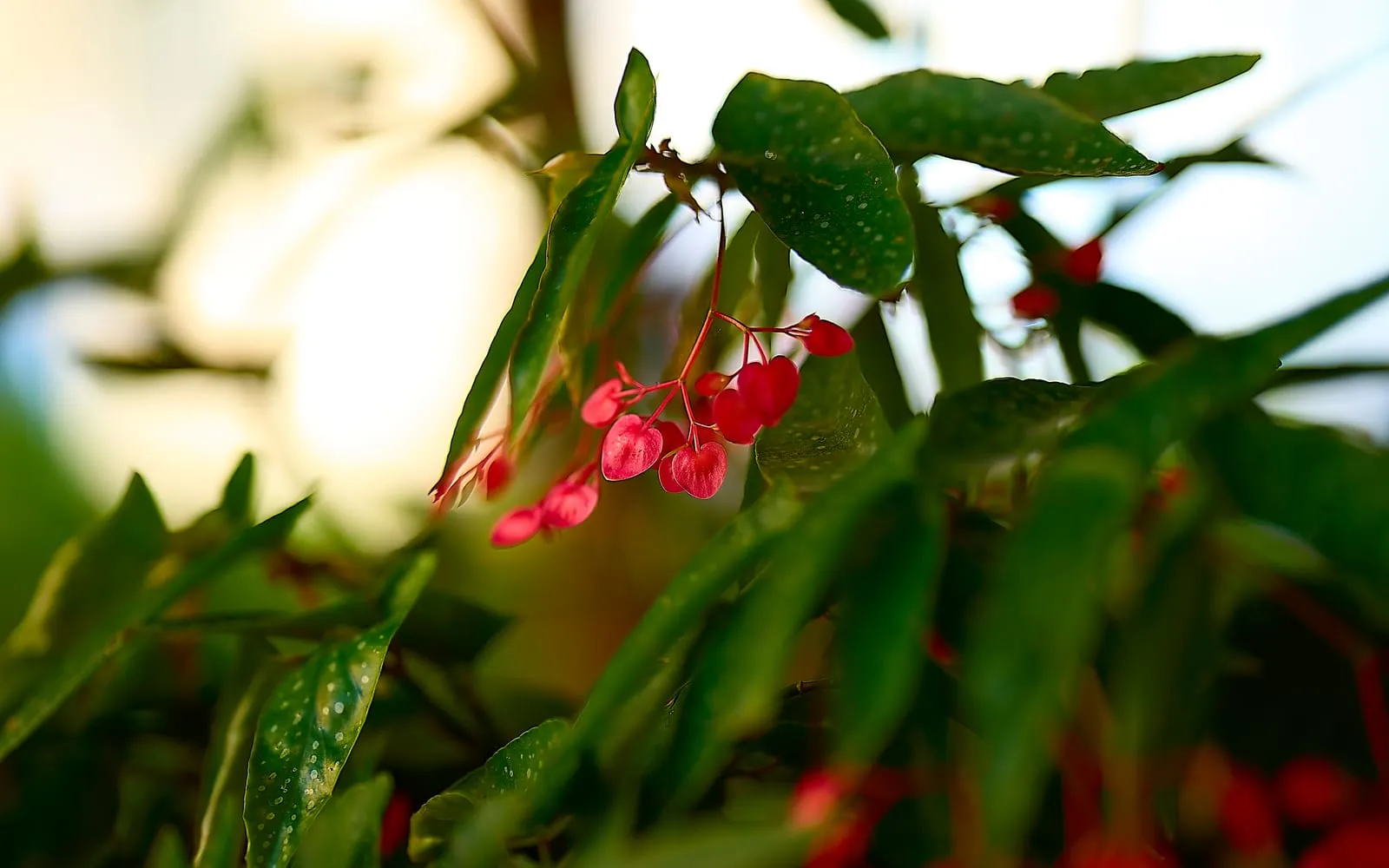
Angel wing begonia grows on tall, jointed canes that look remarkably like bamboo, with paired wing-shaped leaves marked by silver or pale spots standing out from the swollen node at each joint. Clusters of pink to red flowers hang from arching stems above the foliage for much of the warmer part of the year.
It grows fast for a begonia, reaching a metre or more in a single good season under the right conditions, and older canes can be cut back hard without harming the plant, which keeps a mature specimen from becoming permanently leggy the way some cane plants do.
Appearance and character
Leaves are asymmetrical and wing-shaped, one side noticeably larger than the other, olive to deep green above with irregular silvery-white spots and often a reddish or burgundy underside. A single leaf can reach 15 to 20 cm long on a well-grown plant.
Canes are upright, jointed and pale green, thickening and taking on a woodier look with age, marked at intervals by the swollen nodes each pair of leaves emerges from.
Flowers hang in loose, drooping clusters from arching stems above the foliage, typically pink to coral red, opening over an extended period through spring and summer rather than in one short flush.
Older canes eventually shed their lower leaves, leaving bare stem below a tuft of foliage at the top, which is normal rather than a sign of poor care. Regular pruning keeps that bare-cane habit under control.
Where it is from
Begonia coccinea is native to the Atlantic coastal region of Brazil, growing in the broken, dappled light found at a forest edge or clearing rather than in continuous deep shade or open sun.
That intermediate light level explains why the species tolerates brighter conditions than many shade-loving begonias while still scorching in unfiltered midday sun. Rainfall in its native range is frequent through much of the year, with humidity staying comfortably high, conditions the canes and thin-textured leaves use for fast growth.
The jointed, bamboo-like cane habit is itself an adaptation to that competitive, part-shaded environment, letting the plant grow tall fast to reach better light without investing in a thick woody trunk.
How it grows
Plant it in free-draining, peat-free houseplant compost with added perlite, which holds enough moisture for the fast-growing canes without staying wet for long after watering.
Give it bright indirect light, with an hour or so of gentle morning sun bringing out the best leaf colour and encouraging more flowers. Strong midday sun scorches the leaves, particularly through glass.
Pinch out the growing tips of young canes to encourage branching low down, since an unpinched plant tends to grow as a handful of tall, sparsely branched stems rather than a full, well-furnished clump.
Cut back one or two of the oldest canes to a low node each year, even on a healthy plant, to keep fresh growth coming from the base rather than letting the whole plant become tall and bare below.
Propagate easily from stem cuttings a few nodes long, rooted in water or damp compost; a cutting taken in spring or summer roots within a few weeks in a warm spot.
Through the seasons
Spring restarts strong growth. Resume fortnightly feeding, prune out one or two old canes to renew the clump, and repot if the roots have filled the pot.
Summer is the main growing and flowering season, with the fastest cane growth and the most flowers on a well-lit plant.
Autumn slows growth and flowering gradually. Reduce feeding towards the end of the season.
Winter is a quieter rest. Water more sparingly, keep the plant well away from cold draughts, and hold off feeding until spring.
Care difficulty
Moderate, and mostly a matter of keeping ahead of the plant’s fast growth rather than nursing anything delicate. Left unpruned for a year or two, a healthy plant can become tall, top-heavy and bare at the base, a problem solved easily with an annual cane renewal rather than one that threatens the plant’s health.
Humidity and airflow together are the other point to watch. Thin, fast-growing leaves brown at the edges in dry air, while still, damp air around dense foliage invites powdery mildew and grey mould, so good ventilation matters as much as humidity itself.
Watering
Water thoroughly until it runs from the drainage holes, then let the top few centimetres of compost dry before watering again, checking with a finger rather than on a strict schedule.
Avoid wetting the leaves when watering where possible, since standing water on the foliage in a still, humid room encourages both powdery mildew and grey mould.
Reduce watering over winter as growth slows, since compost kept consistently wet at lower temperature is a common cause of stem and root rot in this species.
Warning signs, diseases and pests
Powdery mildew shows as a white, dusty coating on the leaf surface, appearing most often where air is still and humidity swings between damp and dry. Improve air circulation around the plant and remove badly affected leaves.
Grey mould affects stems and flowers in cool, damp conditions, showing as a fuzzy grey coating on decaying tissue. Remove affected growth promptly and improve ventilation.
Mealybug settles in the leaf joints along the canes, showing as small white, cottony tufts. Remove them with a cotton bud dipped in surgical spirit.
Spider mite appears in hot, dry indoor air, showing as fine pale speckling on the leaves with faint webbing in bad cases. Raising humidity and wiping the leaves down regularly helps prevent it.
Growing environment
Bright indirect light suits it best, with a little gentle morning sun improving both leaf colour and flowering. Strong midday sun, especially through glass, scorches the thin leaves.
Keep the room between 16 and 27 deg C. Growth stalls below about 12 deg C, and the plant takes real cold damage close to its stated minimum temperature.
Humidity of 50% or more keeps the leaf edges from browning, though good airflow matters just as much, since still, humid air around dense foliage encourages fungal problems more than dry air does.
Free-draining compost with added perlite suits the fast-growing roots better than a dense, water-retentive mix.
Feeding
Feed fortnightly from spring to early autumn with a balanced liquid houseplant feed, diluted to the strength stated on the label, to support the plant’s fast growth through the warmer months.
Stop feeding over autumn and winter, when growth slows considerably and unused fertiliser only builds up as salts in the compost.
A plant that has just been cut back hard for renewal benefits from resuming feeding once new growth is clearly under way rather than immediately after pruning.
Troubleshooting
The plant has become tall and bare at the base. Normal on an unpruned cane begonia. Cut one or two of the oldest canes back to a low node in spring to encourage fresh growth from below, repeating the renewal each year from then on.
White powdery patches have appeared on the leaves. Powdery mildew, usually from still air around dense foliage. Improve ventilation, remove the worst affected leaves, and avoid crowding the plant against others.
Leaf edges are browning and crisping. Low humidity, most likely. Raise it with a grouping of plants or a pebble tray, and check the plant is not sitting too close to a heating vent.
Flower buds are forming but dropping before they open. Usually a sudden change in light, temperature or watering. Keep conditions as consistent as possible once buds have started to form.
Can I keep this plant small rather than letting it grow tall? Yes, with regular pinching of young growth and an annual hard prune of the oldest canes, which keeps the plant bushy and compact rather than tall and sparse.
Angel Wing Begonia problem guides
Not sure what is wrong? See the common houseplant pests guide.