
Outdoor plant
Judas Tree
Cercis siliquastrum
How to grow Judas tree, Cercis siliquastrum. The legend behind its name, why poor stony soil produces better flowers than a rich border, and why pruning in winter risks coral spot and canker.
At a glance
- Difficulty
- Easy
- Water
- Regularly while young, then rarely once established
- Light
- Full sun
- Temperature
- Fully hardy, but needs a hot dry summer to flower and ripen wood well
- Hardiness
- USDA 6-9, RHS H5, hardy to -18 C
- Type
- Deciduous tree, often low-branched and wide-crowned
- Height
- 6-10 m
- Native to
- the eastern Mediterranean, western Asia
Takes a real winter without damage once its wood is properly ripened, but that ripening is the part the zone number leaves out. It comes from a hot, dry Mediterranean summer, and in a cool, wet, cloudy climate the young growth stays soft into autumn and is then more readily damaged by the same cold an established tree from a sunnier garden tolerates. Give it the hottest, most open spot available and poor rather than rich soil, and it copes with a colder winter than its native range would suggest.
Hardiness zones describe winter cold alone. Summer heat, humidity, rainfall and the length of the growing season decide as much, so treat the range as the outer limit rather than as a recommendation.
Not known to be toxic
- Safe to eat
- The spring flowers, eaten raw in salads or fried, in the tree's native region
Judas tree is not listed by the RHS among potentially harmful garden plants and does not appear on the ASPCA's toxic plant index for cats, dogs or horses. As with its American relative the eastern redbud, the flowers have a long history as food rather than as a hazard, eaten raw in salads or dipped in batter and fried across parts of Greece, Turkey and the Levant, where the tree grows wild. No part of it carries a recorded toxin, and it is planted in gardens, streets and courtyards throughout the Mediterranean without any safety warning attached to it.
Sources: RHS potentially harmful garden plants, ASPCA toxic and non-toxic plants
About
Judas tree carries a legend most gardeners learn before they learn anything about how to grow it. Tradition holds that Judas Iscariot hanged himself from a tree of this species after betraying Christ, and that the flowers, once white, have blushed pink with shame ever since. The story has no botanical basis, but it has followed the tree through centuries of European gardening and given it a name that a straight description of its flowers never would have.
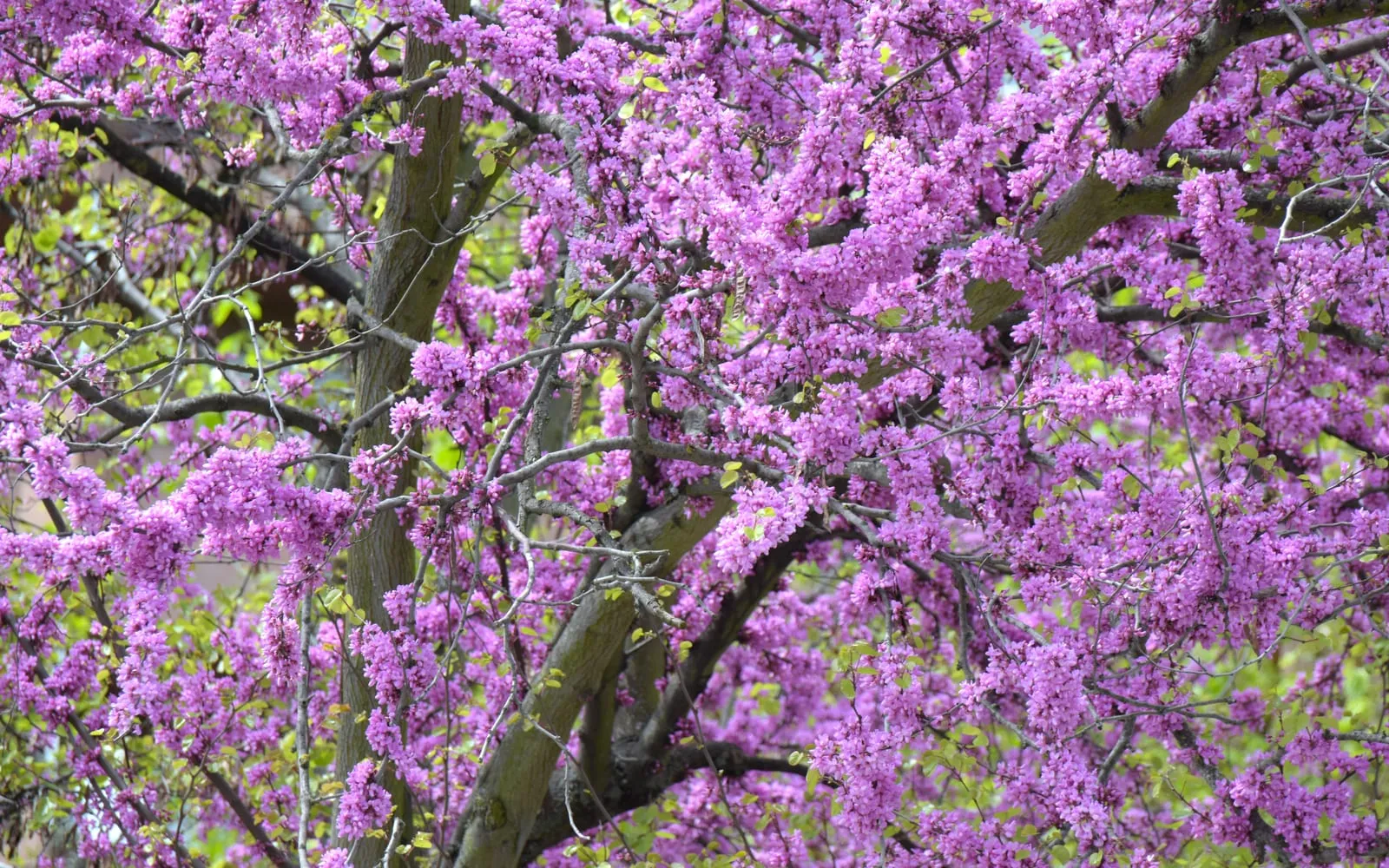
Set the legend aside and it is one of the most reliable small flowering trees for a hot, dry, sunny garden. Rosy-purple pea-flowers cover the bare branches, older wood and sometimes the trunk itself in mid spring, opening before the heart-shaped leaves and giving a mature tree in full bloom a solid, almost startling block of colour against bare stone or a pale wall.
It thrives on neglect in a way few ornamental trees do, performing best in poor, stony soil and a position too hot and dry for most other flowering trees to enjoy.
Appearance and character
Flowers open in mid to late spring, small, pea-shaped and a rich rosy-purple, clustered densely along two-year and older wood, on the main branches and, on an older tree, occasionally straight from the trunk, before any leaves have appeared.
Leaves follow the flowers, rounded to heart-shaped, 7 to 12 cm across, blue-green and slightly glaucous, giving the tree a soft, cool-toned canopy through summer quite different from the flowers that preceded it.
Flat, papery seed pods 6 to 10 cm long develop through summer, purplish at first and ripening to brown, hanging in clusters and often persisting on the bare branches well into winter.
Bark on an older trunk is dark grey-brown and develops a rough, scaly texture with age. The tree is very often low-branched or multi-stemmed from close to ground level rather than carrying a single tall trunk, giving mature specimens a broad, wide-spreading, almost umbrella-like outline.
Where it is from
Cercis siliquastrum grows wild across the eastern Mediterranean and into western Asia, from southern Europe through Turkey, the Levant and Iran, typically on dry, rocky hillsides and open scrubland where summers are long, hot and rainless.
That native habitat explains the tree’s strong preference for poor, free-draining soil and full sun over anything richer or shadier. Wild populations grow in ground that would leave many garden trees struggling, and cultivated specimens perform best when given a similar lean, sun-baked position rather than the fertile, well-watered border that suits most flowering trees.
It has been cultivated since Roman times and was one of the earliest Mediterranean trees introduced to northern European gardens, where its tolerance of poor chalky soil made it a natural fit for exactly the dry, alkaline ground that defeats many other ornamental trees.
How it grows
Plant in full sun, in poor to moderately fertile, sharply drained soil, including chalk, limestone and stony ground where richer soil would be needed for most other flowering trees. Rich, moisture-retentive soil produces soft, leafy growth at the expense of flowering and makes the wood more vulnerable to winter cold.
Choose the hottest, most open position available. A wall-backed spot that bakes in summer sun suits it particularly well, both ripening the wood ahead of winter and encouraging the heaviest flowering the following spring.
Water regularly through the first couple of growing seasons while a young tree establishes, then step back almost entirely. An established Judas tree is drought-tolerant and resents being kept consistently moist far more than it resents being left dry.
Prune, if at all, only to remove dead, damaged or crossing wood, done in mid to late summer rather than winter, since major pruning wounds made during the dormant season are more prone to coral spot and canker infection on this species.
Avoid moving an established tree. As with its American relative, it develops a taproot that makes transplanting difficult once the tree is past its first couple of seasons.
Through the seasons
Mid spring brings the main flowering display on bare wood, the tree’s defining moment, followed shortly by the blue-green leaves.
Summer is quiet growth in full sun and heat, with flat purplish seed pods forming and, given a warm dry season, the wood ripening well ahead of winter.
Autumn turns the leaves a modest yellow before they drop, while the brown seed pods often remain hanging on the bare branches.
Winter is dormant. An established tree in a well-drained, sunny position takes real cold without damage, though a young tree in a cool, wet climate can be caught out if the previous summer was poor.
Care difficulty
Easy, and notably more tolerant of poor soil and neglect than most small flowering trees. Once established in a sunny, well-drained position, it needs almost nothing from the gardener: no routine feeding, minimal pruning, and no watering beyond an occasional deep soak in a severe drought.
The one condition it insists on is drainage and heat rather than richness, and a Judas tree planted in heavy, moisture-retentive soil or deep shade performs poorly regardless of how much other care it receives.
Watering
Water deeply through the first two growing seasons after planting, allowing the soil to dry out between waterings rather than keeping it consistently moist, since this is a species adapted to a long dry Mediterranean summer rather than to steady rainfall.
Once established, an occasional deep soak during a prolonged, severe drought is usually all that is needed, and in most temperate climates even that is rarely necessary.
Good drainage matters far more than watering discipline. A Judas tree sitting in heavy, waterlogged winter ground declines regardless of how carefully summer watering is managed.
Warning signs, diseases and pests
Coral spot shows as small, raised, coral-pink pustules on dead or damaged wood, and can spread into adjoining live tissue if the infected wood is left in place. Prune out and destroy affected branches promptly, cutting back into clean healthy wood well beyond any visible staining.
Bacterial canker produces sunken, cracked patches on the bark of stems and branches, occasionally oozing and sometimes killing the wood beyond the canker. Prune out affected growth well below the visible damage and avoid unnecessary wounding of the bark, since the bacteria typically enter through existing damage.
Leaf spot causes small brown or tan spots to appear across the foliage in a wet summer, cosmetic on an otherwise healthy tree, and clearing fallen leaves in autumn reduces the following year’s source of reinfection.
Honey fungus occasionally attacks a stressed or waterlogged tree, showing as gradual dieback and, eventually, fungal growth visible at the base near soil level. There is no reliable cure once it takes hold.
Growing environment
Full sun is essential, and the hotter and more open the position, the better the tree flowers and the better its wood ripens ahead of winter.
Poor to moderately fertile, sharply drained soil suits it best, including chalk and stony ground that would leave richer-loving trees struggling. Avoid heavy clay or any position where water collects over winter.
A sheltered, wall-backed or south-facing spot particularly benefits a young tree or one grown at the cooler end of its hardiness range, both for flowering and for winter hardiness.
Allow room for a broad, low-branched crown. Left unpruned, the species naturally spreads wide from close to the base rather than rising as a single clear trunk.
Feeding
Little to no supplementary feeding is needed, and a Judas tree grown in rich, well-fed soil typically flowers less freely and produces soft growth more vulnerable to winter damage than one grown hard in poor ground.
A young establishing tree can take a light balanced feed in spring if growth seems slow, but an established specimen in reasonably poor, well-drained soil needs nothing further.
Avoid mulching thickly with rich organic matter close to the trunk, for the same reason: this species performs best kept lean rather than fed generously.
Troubleshooting
Is this the tree from the Bible story? That is the tradition behind the common name, that Judas Iscariot hanged himself from a tree of this species and its flowers turned from white to pink from shame. It has no botanical basis, but it has stuck to the plant for centuries across Europe.
Why hasn’t my tree flowered well this year? Most often a cool, wet previous summer that failed to ripen the wood properly, or soil too rich and moist for the tree’s liking. A hot, dry, sunny position and poor rather than fertile soil produce the heaviest flowering.
The bark has sunken, cracked patches oozing on one branch. Likely bacterial canker. Prune out the affected wood well below the visible damage and avoid wounding the bark elsewhere, since the bacteria enter through existing damage rather than sound wood.
Can I eat the flowers? Yes, in the tree’s native Mediterranean region the flowers are traditionally eaten raw in salads or fried in batter. Only eat flowers from a tree you can positively identify and that has not been treated with garden chemicals.
Why does my tree have several trunks instead of one? This is the species’ natural habit rather than a fault. Left unpruned, it usually branches low and wide from close to the base, and correcting it to a single trunk needs deliberate early pruning while the tree is young.