
Houseplant
Xanadu
Philodendron xanadu
Also known as Winterbourn, Thaumatophyllum xanadu, Philodendron Winterbourn
How to care for Philodendron xanadu. The self-heading philodendron that spreads sideways instead of climbing, why it needs floor space rather than a pole, and where the plant came from.
At a glance
- Difficulty
- Easy
- Water
- When the top third of the compost has dried
- Light
- Bright indirect light, and it tolerates moderate shade
- Temperature
- 18-27 deg C, and never below 12 deg C
- Humidity
- Moderate. More forgiving of dry air than the climbing philodendrons
- Hardiness
- USDA 9b-11, RHS H1c, hardy to 5 C
- Type
- Evergreen perennial, self-heading and long-lived
- Height
- 60-120 cm tall and as wide again
- Native to
- Brazil
Subtropical to tropical Brazil, in warm humid forest with no frost and a wet growing season. It is slightly hardier than most philodendrons and an established plant survives brief dips to around 5 deg C outdoors, though growth stops well above that. It wants warmth, humidity and shade from strong sun, and it will not take a dry cold winter or a hard frost anywhere.
Hardiness zones describe winter cold alone. Summer heat, humidity, rainfall and the length of the growing season decide as much, so treat the range as the outer limit rather than as a recommendation.
Toxic if eaten
- Do not eat
- Every part, and the sap most of all
- Harm from
- Eating it and handling it
- Affects
- People, cats and dogs
Like the rest of the arum family, this plant carries needle-shaped calcium oxalate crystals called raphides in its tissues. Chewing a leaf or stem drives them into the soft lining of the mouth, causing immediate burning, drooling, swelling of the lips and tongue and difficulty swallowing. The ASPCA lists Philodendron as toxic to cats and dogs on that basis and the same mechanism applies to people. Serious harm is uncommon because the pain starts at once, but swelling reaching the airway is an emergency in a small animal. The sap irritates skin, so wear gloves when dividing or cutting the plant. A xanadu sits at floor level and spreads wide, which puts a great deal of chewable leaf exactly at the height of a dog or a toddler, and that is worth thinking about before choosing where to stand it.
Sources: ASPCA (Philodendron), RHS potentially harmful garden plants
About
Most philodendrons sold as houseplants climb. Xanadu does not. It is a self-heading philodendron, meaning it builds a short thick trunk and throws its leaves outward in a rosette, spreading sideways into a low dome rather than reaching for a trunk to scale.
That changes what you need to give it. There is no pole to buy and no training to do, and the requirement instead is floor space, because a mature plant covers a square metre and looks wrong crammed against a wall.
It also handles ordinary rooms better than most of the family. The leaves are thicker and stiffer than a heartleaf philodendron’s, it tolerates drier air, and it will take a position with moderate shade without stretching. It is the philodendron to choose when you want a substantial floor plant and do not want to manage a climber.
Appearance and character
A low spreading evergreen perennial with a short, thick, ringed trunk that stays mostly hidden under the foliage until the plant is old.
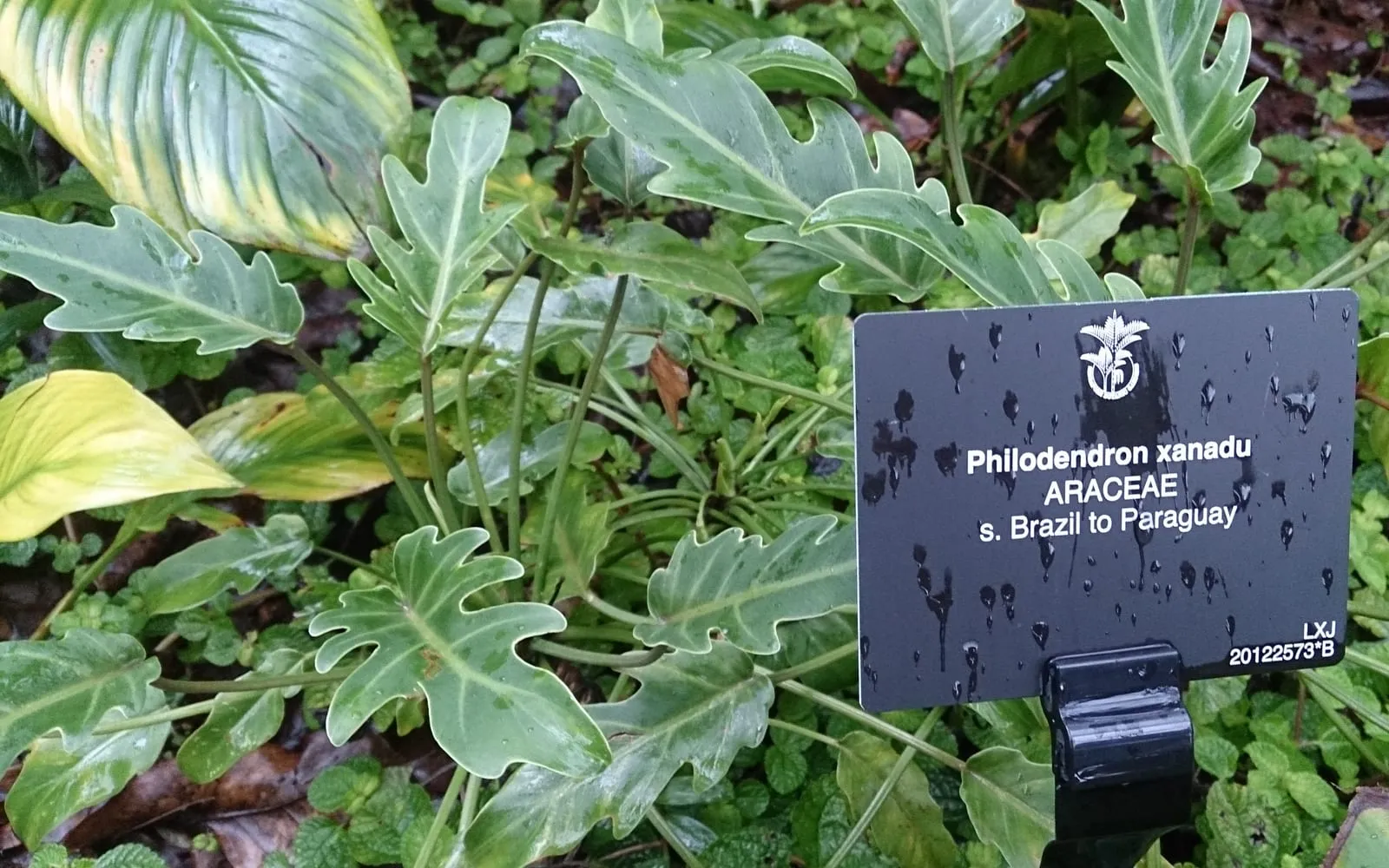
The leaves are the feature. Each is deeply lobed, with fifteen to twenty pairs of finger-like divisions cut almost to the midrib, glossy mid to deep green, and 30 to 40 cm long on a long stiff petiole. The overall effect is of a much larger plant seen at small scale.
Juvenile leaves are far less divided and can be almost entire, which confuses people who buy a small plant expecting the lobing. The divisions develop as the plant matures.
Growth is moderate, adding a ring of new leaves each season and widening steadily. A plant reaches 60 to 120 cm tall and rather more across.
Old lower leaves yellow and are shed as the plant grows, exposing more of the trunk over the years. That is normal and is how a self-heading aroid ages.
Flowering indoors is rare, producing the usual arum spathe in dark red at the base of the plant, where it is easily missed.
Where it is from
Southern Brazil, in warm humid subtropical forest.
Its origin was disputed for years. The plant appeared in Australian nurseries in the 1980s and was patented there as ‘Winterbourn’, and it was widely assumed to be a hybrid raised in cultivation. It was later matched to wild Brazilian material and accepted as a species.
The taxonomy moved again more recently. The self-heading philodendrons with this growth habit were separated into the genus Thaumatophyllum, so botanical literature increasingly calls this Thaumatophyllum xanadu while the trade continues with Philodendron. Both names refer to the same plant.
Its subtropical rather than equatorial range is why it takes a cooler room than most philodendrons and why an established plant outdoors in a mild climate survives temperatures that would finish a heartleaf.
How it grows
Give it bright indirect light for the best leaf division, and accept slower, less divided growth in moderate shade.
Keep it out of direct sun, which bleaches and scorches the leaves.
Give it room. Plan for a spread of a metre or more and stand it where the leaves can extend without being crushed against furniture.
Water when the top third of the compost has dried, thoroughly, and let it drain.
Keep it above 12 deg C and ideally between 18 and 27 deg C.
Feed monthly at half strength through spring and summer.
Repot every two or three years in spring into a free-draining mix with bark through it, moving up one pot size. Use a wide heavy pot rather than a tall one, since the plant is top-heavy and spreading.
Rotate the pot every few weeks so the rosette develops evenly rather than leaning towards the light.
Remove yellowed lower leaves at the base with secateurs. The plant will not regrow leaves lower down the trunk, so tidying is the only option there.
Through the seasons
Spring brings the year’s main flush. Resume feeding, repot if the pot is full, and expect several new leaves in quick succession.
Summer is steady growth. Water when the top third dries, feed monthly, and keep the plant out of direct sun.
Autumn slows it. Reduce watering, stop feeding from October, and move it nearer the light as the days shorten.
Winter is quiet. Water sparingly, keep it above 12 deg C, and expect no new leaves until spring.
Care difficulty
Easy, and one of the more forgiving aroids for a normal room.
Space is the practical difficulty. People buy a compact young plant and find themselves with something a metre across in four or five years.
Overwatering is the way it dies. The short trunk rots at the base in compost that stays wet, and the collapse is sudden once it starts.
Leaf division disappoints on young plants and in low light. Juvenile leaves are much less lobed, and a plant in moderate shade keeps that juvenile look longer.
Mealybug hides well in the crowded petiole bases, which are hard to inspect on a full plant.
Watering
Water when the top third of the compost has dried, roughly weekly in summer in a warm room and every two to three weeks in winter.
Water thoroughly until it drains from the bottom, then empty the saucer.
Water around the plant rather than into the crown. Water sitting among the crowded petiole bases encourages rot at exactly the point where the plant is most vulnerable.
Use rainwater or filtered water where the supply is hard, since salts accumulate and brown the leaf edges.
Underwatering shows as drooping petioles across the whole rosette, and the plant lifts again within hours of watering.
Overwatering shows as yellowing lower leaves in numbers, a soft trunk base and a sour smell from the compost.
Warning signs, diseases and pests
Yellowing lower leaves one at a time are normal ageing on a self-heading plant. Several at once with soft petioles is overwatering.
A soft, dark, collapsing trunk base is rot and is usually fatal by the time it is visible. Reduce watering long before that point.
Leaves that stay entire or barely lobed on a plant of some size mean either youth or insufficient light. Move it brighter and give it time.
Brown crisp edges are dry air or fertiliser salts. Raise the humidity a little and flush the compost through.
White cottony fluff deep in the petiole bases is mealybug. Part the leaves and check the centre of the plant, which is where they establish unseen.
Small flat brown discs on the petioles and leaf undersides are scale insects.
Fine pale stippling is red spider mite in dry heated air, which is less common on this plant than on thinner-leaved philodendrons.
A plant leaning heavily to one side has been left unrotated. Turn it a quarter each time you water.
Growing environment
Bright indirect light for the best leaf shape, and it accepts moderate shade at the cost of division and speed.
Never direct sun.
Warm, 18 to 27 deg C, with 12 deg C as the floor.
Moderate humidity, and it copes with ordinary dry room air better than most philodendrons.
Free-draining peat-free compost with orchid bark or perlite mixed through, in a wide heavy pot with drainage holes.
Floor space for a spread of a metre or more at maturity.
Outdoors it grows in shade in frost-free and near-frost-free climates, roughly USDA 9b and warmer, and it is used as landscape ground cover in those regions.
Avoid direct sun, cold winter draughts and narrow pots that let a top-heavy plant fall.
Feeding
Feed monthly from spring to early autumn with a balanced liquid houseplant fertiliser at half the strength on the label.
Stop feeding from mid-autumn to early spring.
Feed less in a shaded position, where the plant makes little growth and unused fertiliser accumulates as salts.
Repot every two or three years in spring, into a wide pot one size up with a chunky free-draining mix.
Top-dress a large plant instead of repotting, replacing the top few centimetres of compost each spring.
Troubleshooting
My leaves are not divided like the ones in the shop. Either the plant is young, since juvenile leaves are barely lobed, or it is short of light. Both fix themselves with time in a brighter position.
Does it need a moss pole? No. This is a self-heading philodendron and it spreads sideways rather than climbing. It needs floor space instead.
How big does it get? Around 60 to 120 cm tall and rather more across. Plan for a metre of floor.
The lower leaves keep going yellow. One at a time is normal as the plant grows upward on its short trunk. Several at once means the compost is too wet.
Is it safe with a dog? No. It carries calcium oxalate raphides and the ASPCA lists philodendrons as toxic to cats and dogs. A plant this shape puts a lot of leaf at dog height.
Is it a Philodendron or a Thaumatophyllum? Both names are current. Botanists moved the self-heading group into Thaumatophyllum; the trade still labels it Philodendron. It is the same plant.
It is leaning to one side. It has been growing towards the light without being turned. Rotate the pot a quarter turn every time you water.
White fluff in the middle of the plant. Mealybug, sheltering in the crowded petiole bases. Part the leaves to treat the centre, which is where they hide.
Xanadu problem guides
Not sure what is wrong? See the common houseplant pests guide.