
Houseplant
Torch Plant
Aloe arborescens
Also known as Krantz Aloe, Candelabra Aloe
How to grow torch plant, Aloe arborescens. Why it flowers in winter rather than the summer most aloes choose, how it resprouts after wildfire in its native range, and why a plant kept in a small pot may never flower at all.
At a glance
- Difficulty
- Easy
- Water
- Only once the soil has dried out, reduced substantially in winter
- Light
- Full sun
- Temperature
- Above 2 deg C outdoors; tolerates a brief light frost once established
- Hardiness
- USDA 9-11, RHS H3, hardy to -6 C
- Type
- Evergreen succulent shrub
- Height
- 2-3 m grown outdoors; considerably smaller and slower in a pot
- Native to
- southern Africa
More cold-tolerant than most aloes, since plants from the cooler, higher parts of its range regularly take a light winter frost outdoors and resprout after wildfire, a trait few succulents share. The zone range still says nothing about the strong, near-constant sun it grows in in the wild, and a plant given real winter cold but weak indoor light grows soft and pale rather than the tight, upright form it takes outdoors.
Hardiness zones describe winter cold alone. Summer heat, humidity, rainfall and the length of the growing season decide as much, so treat the range as the outer limit rather than as a recommendation.
Harmful to cats and dogs if eaten
- Do not eat
- The leaf sap
- Harm from
- Eating it and handling it
- Affects
- Cats and dogs
The ASPCA lists Aloe as a genus toxic to cats and dogs, and torch plant carries the same saponins and anthraquinones as the aloes better known for causing pet poisoning. Eating leaf material typically brings on vomiting, diarrhoea, lethargy or a change in urine colour, usually mild and resolving without treatment, though a vet visit is worth it for any animal that has eaten a significant amount. The sap can also irritate skin on contact, particularly during pruning of the older, tougher leaves, so gloves are sensible. It is not listed among the RHS potentially harmful garden plants, and there is no record of it posing a serious risk to people beyond mild skin irritation from the sap.
Sources: ASPCA toxic and non-toxic plants, RHS potentially harmful garden plants
About
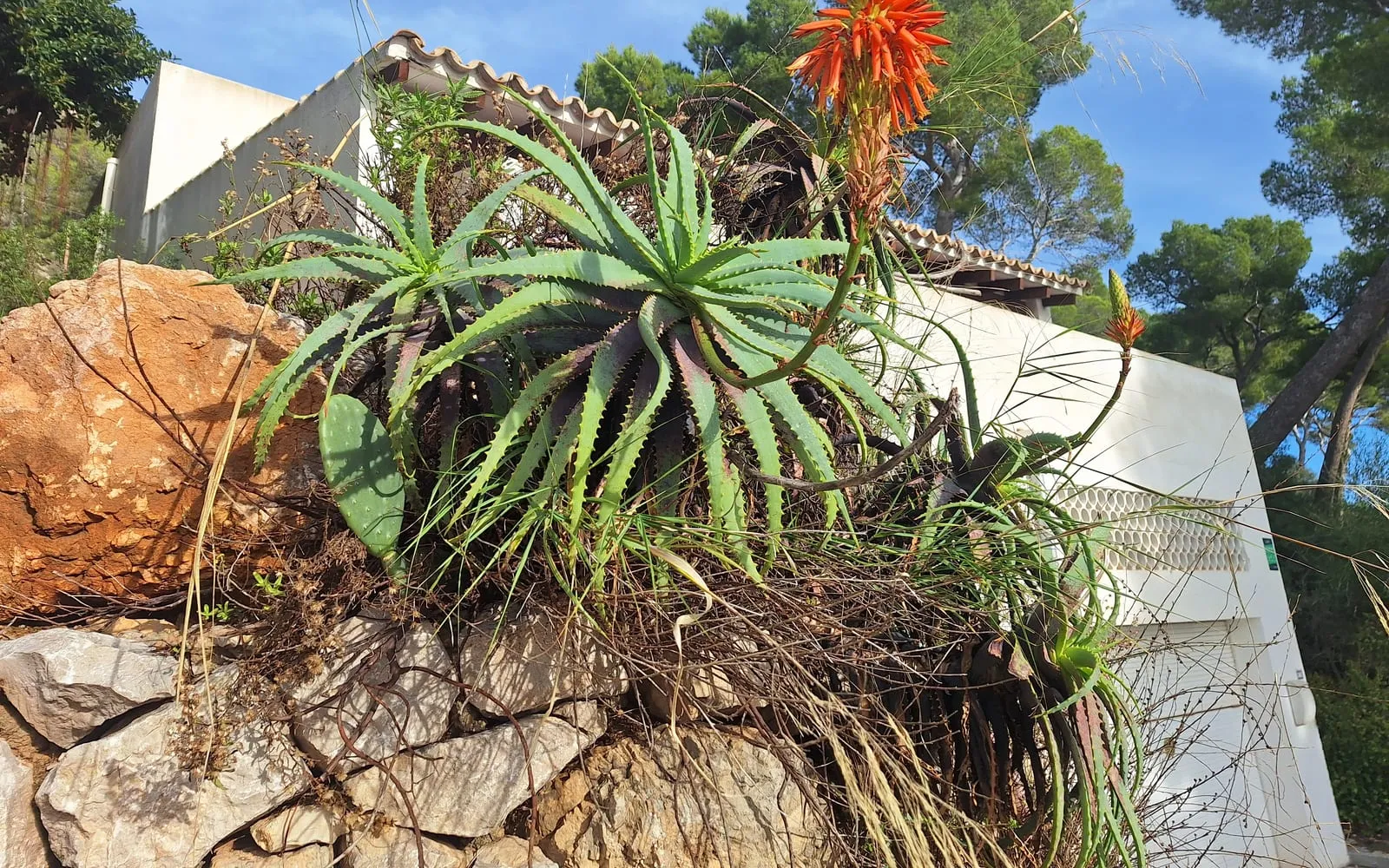
Torch plant is a large, shrubby aloe, branching repeatedly from the base into a sprawling clump of rosettes rather than staying as the single, stemless rosette most houseplant aloes form. Given time and space it becomes a substantial plant, several branches wide and armed all over with narrow, toothed, grey-green leaves.
Its most distinctive habit is when it flowers. Where most aloes bloom in summer, torch plant produces its bright red-orange flower spikes in winter, a trait tied to the flowering pattern of southern African plants that time their display to when nectar-feeding birds most need it. Grown in a pot indoors it stays far smaller and may never flower, but it keeps the same architectural, multi-branched habit even at a fraction of its outdoor size.
Appearance and character
Each rosette carries narrow, recurved leaves in a grey-green that sometimes takes on an orange or reddish tinge under strong sun or stress, edged along both sides with small, pale teeth. The leaves are noticeably softer and more pliable than those of many rosette-forming aloes, bending rather than snapping if handled roughly.
Branching is the plant’s real character. New rosettes form along older stems as well as from the base, so a mature specimen builds outward into a dense thicket of growth over years rather than staying a single tidy clump, and old, leafless stem sections toughen and darken as the plant ages.
Flower spikes rise well above the foliage on a tall, sparsely branched stalk, each one carrying dozens of tubular, red to orange flowers packed tightly from base to tip in a shape that gives the plant its common name. A well-established outdoor clump can produce several spikes from different rosettes in the same winter.
Where it is from
Aloe arborescens grows across a broad stretch of southern Africa, from South Africa north through Mozambique, Zimbabwe and Malawi, typically on rocky ridges, outcrops and hillsides in summer rainfall country. It is one of the more fire-adapted aloes in the region, resprouting readily from its base after the periodic wildfires that sweep through the grassland and scrub it grows among.
That fire and frost tolerance, unusual among aloes, comes from the relatively high, cooler parts of its range, where winter nights can drop close to freezing. The trade-off is a plant that needs strong, close to unfiltered sun to keep its compact, upright form. Indoors, even a bright window rarely matches the light intensity it gets outdoors, and growth softens and leans towards the glass in response.
How it grows
Plant it in free-draining, gritty soil or a coarse succulent mix, in as much direct sun as the space allows. It tolerates poor, sandy soil far better than it tolerates wet feet, and drainage matters more here than fertility.
Give it room to spread. A young plant looks like a single rosette for a while, but new branches soon appear from the base and, on older growth, from part way up existing stems, so a plant that starts compact needs considerably more space within a few years.
Where the climate allows, grow it outdoors year round in a sheltered, sunny spot; it tolerates an occasional light frost once established, though repeated hard frost damages or kills the exposed rosettes. In a colder climate, grow it in a large pot that can move under cover for winter.
Propagate from offsets or stem cuttings, both of which root readily in a gritty mix left dry for a few days after cutting to let the wound callus over before it goes in.
Through the seasons
Spring brings the start of active growth. Increase watering gradually and resume feeding once new leaves are clearly forming.
Summer is the main growing season, with steady watering, full sun and active branching in an outdoor or well-lit plant.
Autumn slows growth. Reduce watering as light and temperature drop, and bring a potted plant under cover before the first frost is expected.
Winter brings the flower spikes on a mature outdoor plant. Water very sparingly and keep an indoor plant in the brightest spot available.
Care difficulty
Easy, and forgiving of neglect in a way few large succulents manage, provided drainage and light are both good from the start. The plant’s size is the main practical consideration rather than any fussiness in its care. A torch plant kept in a small pot for years stays healthy but small and rarely flowers, while one given room to spread outdoors becomes a substantial, largely self-sufficient shrub within a few seasons.
Watering
Let the soil dry out before watering again, judging by touch rather than a fixed schedule, since the interval shifts through the year with light, temperature and whether the plant is in a pot or open ground.
Water more generously through the growing season than most people expect for a succulent this drought tolerant, since a plant given a proper soak followed by a full dry spell grows faster and branches more freely than one kept permanently on the dry side. Cut back hard in winter regardless.
Warning signs, diseases and pests
Gall mites cause distorted, tumour-like growths at the centre of a rosette, disfiguring new growth so badly that the affected rosette is usually best cut out and destroyed entirely rather than treated, since the mites are difficult to eliminate once established and spread readily to neighbouring rosettes.
Mealybug hides in the leaf bases and around developing offsets, showing as small white, cottony tufts. Treat with horticultural soap, checking the tightly packed leaf bases carefully since that is where an infestation tends to start.
Scale insects fix themselves along older leaves, appearing as small, flat, brownish bumps. Scrape them off and treat the same way as mealybug, watching new growth over the following weeks.
Root rot follows soil that stays wet, particularly in winter, and shows as a rosette that softens and discolours from the base. Cut away affected tissue, let the remainder dry, and replant into fresh, free-draining soil.
Growing environment
Full sun is what this plant needs above almost anything else. A rosette kept too shaded grows loose and pale and rarely, if ever, flowers, where one in strong sun stays compact and colours up with an orange or reddish tint at the leaf tips.
Outdoors it tolerates a brief light frost once well established, though sustained cold below about minus 2 to 3 deg C damages or kills exposed growth. Bring a potted plant under cover once night temperatures start dropping close to freezing.
Free-draining, gritty soil matters more than fertility. It grows perfectly well in poor, sandy ground that would starve most garden plants, and struggles far more in rich, moisture-retentive soil that stays wet after rain.
No particular humidity is needed. It is equally at home in a dry, Mediterranean-style garden and in an ordinary centrally heated room, provided the light is strong enough.
Feeding
Feed with a balanced houseplant fertiliser or a cactus and succulent feed, diluted to around half strength, monthly through spring and summer.
An outdoor plant in reasonable soil often needs little to no supplementary feeding at all, since it is adapted to naturally poor ground; feeding is more useful for a plant confined to a pot, where nutrients are not replenished by the surrounding soil.
Stop feeding entirely from autumn through winter, when growth slows sharply and unused fertiliser accumulates as salts rather than being taken up.
Troubleshooting
My plant has never flowered. Most likely light or size. It needs full sun and a reasonably mature, well-established clump before it flowers, and a plant kept in a small pot indoors may never reach that stage. Moving it outdoors into full sun for the growing season, where the climate allows, is the biggest single improvement you can make.
The rosettes have gone loose and pale. Too little light. Move the plant to the brightest spot available, ideally full outdoor sun for at least part of the year, and expect new growth to come in tighter and more colourful once it does.
A rosette has developed a lumpy, distorted growth at its centre. Gall mites, most likely. Cut out and destroy the affected rosette rather than trying to treat it in place, since the mites are hard to eliminate once established and readily spread to healthy growth nearby.
Can it survive outdoors through a UK winter? Only in the mildest coastal areas, and even then with some frost protection on the coldest nights. Most gardens outside zone 9 need to grow it in a pot that comes under cover for winter.
The base has gone soft and dark. Root rot from waterlogged soil. Cut away the affected tissue, let the remainder dry out, and replant into fresh, free-draining soil, then water considerably less often going forward.
Torch Plant problem guides
Not sure what is wrong? See the common houseplant pests guide.