
Houseplant
Desert Rose
Adenium obesum
Also known as Impala Lily, Sabi Star
Practical guidance for growing desert rose, Adenium obesum, including the swollen caudex, dry dormancy, bright light, sparing water, severe toxicity, and repotting a bonsai-like base.
At a glance
- Difficulty
- Moderate
- Water
- Sparingly, only once the mix is fully dry, and much less in winter
- Light
- Full sun to bright light, with several hours of direct sun
- Temperature
- Above 10 deg C
- Humidity
- Low; average room humidity is fine
- Hardiness
- USDA 10b-11, RHS H1b, hardy to 10 C
- Type
- Evergreen to semi-deciduous succulent shrub, long lived
- Height
- 1-1.5 m in a pot, taller with age in the ground
- Native to
- sub-Saharan Africa, the Arabian Peninsula
Native across the dry savanna and semi-desert belt from the Sahel to Arabia, where a long dry season with almost no rain shapes the whole plant. The swollen caudex is a water store built for that drought, not a cold-season adaptation, and the plant has essentially no frost tolerance. Below 10 deg C it drops leaves and stops growing; sustained cold and wet together kill the roots.
Hardiness zones describe winter cold alone. Summer heat, humidity, rainfall and the length of the growing season decide as much, so treat the range as the outer limit rather than as a recommendation.
Poisonous if eaten
- Do not eat
- The milky sap in every part, most concentrated in the roots and stem
- Harm from
- Eating it and handling it
- Affects
- People, cats, dogs and horses
Desert rose contains cardiac glycosides, the same class of compound found in oleander and foxglove, and its sap has a long history of use as an arrow poison in parts of its native range. The ASPCA lists Adenium obesum as toxic to cats and dogs, causing vomiting, sometimes bloody diarrhoea, disorientation, weakness, an abnormal heart rate and, in a large enough dose, potentially fatal cardiac effects. The same compounds affect people and horses. Contact with the sap can also irritate skin and eyes. This is not a plant to keep where a pet or small child might chew a stem or dig into the pot, and any suspected ingestion is a genuine emergency rather than something to watch and wait on.
Sources: ASPCA (Desert Rose, Adenium obesum), RHS potentially harmful garden plants
About
Desert rose stores its history in its base. The swollen, woody caudex at soil level, tapering upward into thick, fleshy branches, is a water reserve built for a homeland where rain arrives for a few months and then stops completely. Left to develop, older specimens are often trained to show off that caudex the way a bonsai grower trains a trunk, part-exposed above the soil surface.
Above the caudex it flowers generously in the right conditions, producing trumpet-shaped blooms in shades from pale pink to deep crimson over a long season. To flower well, it needs a dry winter dormancy. Its sap is seriously toxic if eaten, so place and handle the plant with care.
Appearance and character
The caudex is unmistakable: a bulbous, grey-brown woody base that can reach 20 to 30 cm across on an old plant, smooth-barked and often lifted partly out of the compost to show its shape. Branches emerge from the top, thick and succulent when young, hardening into true wood with age.
Leaves are glossy, dark green and slightly leathery, clustered towards the branch tips, and the plant drops most or all of them during a cold or dry rest period, a normal part of its cycle rather than a sign of trouble.
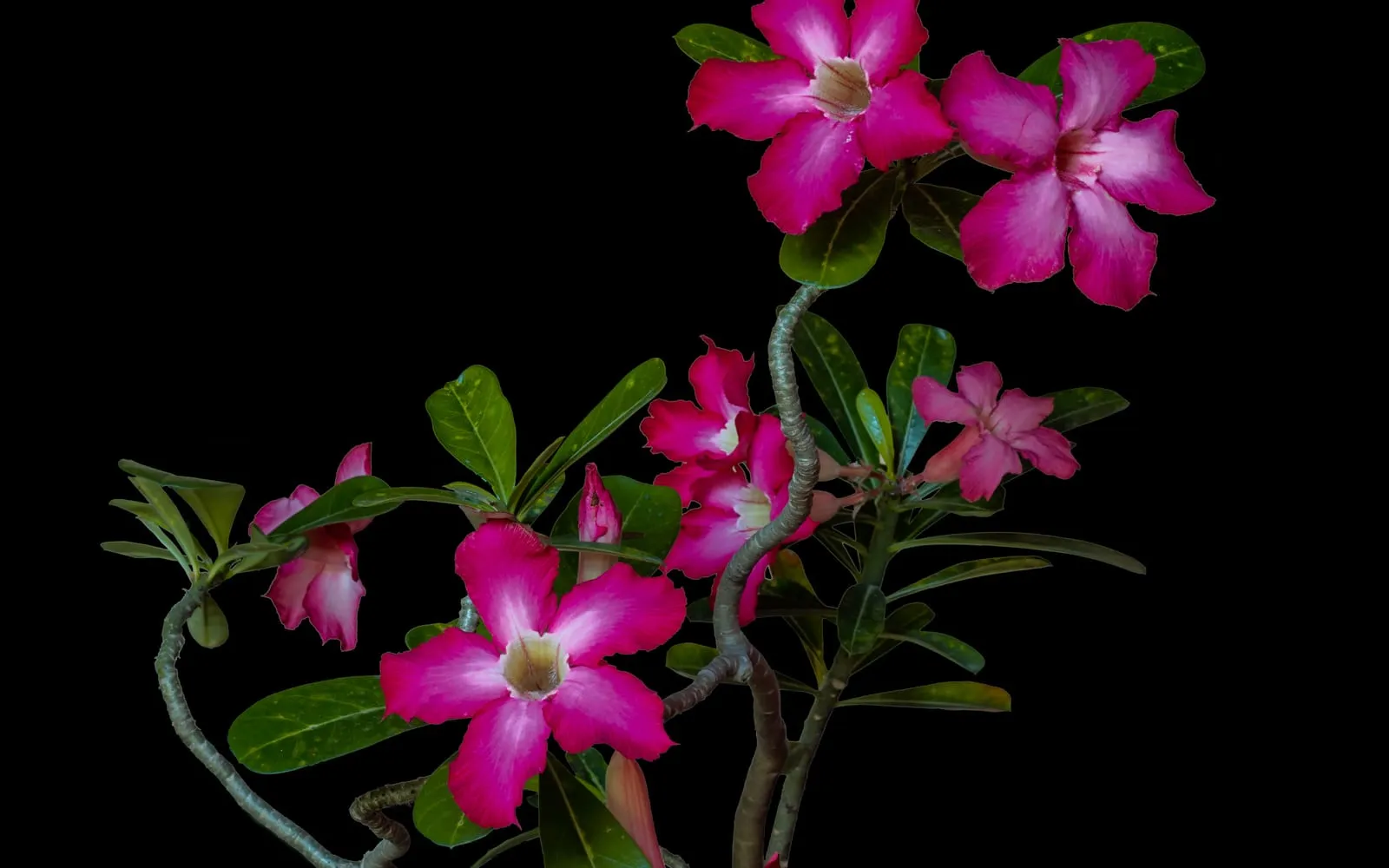
Flowers appear at the branch tips through the warmer months, five-petalled and trumpet-shaped, typically pink to red with a paler throat, though white and bicolour forms exist among the many cultivars sold. A well-grown plant in full sun can flower almost continuously through summer.
Where it is from
Adenium obesum grows wild across a broad belt of dry country running from the Sahel south through East Africa and across the Arabian Peninsula, occupying rocky, free-draining ground in savanna and semi-desert scrub. Rain falls in a short, defined season, and the rest of the year is effectively dry.
The caudex and the plant’s whole dormancy cycle are direct answers to that climate. A plant grown indoors year round with steady warmth and water never experiences the trigger its wild relatives rely on, which is why giving it a markedly drier, cooler winter rest produces stronger flowering the following season than keeping it in constant summer conditions.
How it grows
Plant it in a very gritty, fast-draining mix, heavier on mineral grit than even a typical cactus compost, in a shallow, wide pot that suits the flat- based caudex rather than a deep one built for a tap root.
Give it the sunniest position available. Several hours of direct sun a day is what produces strong, compact growth and reliable flowering; a plant kept too dim etiolates, producing thin, stretched growth and few if any flowers.
Water carefully around the caudex rather than letting it pool at the base, since standing moisture against that swollen tissue is one of the more common routes to rot in an otherwise correctly watered plant.
Repot every two to three years in spring, using the move as an opportunity to lift the caudex slightly higher if a more exposed, bonsai-like base is wanted, exposing a little more of the swollen tissue each time without disturbing the roots below it too severely.
Through the seasons
Spring brings the resumption of growth and, on an established plant, the start of the flowering season. Resume feeding as new leaves appear.
Summer is the main growing and flowering period. Water when the mix has dried out and give it as much sun as possible.
Autumn slows growth as light and temperature fall. Cut back watering and stop feeding as leaves begin to yellow and drop.
Winter is a dry, cool dormancy. Water only enough to stop the caudex shrivelling badly, keep the plant above 10 deg C, and expect it to carry few or no leaves until spring.
Care difficulty
Moderate. Desert rose is forgiving of neglect once its basic needs are met, tolerating missed waterings far better than overwatering, but it is unforgiving of the wrong conditions: too little light produces a plant that grows leggily and rarely flowers, and a mix that stays wet, especially in winter, rots the caudex from the inside before any outward sign appears. Getting the dry winter rest right is the single biggest factor in whether it flowers well the following summer.
Watering
Water thoroughly but sparingly, letting the mix dry out completely between waterings through the growing season, and reduce sharply once leaves begin dropping in autumn.
Through winter dormancy, water only enough to prevent the caudex visibly shrivelling, sometimes as little as once a month or less. A leafless winter plant needs almost no water at all, and the commonest fatal mistake is treating it as if it still needed a summer watering routine.
Warning signs, diseases and pests
Mealybug tends to hide where a branch joins the caudex, a sheltered spot that is easy to miss on a casual glance. Dab visible clusters with a cotton bud dipped in isopropyl alcohol and check the same joints regularly.
Spider mite thrives in the hot, dry air of a centrally heated room over winter, showing as fine speckling on the leaves and faint webbing near the growing tips in bad cases. Wiping the leaves down occasionally helps prevent it building up unnoticed.
Root rot and caudex rot both follow overwatering, particularly in winter, and show as a base that softens, discolours or develops a sour smell. Unpot the plant, cut away any soft tissue back to firm, healthy material, let the wound dry for several days, and repot into fresh, drier mix.
Scale insects appear as small, flat brown bumps on the woody stems. Scrape them off and treat with horticultural soap, repeating as needed since a light infestation is easy to miss on textured bark.
Growing environment
Full sun suits it best. Give it several hours of direct light a day to keep growth compact and flowering strong.
Warmth is essential year round. Keep it reliably above 10 deg C, since it has no meaningful cold tolerance and drops leaves as a first response to anything colder.
Low humidity is fine, and in fact preferable to a consistently damp atmosphere, which encourages the fungal problems that a plant built for dry air is poorly equipped to resist.
Feeding
Feed with a low-nitrogen, phosphorus-rich fertiliser formulated for flowering succulents or cacti, every two to four weeks through spring and summer.
Stop feeding entirely once the plant enters its dry winter rest, since a dormant plant takes up almost nothing and unused fertiliser only accumulates as salts in a mix that is already receiving very little water.
Troubleshooting
The plant dropped all its leaves and I think it has died. Very likely just winter dormancy, provided the caudex still feels firm rather than soft. Reduce watering further, keep it warm and in good light, and expect new leaves to appear as growth resumes in spring.
It has never flowered. Almost always too little light or too little of a dry winter rest. Move it to the sunniest position available and make sure it dries out properly and slows down over winter rather than being kept in constant summer conditions.
The caudex feels soft rather than firm. Rot, and a serious sign. Unpot the plant, cut back to firm tissue, let the wound dry fully before repotting into a drier mix, and review your watering routine, since this is almost always the result of standing moisture around the base.
Can I train the caudex to sit higher out of the soil? Yes, gradually, lifting it a little further at each repotting rather than exposing it all at once, which risks damaging roots the plant still needs.
Is it safe near pets? No. The sap contains cardiac glycosides that are seriously toxic if eaten, and it should be kept somewhere a curious cat, dog or child cannot reach the leaves, stems or roots under any circumstances.
Desert Rose problem guides
Not sure what is wrong? See the common houseplant pests guide.