
Outdoor plant
Yellow Birch
Betula alleghaniensis
Also known as Golden Birch, Swamp Birch, Gray Birch
How to grow yellow birch, Betula alleghaniensis. Telling it apart from a paper birch by its golden bark and a scratched twig's wintergreen scent, and why a hot summer holds it back more than any winter cold.
At a glance
- Difficulty
- Moderate
- Water
- Regularly for the first two or three years, then only in extended drought
- Light
- Full sun for the strongest growth, tolerating shade better than most birches when young
- Temperature
- Fully hardy; a cold-climate species that dislikes hot summers
- Hardiness
- USDA 3-7, RHS H7, hardy to -35 C
- Type
- Deciduous tree, long-lived for a birch
- Height
- 20-25 m, occasionally taller in old forest
- Native to
- eastern North America
The zone range describes a tree built for cold winters and says nothing about the ceiling on the other end. Yellow birch struggles in hot, humid summers and in the wild it is squeezed out of the lowland southeastern United States entirely, surviving there only at altitude in the cooler air of the Appalachians. It needs a cool, moist climate through the growing season, not only a cold winter.
Hardiness zones describe winter cold alone. Summer heat, humidity, rainfall and the length of the growing season decide as much, so treat the range as the outer limit rather than as a recommendation.
Not known to be toxic
Yellow birch is not documented as toxic to people, cats, dogs or horses on any reputable poisoning list, and its sap is safe enough to drink fresh from the tree or boil down into syrup, much as sugar maple sap is. A child chewing a strip of the aromatic bark or a dog gnawing a fallen twig risks nothing worse than a mouthful of wood fibre. The wintergreen scent in the twigs comes from methyl salicylate, the same compound in oil of wintergreen, present in far too small a quantity in ordinary browsing to cause the kind of overdose seen from concentrated wintergreen oil itself.
Sources: ASPCA toxic and non-toxic plants, RHS potentially harmful garden plants
About
Yellow birch is the birch of the northern hardwood forest, growing alongside sugar maple, beech and hemlock across a swathe of eastern North America from Newfoundland down the spine of the Appalachians. Quebec adopted it as the province’s official tree, a fitting choice for a species that defines the look and the economy of that forest type.
Two things separate it from other birches at a glance. The bark peels into thin, curling strips of a warm golden or bronze colour rather than the chalky white of a paper birch, and a scratched twig releases a clear wintergreen scent. Both are useful when a garden already holds a silver or paper birch and the difference needs settling at a glance.
It is a tree for a cool, moist site rather than an easy substitute for any birch anywhere. Hot summers hold it back, and it performs best where the growing season itself stays on the cool side, not only the winter.
Appearance and character
Bark is the standout feature: shiny, golden-yellow to bronze on a young to middle-aged tree, peeling into fine curling papery strips that catch low light beautifully. Very old trunks lose the curl and turn dark, plated and furrowed, closer to the bark of a mature oak than to a birch.
Twigs and the inner bark carry a distinct wintergreen scent when scratched or broken, a useful field character that separates this species from every other birch planted in gardens.
Leaves are oval with a doubly toothed edge, dull dark green through summer, turning a clear, clean gold in autumn, among the more reliable golden birch foliage displays.
The wood is dense and strong for a birch, and it is one of the most commercially valuable hardwoods in eastern North American forestry, milled for flooring, furniture and cabinetry.
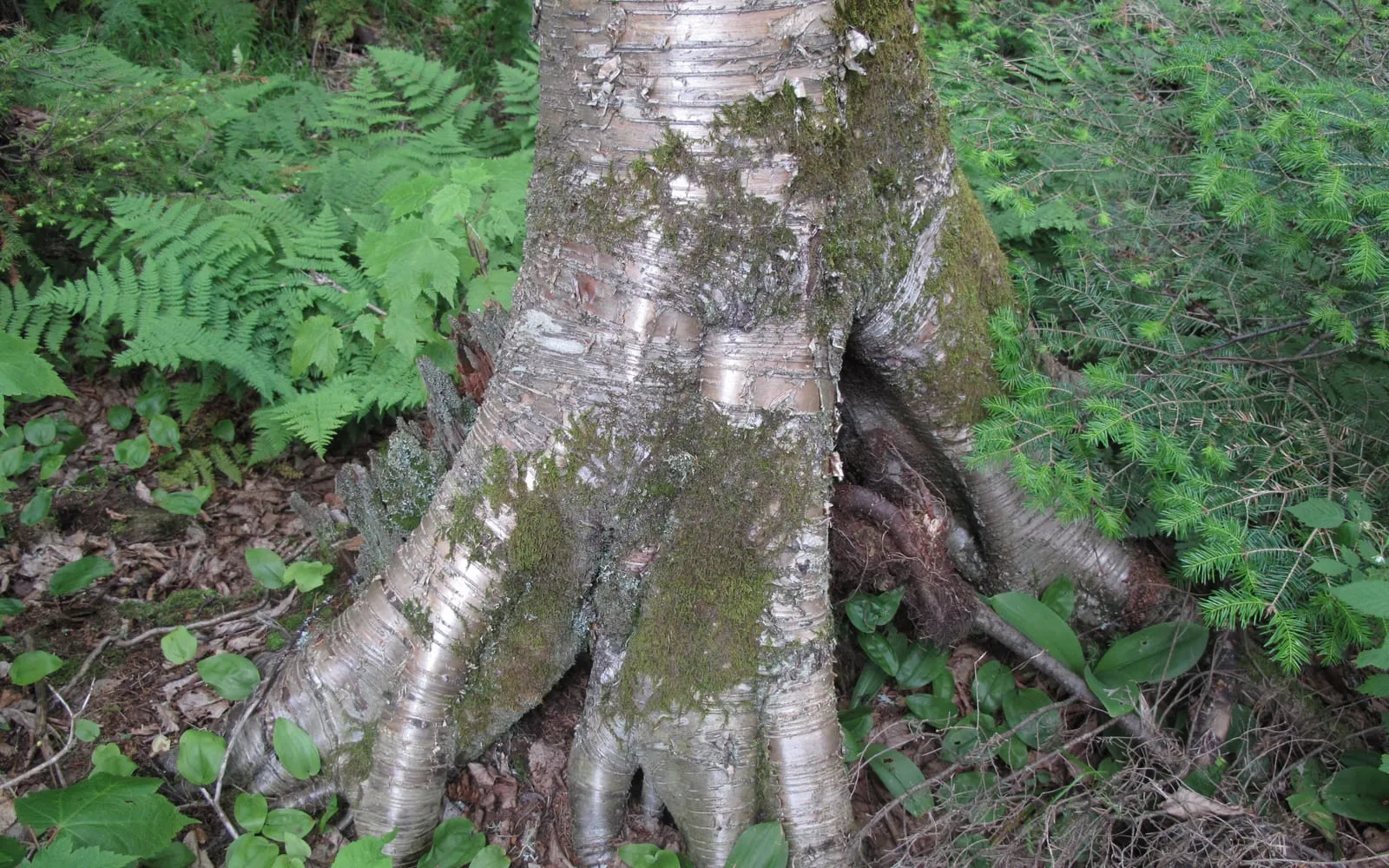
Roots often show a curious habit in older woodland specimens. Seedlings frequently germinate on a rotting log or stump, and as that nurse log decays away over decades, the tree is left standing on a cage of exposed, stilt-like roots where the log once was.
Where it is from
Betula alleghaniensis grows across eastern Canada and the northeastern United States, running south at increasing altitude through the Appalachian Mountains into Georgia, always in cool, moist forest rather than open or dry ground.
It shares that forest with sugar maple, American beech and eastern hemlock, forming the classic northern hardwood community of the region, and it is more shade-tolerant as a seedling than most other birches, letting it persist for years in the dim understory before a gap in the canopy allows stronger growth.
Its need for cool summers, not only cold winters, is what confines it to higher ground as its range runs south. Lowland heat in the southeastern United States excludes it entirely, and mountain populations there survive in a climate pocket that behaves like the tree’s native north.
How it grows
Plant into cool, moist, humus-rich, well-drained soil, ideally with some shade while young, since seedlings and saplings tolerate shade far better than the tree does once mature.
Growth is moderate, neither as fast as a paper birch nor as slow as a beech, and a young tree needs steady moisture through its first several years to establish a root system deep enough to see it through a dry summer.
Avoid a hot, exposed, south-facing site in a warm climate. This is a tree that needs the cooler, damper conditions of a woodland edge or a north or east aspect rather than a baking open lawn.
Little routine pruning is needed beyond removing dead or crossing wood in winter, while the tree is dormant and the wound bleeds least.
Through the seasons
Spring brings catkins opening before the leaves, both male and female on the same tree, followed by the new leaves unfurling in a fresh light green.
Summer is the main growing season, when steady soil moisture matters most to a young tree still building its root system.
Autumn turns the foliage a clear gold, usually among the earlier trees in a mixed planting to colour up, and seed is shed from the small, upright cone-like catkins through the season.
Winter shows off the golden, curling bark to best effect against snow, and it is the season to tap a mature tree for sap if syrup is the goal.
Care difficulty
Moderate. Yellow birch needs a cooler, damper site than many gardeners can offer, and it repays that condition with a handsome tree rather than demanding constant attention once it has one.
Establishment is the main work, with regular watering through the first two or three summers while the roots reach down. After that, a tree on a suitable site needs little beyond an occasional check for dead wood and the pests below.
A garden in a consistently hot summer climate is the wrong match for this species regardless of care, and a paper birch or river birch will do better there.
Watering
Water a young tree regularly through its first two or three growing seasons, more often in a dry spell, since establishment is when this species is least forgiving.
An established yellow birch on a suitable cool, moist site rarely needs watering beyond what rainfall provides, but a prolonged summer drought is a reason to soak deeply, particularly on a tree already showing scorched leaf edges.
Warning signs, diseases and pests
Leaf miner larvae tunnel pale, blotchy mines through the leaf tissue, usually cosmetic on an established tree and rarely needs treatment beyond raking up and disposing of fallen leaves in autumn to reduce the following year’s population.
Birch rust shows as small orange-yellow pustules on the underside of the leaves in summer, worse in a wet season. It weakens rather than kills a tree, and improving airflow around a crowded planting helps more than any treatment.
Bracket fungi and wood decay follow old pruning wounds, storm damage or general old age, showing as shelf-like fungal growths on the trunk or major limbs. There is no cure once decay is established in the heartwood, and a badly affected tree should be assessed for safety near paths or buildings.
Aphids cluster on new shoots in spring and early summer, leaving a sticky honeydew that can coat leaves and anything parked or seated beneath the tree. Natural predators usually bring a light infestation under control without intervention.
Growing environment
Full sun suits a mature tree best, though shade is a genuine advantage while it is young and establishing. That is unusual among birches, so use the shade if the site offers it.
Cool, moist, well-drained soil rich in organic matter is close to essential. A hot, dry, exposed site holds this species back in a way that a paper or silver birch would tolerate far better.
Fully hardy through a cold winter, but a hot summer is the real limiting factor, which is why this is a tree for a cooler region or a shaded, sheltered garden rather than an open plot in a warm climate.
Give it room. A mature specimen forms a broad, rounded crown, and the striking bark is best appreciated with space around the trunk rather than crowded by other planting.
Feeding
A compost mulch in spring is usually enough for a young tree establishing in reasonable soil, applied over the root zone and kept clear of the trunk.
Established trees on a suitable site need little to no supplemental feeding, since the cool, humus-rich woodland soil this species favours already supplies most of what it needs.
Avoid heavy nitrogen feeding, which pushes soft, fast growth more vulnerable to aphids and less able to harden off before winter.
Troubleshooting
How do I tell it apart from a silver or paper birch? Bark colour and scent. Yellow birch peels in golden or bronze curls rather than chalky white, and a scratched twig smells distinctly of wintergreen, which neither of the other two does.
My tree is struggling in a hot summer climate. This is a cool-climate species, and heat rather than cold is usually the real limit on where it thrives. A shadier, damper spot helps, but a consistently hot summer region is the wrong match for it regardless.
Can I tap it for syrup like a maple? Yes, though the sap runs with far less sugar than maple sap, so making birch syrup takes considerably more sap to reduce down to the same amount of finished syrup.
The roots look like they are standing on stilts above the ground. A normal habit in an older woodland-grown tree. The seedling likely germinated on a rotting log or stump, and as that nurse log has decayed away over the years, the tree has been left standing on the roots that once gripped it.
Orange spots have appeared on the undersides of the leaves. Birch rust, worse in a wet season. It weakens rather than kills the tree, and improving airflow around a crowded planting helps more than any direct treatment.