
Edible
Yacon
Smallanthus sonchifolius
Also known as Peruvian ground apple, Bolivian sunroot, Llacon
How to grow yacon, Smallanthus sonchifolius. Telling storage tubers from propagation rhizomes, curing them sweet in the sun, and the inulin they store instead of starch.
At a glance
- Difficulty
- Easy
- Water
- Weekly through summer, more in a dry spell
- Light
- Full sun
- Temperature
- 15-25 deg C. The top growth dies at the first frost
- Hardiness
- USDA 7-11, RHS H2, hardy to 0 C
- Type
- Tender perennial grown as an annual
- Height
- 1.5-2 m
- Native to
- The Andes of Peru, Bolivia and Ecuador
- Best month
- November in the Northern Hemisphere, May in the Southern Hemisphere
Six to seven frost-free months is the requirement, and unlike its Andean neighbours it swells its storage roots without waiting for short days. That makes it much the easiest of the group outside the tropics. The crown is hardier than the top growth and overwinters under a thick mulch in a mild climate.
Hardiness zones describe winter cold alone. Summer heat, humidity, rainfall and the length of the growing season decide as much, so treat the range as the outer limit rather than as a recommendation.
Every month named in this guide is for the temperate Northern Hemisphere. If you garden in the Southern Hemisphere, shift each one by six months, so November becomes May. Closer to the equator the wet and dry seasons matter more than the calendar, and the shift stops being a useful guide.
Not known to be toxic
- Safe to eat
- The storage tubers, raw or cooked, and the young leaves as a tea
Yacon is a food crop eaten across the Andes and carries no toxicity concern. Neither the RHS nor the ASPCA lists Smallanthus sonchifolius, which reflects how rarely it is grown outside South America rather than any assessment. The tubers store fructooligosaccharides rather than starch, which is why they taste sweet and contribute very few calories, and it is also why they are marketed as a diabetic-friendly sweetener. Humans cannot digest those sugars, so they pass to the large intestine and are fermented by gut bacteria, exactly as the inulin in Jerusalem artichoke is. A large portion causes wind and a loose stomach in some people, and the effect is milder than Jerusalem artichoke and lessens with regular eating. Start with a small quantity. Yacon leaf tea is drunk in Peru and has been studied for blood-sugar effects, and rat studies at high doses have shown kidney changes, so the leaf is worth treating with more caution than the tuber. The tuber itself is eaten freely and needs no special preparation.
Sources: RHS potentially harmful garden plants, ASPCA toxic and non-toxic plants
About
Yacon is the odd one out among the Andean tubers. It has no daylength trigger, so it forms its crop through the summer like an ordinary vegetable, and it tastes of pear and water chestnut rather than of anything starchy. Eaten raw and cold it is closer to a fruit than a root.
The plant makes two quite different underground organs and confusing them is the commonest mistake. Large brown storage tubers hang below the crown and are what you eat. A knot of small pink rhizomes sits at the base of the stems and is what you replant. Eat the rhizomes and they are woody. Replant the storage tubers and nothing happens.
Yields are large. Five to ten kilograms from one plant is normal in a good temperate summer, from something that needs a single planting in May and no further attention.
Appearance and character
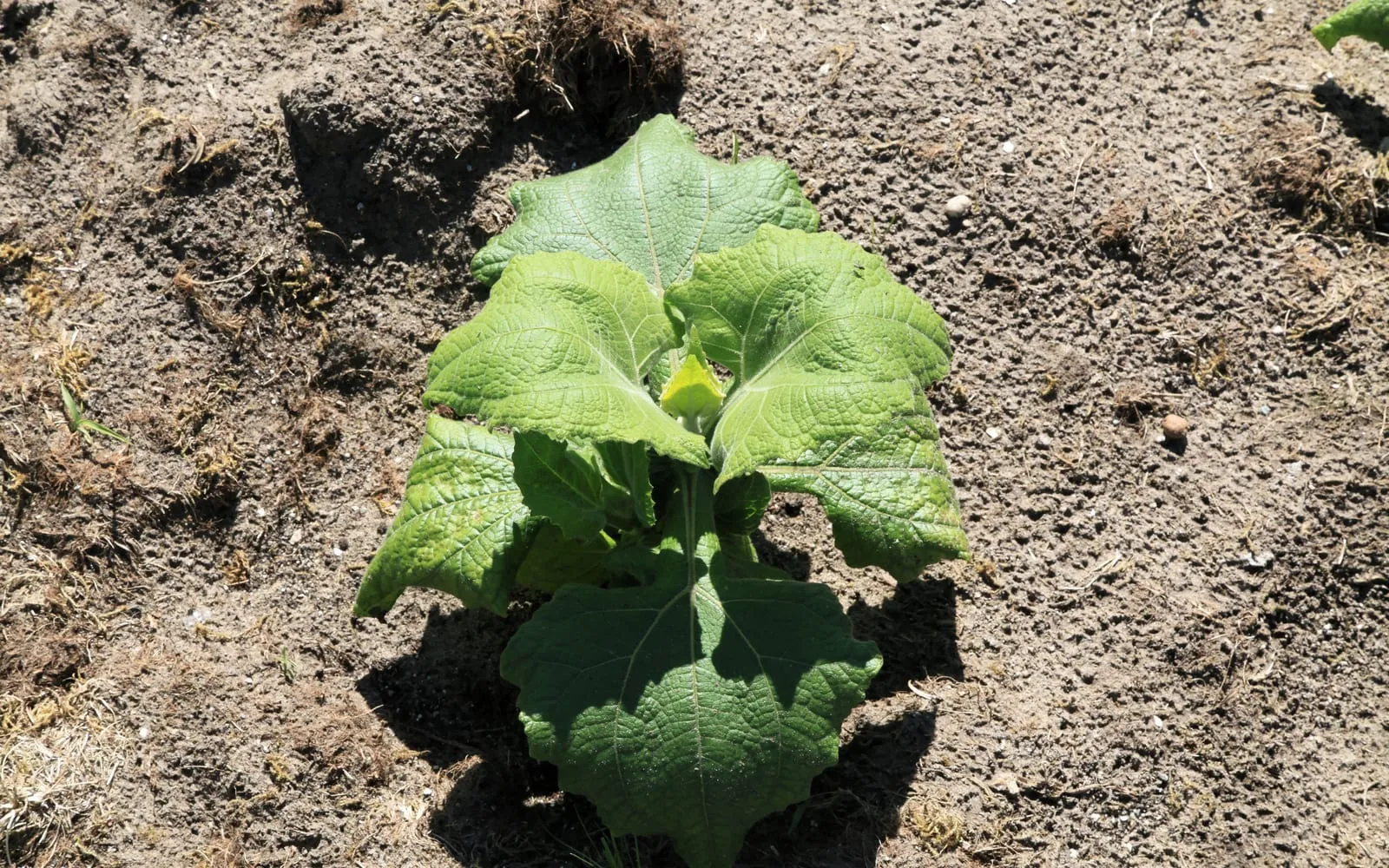
A stout clump of upright stems 1.5 to 2 m tall, hairy and often purple-flushed, carrying very large opposite leaves.
Leaves are arrow-shaped to triangular, up to 30 cm long, softly hairy and coarse in texture, in a dull mid-green. The plant reads as a giant relative of a sunflower, which is what it is.
Small yellow daisy flowers appear in October in a warm year and often not at all in a cool one, which costs nothing since the crop is underground.
Storage tubers are large, 10 to 25 cm long, spindle to pear-shaped, with thin brown or purple skin and translucent white to yellow flesh.
Flesh is crisp, juicy and sweet, tasting of a cross between apple, pear and water chestnut, and it holds that crunch in cooking.
The propagation rhizomes look nothing like them. They are small, pink to purple and knobbly, clustered tight around the crown, and they carry visible growth buds.
Where it is from
Yacon is native to the eastern Andes of Peru, Bolivia and Ecuador, growing at lower altitudes than oca, ulluco or mashua, between 1,000 and 3,000 metres.
Cultivation is ancient, and yacon appears in Nazca and Moche pottery. It has always been a sweet snack and a source of water for travellers rather than a staple.
Spanish chroniclers recorded it in the sixteenth century, and it stayed within South America until the late twentieth.
Japan and New Zealand took it up in the 1980s, initially as a health food for its fructooligosaccharide content, and most European planting material comes through that route.
A cool temperate summer suits it better than it suits the other Andean tubers, because it crops on the summer itself and does not need the autumn window that oca and ulluco depend on.
How it grows
Plant rhizomes in April under cover, or outdoors in May after the last frost. Both the rhizomes and the top growth are frost-tender.
Plant at 5 to 8 cm deep and 90 cm apart. The plant is large and needs the room.
Water and feed through summer. Yacon carries a great deal of leaf and grows fast.
Lift after the first frost has blackened the top growth, from late October or November. Cut the stems down first, then dig wide, since the storage tubers spread 50 cm from the crown and snap easily.
Separate the two organs at lifting. Storage tubers go to the kitchen, the rhizome crown is broken into pieces with a bud each and stored frost-free in damp compost for replanting.
Cure the storage tubers in the sun for a week or two before eating. This converts more of the stored sugars and makes the difference between pleasant and excellent.
Through the seasons
Early spring starts the rhizomes into growth in pots under cover in March or April.
Late spring is for planting out, from mid-May once the frosts have passed. Water in well.
Summer grows the plant to full size. Water weekly and feed monthly. Stake or shelter it in an exposed garden, because two metres of soft stem goes over in a gale.
Autumn fills the tubers. Keep watering into September. The plant continues until frost blackens it.
Late autumn is the harvest, from late October. Lift carefully, separate the storage tubers from the rhizomes, and cure the tubers in the sun.
Care difficulty
Easy, and the simplest of the Andean crops because it has no daylength rule to learn.
Lifting is the one skill. The storage tubers are brittle and spread wide, so dig a trench well outside the clump and work inwards. A damaged tuber rots rather than storing.
Telling the two organs apart is the other thing to get right. Large and brown means eat it, small and pink and clustered at the crown means replant it.
Space is a practical requirement. A metre each way, and the plant shades what is next to it.
Frost ends the season rather than spoiling the crop, since the tubers are below ground.
Pests and diseases barely trouble it.
Watering
Water weekly through summer, around 15 litres per square metre in dry weather. The plant carries a lot of leaf and transpires heavily.
Keep watering into September while the tubers fill.
Avoid waterlogging, which rots both the tubers and the crown.
Mulch after planting to hold moisture and keep the roots cool.
A dry summer gives a much smaller crop, and this is the crop’s main sensitivity.
Container growing works in a very large pot of 50 litres or more, and yields are lower than in the ground.
Warning signs, diseases and pests
Slugs graze the young shoots in spring and the plant grows away from them quickly.
Frost blackens the top growth and ends the season. It does not damage the tubers below ground, so it is the signal to lift rather than a loss.
Wind rock flattens the tall soft stems in an August gale, which checks growth. Stake the clump or plant in shelter.
Root and crown rot follow waterlogging. Improve drainage before planting.
Damaged tubers rot in store rather than keeping. Lift carefully and set aside anything broken to eat first.
Small tubers usually mean a dry summer or a crowded planting.
Nothing else is a serious problem outside its homeland. Yacon has travelled without most of the pests that trouble it in the Andes.
Growing environment
Full sun. Yacon needs a long warm season and repays the best position in the garden.
Deep, fertile, free-draining soil grows the biggest crop. Dig in compost before planting.
Space at 90 cm each way. Crowding costs yield directly.
Shelter matters more than for most crops here, since two metres of soft stem is vulnerable to summer gales.
A warm sheltered spot delays the killing frost, though this matters less than for oca and ulluco because the crop is already made by then.
Rotate on three years. Yacon shares almost no diseases with other vegetables.
Feeding
Dig well-rotted compost into the bed before planting. Yacon is a large plant and rewards a fertile start.
Feed monthly through summer with a balanced liquid feed on poor or sandy soil. On good ground it needs nothing further.
Avoid heavy nitrogen, which gives more of an already large plant without adding to the crop.
A potash-rich feed from August helps fill the tubers.
Never use fresh manure.
Troubleshooting
I planted the big brown tubers and nothing came up. Those are the storage tubers, which have no growth buds. Replant the small pink knobbly rhizomes from the base of the stems instead.
The tubers snapped as I lifted them. They are brittle and spread up to 50 cm from the crown. Dig a trench well outside the clump and work inwards.
A small crop. A dry summer, crowded planting, or too little sun. Space at 90 cm, water weekly, and give it the best position you have.
The tubers are not very sweet. They need curing. Leave them in the sun for a week or two after lifting, which converts more of the stored sugars.
The plants blew over in August. Wind rock on tall soft stems. Stake the clump or plant in shelter.
They gave me wind. Fructooligosaccharides fermented by gut bacteria, the same mechanism as Jerusalem artichoke and milder. Start with small portions.
Can I eat them raw? Yes, and it is the best way. Peel, chill and slice them. The texture is closest to a water chestnut.
Do they store? Yes, for several months in a cool frost-free place, and they get sweeter as they go.
Yacon problem guides
Not sure what is wrong? See the common vegetable pests guide.