
Edible
Mashua
Tropaeolum tuberosum
Also known as Anu, Cubio, Tuberous nasturtium
How to grow mashua, Tropaeolum tuberosum. The Andean nasturtium that crops where nothing else will, the daylength trigger, and taming the peppery flavour.
At a glance
- Difficulty
- Easy
- Water
- Weekly through summer and autumn
- Light
- Full sun to partial shade
- Temperature
- 10-20 deg C. The top growth dies at the first frost
- Hardiness
- USDA 8-11, RHS H2, hardy to 0 C
- Type
- Tender perennial grown as an annual
- Height
- 2-3 m on supports
- Native to
- The Andes of Peru, Bolivia and Colombia
- Best month
- December in the Northern Hemisphere, June in the Southern Hemisphere
Tubers form only once the day drops below about 12 hours, which at high latitude means October, and the first frost usually arrives before the crop has bulked. That single fact governs where it succeeds. New Zealand and Tasmania sit at the right latitude with a late frost, and northern Europe rarely does.
Hardiness zones describe winter cold alone. Summer heat, humidity, rainfall and the length of the growing season decide as much, so treat the range as the outer limit rather than as a recommendation.
Every month named in this guide is for the temperate Northern Hemisphere. If you garden in the Southern Hemisphere, shift each one by six months, so December becomes June. Closer to the equator the wet and dry seasons matter more than the calendar, and the shift stops being a useful guide.
Edible, with limits
- Safe to eat
- The tubers cooked, and the leaves and flowers in small amounts
- Harm from
- Eating it
- Affects
- People
Mashua is a food crop grown across the Andes and the tubers are safe to eat. Neither the RHS nor the ASPCA lists Tropaeolum tuberosum, which reflects how rarely it is grown in Britain rather than any assessment. Two points matter. The tubers are high in glucosinolates, the same class of mustard-oil compound found in radish and horseradish, which is what gives raw mashua its hot peppery bite. Cooking breaks most of them down, and the traditional Andean practice of freezing the tubers or leaving them in the sun before cooking mellows them further. Eating a quantity raw causes stomach discomfort rather than poisoning. The second point comes from Andean folklore rather than a laboratory. Mashua has a long-standing reputation as an anaphrodisiac, and Inca armies were reportedly fed on it to keep soldiers' minds on the campaign. Rat studies have found reduced testosterone at high intakes, and nothing establishes an effect at the quantities anybody eats. The leaves and flowers are edible in the way nasturtium leaves and flowers are, peppery and best in small amounts.
Sources: RHS potentially harmful garden plants, ASPCA toxic and non-toxic plants
About
Mashua is a nasturtium that makes tubers, and it is the most productive and least demanding of the four Andean root crops. Yields of two or three kilograms from a single plant are ordinary, on ground too poor for anything else, with no feeding and almost no pests.
The Andean farmers who grow it plant it around the edges of a potato field, because the plant repels several soil pests and its dense growth smothers weeds.
Two things hold it back in a northern garden. It follows the same daylength rule as oca and ulluco, forming tubers only after the days shorten past twelve hours in late September, so it is lifted in December. And the flavour divides people sharply. Raw mashua is fiercely peppery, and even cooked it keeps a mustardy edge that some find excellent and others cannot get on with.
Appearance and character
A vigorous twining climber, reaching 2 to 3 m on any support and sprawling into a dense mat where none is offered.
Leaves are round to shallowly lobed and peltate, with the stalk joining the centre of the blade rather than the edge, exactly like a garden nasturtium in a blue-green shade.
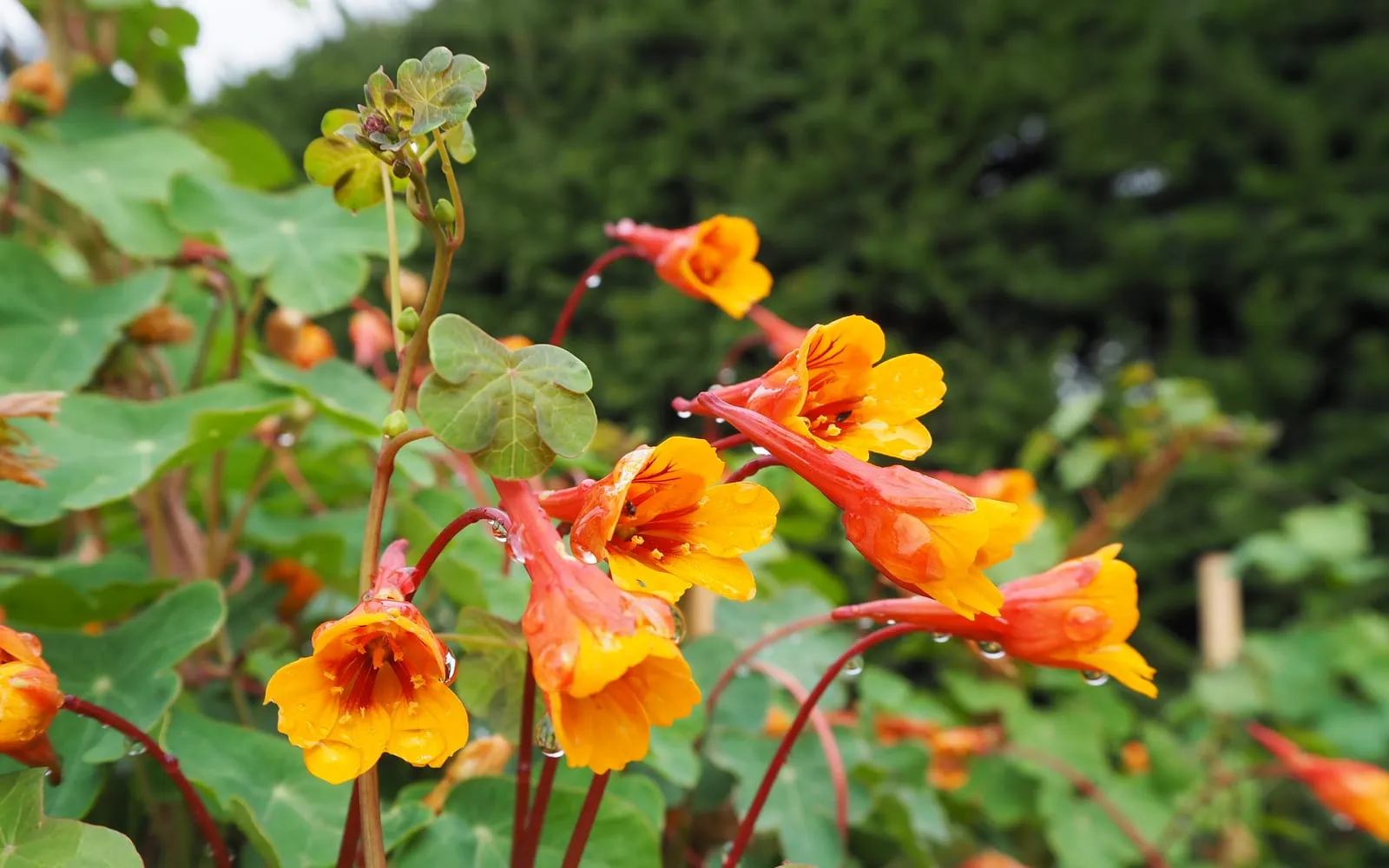
Flowers appear from August and are the reason to grow it even without the crop. Long-spurred, scarlet and orange, held clear of the foliage, and attractive to bumblebees.
Tubers are conical to spindle-shaped, 5 to 15 cm long, with deep eyes and a waxy skin in white, yellow, red or purple, often streaked or splashed with a second colour.
Flesh is yellow or white, waxy, and strongly peppery raw. Cooking turns it soft and sweet with a lingering mustard note.
Where it is from
Mashua is native to the Andes of Peru, Bolivia, Ecuador and Colombia, grown between 2,500 and 4,000 metres.
Cultivation is ancient, and the plant appears in Moche pottery. It ranks fourth among Andean tuber crops after potato, oca and ulluco, and it out-yields all of them on poor ground.
Andean farmers use it as a pest deterrent as well as a crop, planting it around potato plots against nematodes and insects. Extracts have been investigated as a biological control on that basis.
Europe has trialled it since the nineteenth century. It grows perfectly well here and has never caught on, partly because of the daylength problem and partly because of the flavour.
The anaphrodisiac reputation is genuine folklore rather than a marketing invention, recorded by Spanish chroniclers who noted that Inca commanders fed it to their armies.
How it grows
Plant tubers in April, or start them in pots under cover in March and plant out after the last frost. Both tubers and top growth are frost-tender.
Plant at 8 cm deep and 60 cm apart. The plant needs more room than oca or ulluco.
Give it something to climb. A wigwam of canes, a length of netting or a fence all work, and the crop is larger on supports than sprawling on the ground.
Leave it alone through the summer. Tubers form only after the equinox.
Fleece the haulm through the first light frosts. As with oca, every extra fortnight of working leaf after late September adds to the crop.
Lift in December, a fortnight or so after frost has killed the top growth. The tubers sit close to the crown and are easy to find.
Save a few tubers for next year, stored cool, dark and frost-free.
Through the seasons
Early spring starts the tubers in pots under cover in March.
Late spring is for planting out, from late April, with supports in place before the plants need them.
Summer grows a great deal of foliage and no crop. Water weekly, tie in the shoots, and keep it off neighbouring plants.
Autumn makes the crop from late September, and brings the flowers. Keep watering, and fleece against the first frosts.
Early winter is the harvest. Lift in December once the haulm has been dead a fortnight. Freeze the tubers overnight or leave them in the sun for a week before cooking, both of which reduce the pepperiness.
Care difficulty
The easiest of the four Andean tubers and one of the easiest crops here.
The December harvest date is the thing to know, and it is the same rule as oca and ulluco.
Frost protection in October extends the tuber-forming window.
Space and support are the practical requirements. Three metres of vigorous climber swamps whatever is next to it, so give it a fence or a wigwam of its own.
Pests barely touch it. The glucosinolates that make the tubers peppery also make the plant unattractive to most things that eat vegetables.
Blight does not affect it, which makes it another useful crop on a plot where potatoes have failed.
Watering
Water weekly through summer, around 12 litres per square metre in dry weather.
Keep watering through September, October and November, which is when the crop is being made.
Mashua tolerates dry spells better than oca or ulluco and yields less for them.
Avoid waterlogging in late autumn, when the tubers sit in cold wet soil.
Mulch in July to hold moisture and suppress weeds, though the plant shades out most weeds without help.
Container growing works in a large pot of 40 litres with a support, and the pot can be moved under cover in November to extend the season.
Warning signs, diseases and pests
Early frost killing the haulm is the largest single loss. Fleece the plants through the first frosts.
Slugs graze the emerging shoots in spring and the plant outgrows them quickly.
Root and tuber rot follow waterlogging on heavy ground in late autumn. Grow on a raised bed where the soil is heavy.
Aphids occasionally cluster on the growing tips and are dealt with by predators.
Swamping neighbouring crops is the practical nuisance rather than a pest. Give it a support and its own space.
Small tubers mean an early lift or an early frost.
Nothing else troubles it. The pest resistance that makes it useful as a companion crop in the Andes works in a temperate garden too.
Growing environment
Full sun to partial shade. Mashua crops in more shade than most vegetables.
Almost any soil suits it, including poor and thin ground where oca and ulluco would struggle. This tolerance is its main advantage.
Free drainage over the wet autumn matters, since the crop forms in November.
A support of some kind, whether canes, netting or a fence.
A sheltered corner delays the killing frost and adds to the crop.
Rotate on three years, though mashua shares almost no diseases with anything else and is easy to place.
Feeding
Mashua needs no feeding on ground in reasonable heart, and it crops on ground that has had nothing for years.
Avoid nitrogen. It produces more of a plant that already produces plenty, and no extra tubers.
A dressing of sulphate of potash before planting helps on very poor sandy ground.
Container plants take a potash-rich liquid feed such as a tomato feed every fortnight from August.
Never use fresh manure.
Troubleshooting
I lifted in October and found nothing. Mashua forms tubers only after the days shorten past twelve hours in late September. Lift in December.
Frost killed the plants in early October. Fleece the haulm through the first frosts to keep the leaves working into November.
It swamped everything around it. Three metres of vigorous climber. Give it a wigwam, a fence or a corner of its own.
Masses of growth and few tubers. Too much nitrogen, or an early frost. Use potash and protect the top growth.
The tubers are too hot to eat. Glucosinolates. Freeze them overnight or leave them in the sun for a week, then cook them long and slow. Raw mashua is fierce.
The tubers rotted in the ground. Waterlogging in November. Use a raised bed on heavy soil.
Can I eat the leaves and flowers? Yes, in the way you would eat nasturtium leaves and flowers, peppery and in small amounts.
Will blight affect it? No. Mashua is unaffected by potato blight, which makes it worth trying where potatoes keep failing.
Mashua problem guides
Not sure what is wrong? See the common vegetable pests guide.