
Outdoor plant
Pampas grass
Cortaderia selloana
Also known as Cortaderia, Silver pampas grass
How to grow pampas grass, Cortaderia selloana. Cutting it back without shredding your hands, why male plants have no plumes, and its invasive record abroad.
At a glance
- Difficulty
- Easy
- Water
- Rarely once established
- Light
- Full sun, and it flowers poorly in shade
- Temperature
- Hardy to about -15 deg C, and the crown rots in wet cold clay
- Hardiness
- USDA 7-11, RHS H5, hardy to -15 C
- Type
- Evergreen perennial grass, long lived and forming a large dense clump
- Height
- 2-3 m in flower, with foliage at 1.5 m
- Native to
- Southern South America, from Argentina, Brazil, Uruguay and Chile
- Best month
- September in the Northern Hemisphere, March in the Southern Hemisphere
The crown rots in cold wet ground long before the leaves suffer from frost, so drainage buys more hardiness than shelter does. Seed ripens only where autumns are warm and dry, which is what separates the places it behaves from the places it does not. New Zealand bans its sale under the National Pest Plant Accord, Spain banned it in 2020, it is a declared weed across much of Australia, and it has taken over coastal California.
Hardiness zones describe winter cold alone. Summer heat, humidity, rainfall and the length of the growing season decide as much, so treat the range as the outer limit rather than as a recommendation.
Every month named in this guide is for the temperate Northern Hemisphere. If you garden in the Southern Hemisphere, shift each one by six months, so September becomes March. Closer to the equator the wet and dry seasons matter more than the calendar, and the shift stops being a useful guide.
Not known to be toxic
Pampas grass is not listed by the RHS as a potentially harmful garden plant and is not recorded by the ASPCA as toxic to cats, dogs or horses. No part of it is a recognised poisoning hazard, and grasses in general are among the safest plants in a garden. Where a plant is unlisted by both sources rather than positively assessed, read that as no hazard recorded rather than a hazard ruled out. The real hazard from this plant is mechanical and it is substantial. The leaf margins carry fine silica-based serrations that work like a saw blade, and drawing a hand along a leaf produces a deep clean cut that bleeds freely and is slow to heal. The genus name comes from the Spanish for cutting for that reason. Cuts to the face and eyes have occurred where people reached into a clump. Always wear thick gauntlets, long sleeves, eye protection and stout trousers when cutting one back, and keep the dry foliage away from a bonfire, since it burns fiercely.
Sources: RHS potentially harmful garden plants, ASPCA toxic and non-toxic plants
About
Pampas grass gets bigger than anybody expects and cuts you when you deal with it.
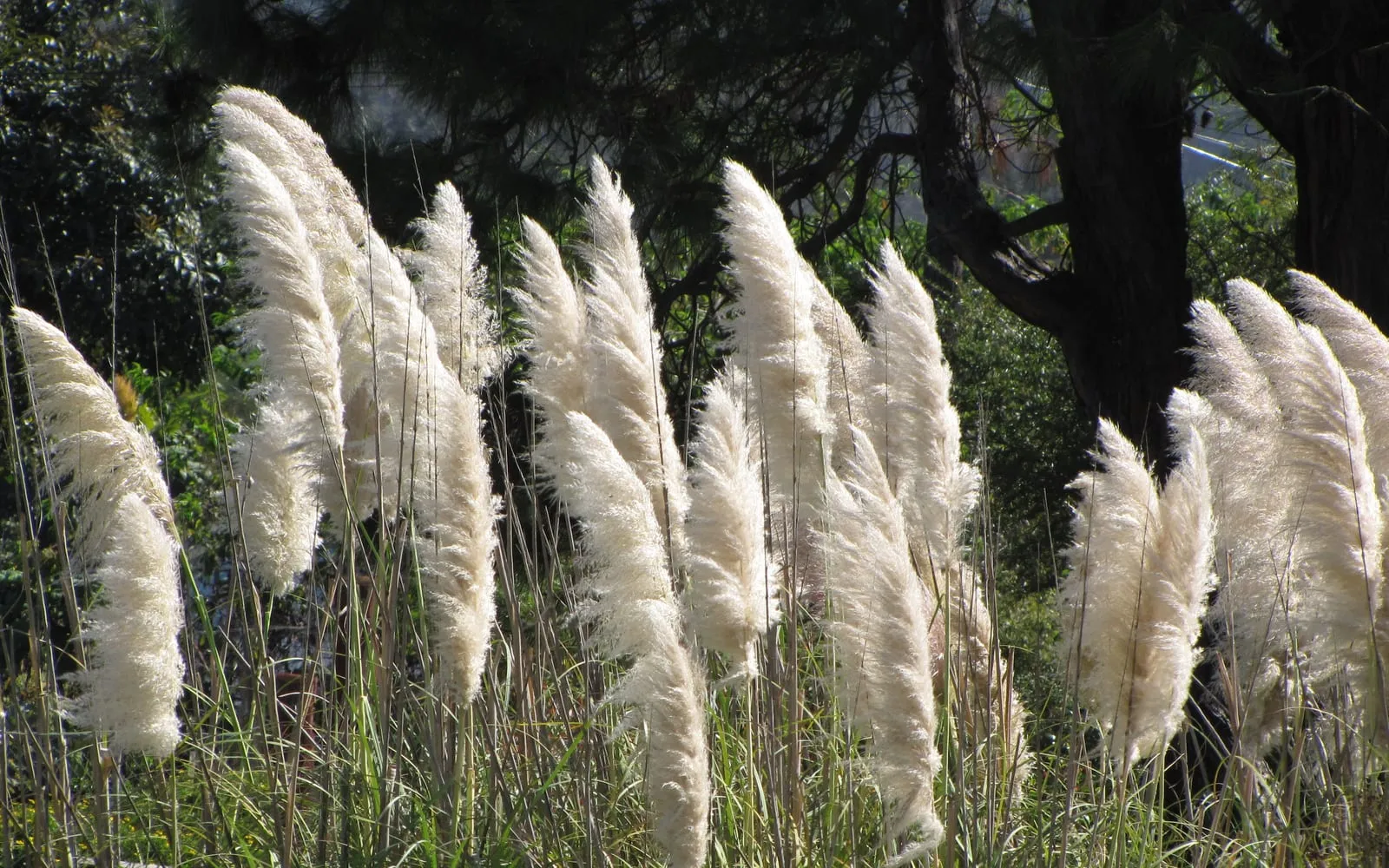
The plumes are spectacular. Silvery-cream feathered heads up to a metre long, held 2 to 3 m above the ground from late August, standing through the winter and catching the light on a frosty morning.
The plant beneath them is a fountain of arching evergreen leaves that reaches 1.5 m tall and 2 m across within a few years, and a mature clump on a small front lawn is out of scale with everything around it. Most of the pampas grass that gets dug out of temperate gardens was planted somewhere it could not fit.
The leaves are the other issue. The margins carry fine serrations that work like a saw, and a hand drawn along one produces a deep clean cut. Cutting the clump back is a job for gauntlets, long sleeves and eye protection.
Its reputation as a 1970s suburban cliche has kept it out of fashion for decades, and the grass itself is a fine plant used properly. Given space, sun and free drainage it is architectural, needs almost nothing, and stands through the winter when the rest of a border has gone.
Only female plants produce the full showy plumes, so check before buying an unnamed one.
Appearance and character
An evergreen perennial grass forming a dense clump with foliage at 1.5 m and flower stems reaching 2 to 3 m.
Leaves are long, narrow, arching, blue-green to grey-green, up to 2 m long, with margins carrying fine sharp serrations along their whole length.
The clump builds outwards from the centre and reaches 2 m across in five years, with a dense mass of old leaf bases at the base.
Plumes appear from late August into September, 30 cm to 1 m long, dense and feathered, held on stiff upright stems well clear of the foliage.
Colour runs from silvery-white through cream to pale pink in the cultivar ‘Rosea’.
Female plumes are the showy ones. Male plumes are narrower, thinner and duller, since they carry no silky hairs on the florets, and an unnamed seed-raised plant may turn out to be male.
The plumes stand through the winter and gradually shed, and they dry well for indoor arrangements if cut before they are fully ripe.
‘Pumila’ is the compact cultivar at 1.2 to 1.5 m, and it is the right choice for most gardens.
Where it is from
Southern South America, from Argentina, southern Brazil, Uruguay and Chile, growing on the pampas grassland and along river margins.
It was introduced to Europe in the 1840s and became fashionable in Victorian gardens, and it had a second wave of popularity in Britain in the 1960s and 1970s.
The plant is invasive in a number of countries with suitable climates. It is a declared weed in parts of California, Australia, New Zealand, South Africa and Spain, where it colonises coastal ground, roadsides and disturbed land in enormous numbers.
Seed production is prolific. A single female plume can carry over a hundred thousand seeds, carried on the wind for many kilometres.
Britain has not seen the same problem, because cool damp autumns stop most of the seed ripening, and it has naturalised only locally along mild coasts. Deadhead the plumes before they shed if you garden anywhere with a warm dry autumn.
The name comes from the Spanish cortar, to cut, describing the leaf edges.
A persistent urban legend that pampas grass in a front garden signals something about the householders has no basis whatever and is worth mentioning only because people ask.
How it grows
Plant in spring rather than autumn, which gives it a full season to establish before facing a wet winter.
Choose full sun and free-draining soil. It flowers poorly in shade and the crown rots in cold wet clay.
Improve drainage on heavy ground with grit, or plant on a slight mound.
Allow the space it will need, which is 2 to 3 m across for the full-sized plant and 1.5 m for ‘Pumila’. Underestimating this is the commonest mistake.
Keep it away from paths, doorways, seats and anywhere children play, because of the leaf edges.
Water through the first summer and after that leave it alone.
Cut it back in late winter, in February or early March, before the new growth starts. Cut the whole clump down to 30 cm with shears, a hedge trimmer or a pruning saw.
Wear gauntlets, long sleeves, stout trousers and eye protection. This is not optional advice.
Comb out the dead material from the base with a gloved hand or a rake afterwards, which tidies the clump and lets light in.
Do not burn it in situ. This was traditional advice, it damages the crown, and it is a real fire risk since dry pampas grass burns fiercely and fast.
Deadhead the plumes in a mild coastal garden before they shed, which stops it seeding into the wild.
Divide only if you must, in spring, and be aware that an established clump is extremely tough and may need an axe or a mattock.
Buy a named female cultivar rather than an unnamed seedling, which may turn out to be male with poor plumes.
Through the seasons
Winter the plumes stand through the season and are at their best under frost, and the foliage remains evergreen.
Spring is cutting-back time in February or early March, followed by fresh growth from April.
Summer builds the clump, and the plumes start to emerge in late August.
Autumn is the peak, with the plumes fully out from September and holding through the autumn.
Care difficulty
Easy in the right place.
It needs no feeding, no watering once established, no staking and no pest control, and it lives for decades.
The two difficulties are both about the gardener rather than the plant. Giving it enough room, and cutting it back once a year while properly protected.
Crown rot in cold wet clay is the only cultural failure worth mentioning, and it is a drainage problem.
Watering
Water through the first summer after planting.
Established pampas grass needs no watering in a temperate climate and tolerates drought well.
It dislikes waterlogged ground far more than dry, so improve drainage rather than adding water.
Mulch lightly in spring with compost if the soil is poor, keeping it clear of the crown.
Warning signs, diseases and pests
A clump that has grown far larger than expected is normal, and it is the commonest complaint. Plant ‘Pumila’ next time and allow 2 to 3 m for the full-sized plant.
Thin dull narrow plumes is a male plant. Only female plants produce the full silky display. Buy a named female cultivar.
No plumes at all is usually shade, a plant that is still too young, or cutting back too late in spring and removing the developing growth.
A dead brown centre with growth only around the edges is a congested old clump. Cut it hard back in late winter and comb out the dead material, or divide it.
The crown failing to grow away in spring after a wet winter is rot. Improve drainage and plant on a mound.
Seedlings appearing around the garden or on nearby waste ground is the plant seeding, which matters most in mild coastal areas. Deadhead the plumes before they shed.
There are almost no pests or diseases worth mentioning.
Growing environment
Full sun. It flowers poorly in shade.
Free-draining, reasonably fertile soil. Improve heavy clay with grit and avoid ground that waterlogs.
Hardy to about -15 deg C, and it does best in mild areas and along the coast, where it also tolerates salt wind well.
Allow 2 to 3 m of space for the species and 1.5 m for ‘Pumila’.
It suits a large lawn as a specimen, a big gravel garden, a coastal garden, a border back, a screen or a modern architectural planting.
Do not plant it beside a path, a door, a seat or a play area, and do not plant a full-sized one in a small front garden.
Grow it with plants of a similar scale. Phormium, yucca, large ornamental grasses, kniphofia and eryngium all sit comfortably with it and want the same free-draining sunny conditions.
Deadhead in a mild coastal garden to stop it seeding into surrounding land.
Its wildlife value is fair. The dense evergreen clump gives good winter shelter for insects and small mammals, and the plumes are used as nesting material by birds.
Feeding
None needed on reasonable soil.
Feed once in spring with a balanced general fertiliser on poor sandy ground.
Mulch lightly with compost in spring, keeping it clear of the crown.
Avoid high-nitrogen feeds, which give soft leafy growth and fewer plumes.
A plant without plumes is short of sun or is male rather than short of nutrients.
Troubleshooting
When do I cut it back? February or early March, before the new growth starts. Cut the whole clump to 30 cm and comb out the dead material from the base.
Should I burn it off? No. The old advice to set fire to it damages the crown and is a real fire hazard, since dry pampas grass burns fiercely and fast.
How do I cut it without getting cut? Gauntlets, long sleeves, stout trousers and eye protection, without exception. The leaf margins are serrated and produce deep clean cuts, and eye injuries have occurred.
My plumes are thin and dull. You have a male plant. Only female plants produce the full silky plumes. Buy a named female cultivar rather than an unnamed seedling.
How big does it get? Two to three metres across and 2 to 3 m tall in flower for the full sized plant. ‘Pumila’ reaches about 1.5 m and is the right choice for most gardens.
It has no plumes. Too much shade, a plant that is still young, or cutting back too late in spring. Move it into full sun and cut it back in February.
Is it invasive? Seriously so in California, Australia, New Zealand, South Africa and Spain. Where autumns are cool and damp the seed does not ripen, which is why it stays put across Britain and northern Europe. Deadhead the plumes if you garden anywhere warmer.
Can I dry the plumes? Yes. Cut them before they are fully ripe, in early autumn, and hang them upside down somewhere dry and airy.
It has died out in the middle. A congested old clump. Cut it hard back in late winter and comb out the dead material, or divide it, which takes a mattock on an established plant.