
Outdoor plant
Japanese Wisteria
Wisteria floribunda
How to grow Japanese wisteria, Wisteria floribunda. Telling it from Chinese wisteria by which way the stems twine, why an unpruned vine grows plenty of leaf but flowers poorly, and the pea-like seed pods that cause severe vomiting if eaten.
At a glance
- Difficulty
- Moderate
- Water
- Regularly for the first two to three years while establishing
- Light
- Full sun for good flowering
- Temperature
- Hardy; new spring growth is frost-tender
- Hardiness
- USDA 5-9, RHS H6, hardy to -20 C
- Type
- Deciduous twining climber, living many decades
- Height
- Up to 9 m trained on a support; stems can extend much further given room
- Native to
- Japan
Fully hardy once established, tolerating a severe winter without damage to the woody framework. The risk sits with a late spring frost after growth has started, which can blacken the young leaves and developing flower buds and reduce or wipe out that year's display even though the plant itself takes no lasting harm.
Hardiness zones describe winter cold alone. Summer heat, humidity, rainfall and the length of the growing season decide as much, so treat the range as the outer limit rather than as a recommendation.
Toxic if eaten
- Do not eat
- The seeds and pods above all, plus the bark
- Harm from
- Eating it
- Affects
- People, cats and dogs
Wisteria is a textbook case of a poisonous plant producing something a child recognises as food. After flowering it sets long, velvety pods that split to reveal round, flat seeds, and to a small child those read as peas in a pod, often hanging at eye level over a path or a patio where the vine has been trained above a seating area. The seeds and pods contain a lectin and a glycoside that irritate the gut severely. Eating even one or two seeds causes burning in the mouth, then nausea, repeated vomiting, abdominal cramps and diarrhoea within half an hour to a couple of hours, and the vomiting can be persistent enough to cause dehydration in a small child, which is usually why these cases end up in hospital. Larger amounts cause weakness, dizziness and collapse. Dogs chew fallen pods off the ground. Where small children use the garden, cutting the pods off as they form is sensible, since it also improves the following year's flowering by redirecting the plant's energy. Any child who has eaten seeds should be assessed rather than watched at home.
Sources: RHS potentially harmful garden plants, ASPCA toxic and non-toxic plants
About
Japanese wisteria is a vigorous climber grown for long, hanging racemes of fragrant flowers in late spring. It needs full sun, strong support and regular pruning. Without that pruning it often makes a lot of leaf and very few flowers.
It is often confused with Chinese wisteria. The most reliable difference is the direction of twining: Wisteria floribunda twines clockwise when viewed from below, while Wisteria sinensis twines anticlockwise.
Appearance and character
Leaves are pinnately compound, 20 to 35 cm long, divided into 13 to 19 oval-lanceolate leaflets, fresh green through summer and turning yellow before falling in autumn.
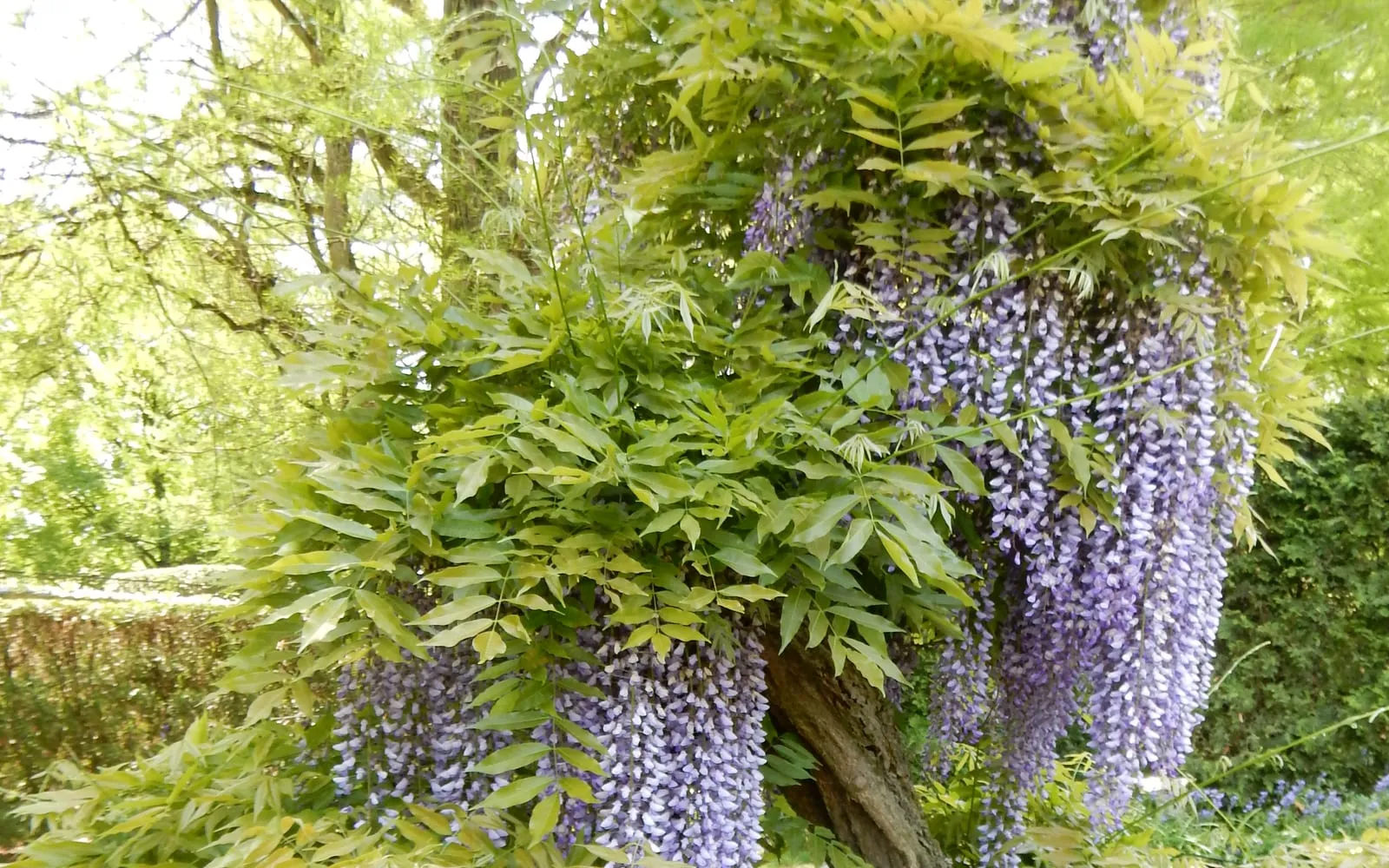
Flowers open in late spring in long, pendulous racemes, violet-blue to lavender in the species, fragrant, and produced in such numbers on a mature plant that the foliage disappears beneath them for the two or three weeks of peak flowering.
The stems twine clockwise around whatever support they are given, thickening with age into a woody, rope-like framework that can outlive the structure it was originally trained on, and an old, well-established plant develops a gnarled, sculptural trunk at the base that is a feature in its own right through winter.
Seed pods follow flowering, flattened, velvety and grey-green, 10 to 15 cm long, splitting explosively when ripe to scatter the seeds inside.
Where it is from
Wisteria floribunda is native to Japan, growing wild as a woodland climber that scrambles into the tree canopy, its long racemes hanging free below the foliage of its host.
It was introduced to Western gardens in the nineteenth century and has been bred since into named cultivars selected for flower colour and raceme length, some of which, such as ‘Multijuga’, are grown specifically for racemes exceeding a metre, trained over high pergolas that give the flowers room to hang their full length.
How it grows
Plant in deep, fertile, well-drained soil in full sun, since flowering depends on the ripening of the previous summer’s growth, which needs strong light to happen properly.
Give it a properly strong support from the start, such as a pergola, a sturdy wall with heavy-duty wires, or a purpose-built frame. A mature plant is immensely heavy and will pull down weak supports, including guttering and light trellis.
Train the main framework where you want it in the early years, tying in new growth to establish the shape, since an untrained young plant grows into a tangled mass that is far harder to bring under control later.
Prune twice a year for the best flowering. In late summer, cut back the long, whippy new growth to five or six leaves from the main framework. In late winter, cut those same shoots back further, to two or three buds, which is what forces the plant to flower rather than put its energy into more leaf.
Through the seasons
Late winter is for the second, harder prune, cutting summer-shortened shoots back to two or three buds to set up the coming season’s flowers.
Spring brings the flush of new leaf growth followed by the main flowering display in late spring, the best reason to have planted the vine in the first place.
Summer is vegetative growth. Watch for aphids on the soft new shoots and water a young, still-establishing plant well.
Late summer is the first prune, cutting the season’s long new growth back to five or six leaves, which controls size and starts building next year’s flower buds.
Autumn brings leaf colour and leaf fall, and is a good time to check and reinforce the support structure before winter winds test it.
Care difficulty
Moderate, and the difficulty is almost entirely about pruning rather than about keeping the plant alive, since an unpruned wisteria is close to indestructible once established. Getting it to flower reliably needs the twice-yearly prune done correctly and consistently, which many gardeners skip or do only once a year, producing a vigorous green vine that flowers poorly or not at all. The plant itself is otherwise undemanding.
Watering
Water regularly through the first two or three years while the root system establishes, a deep soak rather than a light sprinkle, so the water reaches down to encourage deep rooting rather than pooling at the surface.
Once established, an in-ground wisteria in reasonable soil generally needs no supplementary watering beyond rainfall, except during an extended drought, when a deep soak helps protect the developing flower buds.
Warning signs, diseases and pests
Wisteria scale is a hard, brown scale insect specific to the genus, appearing as small raised bumps along stems and branches and weakening the plant over time if left untreated. Horticultural oil applied in late winter, before growth starts, controls it.
Aphids cluster on the soft, new spring growth, distorting shoot tips. They rarely need treatment beyond a strong jet of water, since natural predators usually bring them under control within a few weeks.
Honey fungus occasionally affects older or stressed plants, showing as dieback and, eventually, white fungal growth under the bark near ground level, with black bootlace-like strands in the soil. There is no reliable treatment once established, and an affected plant is usually best removed along with as much root as can be dug out.
Failure to flower is the single most common complaint about this plant and is far more often a pruning or light problem than anything else. See troubleshooting below.
Growing environment
Full sun is close to essential for good flowering. A plant grown in shade produces plenty of leaf and few or no flowers, whatever else is done correctly.
Deep, fertile, well-drained soil suits it best, and it tolerates a wide pH range without difficulty.
Shelter from the worst spring frosts where possible, since established wood is fully hardy but the young leaves and forming flower buds are not, and a late frost after growth has started can blacken a season’s display.
Give the roots room to run. A wisteria confined to a small border or competing hard with other large plants establishes more slowly and flowers less freely than one with open ground to root into.
Feeding
Apply sulphate of potash at around 20 g per square metre in late winter, which firms growth and encourages flowering rather than leaf.
Avoid high-nitrogen feeds and avoid feeding an already vigorous, well-established plant at all beyond an annual potash application, since excess nitrogen produces exactly the soft, leafy growth that flowers poorly.
A mulch of well-rotted compost or manure in late winter, kept clear of the main stem, supplies enough general fertility for most soils without tipping the balance towards leaf over flower.
Troubleshooting
It has grown huge and never flowered. Almost always a pruning problem. Start the twice-yearly prune this year, cutting the current season’s long shoots back to five or six leaves in late summer and those same shoots back further, to two or three buds, in late winter. Flowering usually improves within one to two seasons of consistent pruning, though an unpruned plant may also be too young to flower yet, since seed-grown wisteria can take a decade or more to flower at all.
The buds formed and then turned black and fell. Late frost. There is little to do after the event beyond accepting a poor year; for future seasons, avoid feeding with high nitrogen, which can encourage soft, frost-prone growth, and consider a sheltered position for any new plant.
Is a young plant likely to flower soon? Only if it was propagated from a cutting or graft of a known flowering plant, which is how nearly all named cultivars are sold. A wisteria grown from seed can take ten years or more before it flowers, so buy a grafted or cutting-grown plant if flowering within a reasonable time matters to you.
How do I stop it pulling down my guttering? Prune it back hard, following the twice-yearly routine, and train the main stems onto a support that is physically separate from and stronger than the guttering itself; a wisteria will use anything within reach as a climbing aid regardless of what it was meant to grow on.
Are the seeds dangerous to birds or wildlife that eat them? The concern in most guidance is aimed at people and pets rather than wild birds, which are not commonly reported as poisoned by wisteria seed in the way dogs and children are, though deliberately encouraging birds to feed on the pods is not something to plan for.