
Outdoor plant
Oriental bittersweet
Celastrus orbiculatus
Also known as Asian Bittersweet, Round-leaved Bittersweet
How to identify oriental bittersweet, Celastrus orbiculatus. Telling it from native American bittersweet by where the berries cluster, why its tightening stems girdle and kill the trees it climbs, and why cutting it down alone rarely stops it growing back.
At a glance
- Difficulty
- Easy
- Water
- Established plants need no supplementary watering under normal rainfall
- Light
- Full sun to fairly deep shade, tolerating far more shade than most vines
- Temperature
- Extremely hardy across a wide range of temperate climates
- Hardiness
- USDA 4-8, RHS H6, hardy to -30 C
- Type
- Deciduous woody twining vine, vigorous and long-lived
- Height
- 20 m or more into a mature tree canopy
- Native to
- eastern Asia
A zone range this wide is itself the warning. Oriental bittersweet tolerates hard winter cold, summer heat, drought, waterlogging, deep shade and poor soil about equally well, which is exactly the profile that allows a garden escapee to become established woodland-wide rather than staying confined to where it was planted. Nothing about the climate figures here should be read as a reason to plant it; they explain why control programmes across its introduced range have struggled to contain it once it has a foothold.
Hardiness zones describe winter cold alone. Summer heat, humidity, rainfall and the length of the growing season decide as much, so treat the range as the outer limit rather than as a recommendation.
Harmful if eaten
- Do not eat
- The berries and seeds
- Harm from
- Eating it
- Affects
- People, cats, dogs and horses
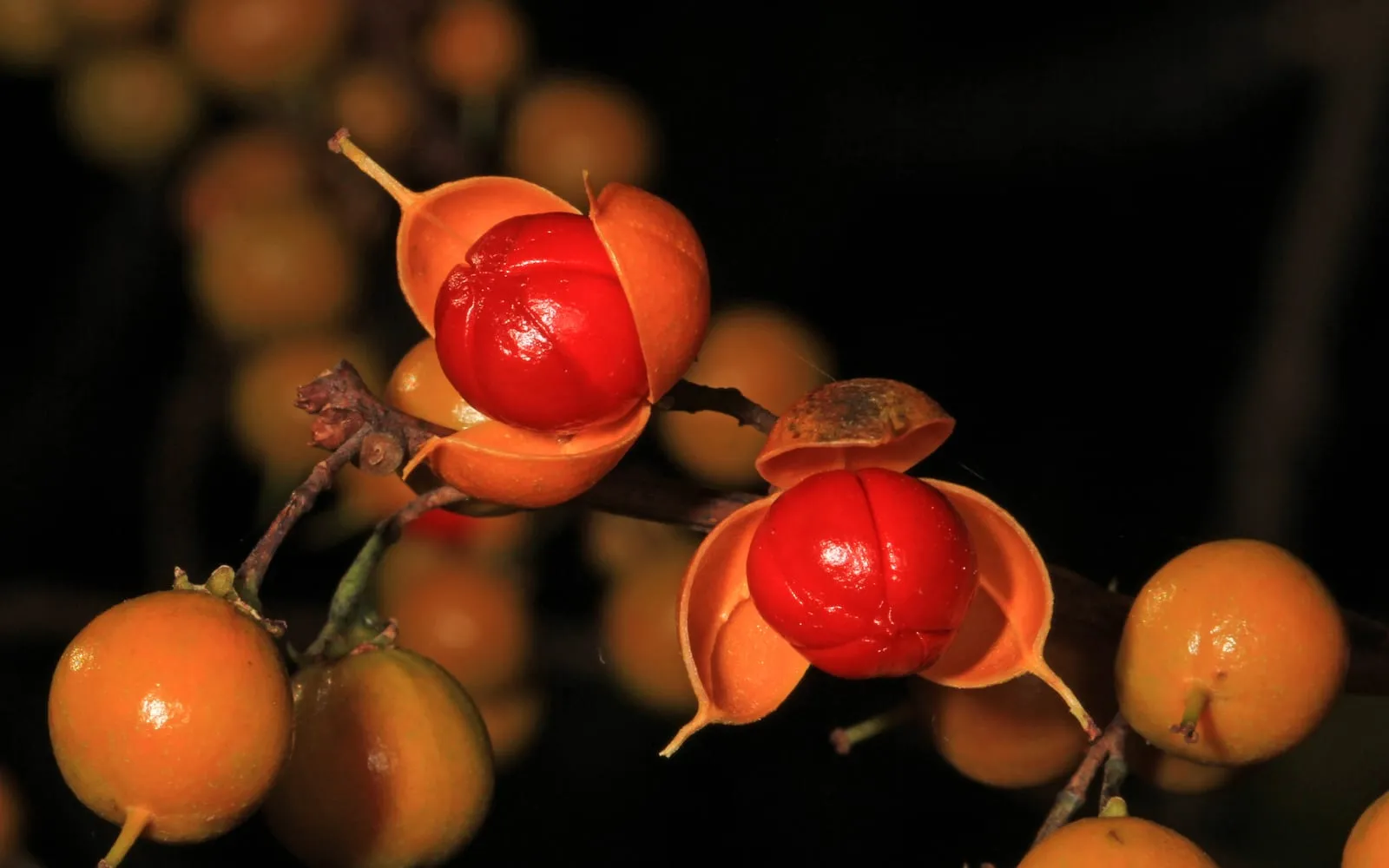
Oriental bittersweet produces bright orange-yellow berries that split to reveal red-orange seed coats, and both berries and seeds cause vomiting, diarrhoea and abdominal discomfort if eaten in quantity by a person or a pet. The ASPCA's documentation for the closely related native species, American bittersweet, Celastrus scandens, records the same pattern of mild gastrointestinal upset rather than anything life-threatening, and the two species are similar enough in chemistry that the same caution reasonably applies to this one. The RHS does not carry a specific entry for this species. In practice, the invasive spread of the plant and the physical damage it does to trees are both a larger concern for most readers than the mild toxicity of its berries, though a child or a pet that has eaten a handful should be watched for stomach upset.
Sources: ASPCA (American Bittersweet), RHS potentially harmful garden plants
About
Oriental bittersweet is not a plant this guide can recommend planting. It is a regulated, invasive vine across much of North America, prohibited or restricted for sale in numerous US states and listed as invasive by conservation agencies well beyond them. It damages trees as it climbs. Its flowers are inconspicuous and easy to miss.
A twining stem wraps tightly around a trunk or branch as it climbs, and as both the vine and the tree thicken with age the wrapped stem cuts into the bark like a tightening rope, girdling and eventually killing limbs or the whole tree it depends on for support. A mature infestation can pull down healthy trees under its own combined weight of vine and foliage, a pattern documented across forests in the eastern United States wherever it has become established.
It also crosses with the native American bittersweet, Celastrus scandens, producing hybrid offspring that erode the genetic identity of the native species over time, which is a second, quieter kind of harm alongside the visible damage to trees. Anyone who already has this vine on their property needs identification and removal advice far more than tips on growing it well.
Appearance and character
A woody, deciduous twining vine with round to oval leaves, 5 to 12 cm long, glossy and toothed at the margin, turning yellow in autumn before they drop.
Flowers are small, greenish-white and easy to overlook, produced in the leaf axils along the length of the stem rather than in the showy clusters typical of many climbers.
The plant was originally introduced and sold for cut-stem arrangements because of its berries. Round, bright yellow-orange capsules split open in autumn to reveal a red-orange seed coat inside, and the display persists on bare stems well into winter. Birds eat the berries and disperse the seeds widely across the landscape.
The single most useful identification point against the native American bittersweet is where the flowers and berries are carried. Oriental bittersweet bears them in clusters along the stem at each leaf axil, while the native species carries them in a cluster only at the tip of the stem. Oriental bittersweet also has rounder leaves and a stouter, more vigorous growth habit overall.
Where it is from
Celastrus orbiculatus is native to eastern Asia, including China, Japan and Korea, where it grows as one component of a diverse forest and scrub ecosystem alongside many other competing plant species and the insects and diseases that keep its populations in check.
It was introduced to North America in the 1860s as an ornamental vine, valued for its autumn berry display, and escaped cultivation repeatedly over the following century as birds carried seed from planted specimens into surrounding woodland.
Without the natural checks present in its native range, it has spread across much of the eastern and midwestern United States and into parts of Canada, forming dense monocultures along forest edges, roadsides and disturbed ground, and outcompeting native vegetation for light and space in the process.
How it grows
Most readers should assume that it should not be planted at all. It is listed as a noxious or invasive species in numerous US states and Canadian provinces, with sale, transport or planting restricted or banned outright in many of them, so checking the current status with a local extension service or department of agriculture before doing anything with this plant is the essential first step.
Where it is already established, on a property boundary or climbing into mature trees, the priority becomes removal rather than management. Small seedlings pull out by hand relatively easily while the root system is still shallow, ideally before they have had a chance to set seed.
Larger, well-established vines need cutting at ground level, followed by treatment of the freshly cut stump with an approved herbicide to prevent the vigorous regrowth this species is known for. A vine cut and left untreated usually resprouts from the root within the same season.
Vines climbing into a valued tree should be cut at both the base and at a second point higher up where it is safe to reach, since a girdling stem left in place after the roots die can continue to constrict the tree for years as both continue slowly thickening.
Monitor a cleared site for several seasons afterwards. Birds continue to bring in seed from surrounding infestations, and the root system can send up new shoots even after the top growth has been removed and treated.
Through the seasons
Spring is when new growth resumes rapidly from any surviving root or stump, making this a useful time to check whether a previous removal effort has succeeded.
Summer brings vigorous vegetative growth. New vines can climb a considerable distance into a supporting tree within a single season.
Autumn brings the conspicuous orange and red berry display that birds feed on and disperse widely, and is the season the plant is most visible and most easily located for removal planning.
Winter leaves the berries persisting on bare stems, still visible and still a source of seed being spread by birds through the coldest months.
Care difficulty
Easy, in the sense that this vine requires no encouragement whatsoever to thrive across an extraordinarily wide range of soil, light and climate conditions, which is the problem it presents. Removal is the far harder task, typically requiring repeated cutting and herbicide treatment over several years to exhaust the root system, plus ongoing monitoring for new seedlings arriving as bird-dispersed seed from any remaining infestation nearby.
Watering
No watering guidance applies to a plant this guide recommends removing rather than growing. An established infestation survives on natural rainfall alone across the full range of conditions it tolerates, from periodic drought to consistently damp ground, and withholding water is not an effective control method on its own.
Warning signs, diseases and pests
Girdling damage to a tree trunk or branch is the best and most serious sign of an established infestation, appearing as a tightening spiral groove where a thickening vine stem has cut into the bark of a thickening host branch over several seasons. Cut the vine at the base and again higher up as soon as this is spotted, since the constriction continues even after the vine’s roots have died if the wrapped stem is left in place.
A tree leaning or pulled over under visible vine growth is a sign of a heavy, mature infestation, where the combined weight of vine and foliage has become a genuine structural load on the host tree, sometimes enough to bring down an otherwise healthy specimen in a storm.
Resprouting from a cut stump within weeks is normal for this species and is why cutting alone, without a follow-up herbicide treatment on the fresh cut, rarely achieves lasting control.
New seedlings appearing at a distance from any known infestation reflect how far birds carry the seed after eating the berries, which is why control on a single property often needs coordinating with neighbours and local land managers to be effective.
Scale insects, powdery mildew and Japanese beetle all affect this species from time to time, but none of them meaningfully slow its growth or spread, and none need treatment on a plant otherwise being removed.
Growing environment
This species tolerates full sun to fairly deep shade, a wider range than most climbers, which is part of why it establishes as readily inside closed woodland as it does along an open, sunny roadside.
It grows in poor, dry, disturbed soil as readily as in good garden ground, showing little sensitivity to soil quality or drainage.
It withstands severe winter cold across most of the temperate zone it has been introduced to, with no meaningful climatic barrier limiting its further spread within that range.
None of this environmental tolerance is a reason to provide favourable conditions for it. It is listed on the strength of exactly this adaptability by conservation agencies across its introduced range.
Feeding
No feeding guidance applies. A plant already capable of climbing twenty metres into a mature tree canopy on unimproved soil needs no assistance from a gardener, and none should be given.
Troubleshooting
How do I tell it from native American bittersweet? Oriental bittersweet carries its flowers and berries in small clusters along the stem at each leaf junction, while the native species carries them only in a cluster at the very tip of the stem. Oriental bittersweet also has rounder leaves and noticeably more vigorous growth.
Is it illegal to grow where I live? Very possibly. It is listed as invasive, noxious or restricted for sale in numerous US states and Canadian provinces, so check with a local extension service or agriculture department before planting, transporting or propagating it.
I cut it down and it grew straight back. Cutting alone rarely works. Treat the freshly cut stump with an approved herbicide within minutes of cutting to prevent the vigorous regrowth this species produces from its root system.
A vine is strangling a tree in my garden. Cut it at the base and again higher up where it is safe to reach, since a girdling stem left in place keeps constricting the tree even after the cut roots have died.
Should I plant the native American bittersweet instead? Yes, where you want a similar berry display without the ecological cost, though even that native species should be sited carefully, since it too climbs vigorously and needs a strong support well clear of anything it might overwhelm.
I keep finding new seedlings after clearing it. Birds disperse the seed widely from any berries eaten nearby, so a cleared site can keep receiving new arrivals for years. Monitor regularly and coordinate with neighbours if a wider infestation is nearby.