
Outdoor plant
Snow Crocus
Crocus chrysanthus
Also known as Golden Crocus
Practical guidance for growing snow crocus, Crocus chrysanthus, including its earliest flowering time, naturalising in turf, corm dormancy, bird and rodent damage, and mild toxicity.
At a glance
- Difficulty
- Easy
- Water
- Rarely needed once established, beyond ordinary rainfall
- Light
- Full sun; the flowers stay part-closed in shade and on dull days
- Temperature
- Fully hardy; a real winter chill is part of what brings it into flower so early
- Hardiness
- USDA 3-8, RHS H7, hardy to -30 C
- Type
- Hardy cormous perennial, dormant from early summer to autumn
- Height
- 5-10 cm in flower
- Native to
- the Balkans, Turkey
Cold is never the obstacle for snow crocus, which survives winters far harsher than most gardens see and often flowers through a late snowfall rather than being set back by it. The corm needs the opposite extreme to complete its year: a summer dry and warm enough to ripen it fully while dormant underground. A garden with cool, damp summers gives the corm a poor rest and a display that fades over a few seasons, even where the winter cold was never a problem.
Hardiness zones describe winter cold alone. Summer heat, humidity, rainfall and the length of the growing season decide as much, so treat the range as the outer limit rather than as a recommendation.
Harmful to cats and dogs if eaten
- Do not eat
- The corm most of all
- Harm from
- Eating it
- Affects
- Cats and dogs
The ASPCA lists true crocus, the genus Crocus, as producing only mild signs if eaten, generally vomiting and diarrhoea in cats and dogs, and that mild rating is worth holding onto because of a dangerous mix-up. Autumn crocus, Colchicum autumnale, is a completely different genus that shares the common name "crocus" and a broadly similar flower shape, and it contains colchicine, a compound that causes severe poisoning and can be fatal in a small quantity. Snow crocus flowers in late winter and spring, from a corm planted the previous autumn, while Colchicum flowers bare-stemmed in autumn from a corm planted in summer; the two are not easily confused once that timing is known, which is the detail worth remembering if a corm of uncertain identity ever turns up in a border.
Sources: ASPCA (Crocus), RHS potentially harmful garden plants
About
Snow crocus flowers earlier than almost anything else in the garden, sometimes pushing up through a light covering of snow while deeper winter cold is still a real possibility. It grows from a corm rather than a true bulb, a solid underground stem base that is entirely used up feeding one season’s growth and replaced by a new corm forming on top of it each year.
It is smaller and generally earlier than the large-flowered Dutch crocus sold alongside it in autumn, and it comes in a wider range of colours and combinations, many with feathered or striped outer petals that the larger hybrids rarely show. Planted in quantity, it naturalises into turf, gravel and open border edges with very little upkeep required.
Appearance and character
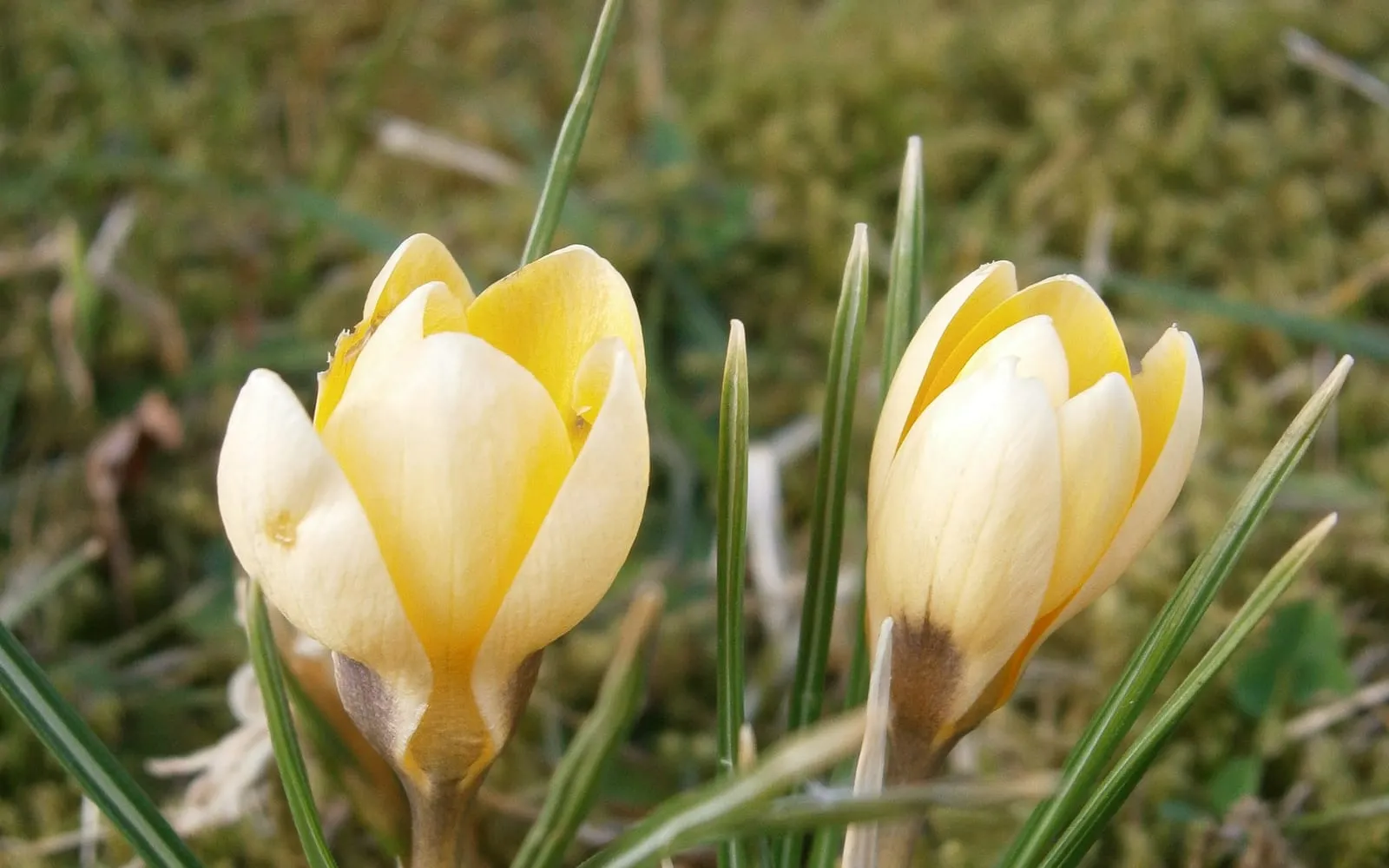
Each corm produces a handful of narrow, grass-like leaves marked with a fine silver stripe down the centre, and a cluster of goblet-shaped flowers that open flat in sun and close, sometimes almost completely, on cold or overcast days and every night.
Flower colour spans cream, soft yellow, deep gold, lilac and white, and many garden forms carry a contrasting flush or feathered marking on the outside of the petals, visible mainly while the flower is closed. The inside typically shows a bold orange stigma against the paler petal colour, prominent even on the smallest flowers.
The whole plant rarely exceeds 10 cm in height even at full flower, which suits it to positions close to a path or lawn edge where a taller bulb would be overlooked or lost among later spring growth.
Where it is from
Crocus chrysanthus is native to the mountains of the Balkans and Turkey, growing in short turf, rocky ground and open woodland margins at moderate altitude, where snow lingers into spring and summer arrives fast and dry. Flowering as early as possible after snowmelt, while taller competing plants are still dormant, is part of how it survives in that habitat.
It has been grown in European gardens since at least the eighteenth century and has been the source of a large number of named cultivars since, bred mainly for flower colour and marking rather than for size, since the species’ small scale and early timing were always the point.
How it grows
Plant corms in early to mid-autumn, about 7 to 10 cm deep, in free-draining soil in full sun. Group them generously and irregularly rather than in straight rows, since a loose, informal drift both looks more natural and matches how the corms spread on their own over time.
It naturalises well in short grass, provided the first mow of the season is held off until the foliage has died down naturally, usually around six weeks after flowering. It also does well in a rock garden, gravel bed, or at the front of a border where its small scale will not be swamped once later perennials come into growth.
Established clumps rarely need lifting. Where flowering has become noticeably thinner in a congested patch, lift the corms once the foliage has yellowed, separate them, and replant immediately rather than letting them dry out and sit unplanted.
Through the seasons
Winter brings the first flowers, often the very first bulb flowers of the year, sometimes opening through late snow in a cold season.
Spring is the main flowering period, tapering as the weather warms, followed by seed set and the leaves yellowing back toward dormancy.
Summer is spent entirely dormant below ground, resting in warm, dry soil while the new corm for next year forms.
Autumn is planting time for new corms and a reasonable season to lift and divide an established, congested clump.
Care difficulty
Easy, and reliably so once planted in a suitable spot. The corm looks after its own watering and feeding needs almost entirely from rainfall and a light annual feed, and the main task is choosing a free-draining, sunny position and leaving it undisturbed afterward. Cold winters cause it no trouble at all; the display suffers far more from a damp, cool summer that fails to ripen the resting corm properly.
Watering
No supplemental watering is needed once corms are established, beyond whatever rainfall the season provides. In an unusually dry spring, while the leaves are actively growing, a light watering supports the corm in building reserves for the following year.
Avoid watering the area through summer dormancy. A corm resting in consistently damp summer soil ripens poorly and is more prone to rot than one left to dry out properly until autumn planting or regrowth.
Warning signs, diseases and pests
Squirrels and mice dig up and eat corms, particularly soon after planting before the soil has settled around them. A layer of chicken wire pegged over a fresh planting, removed once shoots appear, protects corms through the most vulnerable weeks.
Wood pigeons and other birds shred open flowers, sometimes stripping a whole patch of petals within a day or two of the flowers opening, which can look far more alarming than the damage is to the corm underneath. Netting a prized patch during peak flowering is the only reliable deterrent.
Slugs and snails graze the earliest leaf tips in mild, wet weather, though rarely enough to trouble an established clump.
Grey mould occasionally affects flowers and corms in cold, wet weather, showing as a fuzzy grey coating on damaged or decaying tissue. Remove affected material promptly and improve air movement around a crowded planting.
Growing environment
Full sun brings out the flowers fully open; in shade, or on a dull day, the petals stay part-closed and much of the display is lost. Choose the sunniest available spot, particularly one that catches low winter and early spring light before nearby deciduous growth appears.
Free-draining soil matters more than fertility, since the corm’s real vulnerability is a wet summer rest rather than a poor one. A rock garden, gravel bed or lawn edge that dries out reliably all suit it well.
It tolerates being grown in grass provided the first mow waits until the foliage has died down, and it copes with light cultivation nearby as long as the corms themselves are not disturbed by deep digging.
Feeding
A light scattering of bonemeal or a proprietary bulb feed, applied as the flowers fade and the leaves are still green, supports a stronger display the following year, though it is far from essential in reasonable soil.
Stop feeding once the foliage has died back, since a dormant corm has no active roots to take anything up and unused fertiliser only sits in soil that should ideally be drying out.
Troubleshooting
Something ate my newly planted corms. Squirrels or mice are the likeliest culprits, drawn to freshly disturbed soil. Cover a new planting with chicken wire or mesh, removed once shoots appear above ground.
The flowers were shredded within days of opening. Wood pigeons and other birds are a common cause, more of a cosmetic loss than a threat to the corm itself. Netting the area during peak flowering is the most reliable prevention.
Can I grow it in a lawn? Yes, and it is well suited to naturalising in turf, provided the first mow of the season is delayed until the foliage has died down naturally, usually about six weeks after flowering.
Mine barely opened this spring. A cold, overcast run of days is the likeliest cause, since the flowers open widest in direct sun and stay mostly closed on dull days and every night. They should open normally once brighter weather returns.
Is this the same plant as autumn crocus? No, and the distinction matters. Snow crocus flowers in late winter and spring and is only mildly toxic if eaten. Autumn crocus, Colchicum autumnale, is a different genus entirely, flowers bare-stemmed in autumn, and contains a compound that causes severe, potentially fatal poisoning even in a small amount.