
How to make a wildflower meadow
Wildflowers thrive where the soil is poor and the grass is weak. Making a meadow means lowering fertility, choosing plants that suit your climate, and cutting once a year with the hay carried off.
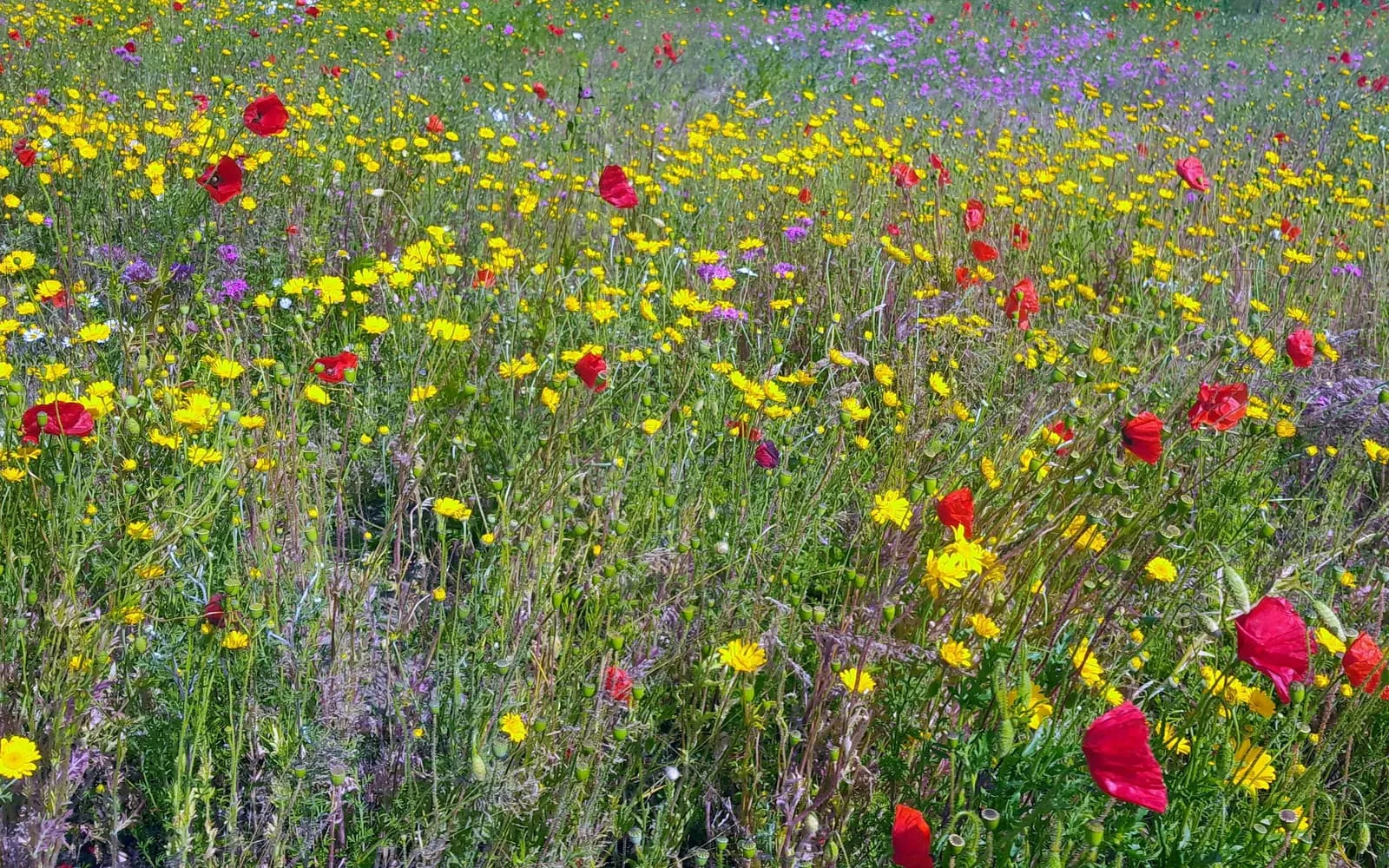
A wildflower meadow is a cut grassland. Left alone, most grassland turns to scrub and then to woodland over a few decades, so a meadow stays a meadow only where something removes the growth each year. For centuries that was a scythe and a grazing animal. In a garden it is you, with a mower or a pair of shears. The flowers you end up with are the ones that can flower and seed before a late summer cut and survive being cleared afterwards.
The hard part is accepting that meadow soil should be poor. Wildflowers evolved on thin soils. On rich ground a few vigorous plants, cocksfoot, perennial ryegrass, nettle, dock and creeping thistle, grow fast enough to shade out everything shorter. Reduce the fertility, especially nitrogen and phosphorus, and those plants grow less strongly. This is the opposite of what you do for a vegetable bed or a border, and it is usually what decides whether you get a meadow or a patch of coarse grass with a few flowers in it.
Start by reducing soil fertility
If you are sowing onto bare ground, add no compost, manure or fertiliser. If you are converting a lawn or rough grass, the fertility is already stored in the soil and the thatch, and you lower it slowly by cutting and clearing over one or two seasons before you sow.
Take the cuttings away, from every meadow and every year. Grass left to rot returns its nitrogen to the soil and feeds the plants you are holding back. Rake off each cut and compost it elsewhere, or stack it in a heap where beetles, amphibians and small reptiles can shelter.
Where the soil is very rich, some people strip off the top few inches of topsoil before sowing and cart it away. It is drastic and it works, because most of the stored fertility sits near the surface. On a garden scale it is worth the effort only on a small patch where the alternative is years of cutting.
Two different things go by the same name
Many people picture a wildflower meadow as red poppies and blue cornflowers. That is not a lasting meadow. Those flowers are annuals of cultivated ground. The common poppy in the photograph above, along with the cornflower, corn marigold and corn chamomile, are the old weeds of arable fields. They germinate on bare, disturbed, reasonably fertile soil, flower in one summer and die, so to see them again you have to break the ground open and usually re-sow. A cornfield annual mix gives you colour in the first year and little by the third.
A perennial meadow develops more slowly. Its plants come back each year from the same roots. Ox-eye daisy, field scabious, yarrow, common sorrel, knapweed and bird’s-foot trefoil grow in among fine grasses and need the low fertility of poor ground. A perennial meadow takes two or three years to look full and can then last for decades. Decide which one you want before you buy seed, because the two are grown in opposite ways.
Yellow rattle weakens the grass
Yellow rattle, Rhinanthus minor, is one of the most useful plants in a perennial meadow. It is a hemiparasite. It makes its own sugars in green leaves but taps the roots of grasses for water and minerals, and a good stand can cut grass growth by a third or more. A new meadow needs those gaps in the grass so slower flowers can root.
Yellow rattle seed is short-lived, so sow it fresh in late summer or early autumn rather than storing it to spring. It also needs a spell of winter cold to break dormancy, so it germinates only after months near or below freezing. Scatter it onto grass cut hard and scarified until bare soil shows, somewhere with a cold winter behind it. In a climate with no real winter it will not come up, and other ways of weakening the grass matter more.
Choose plants that belong where you are
A meadow mix sold in one country is wrong in another. Species that grow well in low, flower-rich grassland in a cool temperate climate will not survive a Phoenix summer or a Queensland wet season, and a mix built for one fails in the other. Buy native species suited to your own region, and where you can, seed of local provenance grown from wild populations near you. Local seed is adapted to your rainfall and season and is far less likely to introduce a plant that turns into a weed.
Grass belongs in a meadow, but it has to be the right kind. Vigorous agricultural grasses such as perennial ryegrass smother flowers. Fine, slow, tuft-forming grasses, common bent, crested dog’s-tail, the fescues and sweet vernal grass, leave room and light between their tussocks. A good meadow mix is mostly these fine grasses, roughly four parts grass to one part flower by weight. On a thin, dry, limy soil, low plants like wild thyme and bird’s-foot trefoil often do well.
Four ways to start one
From bare ground. Clear the site of existing plants, rake it to a fine tilth, and sow a meadow mix in autumn or spring at about four grams per square metre. Do not bury the seed. Most meadow seed needs light to germinate, so press it into the surface, firm it by treading or rolling, and leave it exposed. This is the most reliable way to control what grows, because you remove the existing plants first.
Into existing grass. This is slower, because established grass resists newcomers. Mow the area very short, scarify hard to expose soil across at least half of it, and sow yellow rattle first to weaken the grass over a year or two before you add other flowers.
Plug plants. Pot-grown wildflowers planted straight into turf skip the germination stage, which is where most sowings fail. They cost more than seed, but they establish more reliably and let you place each species where you want it. For a small garden meadow this is often the surest route.
Meadow turf. Rolls of ready-grown meadow, sold like lawn turf, give an instant result at the highest price. Save it for a small, visible area where you cannot wait.
Cut it once a year
A meadow is a managed habitat, and the traditional management is a hay cut. Let the grass grow up through spring and early summer so the flowers bloom and set seed. Cut it once in mid to late summer, once the main flowers have seeded, and leave the cuttings lying for a few days so the seed drops out of them. Then rake everything off. Many meadows also get a shorter second cut or a spell of grazing in autumn, which keeps the coarse grasses in check through winter.
The cutting date changes which flowers do well. A July cut favours plants that flower and seed by midsummer, such as ox-eye daisy and yellow rattle. Holding the cut until late August or September lets later flowers seed but gives the grass more of the season. For spring flowers like cowslip and snake’s-head fritillary, cut from midsummer and mow or graze lightly into autumn, then leave the meadow uncut early in the year so they can bloom.
Whatever the timing, carry the hay away. That matters as much in year ten as in year one, and it is the step people drop once the meadow looks established.
A meadow the size of a lawn
You do not need a field. A corner of a lawn left long, a strip beside a fence, or a single bed can all support meadow flowers, and small patches add up across a street. The simplest start is to stop mowing part of the lawn, watch what appears, cut it once at the end of summer and clear the clippings. Keep the rest as lawn if you want the contrast of mown grass beside it.
Stopping the mower rarely gives you much on its own, because a fed and closely mown lawn has been reduced to a few grasses, a little clover and the odd dandelion, with little else left in the seed bank. To get flowers you usually have to bring them in, by oversowing yellow rattle and setting plug plants into the longer grass. A mown path through the long grass makes it look deliberate rather than neglected, which counts for more with neighbours than it should.
What the first years look like
The first summer often disappoints. Bare-ground sowings often produce fast annual weeds, fat hen, groundsel and thistle seedlings, before the perennials are big enough to show. Hold off feeding and watering, keep cutting to knock the annuals back, and let the slow plants build roots underground. By the second or third year the perennials become more visible and the area starts to look more like a meadow.
Judge it over years rather than weeks. A meadow takes time to settle, and each site settles differently. You are trying to grow low, varied grassland that changes through the season and feeds insects. It will be closer to rough grassland than to a flowerbed, and it will look different every year.
Common questions
- How long does a wildflower meadow take to establish?
- A perennial meadow usually takes two to three years to settle. The first summer is dominated by fast annual weeds while the perennials build roots, and the balance shifts towards the flowers from the second year onwards. An annual cornfield mix flowers within months but needs re-sowing to repeat.
- Do I need to clear the grass before sowing?
- For the most reliable result, clear the existing vegetation and sow onto bare, raked soil. You can sow into existing grass, but it is slower and needs the grass weakened first by hard scarifying and by sowing yellow rattle a year or two ahead of the other flowers.
- Why should I not feed a wildflower meadow?
- Wildflowers are adapted to low-fertility soils. Feeding favours the vigorous grasses and weeds that outgrow and shade the flowers out. Removing the cuttings after every cut lowers fertility over the years and shifts the balance towards the flowers.
- What is yellow rattle and why is it recommended?
- Yellow rattle is an annual that draws water and minerals from grass roots, weakening the grass and opening space for other flowers. Sow fresh seed in late summer or autumn onto short, scarified grass. It needs a cold winter to break dormancy, so it works only where winters turn properly cold.
Sources and further reading
- Creating wildflower meadowsRoyal Horticultural SocietyOn lowering soil fertility, seedbed preparation and sowing rates for a new meadow.
- Wildflower meadow maintenanceRoyal Horticultural SocietyThe annual cut, its timing, and why the hay has to be removed every year.
- How to grow a wildflower meadowPlantlifeA conservation charity's guide, written around native seed and low fertility.
- How to grow yellow rattlePlantlifeSowing fresh seed in autumn onto short grass, and why it suppresses the grass.