
Houseplant
Venus Flytrap
Dionaea muscipula
Also known as Dionaea, Tippitiwitchet
How to care for Dionaea muscipula. Pure water, winter dormancy, full sun, feeding and the trigger hairs inside each trap.
At a glance
- Difficulty
- Difficult
- Water
- Keep the compost wet at all times through the growing season
- Light
- Full sun. Four hours of direct sun minimum, more is better
- Temperature
- 20-35 deg C in summer, 0-10 deg C for winter dormancy
- Humidity
- Moderate. It does not need a terrarium
- Hardiness
- USDA 6-9, RHS H4, hardy to -7 C
- Type
- Herbaceous perennial with a winter dormancy
- Height
- 10-15 cm, with flower stalks to 30 cm
- Native to
- Wet pine savanna within about 100 km of Wilmington, North Carolina
- Best month
- November in the Northern Hemisphere, May in the Southern Hemisphere
A temperate bog plant rather than a tropical one, despite the shelf it is sold on. It needs a cold dormancy of three to four months below about 10 deg C or it exhausts itself and dies in its second year, so a warm windowsill all year is what kills most of them. Rainwater or distilled only.
Hardiness zones describe winter cold alone. Summer heat, humidity, rainfall and the length of the growing season decide as much, so treat the range as the outer limit rather than as a recommendation.
Every month named in this guide is for the temperate Northern Hemisphere. If you garden in the Southern Hemisphere, shift each one by six months, so November becomes May. Closer to the equator the wet and dry seasons matter more than the calendar, and the shift stops being a useful guide.
Not known to be toxic
Non-toxic. The ASPCA does not list Dionaea muscipula among plants toxic to cats, dogs or horses, and it does not appear on the RHS list of potentially harmful garden plants. The traps close on insects and have no capacity to harm a person or a pet. A trap snapping shut on a fingertip is a curiosity rather than a hazard, though triggering traps for entertainment does harm the plant, because each closure costs it energy and every trap has a limited number of closures in it. The digestive fluid is a weak mix of enzymes and acid that is harmless on skin.
Sources: ASPCA toxic and non-toxic plants, NC State Extension, Dionaea muscipula
About
The trap can count. Each lobe carries three fine trigger hairs, and one touch does nothing. A second touch within about twenty seconds closes the trap in under a tenth of a second. Further movement from the trapped insect, five or more stimulations in total, tells the plant it has caught something alive and starts the digestive glands working.
That arithmetic exists because closing is expensive. A raindrop or a falling pine needle triggers one hair and no more, and the plant saves itself the cost.
Almost every Venus flytrap sold in a garden centre dies within a year, and it dies for one of three reasons. It gets tap water, it gets fertiliser, or it is kept warm and growing through the winter. All three are avoidable, and none of them is intuitive.
Appearance and character
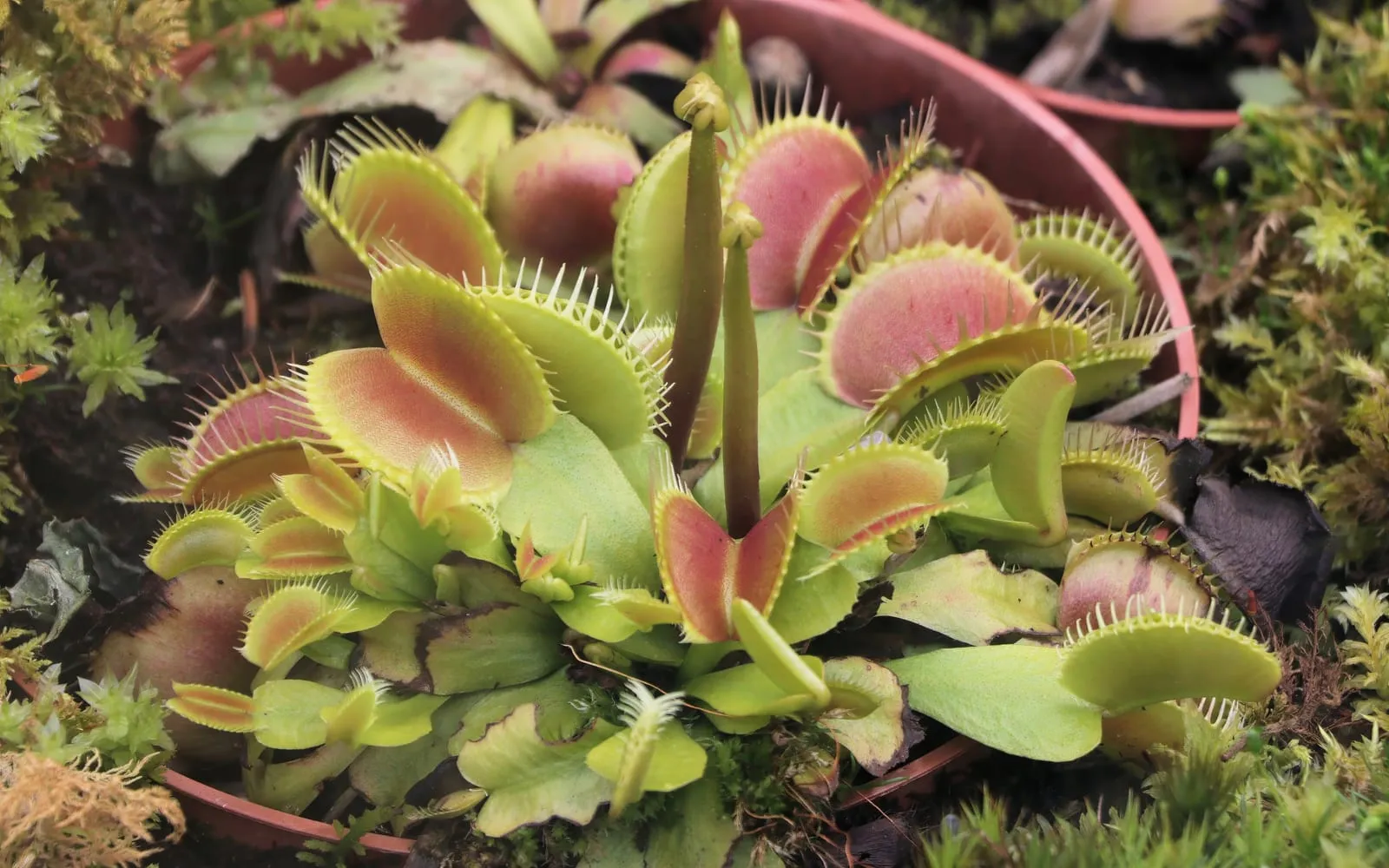
A low rosette, 10 to 15 cm across, of leaves that each end in a trap. The flat part behind the trap is a broadened leaf stalk doing the photosynthesis, and the trap itself is the true leaf blade.
Traps run from about 1 cm on a young plant to 4 cm on a well-grown one, hinged along the midrib, fringed with interlocking spines that mesh like fingers when the trap shuts.
The inside flushes deep red in strong sun and stays green in shade. Red colour is a reliable sign that a flytrap is getting enough light.
Growth habit changes through the year. Spring leaves lie flat and low with short stalks, and summer leaves stand upright on longer stalks. Both are normal on the same plant.
Flowers come in spring on a stalk 20 to 30 cm tall, white and five-petalled, held well clear of the traps so that pollinating insects do not get eaten.
Where it is from
A remarkably small area of wet pine savanna within roughly 100 km of Wilmington, North Carolina. Nowhere else on Earth has a wild population.
The habitat is acidic, permanently wet, and almost devoid of nutrients, kept open by regular fires that clear competing scrub. Carnivory is the plant’s answer to soil that offers no nitrogen. It gets minerals from insects and everything else from sun and water.
That poverty is why fertiliser kills it. A flytrap’s roots are adapted to nutrient-free sand and peat, and dissolved salts scorch them.
The same explains the water rule. Rain falling on that savanna carries almost nothing dissolved in it. Mains water typically carries 100 to 400 parts per million of dissolved minerals, which accumulate in the compost and poison the roots over a few months.
Winters there bring frost, and the plant dies back and rests. That dormancy is not optional.
Wild populations have declined severely and poaching from the remaining sites is a felony in North Carolina. Buy from a nursery that propagates its own.
How it grows
A herbaceous perennial growing from a small white rhizome that looks like a bulb. Leaves emerge from the centre of the rosette in a continuous rotation through the growing season.
Each trap works about four to seven times before it stops closing and blackens. That is ordinary wear rather than a fault, and the plant replaces it.
Blackening traps on an otherwise healthy plant are normal at any time of year. Cut them off at the base once they are fully brown.
Offsets form from the rhizome, so a healthy plant becomes a clump of several rosettes over a few years. Divide them in early spring as growth restarts.
Flowering costs the plant a great deal. Unless you want seed, cut the flower stalk off when it reaches about 5 cm. A plant allowed to flower often produces poor growth for the rest of the season.
Through the seasons
Spring ends dormancy. Growth restarts in March or April, the flower stalk appears, and you should cut it unless you want seed. Divide and repot now if needed.
Summer is the main growing season. Keep the plant in full sun, standing in rainwater, and let it catch its own insects if it is outdoors.
Autumn slows growth. Traps get smaller, leaves lie flatter, and the plant starts shutting down. Reduce watering so the compost is damp rather than saturated.
Winter means dormancy from about November to February. The plant needs three to four months between 0 and 10 deg C. Leaves die back and the plant looks dead, which frightens people into throwing away perfectly healthy rhizomes. Keep the compost just damp and leave it cold.
Care difficulty
Difficult, though not for the usual reasons. The plant tolerates rough handling and needs almost no attention. What it needs is three specific conditions, and each one runs against normal houseplant instinct.
Water must be rainwater, distilled water or reverse osmosis water. Tap water, bottled mineral water and filter-jug water all carry dissolved minerals that build up and kill it over three to six months.
Compost must contain no nutrients. Sphagnum peat with perlite or lime-free sand, and nothing else. Ordinary potting compost kills a flytrap in weeks.
Winter must be cold. A flytrap kept on a warm windowsill all year exhausts itself and dies in its second or third year, having looked fine for the first.
Get those three right and the plant is close to self-sufficient.
Watering
Keep the compost wet throughout the growing season, wetter than you would keep almost any other plant. Standing the pot in a tray with 1 to 2 cm of water is the standard method.
Use rainwater, distilled water or water from a reverse osmosis unit. Nothing else. A water butt is the easiest source.
Tap water is the commonest cause of death. The damage is slow and silent, showing as weak growth and traps that fail to develop months after the harm was done.
Reduce watering during dormancy so the compost stays damp rather than waterlogged. A cold, saturated pot invites rot.
Top water occasionally through the season to flush minerals downward, even when using the tray method.
Warning signs, diseases and pests
Traps blackening one at a time on a healthy plant are worn out and normal. Cut them off at the base.
Whole plant blackening from the centre outward is rot, usually from cold sodden compost in winter or from fertiliser.
Weak floppy growth with small green traps means too little light. This plant needs direct sun.
Traps that no longer close have usually reached the end of their working life, and a whole plant that stops closing suggests it lacks energy from insufficient light.
Traps that close and then reopen within a day caught nothing worth digesting.
Aphids cluster on new growth and distort emerging traps. Rinse them off, and avoid systemic insecticides.
Botrytis appears as grey fuzzy mould during dormancy, in cold still damp air. Remove dead leaves through winter and give the plant some air movement.
Pale, stunted growth with no red colour after a season suggests mineral build-up from tap water. Repot into fresh peat mix and switch to rainwater.
Growing environment
Full sun. Four hours of direct sunlight is the minimum and more produces better colour and larger traps. A south-facing windowsill indoors, or an open position outdoors, both work.
Growing it outdoors from spring to autumn produces a far better plant than a windowsill does, and it catches its own food.
Summer temperatures between 20 and 35 deg C suit it. Winter dormancy needs 0 to 10 deg C for three to four months, which an unheated greenhouse, a cold frame, a porch or a sheltered spot outdoors all provide.
The plant is hardy to about -7 deg C when established, though a pot freezing solid is a risk. Sink the pot into the ground or wrap it in fleece during a hard spell.
Compost should be one part sphagnum peat to one part perlite or lime-free horticultural sand. Nothing else. Avoid peat-free composts here, since the alternatives available carry nutrients this plant cannot tolerate, and this is one of the few remaining cases where peat has no adequate substitute.
Use a plastic pot, deep rather than wide, since the roots go down further than people expect.
A terrarium is unnecessary and often harmful, because the still humid air encourages rot and most terrariums are too dark.
Feeding
Never put fertiliser in the compost. It is the second most common way to kill a Venus flytrap.
A plant grown outdoors needs no feeding at all. It catches what it needs.
A plant grown permanently indoors can be given a live or freshly killed insect every three or four weeks during the growing season. Drop it into a trap and gently press the outside of the lobes a few times to mimic struggling, which triggers the digestive response.
Never feed meat. Beef, chicken and ham all rot inside the trap because the fats and proteins are wrong for the plant’s enzymes, and the trap blackens and dies.
Feed no more than one or two traps at a time. Digestion takes a week or more and costs the plant energy.
Feed nothing during dormancy.
Troubleshooting
All the leaves died back in November and it looks dead. Dormancy. This is what the plant is supposed to do. Keep it cold and just damp, and it will reshoot in March.
The traps are green rather than red. Not enough light. Move it into direct sun.
Traps go black a few days after closing on something. If they caught prey and digested it, this is normal wear. If they blacken without catching anything and the whole plant looks poor, check your water first.
I have been using tap water. Repot into fresh peat and perlite as soon as possible and switch to rainwater. Damage already done cannot be reversed, and the plant often recovers over a season.
A flower stalk has appeared. Cut it off at about 5 cm unless you want seed. Flowering drains the plant.
Can I make the traps close for fun? Please do not. Every closure costs energy, each trap only works a handful of times, and a trap that closes on nothing gains the plant nothing.
Can I feed it a bit of mince? No. The fat rots inside the trap and kills it. Insects only.
Do I need a terrarium? No. It wants sun and cold winters more than it wants humidity, and a closed case usually provides too little sun and no winter cold.
Venus Flytrap problem guides
Not sure what is wrong? See the common houseplant pests guide.