
Houseplant
Narrow-Leaved Ragwort
Senecio inaequidens
Also known as South African Ragwort, Senecio inaequidens
How to grow Senecio inaequidens, the narrow-leaved ragwort, a long-flowering yellow daisy that is invasive and toxic, and how to control it.
At a glance
- Difficulty
- Easy
- Water
- When the soil dries; drought-tolerant once established
- Light
- Full sun
- Temperature
- Fairly hardy; tolerates light to moderate frost
- Humidity
- Low to average
- Hardiness
- USDA 7-10, RHS H4, hardy to -8 C
- Type
- Evergreen to semi-evergreen perennial subshrub
- Height
- 40 to 80 cm
- Native to
- South Africa
A tough perennial from South Africa that has spread as an aggressive weed across much of Europe, colonising roadsides, railways and waste ground. It needs full sun and free-draining soil, tolerates drought, poor ground and moderate frost, and flowers for an exceptionally long season. It is safest above about minus 8 deg C and is invasive where it is not native.
Hardiness zones describe winter cold alone. Summer heat, humidity, rainfall and the length of the growing season decide as much, so treat the range as the outer limit rather than as a recommendation.
Toxic if eaten
- Do not eat
- All parts, which contain pyrrolizidine alkaloids
- Harm from
- Eating it
- Affects
- People, cats, dogs and horses
Like other ragworts, this plant contains pyrrolizidine alkaloids that cause cumulative, irreversible liver damage when eaten, even in small amounts over time. It poisons grazing livestock, especially horses and cattle, and is harmful to people and pets if eaten, or if it contaminates hay, forage or honey. The ASPCA lists Senecio among the plants toxic to cats and dogs. Wear gloves when handling or pulling it, wash your hands afterwards, keep it away from animals and children, and never let it get into forage.
Sources: ASPCA toxic and non-toxic plants, RHS potentially harmful garden plants, North Carolina Extension plant toxicity database
About
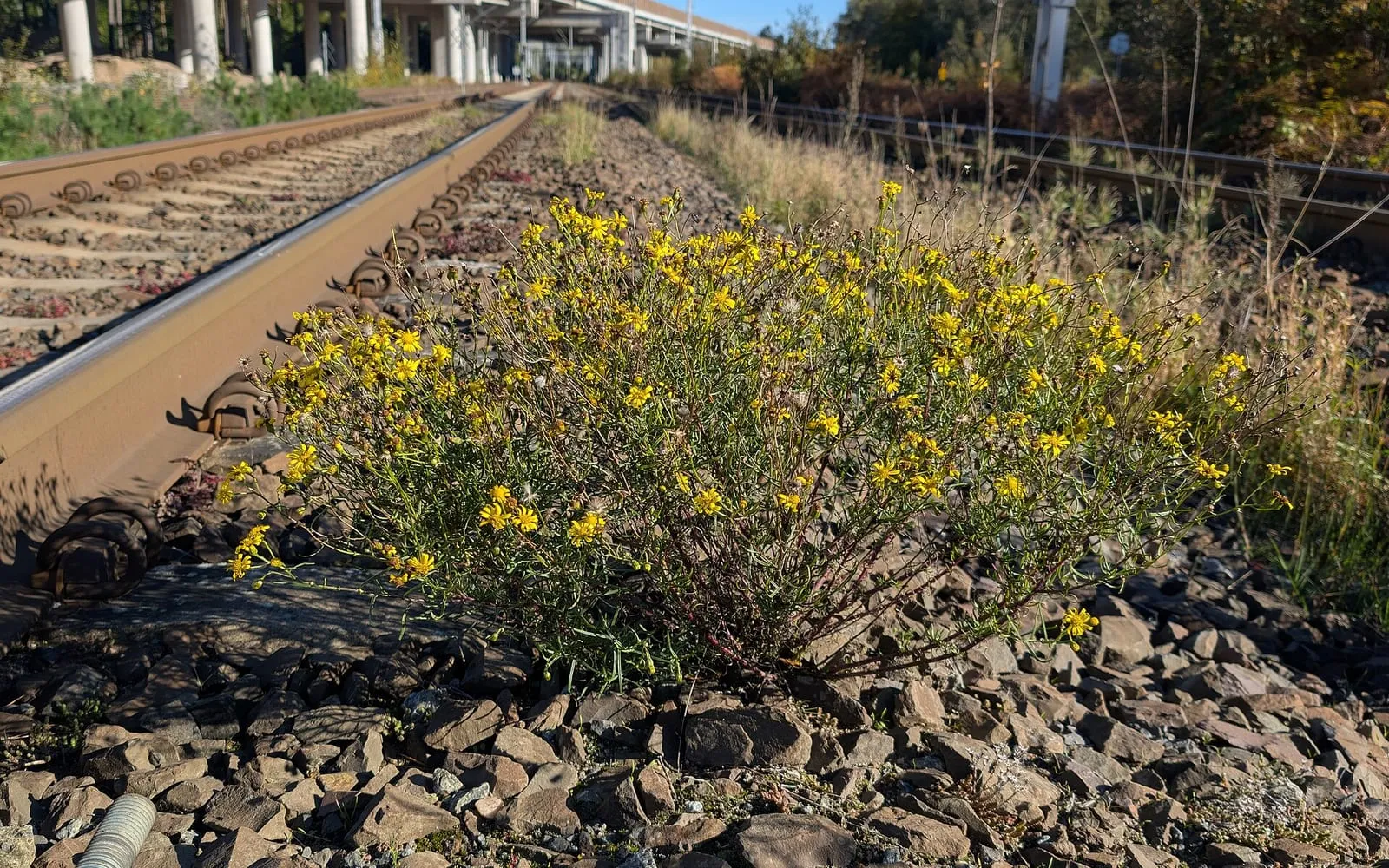
Narrow-leaved ragwort is an invasive ragwort in many regions. It is a bushy, much-branched perennial with fine, narrow, almost linear leaves, and it flowers for months in small, bright yellow daisies. That long flowering season, combined with its toughness, has made it a successful weed. From its native South Africa it has spread across much of Europe, colonising roadsides, railway ballast and waste ground quickly.
It is easy to grow to the point of being a nuisance, thriving on poor, dry, stony ground in full sun and seeding itself prolifically. In much of Europe, the responsible course is to control the plant rather than grow it. It spreads readily into surrounding ground and can move into farmland.
It is also toxic. Like other ragworts it carries pyrrolizidine alkaloids that cause cumulative liver damage in livestock, people and pets, and it is a serious problem where it contaminates hay or grazing. So this is a plant to recognise, handle with gloves, and keep out of pasture and out of reach of animals and children. It is not a good border ornamental.
Appearance and character
The leaves are narrow, almost linear, and fine, a fresh green, crowding the many branched stems and giving the plant a wiry, bushy look.
It forms a rounded, much-branched mound, forty to eighty centimetres high, evergreen or nearly so in mild areas, and woody at the base with age.
Its flowers are small, bright yellow daisies with narrow rays, borne in great numbers over an exceptionally long season, sometimes almost year-round in mild climates.
It sets vast quantities of fluffy, wind-borne seed, which is how it spreads so aggressively along roads, railways and disturbed ground.
Where it is from
Senecio inaequidens is native to the grasslands and mountains of South Africa, but it has naturalised widely across Europe and beyond, spreading along transport corridors and colonising disturbed, free-draining ground in full sun. It is invasive where it is not native.
That colonising nature explains both its ease and its problem. It needs full sun and free-draining soil, tolerates drought, poor ground and moderate frost, and flowers and seeds prolifically. Its toughness, long flowering and heavy seeding make it an aggressive invader.
How it grows
It grows fast and bushy through the warm months, flowering over an exceptionally long season and setting heavy crops of wind-borne seed, and it is evergreen or nearly so in mild areas. It thrives on poor, dry ground and needs no encouragement.
Grown deliberately, it needs only full sun and free-draining soil, but in most of Europe the sensible approach is to control it. Deadhead before it seeds, or better, dig or pull it out, roots and all, wearing gloves, and dispose of it so that it cannot seed or reach forage.
Never let it self-seed into farmland or grazing, and never compost the flowering or seeding tops in a way that spreads them. Where it is a listed invasive, follow local guidance on its control and disposal.
Propagation is by seed, which it produces in great quantity. In practice, the usual task is control rather than raising more.
Through the seasons
Spring brings vigorous bushy growth and the start of flowering. Pull or dig out unwanted plants now, before they seed.
Summer is a long flowering season, with heavy seeding. Deadhead or remove plants to prevent the wind-borne seed spreading.
Autumn flowering continues in mild weather. Clear plants before the last seed is shed.
Winter is evergreen or nearly so in mild areas, with dieback only in harder frost. Remove any plants that have established where unwanted.
Care difficulty
Easy to grow, and the real difficulty is the site. It thrives on poor, dry ground in sun and seeds itself widely, so in most of Europe it is managed as an invasive weed. Its toxicity, from pyrrolizidine alkaloids, makes careful handling and disposal important, and it must be kept out of grazing and forage.
Watering
Water only to establish a deliberately grown plant; thereafter it is drought-tolerant and needs no watering, since it thrives on dry, poor ground. It rots only in heavy, waterlogged soil.
In practice it needs no watering at all, and its drought-hardiness is part of what makes it such a persistent weed.
Warning signs, diseases and pests
Aggressive self-seeding into surrounding ground is the main problem, not a disease. Deadhead before seed sets, or remove plants entirely, and never let the wind-borne seed reach farmland or grazing.
It is little troubled by pests, being tough and, to most animals, unpalatable and toxic. Aphids may gather on soft growth but rarely check it.
Root rot occurs only in heavy, waterlogged soil, which is unusual for so drought-hardy a plant.
Growing environment
Full sun and free-draining, even poor, stony soil suit it, matching the roadsides and waste ground it colonises. It tolerates drought and moderate frost and needs no special conditions.
It is fairly hardy, evergreen or nearly so in mild areas and dying back in harder frost. It needs nothing beyond sun and drainage, which is part of why it spreads so readily.
Grown deliberately, it goes in a sunny, free-draining spot, but it is best treated as a weed to control instead of a border plant, and kept well away from grazing.
Feeding
Feed nothing. It thrives on poor ground, and feeding only makes it grow and seed more vigorously.
There is no case for feeding a plant that is, in most places, an invasive weed to be controlled.
Troubleshooting
It is seeding everywhere. This is its nature as an aggressive weed. Deadhead before seed sets, or dig and pull it out, roots and all, wearing gloves, and dispose of it so it cannot seed or reach forage.
Is it safe to have in the garden? Only with caution. It is toxic, carrying pyrrolizidine alkaloids that damage the liver, and invasive, so keep it from grazing animals, handle it with gloves, and in most of Europe control it instead of encourage it.
Should I compost it? Not the flowering or seeding tops, which can spread seed or contaminate forage. Follow local guidance on disposing of it, especially where it is a listed invasive.
Why does it flower for so long? Its exceptionally long flowering season, with heavy seeding, is part of what makes it such a successful invader, colonising bare ground faster than most plants.
Is it safe around pets and livestock? No. It is toxic to horses, cattle, pets and people through cumulative liver damage, so keep it out of grazing and forage and away from animals and children.
Narrow-Leaved Ragwort problem guides
Not sure what is wrong? See the common houseplant pests guide.