
Edible
Ulluco
Ullucus tuberosus
Also known as Melloco, Papa lisa, Olluco
How to grow ulluco, Ullucus tuberosus. The waxy Andean tuber that will not go soft, the daylength trigger, and lifting in December after the frost.
At a glance
- Difficulty
- Moderate
- Water
- Weekly through summer and autumn
- Light
- Full sun to light shade
- Temperature
- 12-20 deg C. The top growth dies at the first frost
- Hardiness
- USDA 8-11, RHS H2, hardy to 0 C
- Type
- Tender perennial grown as an annual
- Height
- 30-50 cm
- Native to
- The Andes, from Colombia to Argentina
- Best month
- December in the Northern Hemisphere, June in the Southern Hemisphere
The strictest short-day plant of the Andean tubers, needing days under about 12 hours before it will tuberise at all, so a high-latitude crop runs into frost before it has produced anything. It also carries virus readily, and yields fall away within a few seasons unless the stock is certified clean.
Hardiness zones describe winter cold alone. Summer heat, humidity, rainfall and the length of the growing season decide as much, so treat the range as the outer limit rather than as a recommendation.
Every month named in this guide is for the temperate Northern Hemisphere. If you garden in the Southern Hemisphere, shift each one by six months, so December becomes June. Closer to the equator the wet and dry seasons matter more than the calendar, and the shift stops being a useful guide.
Not known to be toxic
- Safe to eat
- The tubers, cooked, and the leaves cooked like spinach
Ulluco is a food crop eaten daily across the Andes and carries no toxicity concern. Neither the RHS nor the ASPCA lists Ullucus tuberosus, which reflects how little grown it is outside South America rather than any finding. It is one of the few Andean tubers with no notable oxalate load, which sets it apart from oca, and no glycoalkaloids, which sets it apart from potato. The tubers are eaten with the skin on and need no peeling and no special preparation. The leaves are cooked and eaten as a green in Peru and Bolivia and are mild. The tuber contains a mucilage that thickens a stew, which is a texture rather than a problem. The one practical point is that ulluco does not soften with cooking however long it is boiled, so treat it as a waxy vegetable and do not expect it to mash.
Sources: RHS potentially harmful garden plants, ASPCA toxic and non-toxic plants
About
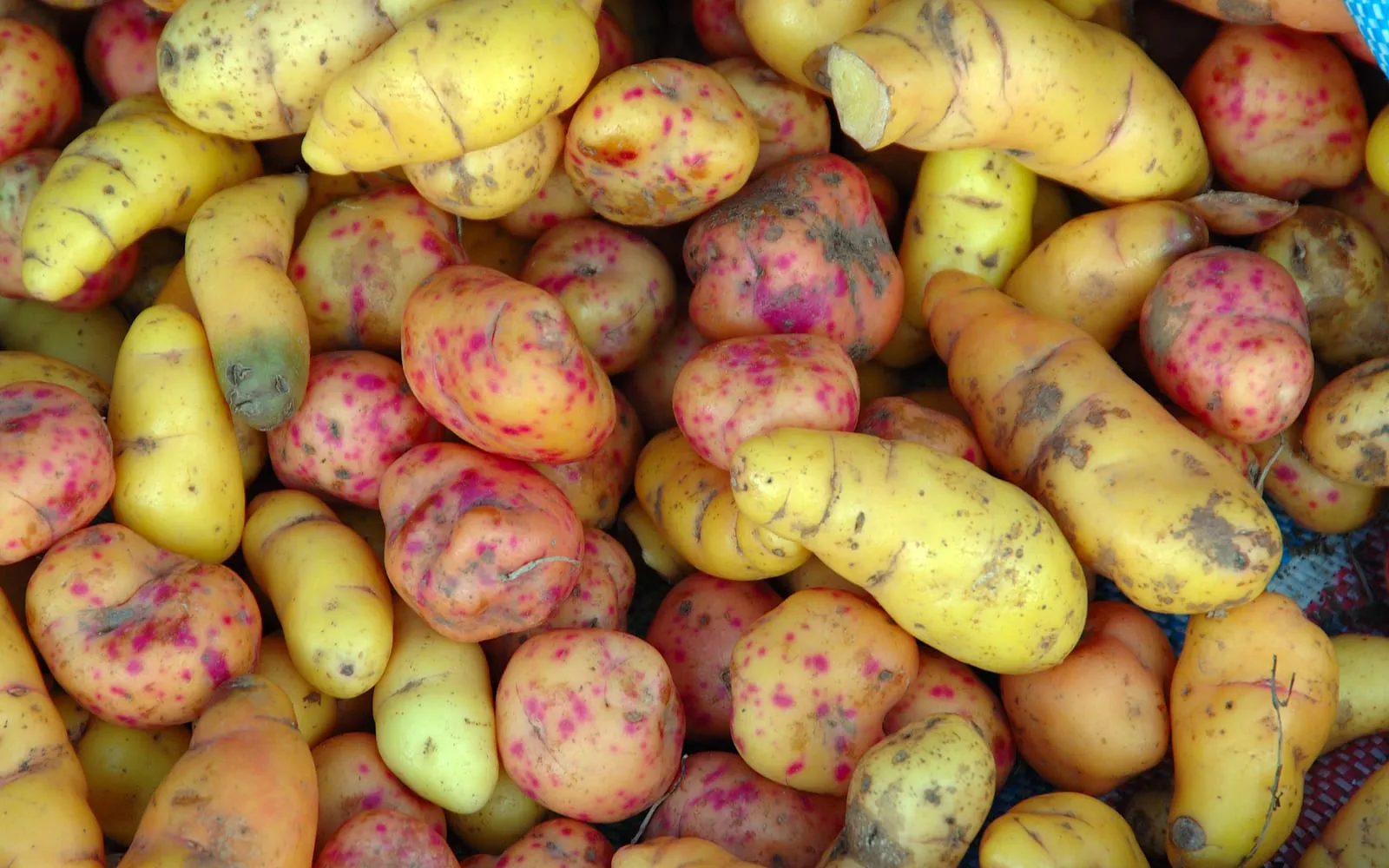
Ulluco produces the most brightly coloured tuber anybody grows, in glossy yellow, magenta, orange and candy-striped pink, with a waxy skin that needs no peeling. In Peruvian and Bolivian markets it is sold in heaps that look like sweets.
It behaves in the garden much as oca does, and for the same reason. Tubers form only once the days shorten past about twelve hours, which in Britain means late September, so the crop is made in October and November and lifted in December. Lifting in autumn because the plant looks finished is the standard way to fail.
The kitchen surprise is texture. Ulluco stays crisp no matter how long it is cooked, holding its shape in a stew for hours. Peruvian cooking uses it exactly that way, and anyone expecting a potato will be disappointed by a vegetable that is doing something else entirely.
Appearance and character
A low sprawling plant 30 to 50 cm tall with thick, succulent, brittle stems that trail outwards and root where they touch soil.
Leaves are thick and fleshy, heart-shaped to almost round, glossy and bright green, feeling more like a succulent than a vegetable.
Flowers are small, star-shaped and greenish-yellow on short spikes, appearing in late summer. Plants outside the Andes rarely set seed.
Tubers are small, 3 to 8 cm, rounded to elongated and often curved, with a smooth waxy skin in yellow, orange, pink, magenta, red or striped combinations. The skin is thin and edible.
Flesh is yellow or white, firm, slightly mucilaginous, and stays crisp through any amount of cooking. The flavour is mild and faintly beetroot-like.
Where it is from
Ulluco is native to the Andes, from Colombia south to Argentina, and it is grown between 2,500 and 4,000 metres.
Archaeological remains put its cultivation back at least 4,000 years, and it ranks second only to potato among Andean tuber crops by area grown. Peru, Bolivia and Ecuador all use it heavily, and olluquito con charqui, ulluco with dried meat, is a Peruvian staple.
Europe has trialled it repeatedly since the nineteenth century and never established it commercially, for the same daylength reason that defeated oca.
Virus infection is the reason Andean farmers periodically renew their stock from clean material, and it is worth any grower knowing about, since a degenerate clone crops poorly.
How it grows
Plant tubers in April, or start them in pots under cover in March and plant out after the last frost. Both the tubers and the top growth are frost-tender.
Plant at 5 cm deep and 30 cm apart in rows 60 cm apart.
Earth up in July or mulch deeply. Tubers form on short stolons close to the surface and green if light reaches them.
Leave the plants through autumn. Tuber formation begins around the equinox, so nothing worth lifting exists before October.
Fleece the haulm through the first light frosts. Every extra fortnight of working leaf after the equinox adds to the crop.
Lift in December, two or three weeks after frost has killed the top growth. Dig carefully because the tubers sit shallow and scatter.
Save a dozen of the best tubers for next year in a cool frost-free place.
Through the seasons
Early spring starts tubers in pots under cover in March.
Late spring is for planting out, from late April to mid-May after the frosts. Water in and mulch.
Summer grows foliage. No tubers form in this period however healthy the plant looks. Earth up in July and water weekly.
Autumn makes the crop, from late September onwards. Keep watering, and fleece against the first frosts to keep the leaves working.
Early winter is the harvest. Lift in December once the haulm has been dead for a fortnight. Store the tubers cool, dark and frost-free.
Care difficulty
Moderate, and the same knowledge problem as oca rather than a skill problem.
December is the harvest date. Nothing else about the crop matters as much.
Frost protection in October and November extends the tuber-forming period and is the single most useful intervention.
Slugs like the fleshy leaves and the shallow tubers more than they like oca.
Drainage in late autumn is the third consideration. The crop forms in the wettest months and rots on waterlogged ground.
Virus degeneration reduces yields over years. Renew stock from a clean source every three or four years, and control aphids, which are the vector.
Watering
Water weekly through summer, around 12 litres per square metre in dry weather.
Keep watering through September and October, which is when the crop is being made. A dry autumn costs yield.
Avoid waterlogging, especially in November when the tubers sit in cold wet soil.
Mulch after earthing up to hold moisture, cover the shallow tubers and keep the soil warmer into autumn.
Container growing suits it well in a 30 litre pot, and the pot can be moved under cover in November to extend the season by several weeks.
Warning signs, diseases and pests
Slugs graze the fleshy leaves and the shallow tubers. Earth up or mulch deeply, and patrol on damp evenings.
Early frost killing the haulm in October is the largest single loss. Fleece the plants.
Aphids cluster on the growing tips and spread the viruses that degrade stock over successive years. Control them, and renew tubers from a clean source periodically.
Virus shows as mottled, distorted or unusually pale leaves and a declining crop year on year. Discard affected stock rather than replanting from it.
Root and tuber rot follow waterlogging on heavy ground in late autumn.
Green patches on the tubers mean light reached them. Earth up more deeply. The green is chlorophyll and, unlike in potatoes, carries no glycoalkaloid concern, though it is best trimmed off.
Small tubers mean an early lift or an early frost.
Growing environment
Full sun to light shade.
Light, free-draining soil is what it wants. Heavy clay is the difficult case, since the crop forms in the wettest part of the year.
Slightly acid to neutral soil, pH 5.5 to 7.
A sheltered warm corner delays the killing frost and adds directly to the harvest.
Raised beds help on heavy ground and warm the soil earlier in spring.
Rotate on three years, though ulluco shares few diseases with other crops.
Feeding
Dig compost into the bed before planting and leave it at that on reasonable soil.
Avoid nitrogen, which gives a sprawling plant and no extra tubers.
Sulphate of potash before planting helps on poor sandy ground.
Feed container plants with a potash-rich liquid feed such as a tomato feed every fortnight from August.
Never use fresh manure.
Troubleshooting
I lifted in October and found almost nothing. Ulluco forms tubers only after the days shorten past about twelve hours in late September. Lift in December.
Frost killed the plants in early October. Fleece the haulm through the first frosts to keep the leaves working into November.
The crop has got worse every year. Virus, spread by aphids and carried in the tubers. Buy clean stock and start again, and control aphids.
Masses of leaf and few tubers. Too much nitrogen, or an early frost. Use potash instead and protect the top growth.
The tubers rotted before I lifted them. Waterlogging in November. Grow on a raised bed or in containers.
Green patches on the tubers. Light reached them. Earth up more deeply. Trim the green off, though it carries none of the risk that green potato does.
It stayed hard however long I cooked it. Normal, and the point of the vegetable. Ulluco holds its texture indefinitely. Use it where you want something that keeps its shape, and do not try to mash it.
Do I peel it? No. The skin is thin, waxy and edible, and peeling wastes the colour that makes it worth growing.
Ulluco problem guides
Not sure what is wrong? See the common vegetable pests guide.