
Houseplant
African Milk Tree
Euphorbia trigona
Also known as Cathedral Cactus, Friendship Cactus
Practical guidance for growing African milk tree, Euphorbia trigona, including its caustic sap, upright ribbed stems, low water needs, safe handling, and repotting a top-heavy plant.
At a glance
- Difficulty
- Easy
- Water
- Only once the mix has dried out fully, roughly every two to three weeks
- Light
- Bright light with some direct sun; tolerates a little shade
- Temperature
- Above 10 deg C
- Humidity
- Low; average room humidity is fine
- Hardiness
- USDA 10b-11, RHS H1b, hardy to 5 C
- Type
- Evergreen succulent shrub, tree-like with age
- Height
- 1.5-2.5 m indoors in a large pot
- Native to
- Central Africa
A tropical succulent from the Congo Basin region rather than a true desert plant, growing where rainfall is seasonal but never absent for long. It has no frost tolerance at all and stalls well before that point. It may drop leaves once the room falls much below 10 deg C. The three-angled stems store water through a dry spell, but they do not protect the plant from cold, which is the opposite of what its cactus-like shape suggests to most owners.
Hardiness zones describe winter cold alone. Summer heat, humidity, rainfall and the length of the growing season decide as much, so treat the range as the outer limit rather than as a recommendation.
Toxic if eaten
- Do not eat
- The milky white latex sap in every part of the plant
- Harm from
- Handling it, sap in the eyes and eating it
- Affects
- People, cats and dogs
Every cut or broken stem weeps a thick white latex that is caustic rather than merely irritating. On skin it causes redness, burning and sometimes blistering in sensitive people; in an eye it can cause severe pain, swelling and corneal damage, and needs immediate rinsing with clean water followed by urgent medical attention rather than a wait-and-see approach. Eaten, the sap burns the mouth and throat and causes vomiting and diarrhoea. The RHS lists Euphorbia among its potentially harmful garden plants specifically for this sap, and the ASPCA lists related caustic-sapped Euphorbia species, such as pencil cactus, as toxic to cats and dogs for the same reason. Handle it in gloves when pruning or repotting, and keep cut stems away from children and pets until the latex has dried.
Sources: RHS potentially harmful garden plants, ASPCA toxic and non-toxic plants
About
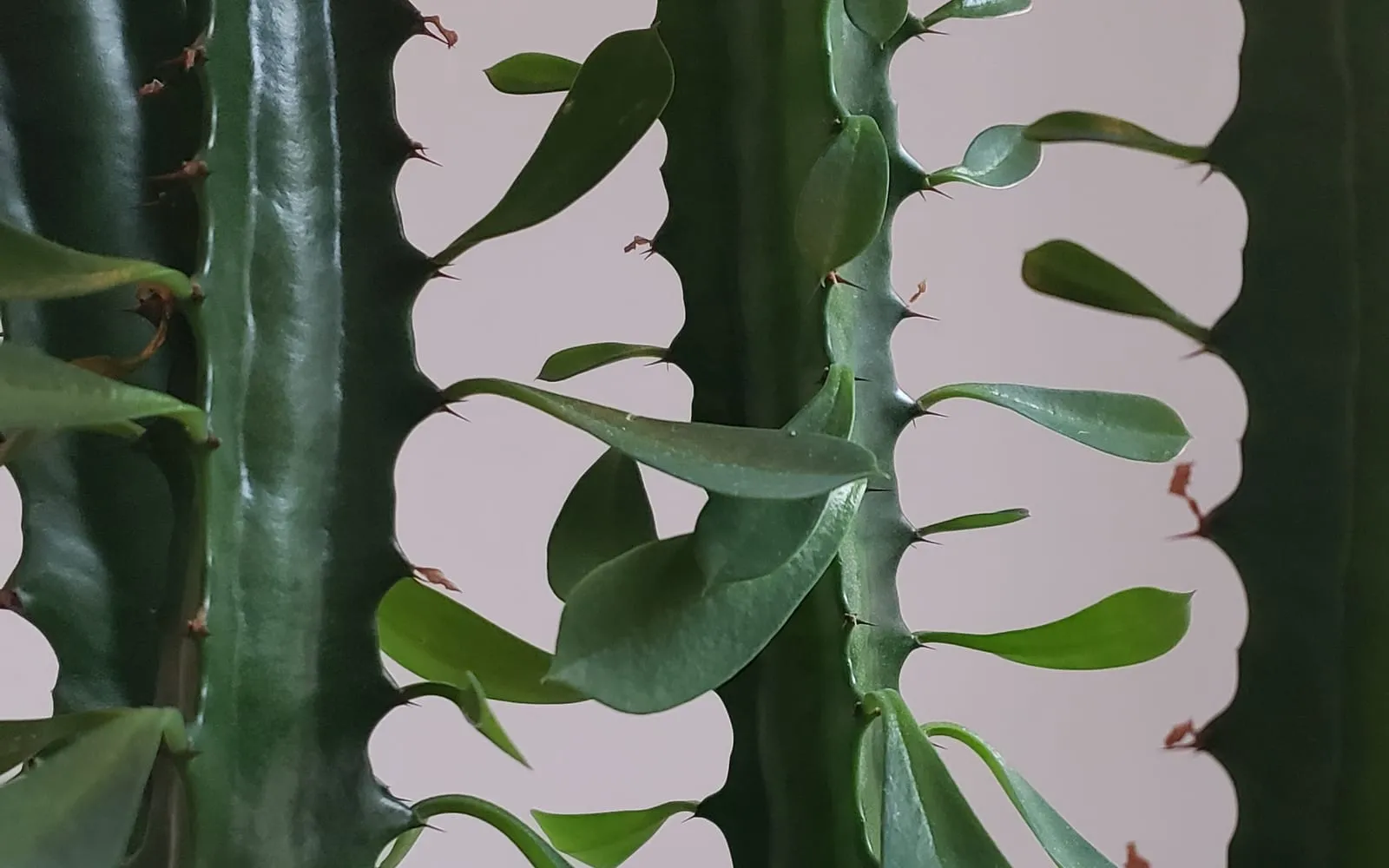
African milk tree looks like a cactus and is not one. The upright, three- angled stems, ribbed and studded with small paired thorns, are pure Euphorbia, and the giveaway is what happens when a stem is cut or broken: a thick white latex wells up immediately, the “milk” the plant is named for and the main handling hazard.
Grown well it forms a striking, architectural houseplant, branching from the base into a candelabra shape that can reach ceiling height in a large pot over years. Give it bright light and infrequent watering. Keep the sap away from eyes, broken skin and curious pets.
Appearance and character
The stems are the plant’s whole character: thick, upright and strongly three-angled in cross-section, with a wavy ridge running down each face edged in small dark thorns set in pairs. New growth is a fresher green than old wood, and a widely sold form, sometimes called “Rubra”, flushes deep maroon-purple across the newest growth in strong light.
Small, narrow leaves appear along the ridges on actively growing stems and drop off during any dry or cool spell, which is normal rather than a sign of distress. A mature specimen branches repeatedly from the base, producing the candelabra or cathedral-like silhouette that gives the plant its other common names.
Flowers are tiny, yellow-green and largely incidental on a houseplant kept indoors, since this species rarely flowers away from strong outdoor light.
Where it is from
Euphorbia trigona comes from Central Africa, most likely the Congo Basin region, though its precise wild origin is blurred by centuries of cultivation and trade across the continent before it reached Western collections. It grows in warm, seasonally dry scrub and open woodland rather than true desert.
That distinction matters for how it is grown. A genuine desert cactus from the Americas tolerates far more cold than this plant does, because its native range never sees the near-freezing nights a high desert can produce. African milk tree comes from consistently warm ground and has no frost tolerance to fall back on at all.
How it grows
Plant it in a gritty, fast-draining cactus or succulent mix, in a pot no larger than needed. The stems store water, and a large pot keeps too much damp compost around the roots.
Give it the brightest spot available. A south- or west-facing window suits it well, and stems kept too dim grow thin, pale and stretched, permanently losing the compact form they would otherwise keep.
As the plant grows taller and heavier, the base can struggle to support the top growth in a lightweight pot. Move up to a heavier, wider-based container before the plant becomes properly top-heavy rather than after it has already toppled.
Propagate from stem cuttings. Wearing gloves, cut a section cleanly, stand it somewhere dry and out of direct sun until the cut end calluses over, usually a week or two, then pot it into barely damp succulent mix and leave it dry until roots form.
Through the seasons
Spring brings the resumption of active growth. Resume feeding and check whether the plant needs a larger, sturdier pot.
Summer is the main growing season. Water once the mix has dried out fully, and give it as much direct sun as the position allows.
Autumn slows growth. Reduce watering frequency and stop feeding towards the end of the season.
Winter is a rest, and the season this plant is most at risk in. Keep it somewhere it will not drop below 10 deg C, and water only sparingly, since cold and wet together do the damage, not cold on its own.
Care difficulty
Easy, once the sap is respected and handled with basic care. Water infrequently, skip misting and feed only occasionally. The two common problems are avoidable. Do not water so often that the mix never fully dries, and move a tall, heavy specimen into a stable pot before it becomes top-heavy.
Watering
Water thoroughly, until it runs from the drainage holes, then leave the mix to dry out completely before watering again. In a warm, bright room in summer that typically means every two to three weeks; in winter it can stretch to a month or longer.
Err on the side of underwatering. The thick stems store enough water to tolerate weeks of drought, and far more plants are lost to a permanently damp base than to being left too dry.
Warning signs, diseases and pests
Mealybug settles into the grooves running down each stem, showing as small white, cottony tufts that are easy to overlook against the ribbed surface. Dab affected spots with a cotton bud dipped in isopropyl alcohol.
Scale insects appear as small, flat, brownish bumps stuck to older stems, sapping the plant’s strength over time. Scrape them off gently and treat with horticultural soap, checking regularly since a light infestation spreads quickly on a plant with this much stem surface.
Root rot follows a mix that never fully dries between waterings, showing as a stem that softens and discolours from the base upward, sometimes with a sour smell. There is no reviving badly rotted tissue; cut back to firm, healthy stem and treat the cutting as fresh propagation material.
Spider mite thrives in hot, dry indoor air and shows as fine pale speckling on the stems with faint webbing in the ribs in bad cases. Wiping the stems down periodically and raising humidity slightly both help prevent it.
Growing environment
Bright light with some direct sun keeps the stems compact and well coloured. A plant kept too dim stretches and loses the tight, architectural form that is most of its appeal.
Warmth matters more than for many houseplants. Keep it reliably above 10 deg C, and treat any spell approaching that as a signal to move the plant away from a cold windowsill or draughty door.
No special humidity is needed, and misting achieves nothing this plant cannot already manage from ordinary room air.
Feeding
Feed with a balanced liquid fertiliser or a cactus and succulent formula, diluted to around half strength, once a month through spring and summer.
Stop feeding from autumn through winter, when growth slows or stops entirely and unused fertiliser only builds up as salts in compost that is already being watered sparingly.
Troubleshooting
White sap oozed out when a stem broke. What should I do? Wear gloves, keep it away from your eyes and mouth, and wipe it up with a paper towel rather than bare hands. If any gets on skin, wash the area with soap and water; if it reaches an eye, rinse immediately with clean water and seek medical attention.
The lower leaves keep dropping off. Usually normal. This species sheds its small leaves readily during any dry spell, a cool snap, or a normal spell of older growth maturing, and the stems themselves stay healthy underneath.
A stem has gone soft and discoloured at the base. Root rot, most likely from a mix that stayed damp too long. Cut back to firm, healthy tissue above the rot, let the cut callus over for a week, and start it again as a fresh cutting in dry mix.
The plant has grown tall and looks unstable in its pot. Move it into a heavier, wider-based container before it topples, and consider staking a particularly top-heavy specimen while the new pot’s extra weight settles in.
Is it safe to keep around a curious cat or a toddler? Keep it out of reach either way. The sap is a genuine skin and eye irritant rather than a mild one, and while a plant sitting untouched poses no risk, a broken stem or a chewed leaf can cause real discomfort within minutes.
African Milk Tree problem guides
Not sure what is wrong? See the common houseplant pests guide.