
Edible
Tamarind
Tamarindus indica
Also known as Indian date, Imli, Asam jawa
How to grow tamarind, Tamarindus indica. The African tree with an Indian name, the sour pod behind Worcestershire sauce and pad thai, and why it makes a better bonsai than an orchard tree outside the tropics.
At a glance
- Difficulty
- Moderate
- Water
- Weekly in growth, sparingly in winter
- Light
- Full sun
- Temperature
- Minimum 10 deg C. A mature tree takes a very light frost
- Humidity
- Low to moderate. It tolerates dry air well
- Hardiness
- USDA 10-11, RHS H1c, hardy to 0 C
- Type
- Tender evergreen or semi-deciduous tree
- Height
- 12-25 m in the open, 1-2 m in a pot
- Native to
- tropical Africa
- Best month
- April and May in the Northern Hemisphere, October and November in the Southern Hemisphere
The dry savannas of tropical Africa. It is deeply drought-hardy once established, wind-firm and long-lived, and it needs a pronounced dry season to fruit well. Seedling trees take six to eight years to bear.
Hardiness zones describe winter cold alone. Summer heat, humidity, rainfall and the length of the growing season decide as much, so treat the range as the outer limit rather than as a recommendation.
Every month named in this guide is for the temperate Northern Hemisphere. If you garden in the Southern Hemisphere, shift each one by six months, so April becomes October. Closer to the equator the wet and dry seasons matter more than the calendar, and the shift stops being a useful guide.
Not known to be toxic
- Safe to eat
- The pod pulp, the young leaves and the flowers
Tamarind is not toxic and the ASPCA does not list it as harmful to cats or dogs. The pulp, the young leaves and the flowers are all eaten, and the pulp is a standard souring agent from West Africa to Thailand. Two ordinary cautions rather than toxicological ones. Tamarind is a mild laxative in quantity, which is a recognised traditional use rather than an accident, and the sticky pulp is acidic enough to be uncomfortable for anyone with reflux or sensitive teeth. The hard seeds are a choking hazard for small children and should be removed before the pulp is given to a young child.
Sources: ASPCA toxic and non-toxic plants, RHS potentially harmful garden plants
About
Tamarind carries a misleading name. The Arabic tamr hindi means Indian date, and Europeans took the tree to be Asian because that is where they met it, but the species is African, from the dry woodland of Sudan and the Sahel.
The pod is what everyone wants. Inside a brittle brown shell is a sticky red-brown pulp around hard seeds, sour and sweet at once, and it does the work of lemon across an enormous range of cooking. Worcestershire sauce, HP sauce, pad thai, sambar and a great many Mexican sweets all lean on it.
For a temperate grower the plant is a foliage subject and a good one. The leaves are fine and feathery, they fold up at night, the tree takes hard pruning, and it is one of the classic bonsai species in tropical Asia for exactly those reasons.
Appearance and character
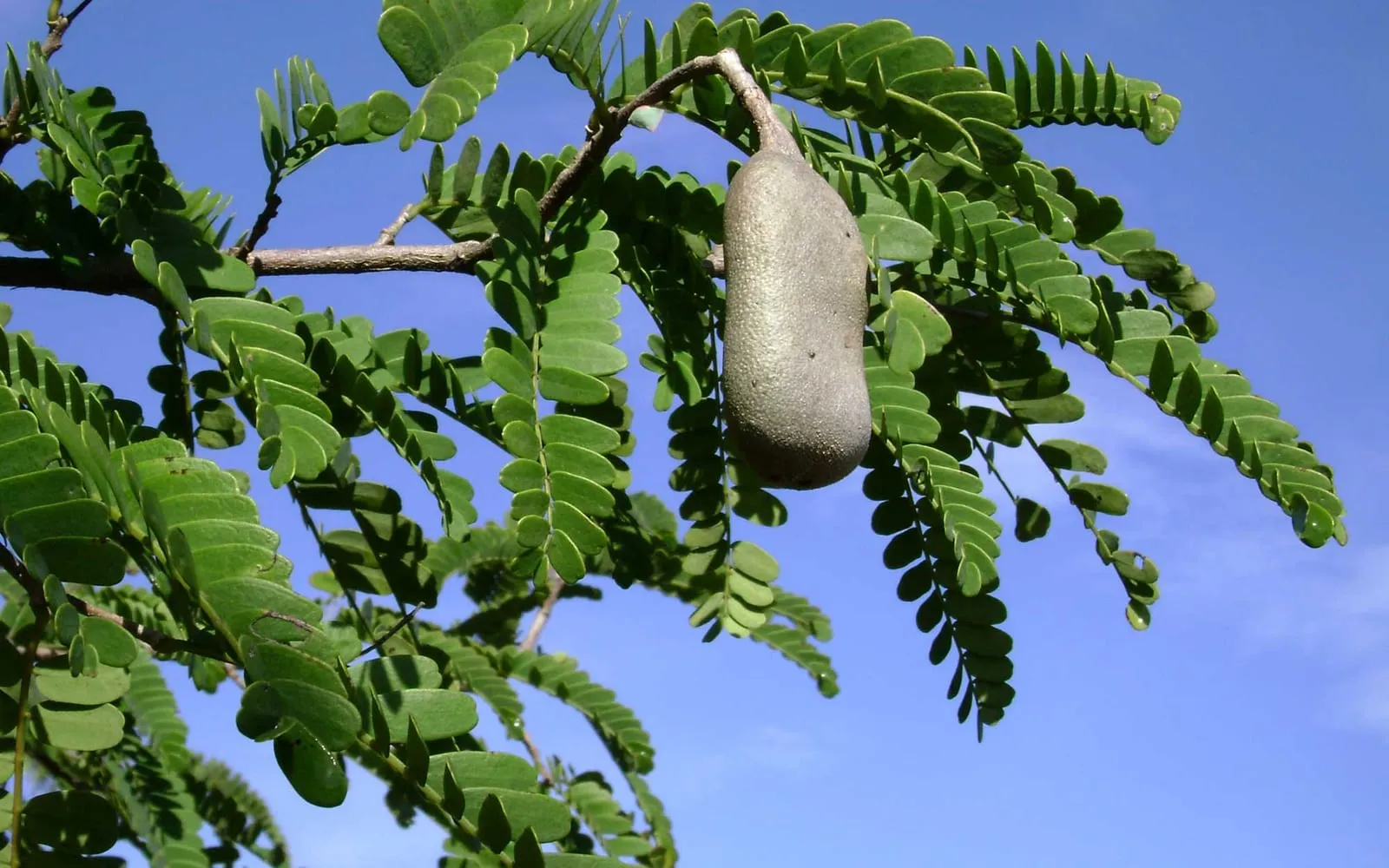
A broad domed tree on a short stout trunk, 12 to 25 m in the open, with rough grey-brown fissured bark.
Leaves are pinnate, 7 to 15 cm, with 10 to 20 pairs of small oblong leaflets that give the whole tree a fine feathery texture.
The leaflets fold together at night and in strong heat, which is a legume habit and is worth watching for.
Flowers are small, about 2.5 cm, pale yellow with red or orange veining, borne in short sprays at the shoot tips, and they are pretty at close range and inconspicuous from a distance.
Pods are 7 to 20 cm, curved and lumpy, with a brittle cinnamon-brown shell that cracks off in flakes.
Inside, the pulp is sticky and red-brown, threaded with tough fibres running the length of the pod, around three to ten hard flat glossy seeds.
Sour cultivars dominate the trade. Sweet types, grown mainly in Thailand, are eaten out of hand and are a different proposition from the block of sour pulp sold in a South Asian grocer.
Where it is from
Tamarind is native to tropical Africa, in the dry woodland belt running across Sudan, Chad, Cameroon and down into East Africa, where old trees are still village landmarks.
It reached India early enough that Sanskrit sources record it, and India adopted it so completely that the Arabic name and then the European one both credit the wrong continent.
From India it moved east into South East Asia with traders, and the Spanish carried it across the Pacific to Mexico, where it became a fixture in sweets and drinks under the name tamarindo.
Africa itself uses it for drinks and porridges, and the tree serves as a shade tree and a meeting place across the Sahel.
India is the largest producer, with Thailand supplying most of the sweet-type trade.
Temperate markets get it as compressed blocks of pulp, as concentrate, and as an ingredient in sauces most people never connect with the tree.
How it grows
Sow seed from a pod. Tamarind seed keeps for years and germinates readily.
Nick the hard seed coat with a file or soak the seed in hot water overnight, then sow at 22 to 28 deg C. Germination takes one to three weeks.
Pot into free-draining compost with plenty of grit. Tamarind grows on poor sandy ground and dislikes a heavy wet mix.
Grow in full sun at a minimum of 10 deg C.
Water weekly in growth and let the compost dry well down between waterings.
Keep humidity low to moderate. This is a dry-country tree and it tolerates a centrally heated room better than most here.
Feed monthly from April to September.
Prune to shape. Tamarind takes hard cutting and back-buds well, which is why it is a standard bonsai subject in India and Thailand.
Expect no fruit. Seedlings take twelve to fifteen years to flower even in the tropics, and a pot plant will not get there.
Through the seasons
Winter is a cool dry rest above 10 deg C. Water sparingly and feed nothing. The tree may drop some leaves.
Spring brings the new flush of feathery growth. Repot if needed and start feeding.
Early summer is the main growing period.
Midsummer is when to stand the pot outdoors in a warm sheltered spot.
Late summer is the point to stop feeding so the growth hardens.
Autumn is when to bring it back under cover and reduce watering as growth stops.
Care difficulty
Moderate as a foliage plant, and impossible as a fruit crop outside the tropics.
Overwatering is the main fault. Tamarind is a dry-country tree and a permanently damp pot rots the roots.
Cold tolerance is better than most here. A minimum of 10 deg C is enough and a mature tree in the ground takes a very light frost.
Dry air suits it, which makes it one of the easier species in this collection to keep indoors.
Growth is slow, and a seedling takes years to become anything substantial.
Pruning is straightforward and rewarding, since the tree back-buds well.
Fruit needs twelve to fifteen years and a tropical climate, so the pulp is best bought in a block for very little money.
Watering
Water weekly through the growing season, giving a deep soak.
Let the compost dry well down between waterings.
Reduce to occasional watering through winter.
Drain fully. Standing water is the commonest cause of loss.
Tap water is fine, including hard water.
Keep humidity low to moderate. Misting is unnecessary.
Water outdoor pots less than instinct suggests, even in a temperate summer.
Warning signs, diseases and pests
Leaflets folded up in the daytime usually mean heat or drought. Folding at night is normal.
Yellowing lower leaves with some leaf drop in winter is normal for a semi-deciduous tree.
Wilting in damp compost is root rot from overwatering.
Brown limpets on the stems and leaf stalks are scale.
White fluff in the leaf axils is mealybug.
Fine webbing on the leaflets is spider mite in dry heated air.
Blackened shoot tips after a cold night are frost damage. Cut back to live wood in spring.
Very slow growth is normal for the species rather than a fault.
Growing environment
A conservatory, greenhouse or bright indoor spot, standing outdoors in a warm summer.
Minimum 10 deg C, with 25 to 35 deg C for real growth.
Full sun.
Low to moderate humidity.
Free-draining compost with plenty of grit, of moderate fertility.
pH from 5.5 to 7.5.
A deep pot, since the root system is substantial.
Shelter from cold wind.
Feeding
Feed monthly from April to September with a balanced liquid feed.
Keep it moderate. Tamarind grows on poor ground and heavy feeding produces soft growth.
Stop feeding at the end of August so the wood hardens.
Give nothing through winter.
Repot every second or third spring into fresh gritty compost.
Root-prune a pot-bound specimen if you are growing it as a bonsai.
Add magnesium if older leaves yellow between the veins.
Troubleshooting
Is tamarind Indian or African? African. The Arabic name means Indian date and the tree was named by people who met it in India, but it is native to the dry woodland of Sudan and the Sahel.
What is tamarind used in? Worcestershire sauce, HP sauce, pad thai, sambar, Mexican tamarindo sweets and drinks, and a great deal of West African and South Asian cooking.
Sweet or sour, which have I bought? The block of dark sticky pulp in a South Asian grocer is the sour type. Sweet cultivars, mostly Thai, are sold as whole pods for eating out of hand.
Will it fruit outside the tropics? No. Seedlings take twelve to fifteen years to flower even in the tropics.
How do I use a block of pulp? Break off a piece, soak it in hot water for twenty minutes, then rub it through a sieve to separate the pulp from the fibres and seeds.
The leaves fold up at night. Normal, and a legume habit. Folding in the daytime means heat or drought.
Can I grow it as a bonsai? Yes, and it is one of the classic tropical bonsai species. It takes hard pruning, back-buds well and has naturally small leaves.
It has barely grown in a year. Tamarind is slow. That is the species rather than a problem.
Tamarind problem guides
Not sure what is wrong? See the common vegetable pests guide.