
Houseplant
Tropical Pitcher Plant
Nepenthes alata
Also known as Winged Pitcher Plant
How to grow Nepenthes alata indoors. Upper and lower pitchers, a slippery rim insects cannot walk on when wet, and why this species tolerates a home so well.
At a glance
- Difficulty
- Moderate
- Water
- Keep the growing medium constantly moist, never fully dry
- Light
- Bright, indirect light with some direct morning or evening sun
- Temperature
- 15-30 deg C; avoid below 10 deg C
- Humidity
- 50 percent or higher; benefits from a tray of water or a cabinet
- Hardiness
- USDA 10-11, RHS H1b, hardy to 10 C
- Type
- Tender evergreen perennial vine
- Height
- Climbs to 3 m given a support; easily kept to 40-60 cm by pruning
- Native to
- Southeast Asia
A lowland-to-mid-elevation species found from close to sea level up to around 1,400 m in the Philippines, which is an unusually wide elevational range for a Nepenthes. That spread is why it tolerates the swings of an ordinary home better than most of its relatives, which tend to specialise for either hot lowlands or cool highlands. It has no frost tolerance at all and must be grown indoors or under glass year-round outside the tropics.
Hardiness zones describe winter cold alone. Summer heat, humidity, rainfall and the length of the growing season decide as much, so treat the range as the outer limit rather than as a recommendation.
Not known to be toxic
Tropical pitcher plant has no toxicity listing from the RHS or the ASPCA. The fluid inside a pitcher is mostly water, digestive enzymes and decaying insects, and there is no documented case of it harming a person or a pet, beyond the ordinary risk of a curious cat chewing through unfamiliar foliage.
Source: RHS
About
Nepenthes alata is one of the more forgiving tropical pitcher plants, and it was the species researchers used to work out exactly how a wet pitcher rim manages to be so lethal to an insect that has landed on plenty of ordinary wet surfaces without falling in. The answer turned out to be physics rather than chemistry: the peristome, the ribbed rim around the pitcher’s mouth, is covered in microscopic radial ridges that hold a continuous film of water. An insect’s feet cannot get purchase on it any more than a shoe can grip wet ice, and it slides straight into the trap below.
The pitcher fluid itself does further work once the insect is inside. Rather than being ordinary water with enzymes dissolved in it, Nepenthes fluid is viscoelastic, meaning it behaves partway between a liquid and a stretchy gel. A struggling insect’s legs and wings get caught in threads of fluid that resist snapping back, which drags it under far more effectively than plain water would, and the effect holds up even when the fluid has been diluted by rain.
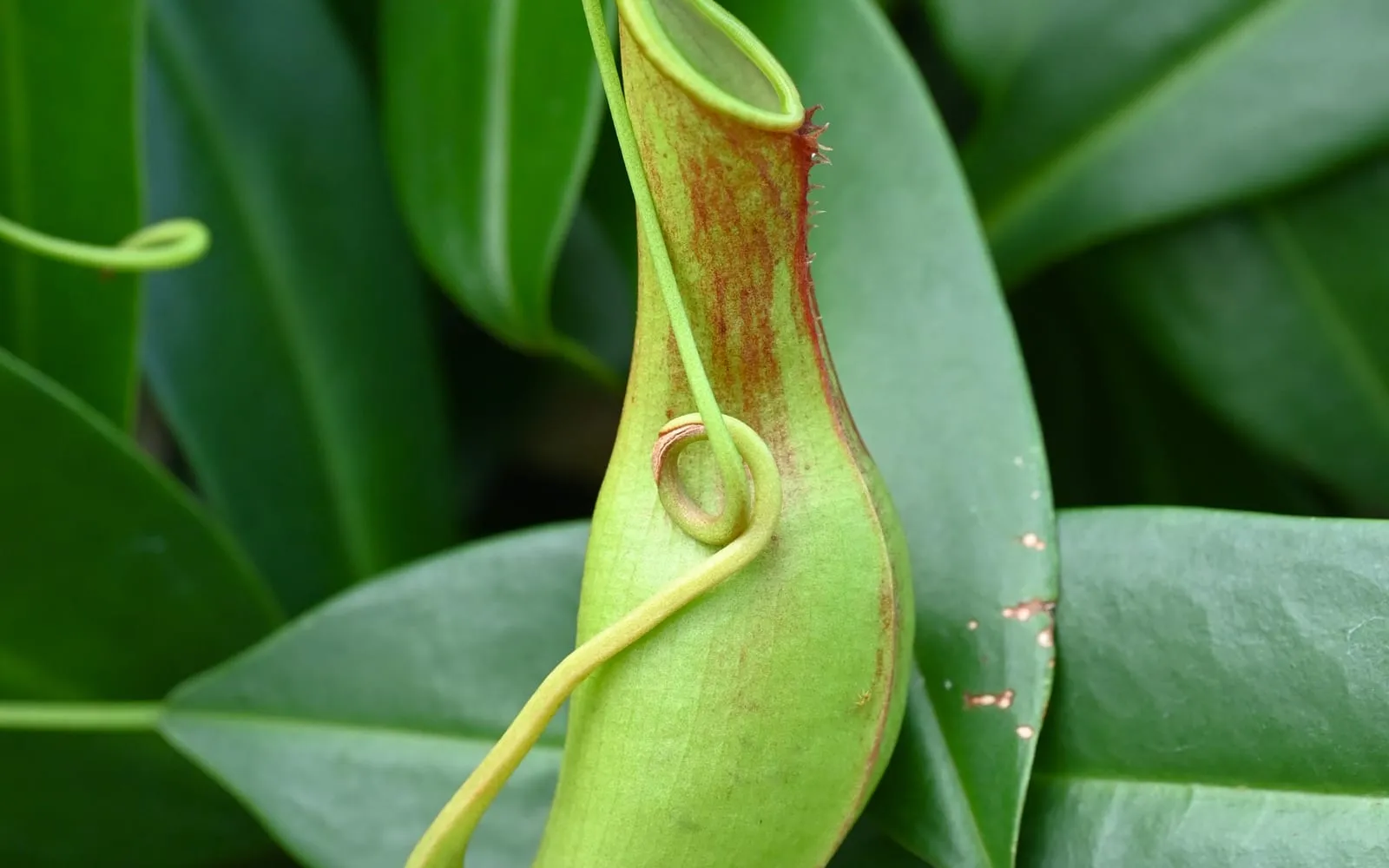
It climbs by producing a slender tendril at the tip of each leaf, which first wraps around a support and only then swells and unfurls into a pitcher, so the trap always ends up dangling in open air rather than tangled in foliage.
Appearance and character
A single plant produces two distinct kinds of pitcher as it matures, and telling them apart is part of learning to grow it. Lower pitchers form close to the base while the plant is young or short, and they are squat, rounded and boldly marked, usually pale green streaked and speckled with maroon, with two fringed wings running down the front designed to guide crawling insects up towards the rim. Upper pitchers develop once the vine starts to climb, and they are narrower, more funnel-shaped, and lose the wings almost entirely, relying instead on nectar scent to draw flying insects rather than ants and other ground-dwelling prey.
Leaves are long, leathery and pointed, each tapering into the tendril that becomes the next pitcher, and a healthy plant is rarely without at least one trap developing at various stages along its newest growth.
Where it is from
The Philippines, chiefly the island of Luzon, where it grows from near sea level in disturbed, scrubby ground up through montane forest to around 1,400 m. Rainfall is heavy and fairly even across the year, and the air stays warm and humid at almost every elevation the species occupies.
That breadth of habitat is unusual for the genus. Most Nepenthes species are tied to a narrow elevation band and either cook or chill if moved far from it, whereas N. alata has already adapted to a wide range of temperatures in the wild, which is the main reason it survives ordinary room conditions better than showier highland or lowland specialists.
How it grows
Growth is continuous rather than seasonal in a warm, humid environment, with new leaves and pitchers forming steadily through the year rather than in a single flush. A young plant stays low and bushy, producing lower pitchers, before eventually sending out a longer climbing stem that switches over to upper pitchers as it goes.
Stems left unsupported will trail and eventually flop rather than climb, which is not a problem so much as a different habit; many growers let it hang from a basket instead of training it up a support. Older stems that have grown long and leggy, with widely spaced leaves and few pitchers, can be cut back hard in spring; the plant reliably breaks new growth from lower down the stem.
Propagation is usually by stem cuttings taken with at least one leaf node, rooted in damp sphagnum moss under high humidity, since seed is slow and requires two different plants to cross-pollinate.
Through the seasons
Indoors, this species has no true dormancy and keeps growing year-round provided warmth and humidity hold up, but its pace still tracks the changing light through the year.
Spring brings the strongest flush of new growth as daylight lengthens. This is the best time to prune a leggy stem and to take cuttings from the material removed.
Summer is the fastest period of pitcher production, particularly with extra humidity from a tray of water or a period spent outdoors in a sheltered, shaded spot once night temperatures stay reliably above 15 deg C.
Autumn brings a natural slowdown as light drops, and new pitchers tend to come smaller than the summer’s. Bring any plant that spent summer outside back in well before temperatures start falling towards 10 deg C at night.
Winter is the quietest stretch rather than a true rest. Reduce feeding and keep the medium a touch drier than in summer, since growth is slower and the roots use less water, but do not let it dry out fully, and keep the temperature above 10 deg C throughout.
Care difficulty
Moderate. It is one of the easier Nepenthes for a windowsill or a plant cabinet, but it still needs more humidity than most houseplants and does not forgive tap water or ordinary fertiliser the way a typical foliage plant would.
The main skill is providing consistent warmth and humidity rather than anything exotic, and once those two things are stable, the plant is resilient to a fair amount of neglect elsewhere.
Watering
Keep the growing medium constantly moist rather than letting it swing between wet and dry. Water whenever the surface starts to feel dry to the touch, using only rainwater, distilled water or water that has been through reverse osmosis; the dissolved minerals in ordinary tap water accumulate in sphagnum moss and damage the roots over a few months.
Bottom-watering, standing the pot in a shallow saucer of rainwater for twenty minutes and then letting it drain, works well for sphagnum-grown plants and reduces the risk of disturbing the loose medium from above.
A pitcher that has dried out or lost its fluid is not necessarily a sign of underwatering; it can have finished its working life instead. New pitchers usually already fill with fluid the plant produces itself as they open.
Warning signs, diseases and pests
Mealybugs hide in the leaf axils and around developing pitchers, showing as small white cottony tufts. Wipe them off with a cotton bud dipped in diluted washing-up water, repeating over several weeks to catch newly hatched ones.
Scale insects appear as flat brown discs on the stems and undersides of leaves and can usually be scraped off by hand. Aphids occasionally cluster on soft new growth and respond to a strong rinse under the tap.
Root rot follows waterlogged, poorly draining medium or the use of ordinary potting compost instead of sphagnum or an orchid mix. A plant that has stopped producing pitchers and is dropping leaves from the base should be tipped out and checked; soft, blackened roots need cutting back to healthy tissue and repotting into fresh medium.
Brown, crisping pitcher edges usually mean the humidity has dropped too low rather than any pest or disease.
Growing environment
Bright, indirect light suits it best, with some direct morning or evening sun tolerated once the plant is acclimatised; harsh midday sun through glass can scorch the leaves. A spot a metre or so back from a bright window, or under a grow light, usually works well.
Humidity above 50 percent produces the best pitchers, and this species will still grow at lower humidity but stops forming new traps and eventually produces leaves with no pitcher at all. A pebble tray, a nearby humidifier, or growing it in a covered cabinet or large glass terrarium all raise the humidity around the foliage.
Temperatures of 15 to 30 deg C suit it well; avoid letting it sit below 10 deg C, which stresses the roots even where the leaves show no immediate damage. Use a nutrient-poor medium such as long-fibre sphagnum moss, or a peat-free bark, perlite and orchid mix, in a pot with good drainage.
Feeding
No fertiliser applied to the compost or sprayed on the leaves; the roots are adapted to bog conditions with almost no available nutrients and are easily burned by anything stronger. Nitrogen instead comes from prey caught in the pitchers.
A plant with few flying insects nearby can be fed directly into an open, fluid-filled pitcher: a small dead insect, a pinch of fish flake, or a diluted liquid feed specifically formulated for carnivorous plants, no more than once every few weeks and only ever into the pitcher itself, never onto the roots.
Troubleshooting
New leaves are opening with no pitcher at the tip. Usually low humidity. Raise the humidity around the plant with a tray, cabinet or humidifier, and new leaves should start pitchering again within a few weeks.
Pitchers are turning brown and drying out from the rim inward. Also a humidity problem, this time affecting existing traps rather than new growth. Increase ambient moisture and trim off pitchers that have fully dried.
Leaves are pale and the whole plant looks washed out. Too much direct sun, particularly through glass on a hot day. Move it back from the window or add some shading.
The stem has grown long and leggy with few pitchers. Ordinary growth habit rather than a problem. Prune it back hard in spring and root the cuttings to make new plants.
White cottony fluff is appearing in the leaf joints. Mealybugs. Wipe them away by hand and repeat weekly until none return.
The medium smells sour and the roots feel mushy when repotting. Root rot from waterlogging or ordinary compost. Cut back to firm, pale roots and repot into fresh sphagnum or an orchid mix.
Can I keep it in a closed terrarium permanently? Yes, provided there is some airflow, since permanently stagnant air encourages fungal problems. Crack the lid periodically or choose a terrarium with a small vent.
Tropical Pitcher Plant problem guides
Not sure what is wrong? See the common houseplant pests guide.