
Houseplant
Wax Vine
Hoya linearis
Also known as Hoya linearis, String Hoya
How to grow Hoya linearis, the wax vine, a cool-growing Himalayan hoya with curtains of narrow furry leaves and scented white flowers.
At a glance
- Difficulty
- Moderate
- Water
- When the airy mix is nearly dry
- Light
- Bright indirect light
- Temperature
- Cool to warm, 12 to 24 deg C; keep above 10 deg C
- Humidity
- Moderate to high
- Hardiness
- USDA 10-11, RHS H1b, hardy to 10 C
- Type
- Evergreen trailing epiphyte
- Height
- 1 to 2 m of trailing growth
- Native to
- The Himalaya
A hoya from the cool, humid forests of the Himalaya, and one of the few that prefers things on the cool side. It has no frost tolerance and wants to stay above about 10 deg C, but it dislikes the stuffy heat many hoyas enjoy, doing best in a bright, airy, cool to average room. Cold, wet compost rots its fine strands quickly.
Hardiness zones describe winter cold alone. Summer heat, humidity, rainfall and the length of the growing season decide as much, so treat the range as the outer limit rather than as a recommendation.
Not known to be toxic
Hoyas are not listed as toxic by the ASPCA, which records the wax plants as non-toxic to cats and dogs. A little milky sap can mildly irritate sensitive skin, so wash it off if you prune the plant, but there is no real poisoning hazard. It is a safe trailing plant to grow around pets and children.
Sources: ASPCA toxic and non-toxic plants, RHS potentially harmful garden plants
About
Wax vine is a trailing hoya with dense curtains of slender, downy, needle-like leaves. Where the common wax plant has thick, flat, waxy leaves, this one has fine, fuzzy, cylindrical strands.
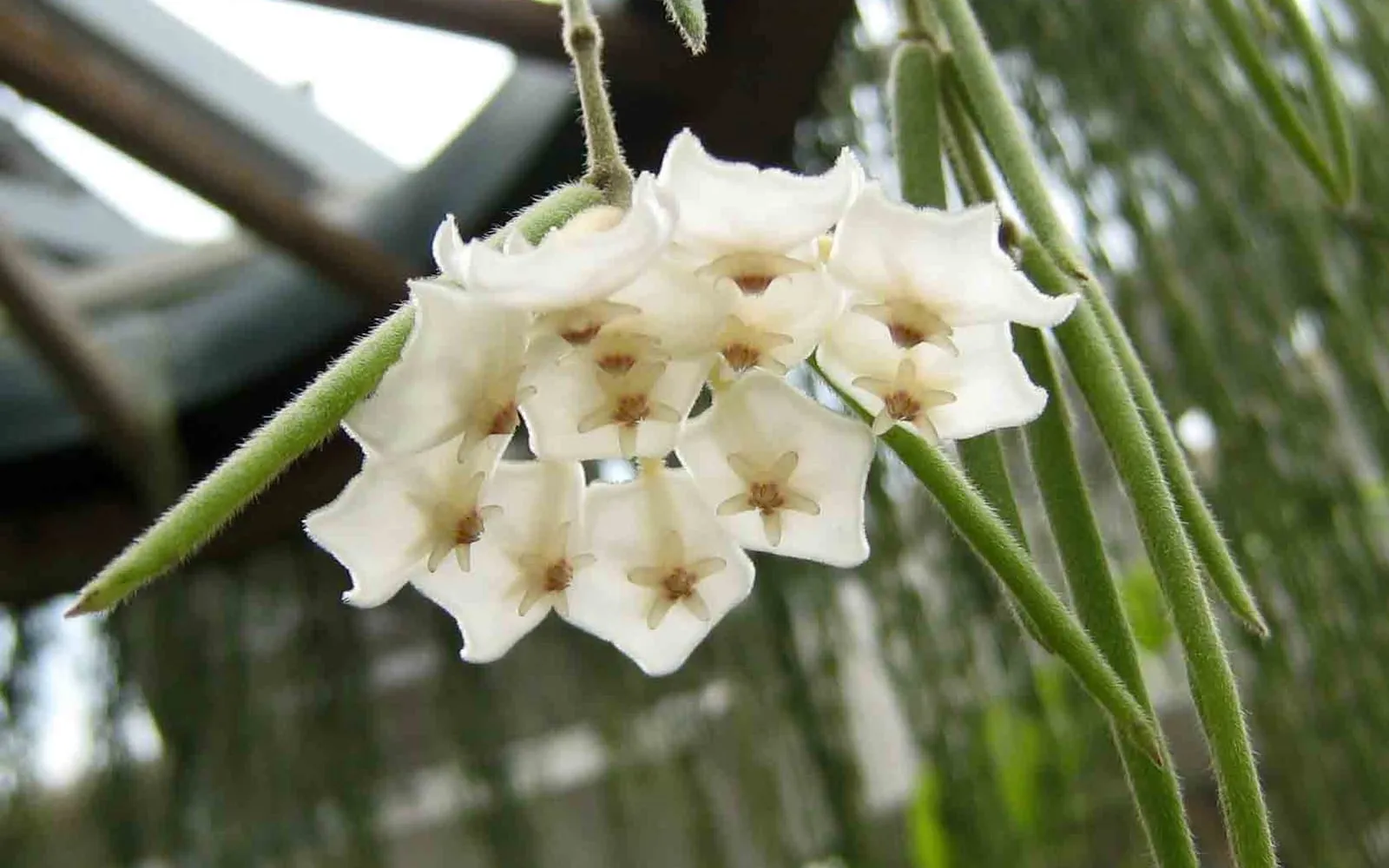
It comes from the cool, misty forests of the Himalaya, which makes it one of the few hoyas that prefer cooler, airier conditions to stuffy warmth. In summer it opens rounded clusters of small white star flowers with a light lemon scent.
It is grown almost entirely as a trailing plant, hung high so its long soft strands can fall freely. In cool, bright, airy conditions it is not difficult, though its fine stems rot faster than a thick-leaved hoya’s if it is kept too wet.
Appearance and character
Leaves are narrow, soft and almost cylindrical, downy to the touch and closely set along fine trailing stems, giving the plant its distinctive soft, hanging look.
Stems trail down a metre or two in long, soft strands instead of climbing, so the plant is grown in a hanging pot where the curtains can hang free.
Flowers come in summer as rounded clusters of small, waxy, white five-pointed stars with a faint yellow centre, lightly scented of lemon, hanging beneath the strands.
The flower clusters form on short spurs that rebloom year after year, so these should be left in place after flowering instead of removed.
Where it is from
Hoya linearis grows in the cool, humid, montane forests of the Himalaya, perched as an epiphyte on mossy branches in filtered light and moving air. Cool, damp, airy conditions suit it best.
Give it bright but filtered light, moderate to high humidity, moving air and an open root run. It dislikes both frost and the stuffy heat that suits tropical-lowland hoyas.
How it grows
It grows in flushes of long trailing strands through the warmer, brighter months and flowers in summer, slowing in winter. Cool, bright, airy conditions keep it at its best.
Pot it in a very free-draining, airy mix of orchid bark and perlite with a little compost, in a hanging pot, and water when the mix is nearly dry. The fine strands rot if the roots sit wet, so keep the mix open and never soggy.
Keep it bright, humid and cool to average, above about 10 deg C, with some air movement, and out of stuffy heat and cold draughts alike. Leave the flowering spurs in place, since they rebloom.
Take stem cuttings to propagate, which root in an airy mix or sphagnum, the same way as other hoyas.
Through the seasons
Spring brings renewed trailing growth as light increases, the time to repot if needed and to resume feeding.
Summer is the flowering season, the scented white clusters opening beneath the strands. Keep it bright, airy and evenly but lightly watered.
Autumn growth slows as light falls. Reduce feeding and watering as the season turns.
Winter the plant rests in a cool, bright spot, which along with the drier rest helps set next year’s flowers. Keep it above about 10 deg C and much drier.
Care difficulty
Moderate, and a little more particular than the tough common wax plant. In cool, bright, airy conditions, high humidity and an open mix it grows and flowers well. Its weaknesses are wet compost, which rots the fine strands, and hot, dry, stuffy air. Keep it cool, bright and just moist.
Watering
Water when the airy mix is nearly dry, giving enough to moisten the roots and letting the excess drain straight through. The fine strands dislike sitting wet far more than a short dry spell, so keep the mix open and err on the dry side.
Ease off further in winter for a cooler, drier rest, which helps flowering. Empty any saucer, and rely on humid air rather than heavy watering for extra moisture.
Warning signs, diseases and pests
Mealybugs hide among the dense strands as small white woolly tufts and are easy to miss. Part the strands to check, and dab them off or treat with horticultural oil.
Root and stem rot follow heavy, wet compost, showing as blackening, collapsing strands. Move the plant into an airier mix, water less, and root healthy cuttings if much is lost.
Shrivelled, thinning strands usually mean the air is too dry or the roots have been left too dry. Raise the humidity and water a little more often, keeping the mix open.
Growing environment
Bright, indirect light suits it, with a little gentle sun to encourage flowering, though harsh sun scorches the soft leaves. Too little light gives sparse growth and no flowers.
Cool to average warmth and moving air suit it better than stuffy heat. Keep it above about 10 deg C, raise the humidity in dry rooms, and give it some air movement, which it prefers as a montane epiphyte.
Give it a very airy, free-draining mix in a hanging pot where the long strands can fall freely, in a bright, cool, humid, airy spot out of cold draughts.
Feeding
Feed monthly through spring and summer with a dilute balanced feed, switching to a high-potassium feed as buds form to support flowering. Feed at half strength, since the fine roots scorch easily.
Ease off in autumn and stop in winter during the cooler, drier rest. Fresh mix carries a newly potted plant for its first weeks.
Troubleshooting
The strands are shrivelling. Usually dry air or roots left too dry. Raise the humidity and water a little more often, keeping the airy mix just moist instead of wet.
It never flowers. Often too little light, or no cooler, drier winter rest. Give it brighter indirect light, feed with a high-potassium feed in summer, and rest it cool and drier over winter.
The strands are blackening at the base. Rot from wet compost. Move it into an airier mix, water less, keep it cool but not cold, and root healthy cuttings to start again.
Why does it prefer cooler conditions than my other hoyas? Because it comes from cool Himalayan forest instead of the tropical lowlands. Stuffy heat suits it less than a bright, airy, cool to average room.
Is it safe around pets? Yes. Hoyas are listed as non-toxic to cats and dogs by the ASPCA, so it is a safe trailing plant for a home with animals.
Wax Vine problem guides
Not sure what is wrong? See the common houseplant pests guide.