
Outdoor plant
Grecian Windflower
Anemone blanda
Also known as Winter windflower, Balkan anemone
How to grow Grecian windflower, Anemone blanda. Soaking the knobbly tuber before planting, naturalising a woodland floor, and why the flowers shut on a dull day.
At a glance
- Difficulty
- Easy
- Water
- Regularly while in leaf and flower, none needed once dormant
- Light
- Dappled shade under deciduous trees, or full sun in cooler climates
- Temperature
- Fully hardy, dormant through summer
- Hardiness
- USDA 4-8, RHS H5, hardy to -25 C
- Type
- Tuberous perennial, low and spreading
- Height
- 10-15 cm
- Native to
- Southeast Europe and the eastern Mediterranean, from the Balkans through Turkey to the Caucasus
Winter cold is not the limiting factor here; the plant is hardy well beyond zone 4 while dormant underground. What the zone number leaves out is a genuine summer dry rest. Grecian windflower is a woodland-floor plant of the eastern Mediterranean, growing and flowering while deciduous trees are still bare and going dormant as the canopy closes and the ground dries out, so a spot that stays consistently wet in summer suits it far worse than one that gets cold in winter.
Hardiness zones describe winter cold alone. Summer heat, humidity, rainfall and the length of the growing season decide as much, so treat the range as the outer limit rather than as a recommendation.
Harmful if eaten
- Do not eat
- The whole plant, especially the tuber and fresh sap
- Harm from
- Eating it and handling it
- Affects
- People, cats, dogs and horses
Anemone species contain ranunculin, which breaks down into protoanemonin when the tissue is crushed or chewed, an acrid oily compound also found in buttercups and Ranunculus. It is a strong irritant to the mouth and gut instead of a systemic poison, and eating any part causes burning in the mouth, drooling, vomiting and abdominal pain in a person or a pet. The RHS lists Anemone as harmful if eaten and as a skin irritant, and fresh sap on skin can cause blistering in sensitive individuals. Protoanemonin is unstable and breaks down into the harmless compound anemonin when the plant tissue is dried or heated, so dried anemone material poses far less risk than fresh foliage or a freshly cut tuber. Poisoning cases are uncommon because the taste is bitter and off-putting enough that most animals stop after the first mouthful.
Sources: RHS potentially harmful garden plants, ASPCA toxic and non-toxic plants
About
Grecian windflower opens and closes its flowers in response to the weather, sometimes on the same day. A clump in full flower on a bright morning can be entirely shut by mid afternoon if cloud rolls in, with the daisy-like blooms folded around their centres. The same flowers open again the following morning if the sun returns. The movement is fast enough to watch happen over an hour.
Underground it grows from a small, dark, irregular tuber, knobbly rather than smoothly rounded, with no obvious top or bottom to the untrained eye. That irregular shape is the main reason gardeners hesitate over planting it correctly. It is also why this species has different planting advice from almost every other bulb, corm or true tuber in this collection: soak it first.
Few plants naturalise a bare patch of ground under deciduous trees as reliably or as quickly. A modest planting of a few dozen tubers can be a substantial drift within four or five years, self-seeding and spreading by offset tubers at the same time.
Appearance and character
Ferny, deeply divided leaves emerge close to the ground, each plant carrying one or two leaves beneath a single daisy-like flower held just above the foliage on a short stem.
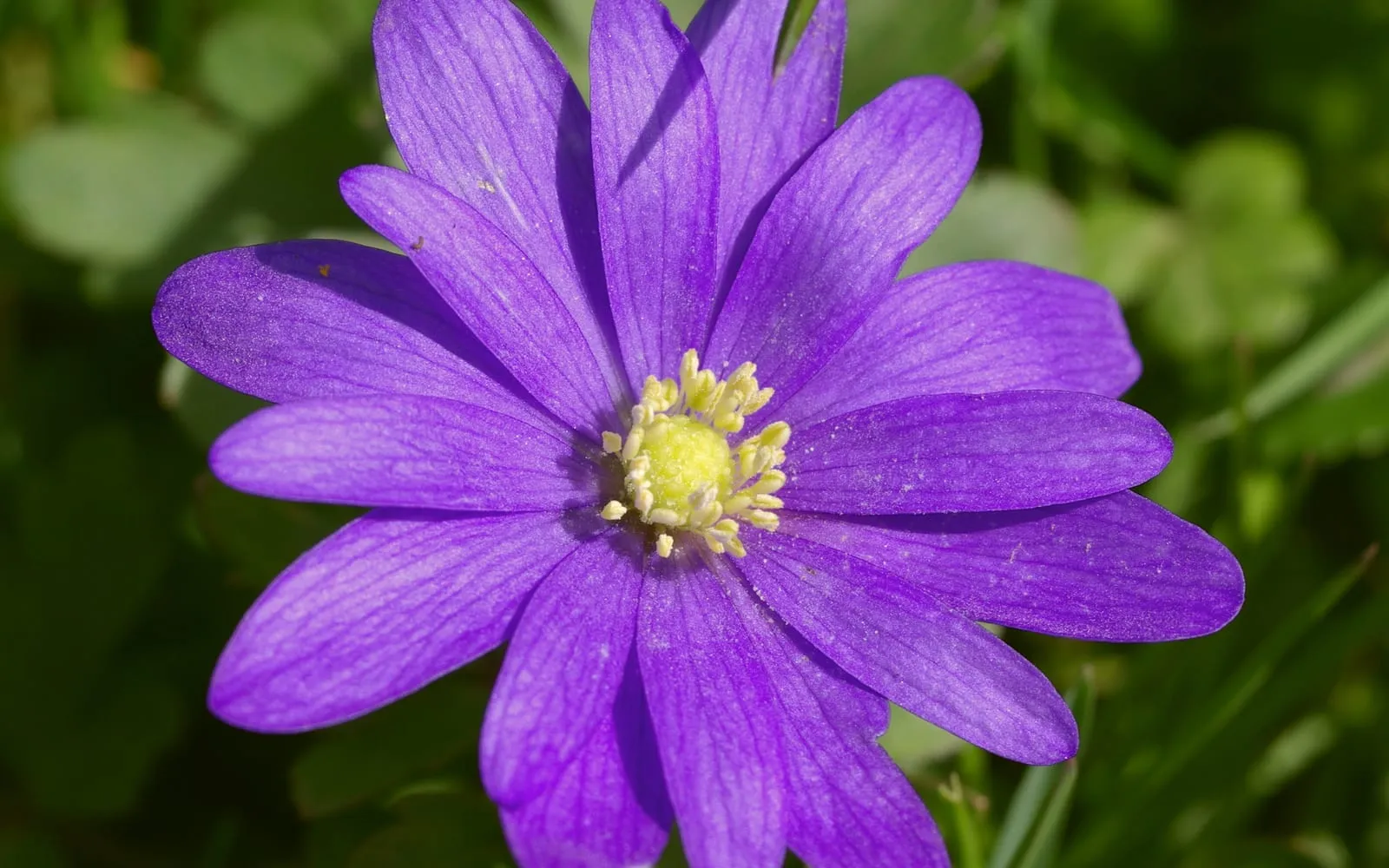
The flower is a ring of nine to fourteen narrow petal-like segments surrounding a cluster of yellow stamens, in blue, violet, pink or white depending on variety, with the true species typically a soft violet-blue. Unlike a true daisy, which is dozens of tiny flowers packed into one head, an anemone flower is a single bloom, and the number of segments varies noticeably from flower to flower on the same plant.
The tuber itself is small, usually 1 to 2 cm across, dark brown to black, hard and dry when bought, and difficult to orient by eye. Growing points, small pale swellings on the surface, are the only reliable guide to which side should face upward, and on a dry, shrivelled tuber straight from a packet they are often impossible to see at all.
Where it is from
Southeast Europe and the eastern Mediterranean, native across the Balkans, through Turkey and into the Caucasus, growing in open woodland, scrub and rocky hillsides at low to moderate altitude.
That range gives it a climate of cool wet winters and springs followed by a hot dry summer, and a woodland floor in that region follows the same rhythm as the trees above it: full light in late winter and early spring before deciduous leaf cover develops, then increasing shade and eventually complete drought as summer takes hold. The plant’s entire life cycle, emerging, flowering and setting seed, happens inside that early window, so it is finished and invisible above ground well before most garden perennials have properly got going.
It is often confused with the British native wood anemone, Anemone nemorosa, which shares the daisy-like flower and a similar early spring display but is a different species entirely, spreading by a thin creeping rhizome instead of a knobbly tuber and tolerating far wetter summer conditions as a genuine woodland floor plant of temperate Britain and northern Europe.
How it grows
A tuberous perennial spreading by both offset tubers and self-sown seed once established, forming an expanding patch instead of staying as isolated clumps.
Soak the dry tubers in tepid water for several hours, or overnight, before planting. This is the step that often separates a good first-year display from a poor or absent one. A dry tuber straight from a packet has often shrivelled in storage, and rehydrating it before it goes into the soil gives it a far better chance of sprouting promptly instead of sitting inactive and rotting before it starts growth.
Orientation matters less than the guidance often implies. If the growing points are impossible to identify after soaking, plant the tuber on its side instead of guessing at flat and risking it upside down; the shoot will find its way to the surface regardless.
Plant 5 cm deep and about 5 to 8 cm apart, in generous groups instead of thin lines, since a scattered handful planted where it falls gives a far more natural look than a planted grid.
Once established, leave the tubers entirely undisturbed. They resent lifting and division, and a patch left alone widens on its own timetable, usually visibly larger within three to four years of the original planting.
Through the seasons
Autumn is the planting season, ideally in September or October after soaking the tubers, giving them time to root before the ground turns cold.
Winter brings the first leaves through in a mild spell, often before Christmas in a sheltered spot, well ahead of most other spring bulbs.
Spring is the flowering season proper, from February through April depending on climate and situation, with individual flowers opening and closing daily according to light and temperature.
Summer is dormancy. The foliage yellows and disappears by early summer as the tree canopy above closes and the soil dries, and nothing further needs doing until the following autumn.
Care difficulty
Easy, and one of the most reliable naturalisers available for a spot under deciduous trees that most other plants find difficult. The main task is getting the planting right in the first place. Soak the tubers, plant generously instead of sparingly, and choose a site that dries out over summer.
Once established it needs almost no attention at all, and the temptation to interfere, by lifting and dividing, or by watering through a dry summer out of habit, usually does more harm than leaving it alone.
Watering
Water after planting to settle the soaked tubers in, and keep the soil consistently moist while the plant is in leaf and flower through late winter and spring, particularly in a dry spring with little natural rainfall.
Stop watering as the foliage begins to yellow in late spring, and do not water the area at all through summer dormancy. A dry summer rest is part of what the plant is adapted to, and irrigating a border that includes it through July risks rotting the dormant tubers.
Warning signs, diseases and pests
Slugs occasionally graze the earliest emerging leaves in a wet, mild winter, though damage is rarely severe enough to prevent flowering, since the leaves toughen quickly.
Tubers that fail to appear at all, in soil that has stayed wet through summer, have most likely rotted in place. There is no remedy beyond replanting fresh tubers somewhere with better summer drainage, or under denser tree cover where the soil dries more reliably once the canopy closes.
Squirrels and mice occasionally dig up newly planted tubers before they have rooted, mostly in the first autumn. A layer of chicken wire pegged just below the soil surface over a new planting deters them until the roots anchor the tubers properly.
Flowers that never seem to open fully, staying tightly furled even in apparently reasonable weather, usually means not enough direct light reaches the site. The flower’s opening mechanism responds to both light and warmth, and a spot in permanent deep shade under evergreen cover gives neither.
Growing environment
Dappled shade under deciduous trees is the classic and best position, giving full light in late winter and early spring before the canopy fills in and increasing shade through the rest of the year, which matches the plant’s own dormancy schedule. In a cooler climate with less intense summer sun, full sun works equally well.
Humus-rich, free-draining soil suits it best. Working leaf mould or garden compost into the planting area before the tubers go in mimics the leaf litter of its native woodland habitat and improves both moisture retention in spring and drainage in summer.
It tolerates a wide range of soil pH but performs best in neutral to slightly acid ground, and struggles on heavy clay that stays cold and wet through winter.
Plant generously. A thin scatter of a dozen tubers looks sparse and takes years to look like a drift; a hundred or more planted in irregular groups gives an immediate effect that then continues to spread on its own.
Feeding
Very little feeding is needed. A yearly mulch of leaf mould or well-rotted compost applied in autumn, after the ground has cooled, replicates the leaf litter the plant would receive under trees in the wild and is generally sufficient on its own.
Avoid rich fertiliser, particularly anything high in nitrogen, which encourages soft leafy growth at the expense of the tuber’s ability to store reserves for next year’s display.
On poor soil, a light scatter of balanced granular feed as the leaves emerge in late winter gives an underperforming patch a boost, though most established plantings need nothing at all.
Troubleshooting
The tubers are just knobbly lumps with no obvious top or bottom. That is normal. Soak them in tepid water overnight before planting to soften them and reveal the growing points, and if you cannot tell, plant on their side instead of guessing.
Planted them and nothing came up. Most likely the tubers were not soaked before planting and never rehydrated in the soil, or they rotted in ground that stays wet in summer. Soak next time, and improve drainage if rot is the cause.
The flowers keep closing during the day. That is the plant responding to cloud, cooler temperatures or fading light, and it is entirely normal rather than a problem. They reopen when conditions brighten.
Is this the same as wood anemone? No. Wood anemone, Anemone nemorosa, has a rhizome, not a tuber, and it tolerates wetter summer soil, so it thrives as a native woodland plant across Britain in a way that Grecian windflower does not.
Can I move an established patch? It is best left alone. The tubers resent disturbance, and a patch that has taken years to spread naturally will take just as long to recover if lifted and replanted.
How long before it forms a proper drift? Three to four years for a generous initial planting to look like a continuous carpet, spreading further after that through both self-sown seed and offset tubers.
Is it safe around pets? All parts are mildly toxic through protoanemonin, which can cause mouth irritation and an upset stomach if a pet eats a significant amount. Fresh sap can also irritate sensitive skin.