
Outdoor plant
Chinese Rhubarb
Rheum palmatum
Also known as Da huang, Turkey rhubarb, Ornamental rhubarb
How to grow Rheum palmatum, the ornamental rhubarb behind da huang. A two-metre flower spike, leaves the size of a table, and why the leaf blades are not food.
At a glance
- Difficulty
- Easy
- Water
- In dry spells through the growing season
- Light
- Full sun or light shade
- Temperature
- Fully hardy, to about minus 20 deg C
- Hardiness
- USDA 5-9, RHS H6, hardy to -20 C
- Type
- Hardy herbaceous perennial from a thick rhizome
- Height
- 2-2.5 m in flower, 1.2 m in leaf
- Native to
- the mountains of western China and Tibet
- Best month
- March in the Northern Hemisphere, September in the Southern Hemisphere
Deep rich moist soil is what makes the two-metre leaves it is grown for, and it sulks on anything dry or thin. Cold does not trouble it. The root takes three to four years to reach a usable size, and lifting it ends the plant.
Hardiness zones describe winter cold alone. Summer heat, humidity, rainfall and the length of the growing season decide as much, so treat the range as the outer limit rather than as a recommendation.
Every month named in this guide is for the temperate Northern Hemisphere. If you garden in the Southern Hemisphere, shift each one by six months, so March becomes September. Closer to the equator the wet and dry seasons matter more than the calendar, and the shift stops being a useful guide.
Toxic if eaten
- Do not eat
- The leaf blades, which contain oxalic acid, and the root, which is a strong laxative
- Harm from
- Eating it
- Affects
- People, cats, dogs and horses
The leaf blades of every rhubarb are poisonous and this one is no exception. They contain oxalic acid and other compounds that cause mouth and throat burning, vomiting and abdominal pain, and the RHS lists rhubarb leaves among potentially harmful garden plants for exactly that reason. Cases severe enough to threaten the kidneys are rare and need a large quantity. The root is a different matter and is the reason the plant is in this collection. It contains anthraquinones and is a powerful stimulant laxative, used under the name da huang in Chinese practice and formerly listed in European pharmacopoeias as Turkey rhubarb. The European Medicines Agency maintains a herbal monograph on rhei radix covering that material. Nobody should be eating the root of a garden plant on the strength of that, and the practical advice for a garden is the one that applies to culinary rhubarb: leaf stalks are food where a variety is grown for them, leaf blades go on the compost heap, and the root stays in the ground.
Sources: RHS potentially harmful garden plants, ASPCA toxic and non-toxic plants, European Medicines Agency herbal monograph, rhei radix
About
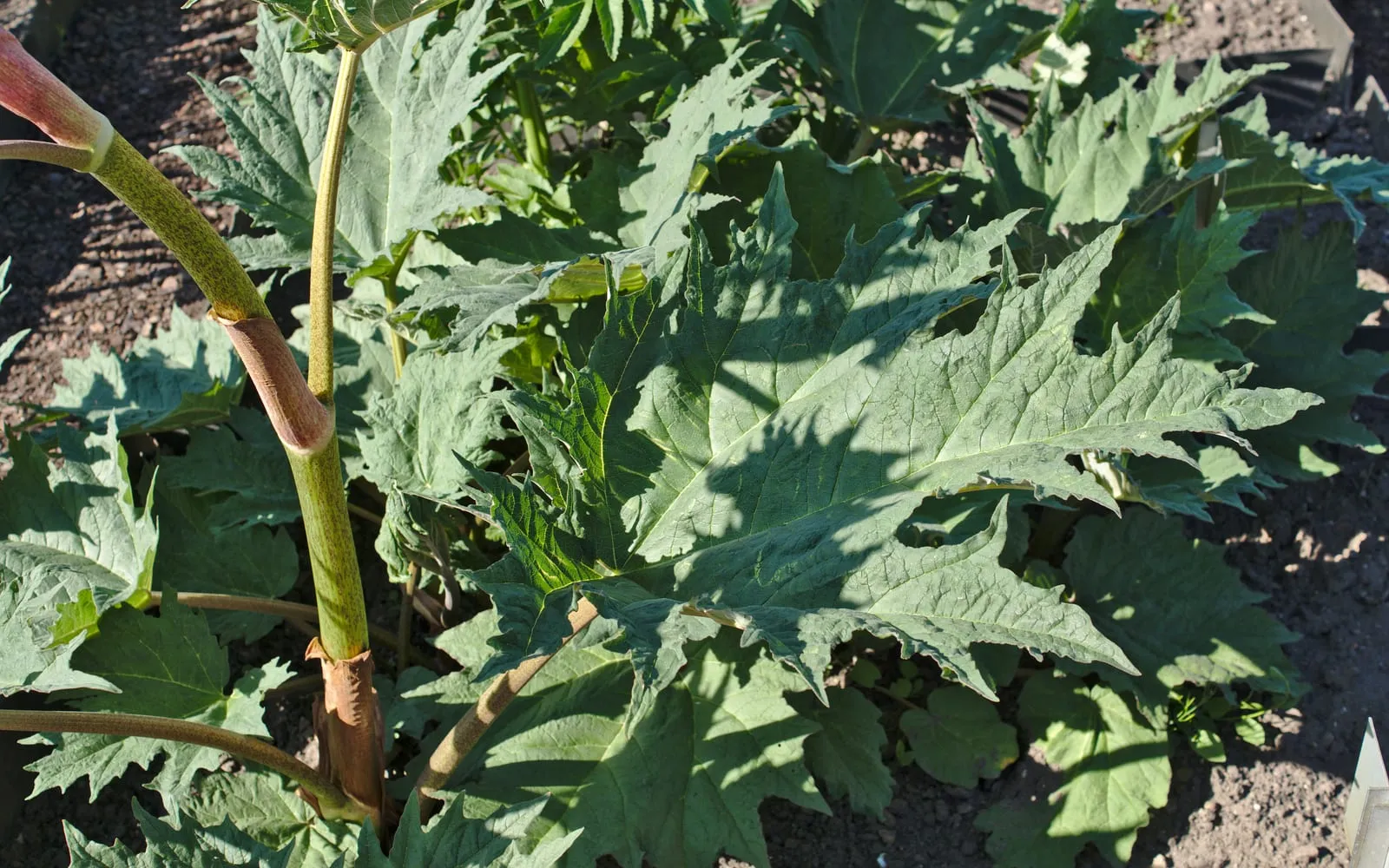
Rheum palmatum is grown in temperate gardens for its size. The leaves reach 90 cm across, deeply cut into pointed lobes, on red-flushed stalks, and in June the plant throws up a flower spike two metres tall carrying thousands of small red or cream flowers. Beside a pond or at the back of a big border it is one of the most striking hardy plants available.
Its other life is as da huang, one of the oldest items in the Chinese materia medica and one of the few that travelled all the way to Europe and stayed there. Rhubarb root was a major article of trade along the Silk Road for centuries, reaching Europe through Turkey, which is why old English pharmacy called it Turkey rhubarb, and it was still in the British Pharmacopoeia in the twentieth century.
The species is not the culinary rhubarb. That is Rheum x hybridum, bred for thick edible stalks. Rheum palmatum has thinner stalks and a much bigger leaf, and it is grown as an ornamental here. The rule about the leaf blades applies to both.
Appearance and character
The leaves are the plant. Each blade is roughly circular in outline, up to 90 cm across, cut into five to seven deep pointed lobes that are themselves toothed, rough to the touch, and held on a stout stalk that can be green or strongly flushed red.
The cultivar Atrosanguineum, which is what most nurseries sell, has new growth that emerges an intense crimson in spring and fades to green with red undersides as it expands. That spring flush is the strongest reason to choose it over the species.
The flower spike rises in June, a stout hollow stem to 2.5 m carrying a huge branched panicle of small flowers in cream, pink or deep red. It is followed by winged brown seeds that stay decorative into autumn, and the whole spike can be left standing for winter structure.
Where it is from
The species is native to the mountains of western China, from Sichuan and Gansu into Tibet and Qinghai, growing at 2000 to 4000 m on grassy slopes, in scrub and along stream sides. That is cold, bright, moist ground with excellent drainage.
Those origins explain the plant in a garden. It is fully hardy, wants moisture through the summer, dislikes stagnant wet in winter, and comes into growth early because the mountain season is short.
Root for the herb trade is grown in Gansu, Qinghai and Sichuan and lifted at three to five years. The related Rheum officinale and Rheum tanguticum are used in the same way, and the three are treated as sources of the same material.
How it grows
Growth begins early. Fat red buds push through the soil in March and expand into full-sized leaves within six weeks, which is one of the more dramatic things a garden does in spring.
The plant flowers from its third or fourth year, in June, and setting seed takes a great deal out of it. Cutting the spike out at the base as it emerges puts that energy into leaves and rhizome instead, which is the choice growers make when they want the root.
The rhizome is thick, woody and yellow inside, sitting at or a little below the surface and widening each year. A clump reaches full size in five years and can be divided in early spring, with each piece needing a visible bud.
Through the seasons
Plant crowns or pot-grown plants in March, into ground dug deeply with plenty of manure or compost worked in, allowing a good 1.5 m of space in every direction.
Leaves expand through April and May, the flower spike rises in June, and seed ripens through late summer. Water in dry spells, since a leaf that large loses a lot of water, and mulch generously in spring.
Foliage collapses after the first frosts. Clear the dead leaves in late autumn or leave the flower spike standing for structure and cut it in February. Divide established clumps in March.
Care difficulty
Easy, with two conditions. It needs a deep rich moist soil and a great deal of space, and neither can be improvised later.
The commonest failure is planting it somewhere too small and too dry. A plant squeezed into a border between shrubs scorches at the leaf margins by July and never reaches the scale that makes it worth having.
Beyond siting there is nothing to it. No staking, no pruning, no spraying, and a plant that lives for decades. Slugs on the emerging buds in March are the only regular job.
Watering
Water in dry spells through spring and summer, especially in the first two years and on light soil. The leaf area is huge and the plant transpires accordingly.
Established clumps on deep moisture-retentive soil manage most summers alone, and a thick mulch of compost each spring does more than a hose.
What the plant will not take is standing winter water at the crown. Moisture through the growing season and drainage in winter is the combination it wants, which is why it does so well on a bank above a pond rather than in the pond margin itself.
Warning signs, diseases and pests
Slugs and snails go for the fat emerging buds in March and can spoil the first flush of leaves. Grit, traps and a torch on damp evenings are the answer.
Leaf scorch, showing as brown crisp margins by midsummer, means the plant is short of water or standing in too much sun for the soil it is in. More mulch and a deeper soak fix it, and a badly sited plant is better moved in spring.
Crown rot is what kills established plants, and it follows waterlogging. Buds that fail to develop and a soft brown rhizome are the signs. Improve the drainage before replanting, because the same spot will do the same thing again.
Growing environment
Full sun or light shade, in an open position with room to spread. It tolerates more shade than most people expect and flowers less in it.
Soil should be deep, rich and moisture-retentive, with drainage that stops water standing in winter. Dig in plenty of organic matter before planting, since the plant will be in the same place for twenty years.
Shelter from strong wind is worth arranging. A leaf 90 cm across acts as a sail and shreds in an exposed position, which spoils the plant’s whole effect.
Feeding
A generous mulch of well-rotted manure or garden compost each spring, spread around the crown rather than over it. This is a hungry plant and it responds to feeding better than most perennials.
A general-purpose fertiliser in March supports a plant on poor soil. Nothing is needed on ground that gets an annual mulch.
Do not feed in late summer. Soft growth going into autumn is more likely to rot at the crown over winter.
Troubleshooting
Can I eat the stalks? Rheum palmatum is grown as an ornamental rather than a food plant, and its stalks are thinner and more fibrous than culinary rhubarb. The leaf blades of every rhubarb are poisonous and must not be eaten.
Why are the leaf edges brown and crisp? Leaf scorch from drought or too much sun. The leaves lose water fast and the plant needs deep moist soil. Mulch heavily and water in dry spells.
Should I cut the flower spike off? If you want the biggest leaves and the strongest clump, yes, cut it out at the base as it emerges. If you want the display, leave it, and accept a slightly smaller plant that year.
How much room does it need? At least 1.5 m in every direction, and 2 m is better. This is a plant for the back of a large border or beside water.
Is it the same as garden rhubarb? No. Culinary rhubarb is Rheum x hybridum, bred for edible stalks. Rheum palmatum is a much larger ornamental species and the source of the medicinal root known as da huang.
When do I divide it? In March, as growth starts. Cut the rhizome with a spade so each piece has at least one visible bud, and replant at once into prepared ground.
The buds have failed to come through this spring. Check the rhizome. If it is soft and brown, crown rot has taken it, and the cause is winter waterlogging. Improve drainage before replanting anything in that spot.