
Outdoor plant
Summer Snowflake
Leucojum aestivum
Also known as Loddon Lily, Summer Snowdrop
How to grow summer snowflake, Leucojum aestivum. Why it flowers weeks before summer starts, needs soil that never dries out even in summer unlike almost every other bulb, and why several bells hang from each stem rather than the single flower a snowdrop carries.
At a glance
- Difficulty
- Easy
- Water
- Keep the soil moist year round, including through summer
- Light
- Partial shade to full sun
- Temperature
- Fully hardy
- Hardiness
- USDA 4-9, RHS H6, hardy to -20 C
- Type
- Bulbous perennial
- Height
- 30-60 cm
- Native to
- Europe, western Asia
Cold is not the limiting factor for this bulb; ground that dries out is. It grows naturally in wet meadows and on riverbanks, and a border that bakes hard in summer suits it far worse than one that stays damp all year, whatever the winter minimum. Where soil moisture is reliable, it tolerates a hard frost.
Hardiness zones describe winter cold alone. Summer heat, humidity, rainfall and the length of the growing season decide as much, so treat the range as the outer limit rather than as a recommendation.
Harmful if eaten
- Do not eat
- Every part, and the bulb most of all
- Harm from
- Eating it
- Affects
- People, cats and dogs
Summer snowflake belongs to the Amaryllidaceae, the same family as snowdrop and daffodil, and carries the same lycorine alkaloid through its tissue, concentrated most heavily in the bulb. Eating any part causes vomiting and stomach upset, and the RHS lists Leucojum among its potentially harmful garden plants on that basis. The ASPCA has no entry for this genus specifically, but it lists Narcissus, a close relative carrying the same compound, as toxic to cats, dogs and horses, so treat this bulb with the same caution. The real-world risk is modest: the bulbs sit underground for most of the year and a passing nibble of a leaf or flower is more likely than anyone digging up and eating the bulb itself, but keep lifted bulbs away from pets and small children.
Sources: RHS potentially harmful garden plants, ASPCA (Narcissus, same family)
About
Summer snowflake carries a misleading name. It flowers in April and May, weeks before summer starts, and the name marks it as later than the snowdrops it resembles rather than as a summer plant in its own right.
Unlike a snowdrop, each stem carries several nodding bells rather than one, and unlike most bulbs, it needs ground that never dries out. Given a damp spot it is one of the easiest bulbs to grow, spreading steadily into a clump that needs almost nothing done to it from one year to the next.
Appearance and character
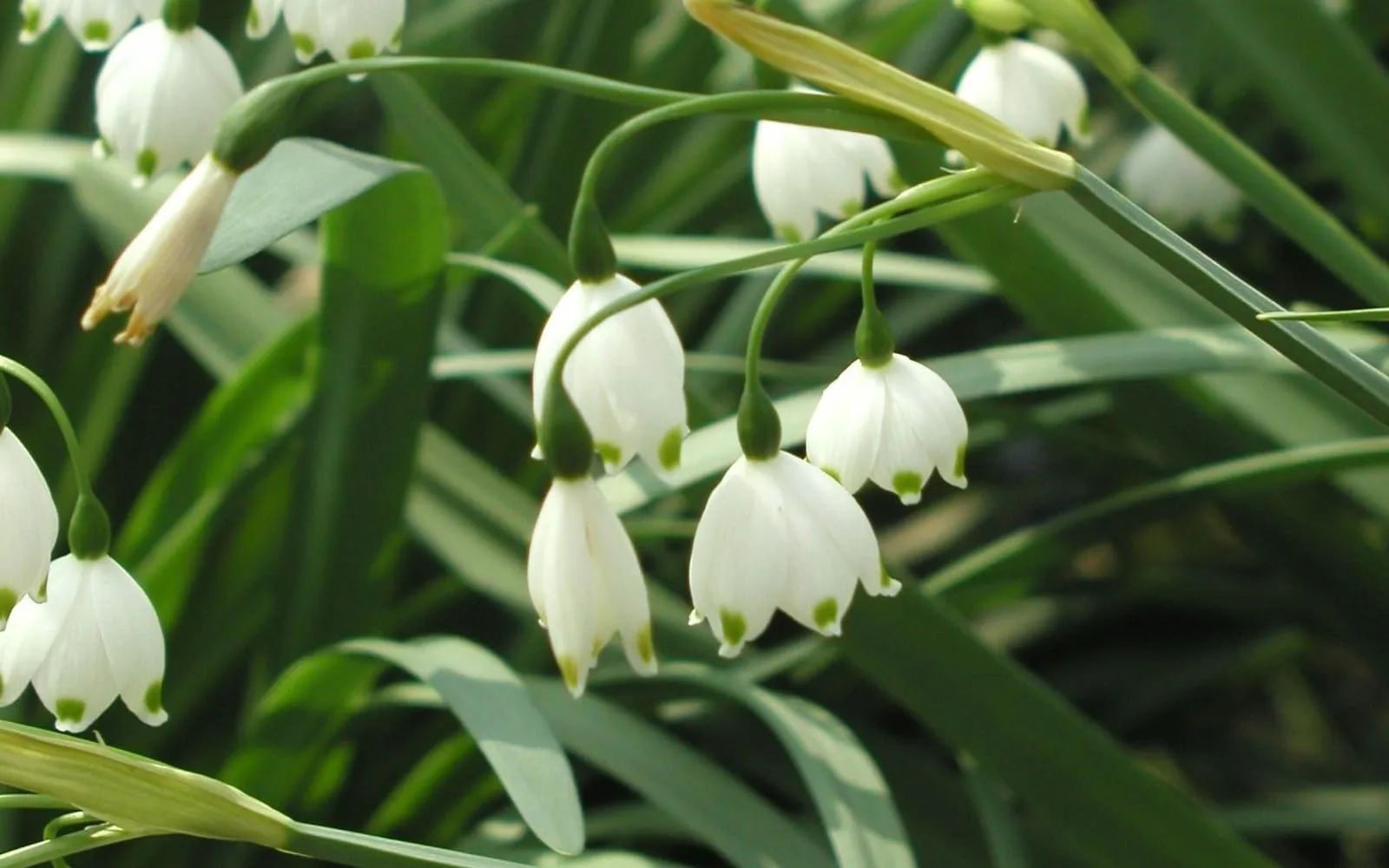
Each stem, 30 to 60 cm tall, carries a loose cluster of three to seven nodding, bell-shaped flowers rather than the single bloom a snowdrop produces on its own stem. That difference is the fastest way to tell the two apart in the garden even before looking closely at the flowers themselves.
Individual flowers are pure white, with six petal-like segments of equal length, each tipped with a small spot of green, sometimes yellow, near the tip. There is a faint chocolate scent on a warm day, noticeable close up rather than carrying across a bed.
Leaves are broad, strap-shaped and glossy dark green, considerably wider than a snowdrop’s, and they persist well into summer before dying back, tracking the plant’s later flowering time all the way through its cycle.
Where it is from
Leucojum aestivum grows across much of Europe and into western Asia, in wet meadows, damp woodland and on riverbanks that flood in winter and stay moist through the growing season.
It occurs as a true native in parts of southern and central England, along the Thames and its tributaries in particular, where the common name “Loddon lily” comes from a stretch of the River Loddon in Berkshire where it grows wild in quantity.
That riverbank origin explains the one requirement that separates it from most other spring bulbs. Ground that dries hard in summer, which suits a tulip or a daffodil perfectly well, leaves this species struggling, because it evolved in soil that a snowdrop or a crocus would find uncomfortably wet all year round.
How it grows
Plant bulbs in early autumn, 10 cm deep, in soil that stays reliably moist, ideally near a pond margin, a stream, or in a naturally damp part of the garden that other bulbs would rot in.
Choose a position in partial shade or full sun; it tolerates both, provided the soil moisture is right, and a shaded streamside spot suits it just as well as an open, sunnier border with damp soil.
It multiplies steadily by offsets around the parent bulb, building into a dense clump over a few years without needing any help.
Divide only when a clump becomes obviously congested and flowering starts to fall away, lifting and separating it in late spring while the leaves are still green rather than waiting for full dormancy.
Through the seasons
Winter is largely dormant, though the ground it grows in is often at its wettest, which suits the plant rather than harming it.
Spring is the main event. Flowers open in April and May, followed by the leaves continuing to grow and feed the bulb for several weeks after.
Summer brings the leaves dying back gradually; keep the soil damp throughout rather than letting it dry as most bulb foliage prefers.
Autumn is for planting new bulbs and for dividing any congested clump, and for mulching around established plantings.
Care difficulty
Easy, provided the site is right from the start. The one decision that matters is choosing reliably moist ground, ideally somewhere that stays damp through a dry summer rather than merely well-watered in spring. Planted there, it needs no further attention beyond an annual mulch and occasional division once a clump thickens up, and it is markedly less fussy than most spring bulbs about soil type otherwise, tolerating clay and heavy ground that would rot many others.
Watering
Keep the soil consistently moist throughout the year rather than only during active growth, which is the opposite of how most spring bulbs are watered.
In any dry summer, water a border planting rather than letting the ground dry out, since this is one of the few bulbs where summer drought does more harm than winter wet.
A pond-margin or streamside position that floods occasionally causes no problems at all, and if anything suits the plant better than consistently dry, well-drained soil would.
Warning signs, diseases and pests
Narcissus bulb fly lays eggs at the neck of the bulb in late spring, and the grub hollows it out over summer, so a bulb that was flowering well fails to appear the following year. There is no reliable chemical control; firming the soil around dying foliage reduces the gaps the fly lays in.
Grey mould shows as fuzzy grey growth on flowers and stems in cool, wet, still conditions, worse in a crowded, poorly ventilated clump. Remove affected growth and thin a dense planting to improve air movement.
Slugs and snails target the soft new shoots as they emerge in early spring, particularly in the damp conditions this plant is grown in. Protect emerging growth if slug damage is a regular problem in the bed.
Aphids on the leaves and flower stems can spread virus between clumps as they feed, leaving streaked or distorted growth with no cure. Control aphids promptly rather than waiting for symptoms to appear.
Stem nematode causes swollen, distorted bulbs and puckered, discoloured foliage. There is no treatment; lift and destroy affected bulbs and avoid replanting the same spot with bulbous plants for several years.
Growing environment
Partial shade to full sun both suit it, with soil moisture mattering far more than light level in deciding how well it grows.
Reliably moist to wet soil is the one non-negotiable requirement. A pond margin, a streamside bed, or a naturally damp corner of the garden all work well; free-draining soil that dries out in summer does not.
Fully hardy to around minus 20 degrees C, and untroubled by frost or cold, wet winter ground, which is exactly the condition it evolved to grow in.
Feeding
An annual autumn mulch of leaf mould or well-rotted garden compost supplies most of the fertility this plant needs, in keeping with its origin on an undisturbed riverbank that received no feeding at all.
A weak, congested clump on poor soil benefits from a low-nitrogen feed as the leaves emerge in spring, but avoid anything high in nitrogen, which produces soft foliage rather than more flowers.
Troubleshooting
My bulbs never come up in a border that dries out in summer. That is almost certainly the cause. This species needs soil that stays moist all year, and a border that bakes hard in summer, even one with rich soil, is the wrong spot for it.
How is this different from a snowdrop? Several flowers per stem rather than one, larger and glossier leaves, and a later flowering time in April and May rather than midwinter. It also tolerates far wetter soil than a snowdrop will.
A congested clump is flowering less than it used to. Lift and divide it once the leaves have finished feeding the bulb, in late spring or early summer, and replant straight away at the same depth.
Fuzzy grey growth appeared on the flowers. Grey mould, encouraged by still, damp air. Remove affected growth and improve airflow around the clump.
Can I grow it in an ordinary dry border? Not successfully long term. Without reliably moist soil the bulbs decline over a few years even if the initial planting looks promising. Choose the dampest spot available rather than the most conventional bulb bed.