
Outdoor plant
Martagon Lily
Lilium martagon
Also known as Turk's Cap Lily, Turban Lily
How to grow martagon lilies, Lilium martagon. Why a newly planted bulb can show no growth at all for a full year, the whorled leaves that mark it out from every other lily, and the fatal risk it poses to cats.
At a glance
- Difficulty
- Moderate
- Water
- Regular through the growing season, more so in dry woodland soil
- Light
- Light, dappled woodland shade; tolerates more shade than most lilies
- Temperature
- Fully hardy
- Hardiness
- USDA 3-7, RHS H6, hardy to -30 C
- Type
- Bulbous perennial, slow to establish and very long-lived once settled
- Height
- 90-180 cm
- Native to
- Europe, temperate Asia
Its native range stretches from France to Mongolia across some of the coldest winters any garden lily tolerates, and severe cold is never what limits it. The real constraint is patience rather than climate: a newly planted bulb commonly sends up nothing visible for a full year while it establishes below ground, which reads as a dead bulb to anyone expecting the faster growth of most other lilies and leads people to dig up and discard bulbs that were never in trouble at all.
Hardiness zones describe winter cold alone. Summer heat, humidity, rainfall and the length of the growing season decide as much, so treat the range as the outer limit rather than as a recommendation.
Poisonous to cats if eaten
- Do not eat
- Every part, including the pollen and the water from a vase
- Harm from
- Eating it
- Affects
- Cats
Every true lily is lethal to cats, and Lilium martagon is no exception despite its smaller, less showy flowers than the border lilies most people picture. Every part is involved, including the leaves, stem, flowers, pollen and even water a cut stem has stood in, and the toxin causes acute kidney failure. A cat that grooms pollen off its coat after brushing past the flowers has taken a dose. Vomiting and lethargy begin within hours, followed by an apparent improvement and then progression to kidney failure over the next two or three days, at which point the outlook is poor. There is no home treatment, and any suspected exposure needs a same-day vet visit, since fluids started early are what decide the outcome. Do not plant it in a garden a cat uses, and never bring cut stems into a house with one. Dogs suffer stomach upset rather than kidney damage, and in people the plant causes mild stomach upset if eaten and staining from the pollen, neither of them serious.
Sources: RHS potentially harmful garden plants, ASPCA toxic and non-toxic plants
About
The martagon lily is the one lily that tolerates real shade, which makes it the species to plant under trees or at a woodland edge where every other lily would sulk in too little light. Its flowers are smaller and more numerous than a border lily’s, its leaves grow in neat rings around the stem rather than singly, and its scent is faintly musky rather than sweet, all of which mark it out from the showier lilies most gardeners already know.
It also tests patience in a way few other bulbs do. A newly planted martagon can spend its first year entirely underground, building roots with no top growth at all, before finally sending up a stem the second spring. Buy the bulb expecting that delay and it causes no worry; buy it expecting typical lily speed and it looks, for a full season, exactly like a bulb that failed.
Appearance and character
Leaves are the fastest way to identify this species even without flowers. They grow in whorls, tight rings of six to ten leaves spaced at intervals up the stem, rather than singly and alternately the way almost every other garden lily’s leaves do.
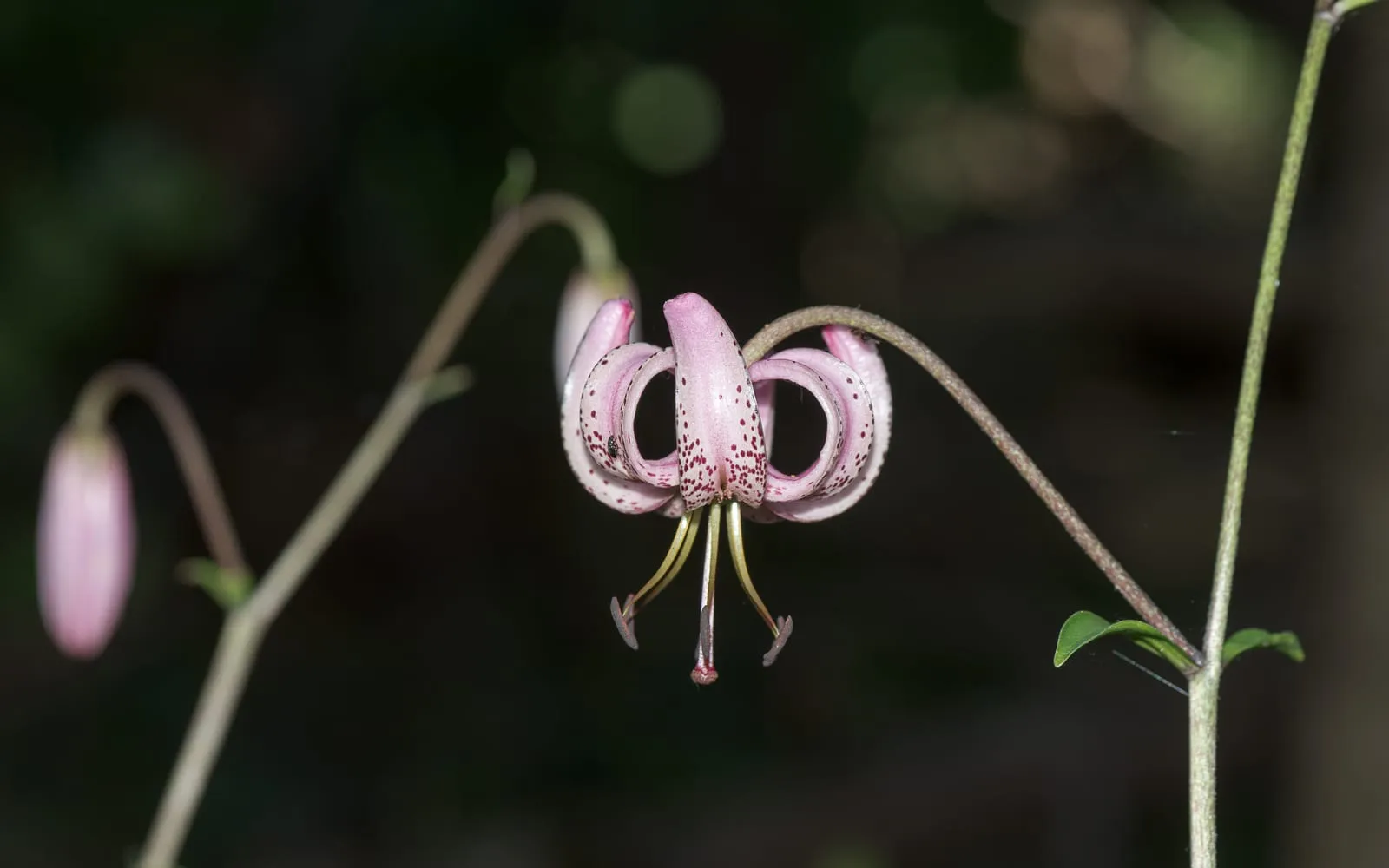
Flowers open from early summer, small by lily standards at 4 to 5 cm across, but produced in far greater numbers, with a well-grown mature stem carrying twenty, thirty or occasionally as many as fifty blooms. Each is a Turk’s cap, with petals rolled back so far they touch behind the flower, in dusky pink to purple, usually with darker spotting, though a pure white form is also widely grown.
The scent is musky and, to many noses, faintly unpleasant at close range, a marked contrast with the heavy sweetness of a trumpet or Oriental lily, and one of the clearer ways this species signals that it is built for a different pollinator and a different garden role.
The bulb is white, scaly and slow to bulk up, increasing mainly by seed and by a gradual build of offsets rather than the rapid bulbil production some other lilies rely on.
Where it is from
Lilium martagon has one of the widest natural ranges of any lily, running from France and the Alps across central Europe and Russia to Mongolia, through alpine meadows, open woodland and scrubby hillsides across that entire distance.
That huge range explains both its extreme cold tolerance and its comfort with light shade, since much of its native ground sits at the dappled edge of forest rather than in full, unbroken sun the way most garden lilies’ wild habitats do.
Its common name comes from a Turkish word for a style of turban, a comparison Linnaeus preserved when he formally named the species, describing the tightly rolled-back petals of the flower.
In parts of its range, particularly on limestone in the Alps, it grows on distinctly alkaline soil, which is unusual among lilies and puts it alongside the regal lily as one of the few species a chalk garden can grow well.
How it grows
Plant bulbs in autumn, 15 cm deep, in humus-rich, well-drained soil, in a lightly shaded spot such as the edge of a border overhung by trees or open, deciduous woodland.
Expect little or nothing above ground in the first year. This is normal rather than a sign of failure, and digging up the bulb to check on it usually does more harm than leaving it alone through what growers call its sulking period.
Once established, leave the clump undisturbed for as long as possible. Martagon lilies resent root disturbance more than most and can take several years to recover their flowering if moved.
Feed with a high-potash liquid feed every two weeks from the moment shoots appear until several weeks after flowering, and deadhead spent flowers while leaving the stem and leaves standing to build the bulb.
Raise new plants from seed if you want quantity at low cost, since seed-raised martagon lilies, while slow, eventually produce more plants than division ever will from a species this reluctant to offset quickly.
Through the seasons
Winter is dormant, and the bulb tolerates severe cold without any protection needed.
Spring brings shoots, though a newly planted bulb may show nothing at all in its first spring.
Summer is the flowering season, opening earlier than most border lilies and running into midsummer on an established clump.
Autumn is for planting new bulbs and for collecting seed if wanted, once the stem has yellowed and can be cut down.
Care difficulty
Moderate, and the difficulty is almost entirely about patience rather than any ongoing labour. A newly planted bulb needs to be left alone for a year with no visible reward, which unsettles gardeners used to faster bulbs, and an established clump then needs to be left alone again, since disturbance sets flowering back for years. Beyond that, it needs the same lily beetle vigilance as any other lily and takes shade better than the rest of the genus, which makes it easier to site well in a garden with mature trees.
Watering
Water regularly through the growing season, keeping the soil damp without letting it become waterlogged, particularly in the drier soil often found under trees.
Woodland planting sites can dry out surprisingly fast once deciduous trees are in full leaf and drawing moisture from the same ground, so check the soil rather than assuming shade means damp.
Reduce watering as the stem yellows in autumn, and keep the site on the drier side through winter dormancy, since standing winter wet is a greater risk to the bulb than summer drought.
Warning signs, diseases and pests
Scarlet lily beetle attacks this species exactly as it does every other lily, stripping leaves, buds and flowers within days if left unchecked. Check plants from spring onwards and hand-pick both the bright red adults and the larvae, which coat themselves in their own excrement.
Botrytis, sometimes called lily disease on this species, produces orange-brown spots on the leaves that spread upward in wet summer weather. Remove affected foliage, improve air movement around the planting, and clear fallen debris in autumn.
Bulb rot follows heavy or waterlogged soil, showing as a stem that fails to appear or that collapses early. Add grit at planting time on any ground that holds water, and avoid planting in a hollow that puddles.
Mosaic virus, spread by aphids, causes streaked and mottled leaves with no cure. Control aphids promptly and destroy an infected plant rather than risk it spreading virus to lilies nearby.
Slugs and snails are a bigger threat here than to most lilies, since the shaded, humus-rich sites this species favours are exactly the conditions slugs prefer too. Protect emerging shoots in spring if slug pressure is high.
Growing environment
Light, dappled woodland shade suits it best, a genuine point of difference from almost every other lily grown in gardens, which want full sun.
Humus-rich, well-drained soil is what it needs most, and unlike most lilies it tolerates some lime, making it a workable choice on chalky woodland soil that would rule out many other species.
Fully hardy to around minus 30 degrees C or lower, reflecting a native range that runs deep into continental Russia and Mongolia.
Feeding
Feed with a high-potash liquid feed, the kind sold for tomatoes, every two weeks from shoot emergence until several weeks after flowering ends, when the bulb is building the following year’s display.
Mulch in spring with leaf mould or garden compost, which suits the woodland conditions this species is adapted to far better than a concentrated chemical feed would.
Avoid high-nitrogen fertilisers, which produce soft growth more attractive to both slugs and botrytis.
Troubleshooting
I planted a bulb and nothing came up in the first year. Is it dead? Probably not. Martagon lilies commonly spend their first year building roots underground with no visible top growth, then appear the following spring. Leave the site undisturbed rather than digging to check.
What are the whorled leaves everyone mentions? Leaves arranged in tight rings around the stem at intervals, rather than singly up the stem the way most lilies grow. It is the best way to identify this species even before it flowers.
Can I grow lilies in a shaded garden? This is the one to choose. Martagon tolerates light, dappled shade far better than any other widely grown lily, which mostly need full sun to perform well.
Why does it smell unpleasant compared with other lilies? A musky scent rather than a sweet one is normal for this species and not a sign of disease. It suits a different set of pollinators from the sweetly scented trumpet and Oriental lilies.
Is it dangerous to cats like other lilies? Yes, exactly as dangerous. Every part, including the pollen, can cause fatal kidney failure in cats, and this species carries no lower risk despite its smaller, less showy flowers.