
Outdoor plant
Giant Snowdrop
Galanthus elwesii
Also known as Elwes's Snowdrop
How to grow giant snowdrops, Galanthus elwesii. Why dry autumn bulbs fail and planting in the green succeeds, telling it apart from the common snowdrop by its double-marked petals, and flowering as early as December.
At a glance
- Difficulty
- Easy
- Water
- Rain is enough in most gardens; needs no extra summer watering
- Light
- Partial shade to full sun
- Temperature
- Fully hardy, and more tolerant of a dry, hot summer than most snowdrops
- Hardiness
- USDA 4-9, RHS H6, hardy to -20 C
- Type
- Bulbous perennial
- Height
- 15-25 cm
- Native to
- southeastern Europe, western Asia
Its native ground runs hot and dry through summer, well beyond anything a woodland snowdrop from further west and north tolerates, and that background makes it the better choice for a garden with a baking summer border rather than reliably damp shade. Winter cold is not the constraint; a real chill is still needed to flower well, but the bulb takes a harder summer drought without resenting it the way the common snowdrop does.
Hardiness zones describe winter cold alone. Summer heat, humidity, rainfall and the length of the growing season decide as much, so treat the range as the outer limit rather than as a recommendation.
Harmful if eaten
- Do not eat
- Every part, and the bulb most of all
- Harm from
- Eating it
- Affects
- People, cats and dogs
Like every snowdrop, Galanthus elwesii contains lycorine and galantamine, and the RHS lists the genus in its category of potentially harmful garden plants. Eating any part causes vomiting and stomach pain, and the bulb, mistaken for a small onion or shallot by someone digging near a vegetable patch, is the source of nearly every serious human case on record. The ASPCA carries no entry for Galanthus specifically but lists Narcissus, a relative in the same family with the same lycorine content, as toxic to cats and dogs, and the same caution applies here. Galantamine, the same compound extracted commercially from snowdrop bulbs, including this species, as a licensed treatment for Alzheimer's disease, is a reminder that the toxin is a real pharmacologically active alkaloid rather than a theoretical hazard, even though a garden-scale accidental exposure is rarely serious.
Sources: RHS potentially harmful garden plants, ASPCA (Narcissus, same family)
About
The giant snowdrop earns its name honestly. Flowers and leaves both run noticeably larger than the common snowdrop’s, often by half again, and a well-grown clump reads as a bolder, more substantial planting rather than the delicate drifts most people picture when they hear the word snowdrop.
It also flowers earlier, commonly from December in a mild spell, weeks ahead of the January and February display most gardens expect, which makes it the species to plant for the very first flowers of the winter garden. Left undisturbed it naturalises readily, and it tolerates a warmer, drier summer than most of its relatives, which makes it the more forgiving choice outside the cool, damp climates snowdrops are usually associated with.
Appearance and character
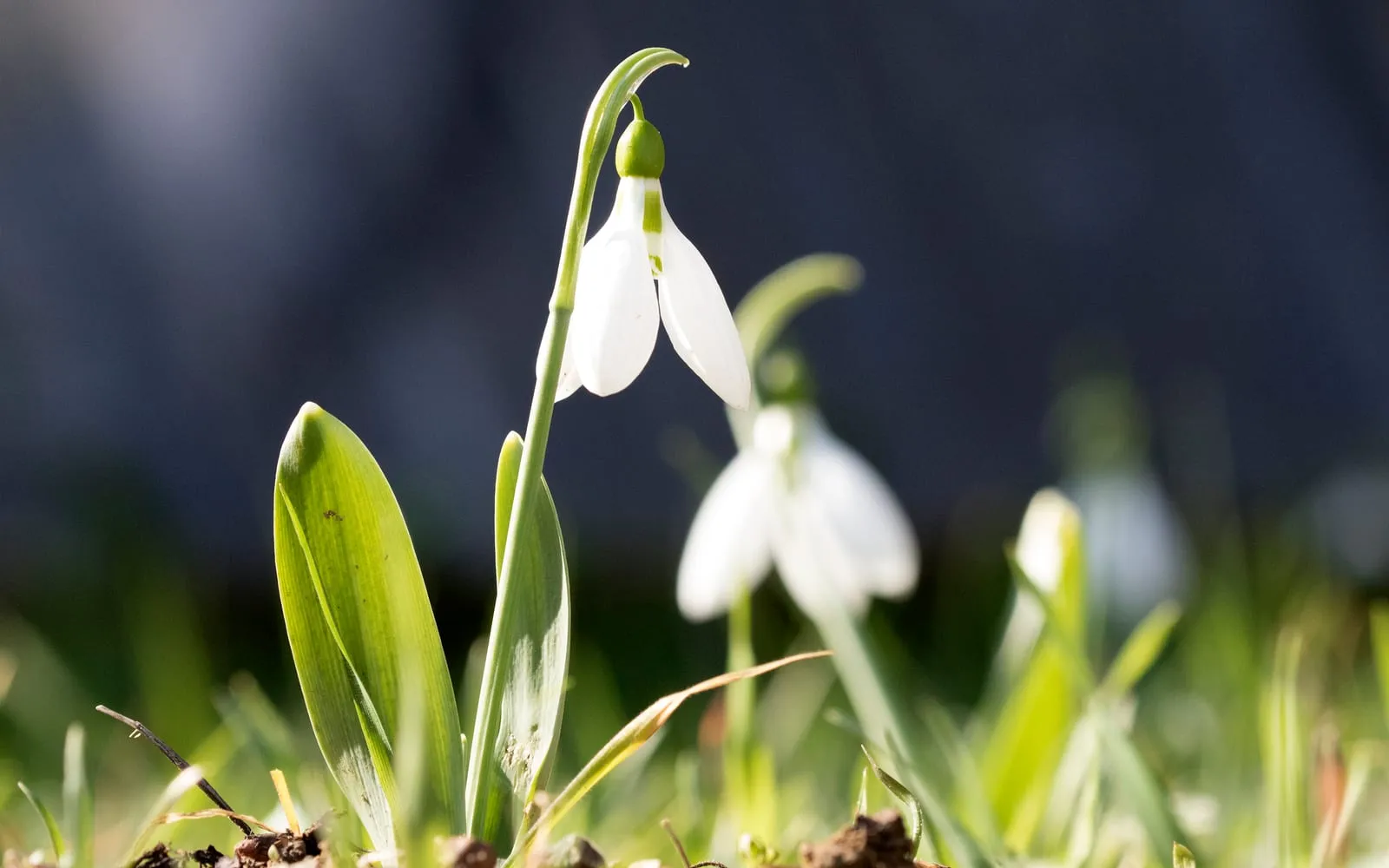
Flowers are held on single nodding stems, each with three long outer segments and three short inner ones marked with green, the standard snowdrop pattern, but scaled up. Where the common snowdrop typically shows one green mark near the tip of each inner segment, this species usually carries two, one at the tip and a second at the base, giving the inner petals a distinctive double-marked look. Check for it when telling species apart in the garden.
Leaves are broad, strap-shaped and a pronounced grey-green, considerably wider than most other snowdrops’ narrower, plainer green leaves. In the bud the two leaves are folded face to face around each other rather than lying flat side by side, a detail botanists call the vernation and one of the more reliable ways to identify this species even before the flowers open.
A mature bulb sends up flowers noticeably larger than a common snowdrop’s, on a stem that stands taller and sturdier, and the whole plant carries a more substantial, almost architectural presence in a winter border.
Where it is from
Galanthus elwesii grows across the Balkans and through Turkey, on rocky hillsides, open scrub and thin woodland that bakes dry through a hot Mediterranean-influenced summer, quite unlike the damp deciduous forest most snowdrop species favour further west.
It was collected in Turkey in 1874 by the naturalist Henry John Elwes, whose name it carries, and introduced to British gardens shortly after, where its size and vigour made it popular with collectors almost immediately.
That drier, more open native habitat explains why this snowdrop tolerates garden conditions that would weaken a common snowdrop, taking a hot, dry summer rest in its stride and often naturalising more freely in warmer regions where the common species struggles to persist.
How it grows
Buy and plant it “in the green”, as growing plants with leaves still attached in late winter or early spring, exactly as you would the common snowdrop, since dry bulbs sold in autumn establish poorly and often fail outright.
Choose a position in partial shade or full sun. Unlike a woodland snowdrop, this species tolerates considerably more sun and a drier summer without decline, which makes it a workable choice in beds that other snowdrops find too exposed.
Plant at the same depth the bulb was growing at previously, marked by the pale section of stem below the leaves, and water new plantings in well while the roots re-establish.
Leave the clump entirely alone through spring while the leaves die back, since this is when the bulb is building the following year’s flower. Divide only once flowering has clearly declined from congestion, lifting and separating the clump just after flowering while the leaves are still green.
Through the seasons
Winter is the flowering season, often starting as early as December in a mild spell and running through into February.
Spring is when the leaves finish feeding the bulb and when any division should happen, right after flowering ends.
Summer is a dry dormancy that this species tolerates comfortably, needing no supplementary watering even in a hot spell.
Autumn is for mulching an established clump and for planting any dry bulbs, though bulbs planted in the green in late winter establish far more reliably.
Care difficulty
Easy, and noticeably more forgiving than the common snowdrop once established, because it tolerates a warmer, drier summer without the same risk of the bulbs baking or the clump thinning out. The one decision that matters, as with any snowdrop, is buying plants in the green rather than dry bulbs, since dry stock of this species establishes just as poorly as any other. After that first season, a clump largely looks after itself.
Watering
Rain supplies everything an established clump needs in an open garden border, and this species tolerates a drier summer than most snowdrops without any decline in vigour.
Water a new planting in thoroughly, particularly one moved in the green with disturbed roots, and keep an eye on it through an unusually dry spring in its first year.
Pot-grown clumps need watering through the growing season but should be allowed to dry out considerably more in summer than a common snowdrop in a pot would tolerate.
Warning signs, diseases and pests
Narcissus bulb fly lays eggs at the neck of the bulb in late spring, and the resulting grub hollows the bulb out over summer, so a previously healthy clump fails to appear the following winter. Firming the soil as the foliage dies back reduces the gaps the fly can lay in.
Grey mould shows as fuzzy grey growth on leaves and flower stems in wet, still conditions, spreading fastest through a dense, crowded clump. Remove affected growth promptly and thin congested plantings to improve airflow.
Squirrels and mice dig up newly planted bulbs, usually out of curiosity rather than because they intend to eat them, most often in the first autumn after planting. Netting the area until growth appears is generally enough protection.
Stem nematode causes swollen, distorted bulbs and puckered foliage, with no reliable treatment available. Lift and destroy affected bulbs and avoid replanting bulbous species in the same spot for several years.
Growing environment
Partial shade to full sun both suit this species, a wider tolerance than most snowdrops offer, and it copes with more exposed, sunnier positions than a woodland species would.
Free-draining soil that is allowed to dry out through summer suits it better than the consistently moist ground a common snowdrop prefers, reflecting its native habitat on open, sun-baked slopes rather than in damp forest.
Fully hardy to around minus 20 degrees C, and entirely unbothered by winter cold; flowers that flatten in a hard frost lift again as the ground thaws.
Feeding
An annual autumn mulch of leaf mould or well-rotted garden compost supplies most of the fertility this species needs, feeding the soil rather than the bulb directly.
A weak clump on very poor soil benefits from a low-nitrogen feed as the leaves emerge, but avoid anything nitrogen-rich, which produces soft foliage rather than more flowers.
Troubleshooting
How can I tell this apart from a common snowdrop? Look for larger flowers, broader grey-green leaves, and, on the inner petals, two green marks rather than one. The leaves in bud are also folded around each other rather than lying flat side by side.
Why did my dry autumn bulbs never come up? The usual outcome for this species, exactly as for the common snowdrop. Buy plants in the green, with leaves attached, in late winter or early spring instead.
Can I grow this where summers are hot and dry? Yes, better than most snowdrops. Its native ground bakes dry through summer, so a warm, sunny border suits it considerably better than it would suit a woodland species.
Fuzzy grey mould has appeared on the leaves. Remove and destroy the affected growth and thin a crowded clump to improve air movement around the remaining plants.
When should I divide a large clump? Right after flowering finishes, while the leaves are still green, lifting sections and replanting them immediately at the same depth.