
Outdoor plant
Wild Daffodil
Narcissus pseudonarcissus
Also known as Lent lily, Daffodil, Narcissus
How to grow and naturalise wild daffodils, Narcissus pseudonarcissus. Planting depth, why the leaves must be left alone, the sap that kills other cut flowers, and why the bulbs are dangerous.
At a glance
- Difficulty
- Easy
- Water
- Rain is enough once established
- Light
- Partial shade to full sun. Flowers before trees leaf up
- Temperature
- Fully hardy, to about -25 deg C
- Hardiness
- USDA 3-8, RHS H6, hardy to -25 C
- Type
- Bulbous perennial
- Height
- 25-35 cm
- Native to
- Western Europe, including Britain
- Best month
- March and September in the Northern Hemisphere, September and March in the Southern Hemisphere
It needs a cold winter to flower and about twelve weeks below 9 C is the usual requirement, so through zone 9 and warmer the bulbs are pre-chilled and grown as annuals. Tazetta daffodils such as paperwhites and Grand Soleil d'Or need no chilling at all and are the ones to grow in a warm climate. Leaves must be left for six weeks after flowering to build next year's bulb, whatever it looks like.
Hardiness zones describe winter cold alone. Summer heat, humidity, rainfall and the length of the growing season decide as much, so treat the range as the outer limit rather than as a recommendation.
Every month named in this guide is for the temperate Northern Hemisphere. If you garden in the Southern Hemisphere, shift each one by six months, so March becomes September. Closer to the equator the wet and dry seasons matter more than the calendar, and the shift stops being a useful guide.
Poisonous if eaten
- Do not eat
- Every part, and the bulb most of all
- Harm from
- Eating it and handling it
- Affects
- People, cats, dogs and horses
Every part of a daffodil is poisonous and the bulb is the worst of it. The ASPCA lists Narcissus as toxic to dogs, cats and horses through lycorine and related alkaloids, with vomiting, drooling and diarrhoea from small amounts, and convulsions, low blood pressure, tremors and cardiac arrhythmia from large ones. The RHS places Narcissus in category B, harmful if eaten, and also lists it as a skin irritant. The bulbs are the most common cause of serious cases because they are mistaken for onions, which they resemble closely enough that hospital admissions happen most years. The sap causes a contact dermatitis well known to commercial pickers as daffodil itch, so wear gloves when handling large numbers. The same sap kills other flowers in a vase, so stand cut daffodils alone in water for several hours and do not recut the stems before mixing them with anything else.
Sources: ASPCA (Daffodil, Narcissus spp), RHS potentially harmful garden plants
About
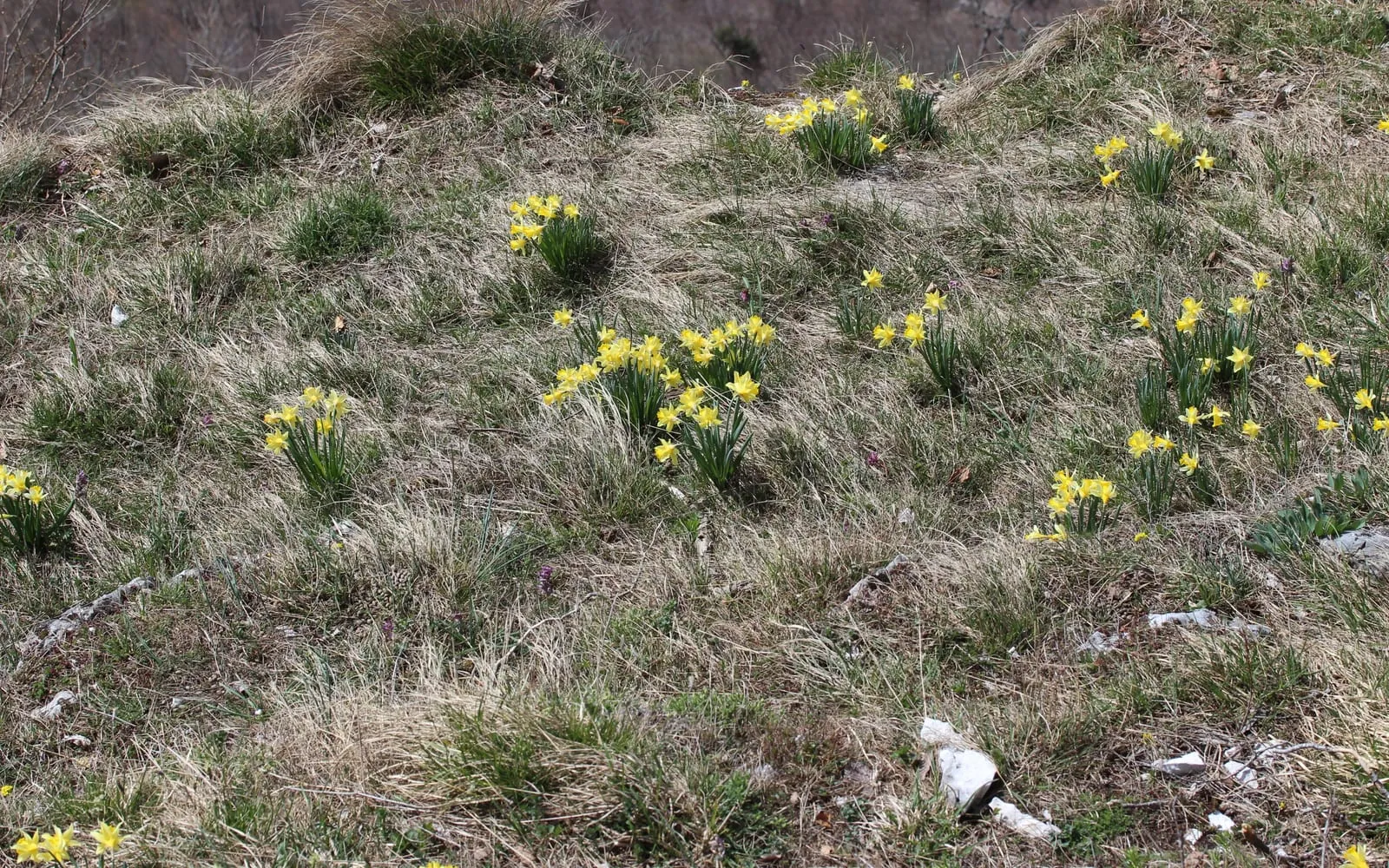
The wild daffodil is a smaller, paler and more graceful thing than the garden hybrids sold by the sackful in autumn. Its petals are pale lemon, its trumpet a deeper gold, and the flower nods rather than staring straight ahead. Planted in grass it looks like it arrived on its own.
It is a British native, the Lent lily of old country names, and it once carpeted damp meadows and open woodland across much of England and Wales. Drainage and ploughing have taken most of that away. A few strongholds remain, notably in Gloucestershire and Herefordshire, where the daffodil meadows still draw people out in March.
Buy bulbs from a nursery. Digging up wild plants is illegal at protected sites and unhelpful everywhere else.
Appearance and character
Strap-shaped grey-green leaves, upright and slightly twisted, rising from an underground bulb. Flower stems reach 25 to 35 cm and each carries a single bloom.
The flower has six pale outer segments around a darker yellow trumpet, and the contrast between the two is the quickest way to separate the wild plant from the garden hybrids, which are usually one uniform colour and considerably larger.
The bulb is a true bulb, made of compressed layers like an onion, which is exactly the resemblance that leads to poisoning cases every year.
There is a faint sweet scent on a warm afternoon and almost none on a cold one.
Where it is from
Western Europe, from Spain and Portugal north through France to Britain and into Germany. In Britain it grows in damp meadows, old orchards, and open deciduous woodland, mostly on neutral to slightly acid soils.
Woodland floor in March is bright, because the trees are bare, and it is moist. By July the canopy is closed, the ground is drier, and the daffodil has gone underground.
Reproduce that cycle and the plant naturalises without any further help.
How it grows
A bulbous perennial with a rigid annual rhythm. Roots grow in autumn, leaves push up in January and February, flowers open from March to April, and the whole plant dies back by June.
Everything in next year’s flower is built by this year’s leaves in the six to eight weeks after flowering finishes. The bulb is a store, and the leaves fill it. Cut them early and you are spending next spring’s flowers on a tidy lawn.
Bulbs multiply by producing offsets around the parent, so a planting thickens steadily. Wild daffodils also set seed freely in grass, though a seedling takes five to seven years to reach flowering size.
Depth matters. Plant at three times the height of the bulb, which is around 10 to 15 cm for most, with the pointed end up. Shallow bulbs split into many small non-flowering ones.
Through the seasons
Autumn is planting, from September to early November. Wild daffodils are also sold “in the green”, in leaf and just after flowering, which establishes more reliably than dry bulbs for this species.
Winter brings the leaves through, often in January. Frost does not trouble them.
Spring is flowering, March into April, followed by the critical foliage period. Deadhead spent flowers so the plant does not waste energy on seed, unless you want it to spread by seed.
Summer is dormancy. Leave the ground alone, and do not water. In grass, delay the first mow until late June.
Care difficulty
Easy, with one rule that gets broken constantly.
Leave the leaves alone for at least six weeks after the last flower fades, and preferably until they yellow and flop. No mowing, no tying into knots, no plaiting. A lawn full of daffodils that flowered well for two years and then stopped was almost certainly mown in May.
Deadheading is the other half of the routine, and it takes seconds. Snap off the faded flower behind the swelling seed pod and leave the green stem, which photosynthesises like a leaf.
Watering
Rain does the work in a temperate climate. Newly planted bulbs get one good soaking in autumn and nothing after that.
Water in a dry spring while the plants are in leaf, since drought then reduces next year’s flowering. This is rarely needed here.
Never water the area in summer. Bulbs sitting in warm wet soil during dormancy rot, which is the main reason daffodils vanish from irrigated borders.
Containers are the exception at both ends. Keep them just moist through growth, then move the pot somewhere dry once the leaves yellow.
Warning signs, diseases and pests
Narcissus bulb fly is the serious pest. The adult resembles a small bumblebee and lays at the base of the leaves in May and June, and the grub eats the bulb out from the inside. Affected bulbs produce a few thin grassy leaves and no flower. Firming the soil around the dying foliage removes the entry point, and naturalised bulbs in dense turf are largely protected. Lift and destroy blind bulbs.
Narcissus basal rot is a soil fungus that turns the base of the bulb brown and soft, spreading upward. There is no treatment. Lift and bin affected bulbs, and avoid replanting daffodils in that spot.
Slugs graze emerging shoots in a mild wet winter and can shred the leaf tips.
Squirrels dig newly planted bulbs in their first autumn. Wire mesh laid just under the soil surface stops them.
Blindness, meaning leaves without flowers, has several causes and the troubleshooting section separates them.
Growing environment
Partial shade to full sun. Under deciduous trees works perfectly, because the daffodil finishes before the canopy closes. Dense evergreen shade does not.
Fully hardy to about -25 deg C. Cold is a requirement rather than a hazard, since the bulb needs a proper winter to flower well.
Soil should stay moist through spring and dry somewhat in summer without ever being waterlogged. Heavy clay that sits wet all winter rots the bulbs, so add grit to the planting hole. This species tolerates damper ground than garden hybrids, which suits its meadow origins.
Grass is the ideal setting for naturalising. Scatter bulbs by the handful and plant them where they land, since a planted line never looks right.
Feeding
Naturalised bulbs in decent soil need nothing. A thin mulch of leaf mould in autumn replicates the woodland floor and is the only feeding most plantings ever get.
If a colony is flowering poorly and congestion is not the cause, a high-potassium feed applied straight after flowering builds the bulb for next year. Tomato feed works.
Avoid high-nitrogen fertiliser, which gives lush leaves and fewer flowers, and avoid feeding when the plant is dormant.
Bone meal at planting helps establishment on thin soils.
Troubleshooting
Leaves but no flowers. Congestion, bulbs planted too shallowly, foliage cut too early last year, or bulb fly damage. Lift in summer, discard soft or undersized bulbs, and replant the good ones deeper and further apart.
Flowered well for two years, then stopped. Almost always early mowing. Delay the first cut until the leaves have yellowed, which usually means late June.
A few thin grassy leaves and nothing else. Narcissus bulb fly. Lift and destroy the bulb.
Bulbs soft and brown at the base. Basal rot. Bin them and do not replant daffodils there.
Flowers on very short stems. A warm dry spring, or a bulb planted too shallowly.
Cut daffodils killing the other flowers in the vase. The sap is toxic to other stems. Stand them alone in water overnight first, then arrange them without recutting.
Itchy rash after picking a lot of them. Daffodil itch, a contact dermatitis from the sap. Wear gloves.