
Outdoor plant
Madonna Lily
Lilium candidum
Also known as White Lily, St Joseph's Lily
How to grow Madonna lily, Lilium candidum. Why it needs planting shallow and early in late summer to grow the evergreen winter rosette most lilies never form, why it prefers lime rather than merely tolerating it, and the severe risk every part poses to a cat.
At a glance
- Difficulty
- Moderate
- Water
- Moderate through the growing season; avoid wetting the foliage
- Light
- Full sun
- Temperature
- Fully hardy
- Hardiness
- USDA 6-9, RHS H6, hardy to -20 C
- Type
- Bulbous perennial, holding a basal leaf rosette through winter
- Height
- 1-1.5 m
- Native to
- the eastern Mediterranean, western Asia
This lily takes hard winter cold without difficulty, and the zone figures understate how particular it is about timing rather than temperature. It makes a rosette of basal leaves in autumn that stays green through winter rather than dying back like most lilies, so it needs planting early enough in late summer to establish that rosette before the cold arrives, and a late, wet planting misses the window the bulb is built around. It also tolerates lime, unlike a large share of garden lilies, which widens the soils it succeeds on considerably.
Hardiness zones describe winter cold alone. Summer heat, humidity, rainfall and the length of the growing season decide as much, so treat the range as the outer limit rather than as a recommendation.
Poisonous if eaten
- Do not eat
- Every part, and for cats the pollen and any water from a cut-flower vase as well
- Harm from
- Eating it
- Affects
- People, cats and dogs
Every true lily carries the same extreme risk to cats, and Madonna lily is no exception. A cat that eats a petal or leaf, chews on the stem, grooms pollen off its fur, or drinks from a vase that has held cut stems can develop acute kidney failure within one to three days of exposure, and the ASPCA treats any lily ingestion by a cat as a veterinary emergency requiring treatment within hours rather than a situation to monitor at home. Dogs that eat the bulb or foliage typically develop vomiting and gastrointestinal upset rather than the kidney damage seen in cats, though a large ingestion still warrants a call to a vet. In people the plant causes stomach upset if eaten in quantity and is not considered a serious poisoning risk, though the pollen stains skin and fabric persistently, which is why the anthers are often removed from cut flowers brought indoors. Do not keep this plant, or any true lily, in a home with a cat, and think carefully before planting it anywhere a neighbourhood cat has access to the garden.
Sources: ASPCA (Lily), RHS potentially harmful garden plants
About
Madonna lily has been grown in gardens for longer than almost any other ornamental plant still in general cultivation. Frescoes on Crete dating back roughly 3,500 years show a lily that botanists identify as this species, and it went on to become deeply woven into Christian symbolism, associated with purity and with the Virgin Mary, a connection that gives the plant both its common name and much of its enduring popularity in churchyard and cottage gardens.
Its habit sets it apart from almost every other lily grown today. Most lily bulbs sit fully dormant below ground once their foliage dies back in autumn, but Madonna lily sends up a rosette of basal leaves at that same point in the year, and that rosette stays green through winter, only dying back once the flowering stem itself has finished for the season.
The flowers are pure white and unmarked, without the streaks, spots or flushes of colour that decorate the buds and petals of many other garden lilies, giving the plant a simplicity that has suited its long symbolic role.
Appearance and character
A bulbous perennial producing an autumn rosette of narrow, strap-shaped basal leaves that persists through winter, followed in spring by a single upright flowering stem, 1 to 1.5 m tall, clothed in narrower leaves along its length.
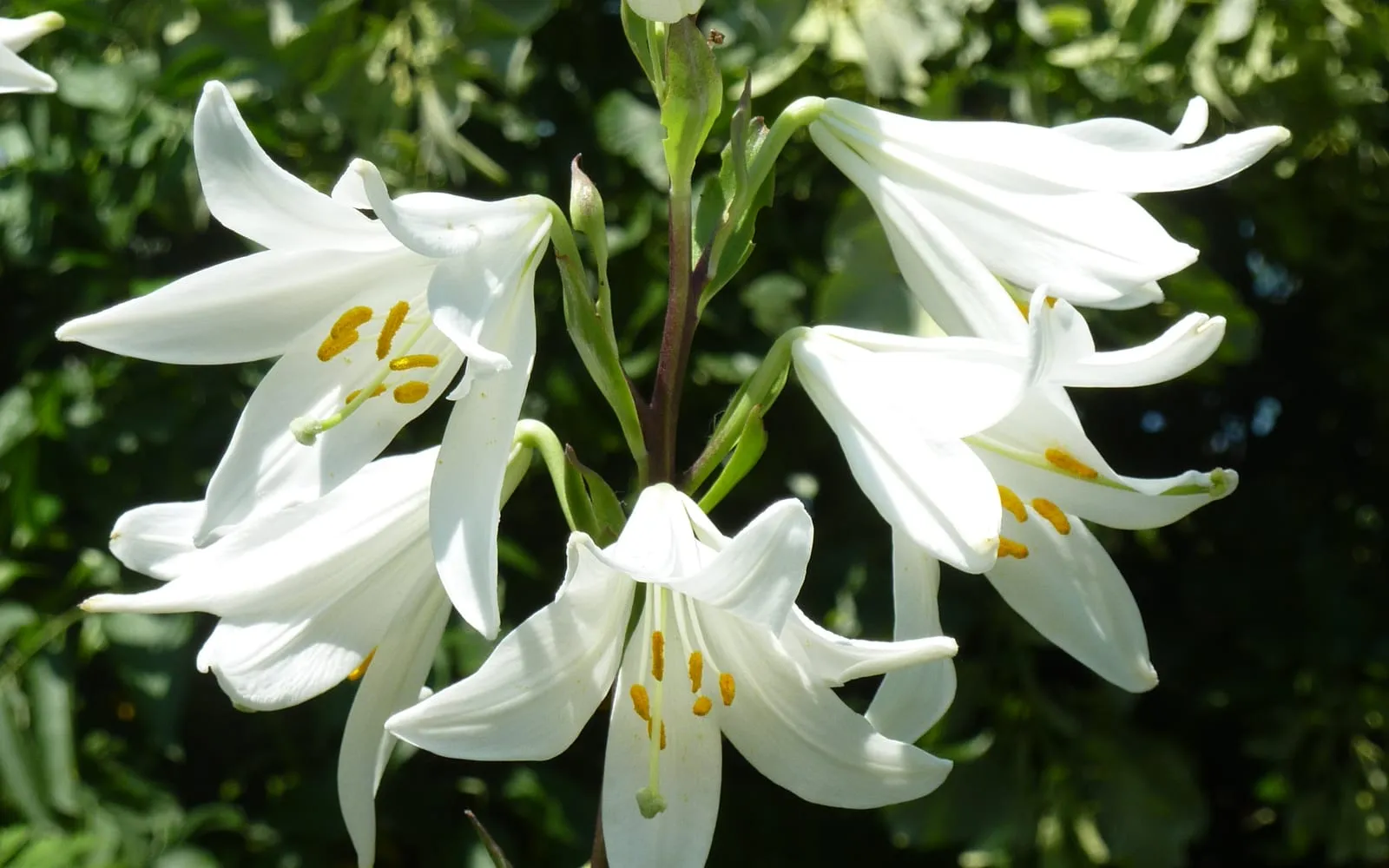
Flowers open in early to midsummer, up to a dozen or more on a strong established clump, each a broad, outward-facing to slightly nodding trumpet, pure white throughout with no spotting or streaking, and carrying a strong, sweet fragrance that is at its most noticeable in the evening.
Anthers are golden-yellow, held on slender filaments, and the pollen stains fabric and skin persistently, much as it does on other lilies.
The bulb itself has no protective outer tunic, made up instead of loose, overlapping white scales, and unlike many lily bulbs it is planted shallowly, close to the surface, rather than deep, which reflects the basal rosette it sends up each autumn from close to the soil surface.
Where it is from
Lilium candidum is native to the eastern Mediterranean and parts of western Asia, from the Balkans through Greece, Turkey and the Levant, growing on rocky, sunny hillsides among scrub, generally over limestone or otherwise alkaline rock.
That origin explains its unusual tolerance of lime, uncommon among garden lilies, since the wild plant grows directly on and around limestone rather than avoiding it. It also explains the autumn rosette: a Mediterranean climate delivers its main growing rains in the cooler months, so a plant that puts out fresh leaf growth as autumn arrives is following its native rainfall pattern rather than behaving unusually.
Long cultivation across the ancient world, evidenced by that Minoan fresco and by its continued presence in classical and later religious art, means the wild and garden populations have been intermixed and selected for so long that tracing the plant’s original range with real precision is difficult.
How it grows
Plant bulbs in late summer, from around August, as soon as they become available, since the plant needs time to establish its basal rosette before winter arrives, unlike most lilies planted through autumn and into winter.
Plant shallowly, with no more than about 2.5 to 5 cm of soil covering the top of the bulb, a notably shallower depth than most other lily species, which reflects the autumn rosette the bulb produces close to the surface each year.
Choose a position in full sun with free-draining, fertile soil, neutral to alkaline in reaction. This is one of the few lilies that positively prefers lime rather than merely tolerating it.
Space bulbs around 25 to 30 cm apart, and avoid disturbing an established clump once it is settled, since the plant resents being moved and can take a year or more to flower well again afterwards.
Avoid overhead watering once the flowering stem is up, since wetting the foliage and stem encourages the Botrytis infection this species is particularly prone to in a damp climate.
Deadhead spent flowers to prevent the plant putting energy into seed, but leave the stem and leaves in place until they die back naturally, since they continue feeding the bulb well after the flowers themselves have finished.
Through the seasons
Late summer is planting time for new bulbs, timed early enough for the autumn rosette to establish before cold weather arrives.
Autumn brings that basal rosette of leaves, which stays green through the cooler months rather than dying back the way most lily foliage does.
Spring sends up the flowering stem from the established rosette, with buds developing steadily towards a midsummer display.
Summer carries the flowering display, strongly scented and at its best in the cooler part of a summer day or in the evening, after which the whole plant dies back to the dormant bulb.
Care difficulty
Moderate, and most of the difficulty lies in getting the planting depth and timing right rather than in any complicated ongoing care. Planted too deep, too late, or in acid soil, it can sulk for years without flowering well, while a bulb planted shallowly in alkaline soil in late summer generally settles and flowers reliably. Its susceptibility to Botrytis in a wet climate is the other real challenge, calling for a more careful approach to watering and air movement than most other garden lilies need.
Watering
Water moderately through the growing season, enough to keep the soil from drying out completely but without overwatering, since good drainage matters as much as moisture for a bulb with no protective tunic.
Avoid wetting the foliage and stem where possible, watering at the base instead, since damp foliage in still air is exactly the condition that encourages Botrytis to take hold on this particularly susceptible species.
Reduce watering once the flowering stem has died back, and let the autumn rosette establish under normal seasonal rainfall rather than active irrigation.
Warning signs, diseases and pests
Lily beetle is a serious pest of this species as it is of nearly every garden lily, the adults a bright, unmistakable scarlet and the larvae orange grubs that coat themselves in their own excrement while stripping leaves, buds and flowers at speed. Check plants every few days from early spring and remove both stages by hand as soon as they appear.
Botrytis, widely known on lilies as lily disease, shows as brown spots on the leaves that spread into larger blotches in wet or humid weather, sometimes working up the whole stem in a bad case. Madonna lily is more prone to this than many other garden lilies, so improving air movement around the clump and avoiding overhead watering both matter more here than for most lilies.
Aphids on the young growth control them promptly, since beyond the direct damage they cause, they can spread mosaic virus between plants as they feed.
Mosaic virus produces streaked, mottled and distorted new growth with no cure available. An infected plant should be removed and destroyed rather than kept, both because it will not recover and because it acts as a source of infection for aphids to carry to healthy plants nearby.
Growing environment
Full sun is essential, more so than for many other garden lilies, since this species comes from consistently sun-exposed Mediterranean hillsides rather than the woodland-edge conditions some lilies tolerate.
Free-draining, fertile soil that leans neutral to alkaline suits it best, and it is one of relatively few lilies that prefers lime rather than merely putting up with it.
Good air movement around the clump reduces the risk of Botrytis considerably, so avoid a cramped, still corner even where the light is otherwise good.
Plant it where its strong evening fragrance can be appreciated, near a path, a door or a seating area, in keeping with a very long tradition of growing this particular lily close to where people spend time.
Think carefully before growing it, or any true lily, in a garden used by cats, given the severity of the risk documented for that species.
Feeding
Feed fortnightly with a high-potassium bulb or tomato fertiliser from the emergence of the flowering stem until the blooms have finished, to support both the current display and the bulb’s recovery afterwards.
Avoid high-nitrogen feeds, which produce soft growth more prone to both Botrytis and general disappointment in the display.
A light mulch of well-rotted compost around, but not over, the shallow bulb in autumn supports the soil without burying the bulb any deeper than it needs to be.
Troubleshooting
When should I plant the bulbs? Late summer, from around August, earlier than most other lilies, since Madonna lily needs time to establish its basal leaf rosette before winter arrives.
How deep do I plant it? Shallowly, no more than about 2.5 to 5 cm of soil over the top of the bulb, considerably shallower than most other lily species.
Why has it never flowered? Planting too deep, too late in the season, or in acid soil are the three most likely causes. Check all three, since this species is more particular about them than many other lilies.
The leaves have brown, spreading blotches. Botrytis, known as lily disease on this genus and one this species is especially prone to. Improve air movement, avoid wetting the foliage, and remove badly affected leaves.
Are lilies really that dangerous to cats? Yes, seriously so. Every part, including pollen and vase water, can cause fatal kidney failure in a cat, and any suspected exposure needs veterinary treatment within hours rather than a wait-and-see approach.
Can it grow on chalky soil? Yes, better than most lilies. It tolerates and even prefers alkaline soil, which makes it one of the better lily choices for a garden on chalk or limestone.