
Outdoor plant
Feather Reed Grass
Calamagrostis x acutiflora
Practical guidance for growing feather reed grass, Calamagrostis x acutiflora, including its sterile clumping habit, early flower spikes, staying upright without staking, and cutting back in late winter.
At a glance
- Difficulty
- Easy
- Water
- Regularly through the first growing season, then only in prolonged drought
- Light
- Full sun for the straightest growth; tolerates a little shade but flowers less freely and can lean
- Temperature
- Fully hardy
- Hardiness
- USDA 4-9, RHS H7, hardy to -30 C
- Type
- Deciduous herbaceous perennial grass, cool-season
- Height
- 1.2-1.8 m in flower
- Native to
- of garden hybrid origin
A cool-season grass that grows fastest in spring and autumn and idles through the hottest weeks of summer, which is when it flowers rather than when it grows most. The zone range describes winter cold, not the other limit that matters to it: a long, humid, hot summer softens the base of the clump and invites crown rot, so it performs best where summer heat breaks at night rather than holding.
Hardiness zones describe winter cold alone. Summer heat, humidity, rainfall and the length of the growing season decide as much, so treat the range as the outer limit rather than as a recommendation.
Not known to be toxic
Calamagrostis is not listed by the ASPCA among plants toxic to cats, dogs or horses, and the RHS does not include it among its potentially harmful garden plants. The blades are dry and fibrous rather than fleshy, so a pet that chews one is more likely to bring it back up whole, undigested, than to suffer any lasting effect, in the same way that most lawn grass does no harm beyond the odd bout of vomiting. There is nothing here that a gardener needs to plant around a child or a pet.
Sources: ASPCA toxic and non-toxic plants, RHS potentially harmful garden plants
About
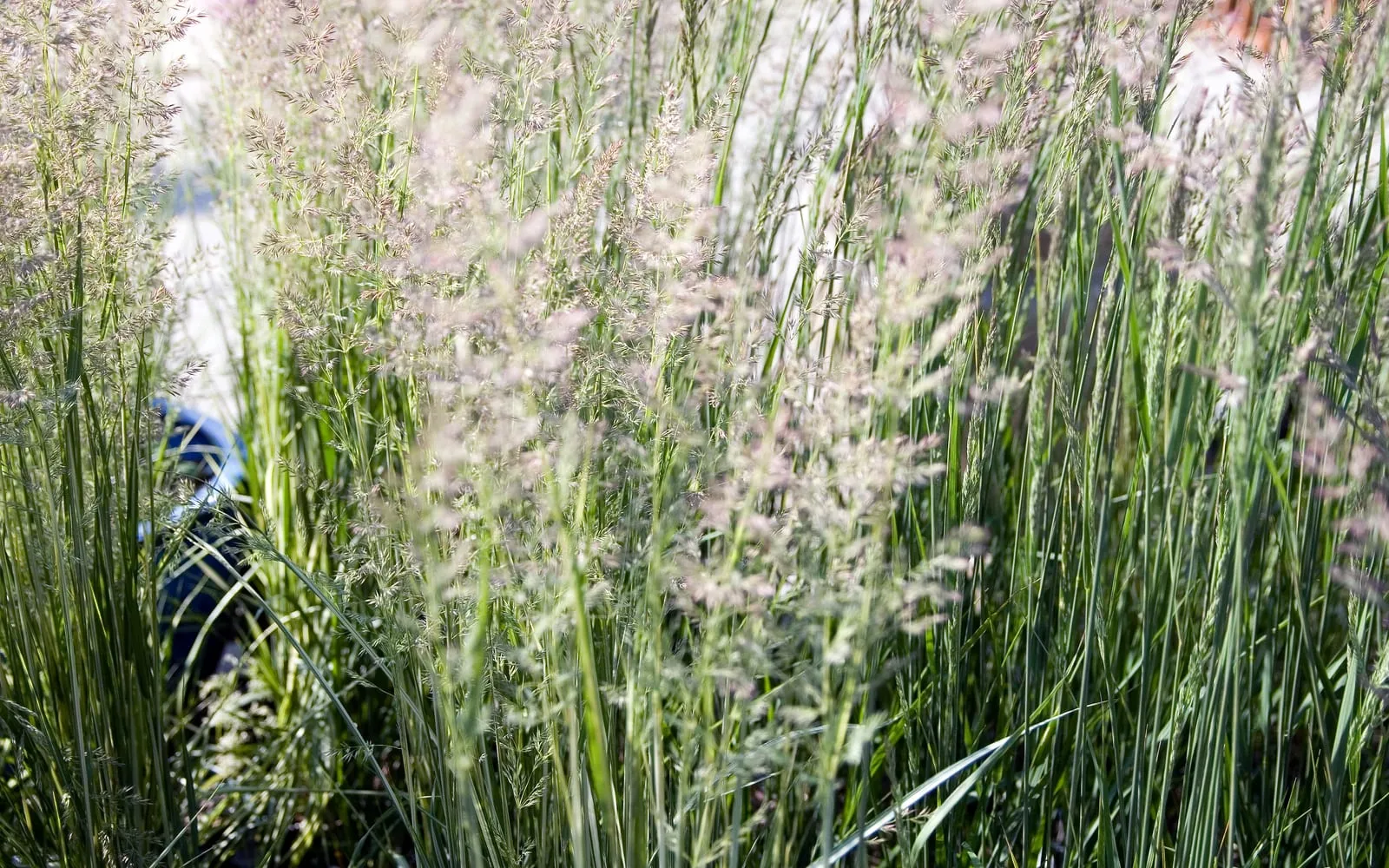
Feather reed grass grows in a single tight, upright column rather than a loose fountain, which is what separates it at a glance from most other ornamental grasses. Narrow flower spikes push up in early summer, weeks ahead of almost anything else in this class, and they hold that vertical line from June through winter without flopping or needing a stake.
It is a garden hybrid between Calamagrostis arundinacea and Calamagrostis epigejos, and the cross is sterile. A plant grown from seed does not exist: every specimen sold is a division of an existing clone, which is also why it never turns up as an unwanted seedling in a border the way many ornamental grasses do.
Appearance and character
Narrow, dark green leaves rise in a tight vertical clump around 60 cm tall before the flower stems appear. The foliage stays neat through the growing season and holds some green even after frost, fading to tan only as winter sets in properly.
Flower spikes emerge in early summer as slim, feathery plumes tinged pink-bronze, standing well above the foliage on stiff, unbranched stems. By midsummer they have opened into narrow, upright seed heads the colour of ripe wheat, and that colour and shape hold through autumn and into winter, catching low light and moving in wind while staying rigidly upright.
‘Karl Foerster’, named for the German nurseryman who selected it in the 1930s, is by far the most widely sold form and the one most guides and nurseries mean when they say feather reed grass. ‘Overdam’ is a variegated sport with a cream-edged leaf and a slightly shorter, looser habit.
Where it is from
Calamagrostis x acutiflora did not arise in the wild. It is a hybrid between two Eurasian reed grasses, Calamagrostis arundinacea and Calamagrostis epigejos, first recorded from cultivation and selected for garden use rather than found growing on its own.
Both parent species are native across a broad stretch of Europe and temperate Asia, arundinacea in woodland and scrub, epigejos on disturbed ground and dune systems, and the hybrid inherits some of that toughness without either parent’s tendency to spread by rhizome into a nuisance. Sterility, and the clumping habit that comes with the arundinacea parent, are what make it behave in a border rather than run through one.
How it grows
Plant in any reasonable garden soil in full sun, spacing clumps 45 to 60 cm apart to give each one room to reach its full upright width without crowding its neighbours.
Growth starts early in spring, well before most warm-season grasses stir, and the flower spikes follow by early summer. Once established, the clump holds its shape and size for years rather than expanding outward, so division is a matter of choice rather than necessity.
Divide an overgrown or thinning clump in early spring, lifting the whole root mass and splitting it into sections with a spade, each with enough roots and shoots to establish on its own. Every third or fourth year keeps a clump vigorous; it is not required annually.
Cut the whole clump back to 10 to 15 cm above ground in late winter, before new growth starts. Leaving the old growth standing through winter is deliberate, since it is the main ornamental feature of the coldest months, and cutting too early sacrifices weeks of structure for no gain.
Through the seasons
Spring brings the earliest new growth of any grass in the garden, followed by a late-winter cut carried out just before it, and division if a clump needs it.
Summer is flowering. Spikes open in June and hold their upright form through the hottest weeks, when the clump itself does comparatively little further growing.
Autumn turns the seed heads from wheat-gold to a duller tan, and the foliage below follows more slowly, some of it staying green into the first frosts.
Winter is when the standing seed heads earn their place, catching frost and low sun through the dormant months until the late-winter cut clears them for the next season.
Care difficulty
Easy. A well-sited clump needs one cut a year and nothing else, and it holds its shape and size without spreading, staking or deadheading. The one condition worth respecting is drainage: a spot that stays wet through winter is the only common way to lose one, particularly in a climate with hot, humid summers, where a soggy crown is more likely to rot.
Watering
Water regularly through the first season while roots establish, aiming for a deep soak that reaches the full depth of the root mass rather than a light daily sprinkle that only wets the surface.
Once established, an existing clump tolerates real drought and needs watering only in an extended dry spell. It is markedly more drought tolerant than it looks, given how lush and upright the foliage stays through summer.
Warning signs, diseases and pests
Rust appears as orange pustules on the underside of the blades, most often in a wet, humid season, and rarely does lasting harm to an established clump. Removing the worst-affected leaves and improving air movement around the clump reduces it.
Leaf spot shows as small brown or tan spots, usually on older leaves toward the base, and is cosmetic rather than threatening on a plant this tough.
Root rot at the crown follows wet ground rather than a disease the plant is especially prone to. A clump planted where winter water collects can rot at the base and fail to resprout in spring, while the same clump on free-draining soil rarely shows any sign of it.
Growing environment
Full sun gives the straightest stems and the heaviest flowering. Light shade is tolerated, though the clump leans toward the light and flowers more sparsely.
Almost any garden soil suits it, from clay to sandy loam, provided it drains through winter. It is markedly more forgiving of poor soil than of poor drainage.
The stiff, unbranched flower stems stay upright in weather that flattens softer, looser ornamental grasses, which is a large part of why it is planted in such quantity along paths, in massed borders and beside water features where a vertical line is wanted without staking.
Feeding
A light annual feed, or a spring mulch of garden compost, is enough for most soils. Rich feeding produces softer, floppier growth that loses the rigid upright habit this grass is grown for.
On poor or sandy soil, a balanced, low-nitrogen fertiliser applied once in spring keeps colour and vigour without pushing the clump beyond its natural size.
Troubleshooting
The clump has flopped over instead of standing upright. Too much shade, too rich a soil, or both. Move a struggling clump into full sun at the next opportunity, and hold back on feeding, since excess nitrogen is a common cause of soft, leaning growth in this otherwise self-supporting grass.
It never sets seed and nothing new comes up nearby. That is normal and by design. The hybrid is sterile, so every plant is a division of an existing clone rather than a seedling, and none will appear uninvited elsewhere in the garden.
The centre of the clump has died out and only the edges are growing. An old clump losing vigour at the centre is ready for division. Lift it in early spring and replant only the vigorous outer sections.
Why has it not flowered this year? Too much shade is the most common cause, followed by a very rich or recently fed soil pushing leafy growth at the expense of flower spikes. A full-sun spot on ordinary soil almost always flowers reliably from its second season.
Can I leave the old growth standing over winter? Yes, and it is worth doing. The dried seed heads are the main winter interest this grass offers, and cutting it back only in late winter, just before new growth starts, gets the full value from them before they are removed.