
Houseplant
String of Buttons
Crassula perforata
Also known as Necklace Vine, String of Coins
Practical guidance for growing string of buttons, Crassula perforata, including stacked triangular leaves, propagation from leaves, bright light, drought tolerance, and mild toxicity.
At a glance
- Difficulty
- Easy
- Water
- Every one to two weeks in summer, monthly or less in winter
- Light
- Full sun to bright light; some direct sun for the best leaf colour
- Temperature
- 10-30 deg C
- Humidity
- Dry air; avoid misting
- Hardiness
- USDA 9b-11, RHS H2, hardy to 0 C
- Type
- Evergreen succulent perennial
- Height
- Upright to 20 cm, trailing stems to 30 cm or more
- Native to
- South Africa
A dry-region succulent from South Africa's semi-arid scrub, where rainfall is unreliable and drainage is sharp. The zone number carries little weight next to sunlight and dry air, since colour and compact growth depend on strong light rather than on anything the winter minimum controls. It tolerates a very brief light frost if the compost is bone dry, and wet, cold conditions kill it far faster than cold alone.
Hardiness zones describe winter cold alone. Summer heat, humidity, rainfall and the length of the growing season decide as much, so treat the range as the outer limit rather than as a recommendation.
Harmful to pets if eaten
- Do not eat
- All parts, in line with the wider Crassula genus
- Harm from
- Eating it
- Affects
- Cats, dogs and horses
Crassula perforata has no page of its own on the RHS or ASPCA sites, but it sits in the same genus as jade plant, Crassula ovata, which the ASPCA lists as toxic to cats, dogs and horses, causing vomiting, depression, incoordination and a slowed heart rate if a significant amount is eaten. Species-level testing across the genus is thin, so the sensible reading is to treat this species with the same caution as its better-documented relative rather than assume the absence of a specific listing means it is safe. In practice the risk is low: the thick, gritty leaves are not especially palatable, and reported cases involve considerable quantities eaten rather than a single curious nibble.
Sources: ASPCA (Jade Plant, Crassula ovata), RHS potentially harmful garden plants
About
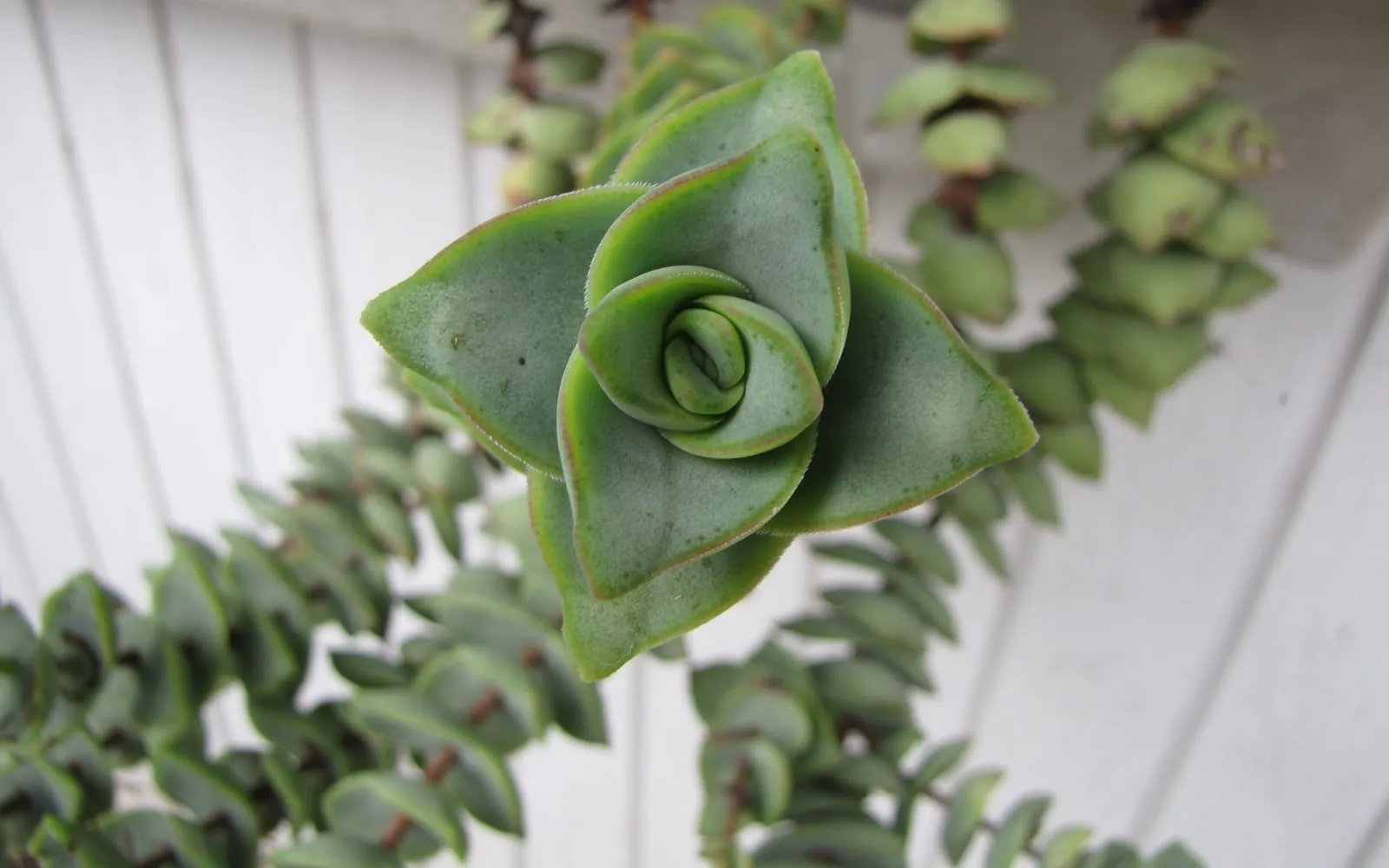
String of buttons grows as neat stacks of small, triangular, fleshy leaves arranged in tight opposite pairs up each stem, each pair rotated ninety degrees from the one below it. The stacked leaves press so closely against the stem that it looks threaded through them, which is where both the common name and the species name, perforata, come from.
Young growth is upright and compact, but stems lengthen and begin to trail as the plant matures, making it a good choice for a hanging pot or a shelf edge where the older growth can spill over.
Appearance and character
Leaves are small, triangular and fleshy, pale grey-green with a fine powdery bloom, stacked in tightly opposite pairs that give each stem a segmented, almost architectural look. In strong light, the leaf margins flush pink to red, deepening further with cooler nights or a touch of stress from light or water.
Stems start upright and, as they lengthen, begin to arch and trail, eventually reaching 30 cm or more in a hanging pot, with new stacked growth continuing to form at each tip.
Small, star-shaped, pale yellow flowers appear in clusters at the stem tips on a mature plant, most often in late winter or spring, though many plants are grown purely for the foliage and rarely reach flowering size indoors.
Where it is from
Crassula perforata is native to the semi-arid scrub of South Africa’s Eastern and Western Cape, growing among rocks and other low vegetation in conditions with sharp drainage and unreliable rainfall.
Its native range explains why the plant tolerates neglect but not wet feet. Strong, often unfiltered sunlight produces the deep pink leaf-edge colour breeders and growers prize, while soil that drains within minutes of rain keeps the roots from sitting wet for long.
Cooler nights at altitude, common across much of its range, also play a part in colour development, which is why a plant kept in a warm, evenly lit room year round often stays plainer green than one that experiences some day-to-night temperature swing.
How it grows
Plant it in a gritty cactus and succulent compost with sharp drainage, either a purpose-made mix or ordinary compost cut roughly half and half with horticultural grit or perlite.
Give it full sun to bright light, with several hours of direct sun where possible. A plant kept too dim stretches quickly, losing the tight, stacked form that makes it worth growing.
Water thoroughly, then let the compost dry out completely before watering again, erring on the side of underwatering rather than overwatering at any point in the year.
Propagate readily from stem cuttings or even single leaves. Let a cutting or a detached leaf callus over for a couple of days, then rest it on top of dry gritty compost; roots and a small new plant form at the base within a few weeks.
Repot every couple of years, or when a hanging specimen has trailed further than looks tidy, into fresh gritty compost, trimming back leggy stems at the same time if a more compact shape is wanted.
Through the seasons
Spring restarts active growth. Increase watering gradually, take cuttings if more plants are wanted, and give the first feed of the season.
Summer is the main growing period. Water every one to two weeks, and move the plant outdoors into full sun once nights stay reliably above about 8 deg C for the best colour of the year.
Autumn slows growth. Bring an outdoor plant back in before nights turn cold, and reduce watering.
Winter is a dry rest. Water monthly at most, keep the plant in the brightest spot available, and expect some stretching in low light that can be corrected with a spring trim.
Care difficulty
Easy, with almost all the risk concentrated in overwatering rather than in anything else. Compost that stays wet, particularly through a cool winter, rots the roots quickly, while a missed watering or two in summer does the plant no visible harm at all.
Light is the other factor worth watching. A dim spot does not kill the plant, but it stretches the stacked leaves apart and fades the colour, undoing the compact, patterned look that is most of the appeal.
Watering
Water the compost thoroughly, then let it dry out completely before watering again. In summer that is roughly every one to two weeks; in winter, monthly or less.
Judge by the leaves rather than a fixed schedule where possible. Slightly soft lower leaves suggest the plant is ready for water, while firm, plump leaves mean it needs none yet.
Never let the pot sit in a saucer of standing water, and choose a pot with drainage holes rather than a sealed decorative container.
Warning signs, diseases and pests
Mealybug tucks itself between the stacked leaves where it is easy to miss, showing as small white, cottony tufts once a colony builds up. Apply surgical spirit with a fine paintbrush to reach into the tight gaps between leaves.
Root rot follows compost that never dries out, showing as translucent, mushy stems and leaves that drop at a touch. Cut away all affected growth, let healthy cuttings callus, and start again in fresh, gritty compost.
Etiolation, a lengthening stem with widely spaced leaves reaching for light, is a light problem rather than a pest or disease. Move the plant into brighter conditions and trim the stretched growth back once light improves, since the affected section will not tighten up again on its own.
Vine weevil grubs feed on the roots and can cause a sudden, unexplained collapse, most often in a plant kept in a container outdoors over summer. Nematode drenches offer effective control where the grubs are confirmed.
Growing environment
Full sun to bright light suits it best, with direct sun for at least part of the day bringing out the strongest leaf colour. Anything less and the stems stretch within weeks.
Temperatures between 10 and 30 deg C suit normal growth well. It survives a brief, light frost only when the compost is completely dry, and cold, wet conditions together are far more dangerous than either alone.
Dry air suits it fine, and misting does more harm than good by encouraging rot where water collects between the stacked leaves.
Gritty, sharply drained compost is essential. A shallow, wide pot with generous drainage holes suits the shallow root system better than a deep one, which tends to hold wet compost below the roots’ reach.
Feeding
Very little feeding is needed. A cactus and succulent fertiliser at half strength, applied once or twice during the growing season, is enough.
Stop entirely over autumn and winter, when the plant is barely growing and any unused fertiliser builds up as salts in the gritty compost.
Fresh compost from a recent repotting supplies enough nutrition for the first season on its own, so skip feeding in a year when the plant has just been repotted.
Troubleshooting
The stems have stretched out with big gaps between the leaves. Etiolation from too little light. Move the plant somewhere brighter and trim the stretched section back; new growth from a cutting or from the base will come in tighter under better light.
Leaves have gone soft, translucent and are dropping. Overwatering, most likely leading into root rot. Stop watering, check the roots, and take healthy cuttings as insurance if the damage looks extensive.
No pink colour on the leaf edges. Not enough direct sun. Move the plant to a brighter spot, ideally with several hours of direct light, and the colour should develop over the following weeks.
A cutting I took has shrivelled instead of rooting. It was likely placed on damp compost before the cut end had calloused over. Let cuttings dry for a couple of days first, and keep the compost dry rather than moist until roots appear.
Can I grow it outdoors year round? Only in a frost-free climate, or somewhere it can be kept completely dry through any brief cold snap. Elsewhere, treat it as a houseplant that can spend summer outside and must come back in before the first real frost.
String of Buttons problem guides
Not sure what is wrong? See the common houseplant pests guide.