
Houseplant
Baseball Plant
Euphorbia obesa
Also known as Living Baseball, Sea Urchin Plant
How to grow baseball plant, Euphorbia obesa. Why it is mistaken for a cactus despite being a euphorbia with irritant sap, why a lone plant never sets seed, and why underwatering is by far the safer mistake.
At a glance
- Difficulty
- Moderate
- Water
- Every two to three weeks in summer, monthly or less in winter
- Light
- Full sun to very bright light, introduced gradually
- Temperature
- 10-32 deg C. Cold combined with wet compost is the real danger
- Humidity
- Dry air. Do not mist
- Hardiness
- USDA 9b-11, RHS H2, hardy to 2 C
- Type
- Evergreen succulent perennial
- Height
- 8-20 cm tall, 8-12 cm across
- Native to
- South Africa
A semi-desert species from the Great Karoo of South Africa, growing in sparse, stony ground under intense sun with rainfall concentrated in a short season. Some established, bone-dry plants survive a very brief dip near freezing in habitat, but the safer approach in cultivation is to treat it as frost-tender, since the combination of cold and any residual moisture in the compost rots it far faster than cold alone would. Below USDA 9b it needs to winter indoors or under glass.
Hardiness zones describe winter cold alone. Summer heat, humidity, rainfall and the length of the growing season decide as much, so treat the range as the outer limit rather than as a recommendation.
Toxic if eaten
- Do not eat
- The milky latex sap released from any cut or damaged tissue
- Harm from
- Eating it, handling it and sap in the eyes
- Affects
- People, cats and dogs
Every part of this plant contains a thick white latex typical of the Euphorbia genus, which the ASPCA lists as toxic to cats and dogs, causing drooling, vomiting and mouth irritation if chewed. The bigger risk is the sap itself rather than eating the plant, since the latex is a strong skin and eye irritant, causing burning, redness and, in the eye specifically, real pain and temporary or even lasting damage to the cornea if not rinsed out promptly. This species produces less sap than some of its Euphorbia relatives, but the compound is the same, and any cut, snapped or heavily handled specimen releases enough to cause a reaction. Wear gloves when repotting or propagating it, keep hands away from your face while doing so, and flush any sap that reaches skin or an eye with plenty of water, seeking medical advice for an eye that keeps stinging or reddening.
Sources: ASPCA (Pencil Cactus, Euphorbia tirucalli), RHS potentially harmful garden plants
About
Baseball plant looks nothing like the spiny cacti it is often mistaken for at a glance. It is a spineless, ridged sphere, greyish-green and faintly patterned, that grows almost geometrically neat for years before it begins to elongate into a shorter column. Despite the resemblance, it belongs to the euphorbias rather than the cacti, a different family with an entirely different, and mildly hazardous, sap.
It is a slow, undemanding grower once its watering needs are understood, and the single biggest risk to an otherwise easy plant is a well-meaning grower treating it like a leafier houseplant and watering it far too often.
Appearance and character
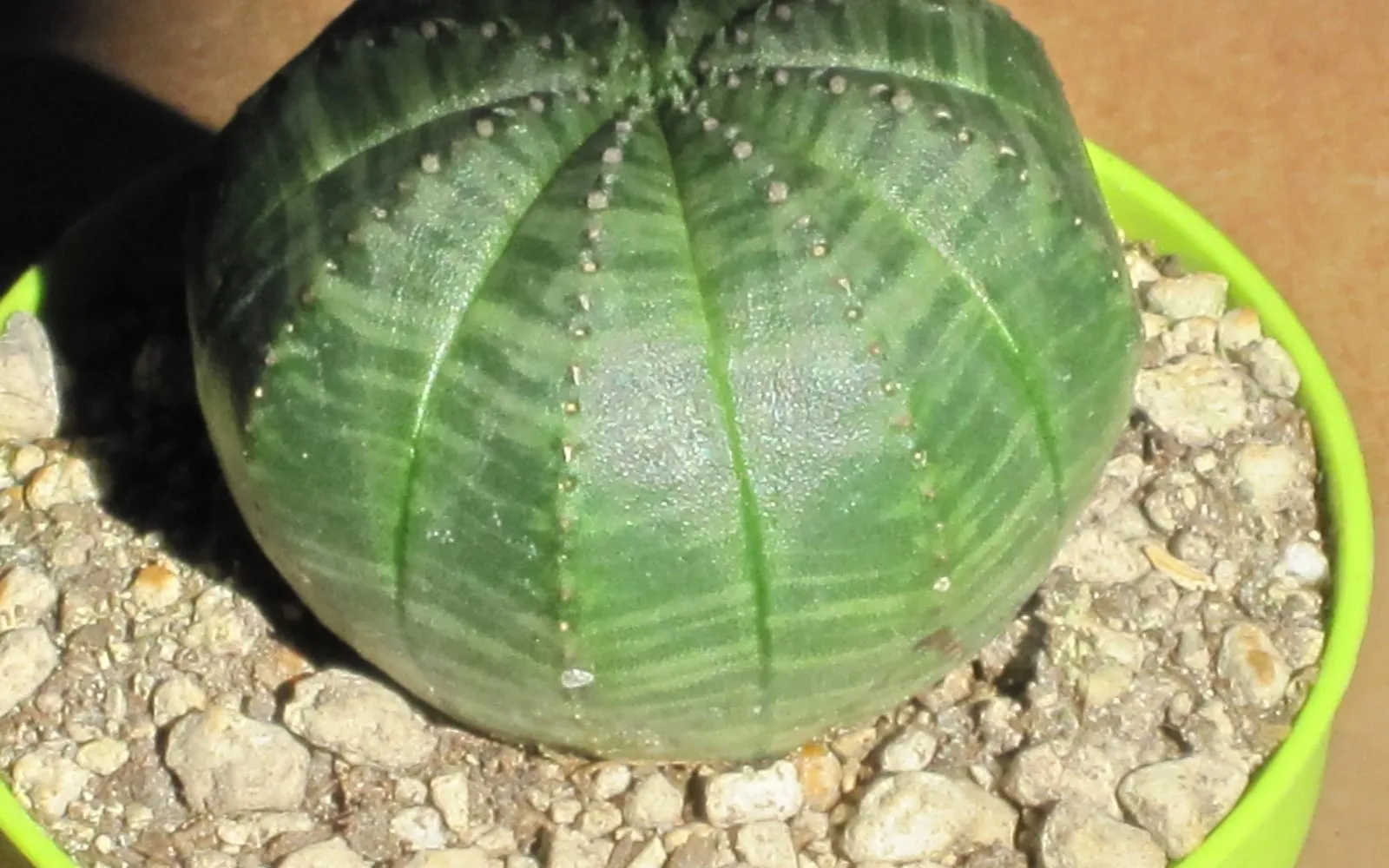
A solitary, spineless globe, 8 to 12 cm across when young, marked with eight low, rounded ridges running from base to crown like the seams on the ball the plant is named for. The surface is a muted grey-green, often with faint darker mottling or thin transverse banding that adds subtle texture without breaking the plant’s overall geometric neatness.
The crown, at the top of the globe, carries a small cluster of tiny flowers called cyathia, greenish-yellow and easy to overlook, that appear over an extended period rather than in one obvious flush. The species is dioecious, meaning individual plants are either male or female, so a single specimen grown alone will never set seed no matter how well it flowers.
With age, over a good many years, the globe gradually elongates into a shorter, slightly columnar shape rather than staying perfectly round indefinitely, a change that happens slowly enough to go unnoticed from one season to the next.
Where it is from
Euphorbia obesa is native to a narrow area of the Great Karoo in South Africa’s Eastern Cape, growing among sparse, stony vegetation in a semi-desert climate of intense sun, wide temperature swings between day and night, and rainfall concentrated into a short part of the year.
That stony, mineral-poor ground drains almost instantly after rain, which is the condition a gritty succulent compost tries to reproduce indoors. The plant’s globose shape, with a low surface area relative to its volume, is itself an adaptation for storing water and losing as little of it as possible to the sun and wind of open Karoo ground.
Wild populations are now rare and the species is protected, having been heavily collected in the past. Almost every plant available to buy today is nursery-propagated rather than wild-collected. Confirm that with a reputable seller when buying one.
How it grows
Pot it in a very gritty, sharply draining cactus and succulent compost, in a pot only slightly larger than the plant’s base, since an oversized pot holds far more moisture than the modest root system can use.
Growth is slow at every stage, typically adding only a small amount of girth or height each year even under good conditions, which is normal for the species rather than a sign of a problem.
Introduce a plant that has been grown in lower light to full sun gradually, over several weeks, rather than moving it straight into a bright south-facing window. A sudden jump in light intensity can scorch the surface with a permanent brown or reddish mark.
Propagation from seed is the standard method, since the plant rarely produces offsets and does not lend itself to cuttings the way many other euphorbias do. A seed-grown plant takes several years to reach a decent size.
Through the seasons
Spring restarts growth after the winter rest. Increase watering gradually and give the first feed of the season.
Summer is the main growing period. Water every two to three weeks as the compost dries, and give the plant its brightest position of the year, introduced gradually if it has spent winter somewhere dimmer.
Autumn slows growth as light drops. Begin spacing out waterings further as the season progresses.
Winter is a dry rest. Water sparingly, no more than monthly, and keep the plant somewhere it will not sit cold and damp at the same time, since that combination is the one this species tolerates worst.
Care difficulty
Moderate, and the difficulty sits almost entirely in watering restraint rather than in anything the plant actively demands. It is slow, undemanding on light within reason, and needs little feeding, but its roots rot readily in compost that stays wet, particularly through a cool winter when the plant is barely using any water at all.
The sap matters when handling the plant, since repotting or any accidental damage releases a latex that irritates skin and is painful in an eye, unlike the comparatively harmless sap of a true cactus this plant is sometimes mistaken for.
Watering
Water the compost thoroughly, then let it dry out completely before watering again, roughly every two to three weeks in summer and monthly or less in winter.
Check the compost with a finger a few centimetres down rather than watering to a fixed schedule, since the correct interval shifts with light, temperature and the size of the pot.
A plant that has gone without water for longer than expected draws on its stored reserves and shows little outward change for some time, which makes underwatering a far safer mistake with this species than overwatering.
Warning signs, diseases and pests
Mealybugs hide at the base of the plant or tucked into the grooves between the ridges, showing as small white, cottony patches. Remove them with a cotton bud dipped in diluted alcohol, taking care around the sap.
Rot from compost kept too wet is the main threat, especially in cool conditions, and shows as a soft, discoloured patch on the body of the plant that spreads if not caught early. Cut away affected tissue with a clean blade if caught in time, let the wound dry and callus, and repot into fresh, dry compost.
Vine weevil grubs feed on the roots underground, sometimes causing a plant to topple or collapse with little warning above soil level. Nematodes applied to the compost are the standard control.
Scale insects appear as small, flat brown discs on the body of the plant. Treat the same way as mealybugs.
Growing environment
Full sun to very bright light suits it best, introduced gradually to avoid scorching a plant that has previously been grown dimmer. A windowsill with several hours of direct sun a day is ideal once the plant is acclimatised.
Temperatures from about 10 to 32 deg C are comfortable. It is cold combined with wet compost, rather than cold alone, that poses the real risk, so keep watering minimal through any cool spell.
Dry air suits it well. Avoid misting and avoid positioning it among humidity-loving plants that want the opposite conditions.
Very gritty, sharply drained compost is essential. A dedicated cactus and succulent mix, ideally with extra grit or pumice added, drains faster than most off-the-shelf blends and suits this species better.
Feeding
Very little feeding is needed. A cactus and succulent fertiliser at half strength, applied once or twice during the growing season, is enough to support this slow-growing plant.
Stop feeding entirely from autumn through winter, when growth has all but stopped and the roots are taking up next to nothing.
A plant repotted into fresh compost within the past year or so needs little to no additional feeding for that first season.
Troubleshooting
A soft, discoloured patch has appeared on the body. Rot, almost certainly from compost that has stayed too wet. Cut away the affected tissue with a clean blade if the damage is limited, let the cut dry and callus for several days, and repot into fresh, dry compost.
The surface has developed a permanent brown or reddish mark. Sun scorch from being moved into strong direct light too quickly. The mark will not disappear, but it will not spread either if the plant is otherwise healthy; introduce any future light changes more gradually.
It has not grown visibly in a long time. Likely nothing wrong. This species grows very slowly under the best conditions and can look static for a year or more, particularly in a pot it has not yet outgrown.
Small yellowish flowers have appeared at the top but no seed has formed. Normal for a plant grown alone. The species is dioecious, with separate male and female plants, so a single specimen cannot self-pollinate.
I got some sap on my skin while repotting it. Is that a problem? Wash it off with soap and water as soon as possible; it commonly causes mild irritation and occasionally a more noticeable reaction. Avoid touching your face or eyes until you have washed your hands thoroughly, and seek medical advice if any sap gets into an eye and keeps stinging.
Baseball Plant problem guides
Not sure what is wrong? See the common houseplant pests guide.