
Outdoor plant
Bee Orchid
Ophrys apifera
How to grow bee orchid, Ophrys apifera. Its flower mimics a female bee down to the scent, it self-pollinates in Britain where that bee is scarce, and leaving a chalk lawn unmown does more than deliberate planting ever will.
At a glance
- Difficulty
- Difficult
- Water
- Rainfall alone is normally sufficient; never irrigate a dormant summer patch
- Light
- Full sun to very light shade
- Temperature
- Needs a distinct dry summer and a cool winter; not suited to a wet, mild, year-round climate
- Humidity
- Dry at the surface through summer dormancy
- Hardiness
- USDA 6-9, RHS H5, hardy to -15 C
- Type
- Herbaceous perennial orchid growing from a pair of underground tubers, often short-lived as an individual plant
- Height
- 20-45 cm in flower
- Native to
- Europe, the Mediterranean
Occurs from Britain south through the Mediterranean basin, and winter cold alone does not explain that spread, since plants at the northern and southern edges of the range face very different minimum temperatures. What every population shares is calcium-rich, low-nutrient, sharply drained soil and a dry season after flowering. Wet, fertile, or acidic ground rules the species out regardless of how mild the winter is.
Hardiness zones describe winter cold alone. Summer heat, humidity, rainfall and the length of the growing season decide as much, so treat the range as the outer limit rather than as a recommendation.
Not known to be toxic
Ophrys apifera carries no recorded toxic compounds and does not appear on the RHS list of harmful garden plants or any equivalent European reference. It is not a plant grown for cutting or kept indoors in quantity, so the practical question rarely arises, but there is no documented reason to keep pets or children away from it beyond the general point that digging up or picking a wild orchid is against the law in most of the countries where it grows.
About
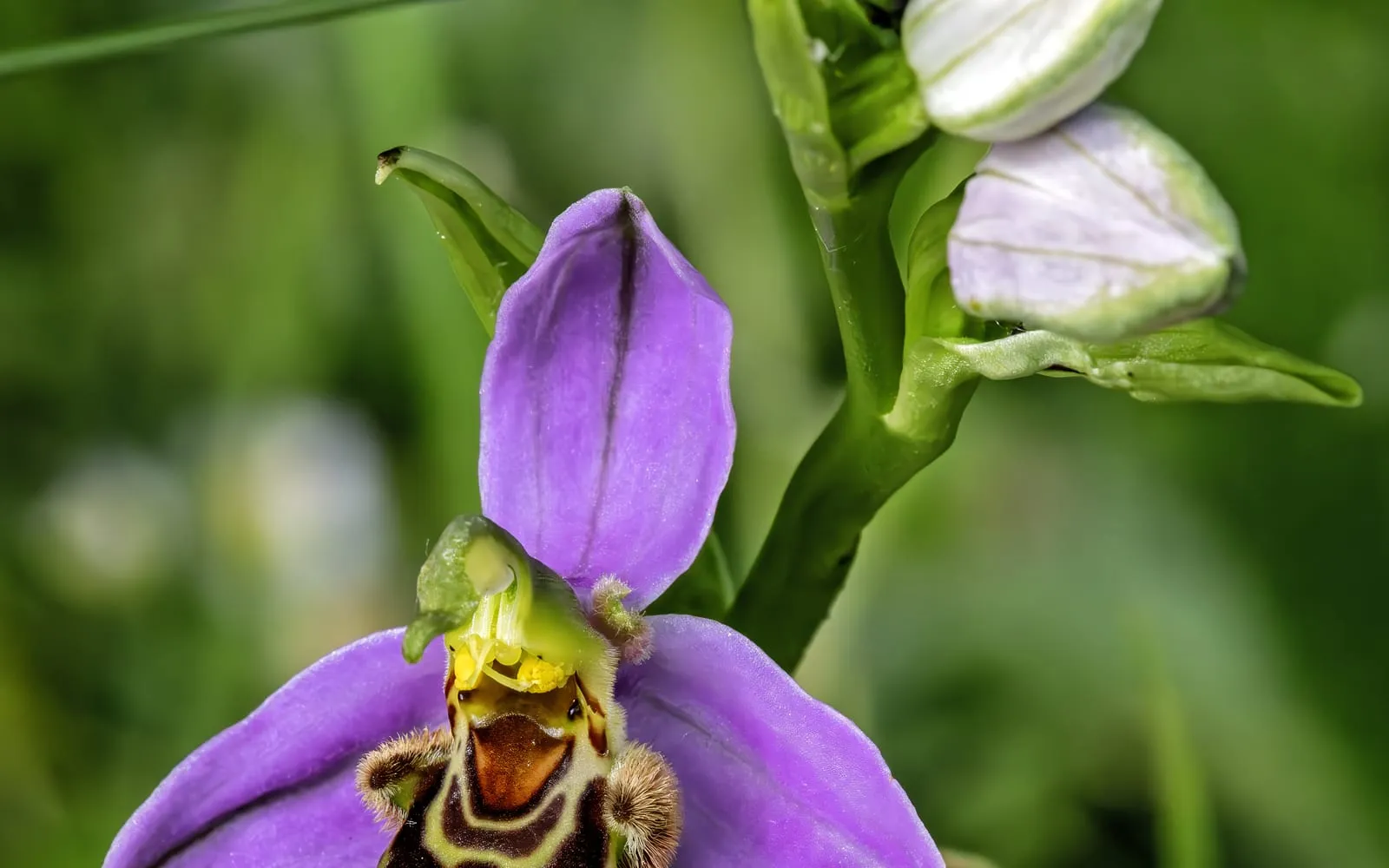
Bee orchid gets its name from a flower that looks and smells like a female solitary bee. Each bloom carries a velvety brown lip patterned with blue-grey markings that mimic folded wings, sitting below three pale pink sepals that read, from a short distance, as the rest of the insect’s body.
It is a genuine wildflower rather than a garden plant in the usual sense. Deliberately buying and planting a specimen very rarely succeeds, because the species depends on precise soil chemistry and a fungal partner that a garden bed cannot easily reproduce, and digging one up from the wild is illegal across most of its range. Where it does appear in a garden, it is almost always a colony that has arrived and established on its own, usually on a chalk or limestone lawn left unmown and unfertilised.
Appearance and character
The flower spike carries anywhere from two or three blooms to a dozen or more on a strong plant, opening in succession up the stem over several weeks. Each flower’s lip is the striking part: a rounded, furred, deep brown pad marked with pale blue-grey lines, evolved to resemble the body of a female Eucera bee closely enough to draw a male in.
The flower also produces a scent mimicking the female bee’s pheromones, and where the right Eucera species is common, a male attempting to mate with it carries pollen on to the next bloom he visits. In Britain and much of northern Europe, that pollinator is scarce or absent, and the flower self-pollinates instead: its pollen sacs bend down on their own and touch the stigma without any insect involved, part of why the species can turn up and set seed in a garden with no bees present to explain it.
Leaves form a low rosette at the base, greyish green and unremarkable next to the flower, dying back once the plant has finished flowering and setting seed for the year.
Where it is from
Ophrys apifera grows across Europe and the Mediterranean basin, from southern Britain and the Netherlands south through France, Italy, Greece and Turkey. Every population sits on calcium-rich ground with thin, alkaline, nutrient-poor soil, whether that is chalk downland, limestone grassland, an old quarry or a dune system.
The species depends on a mycorrhizal fungus present in old, unimproved grassland soil that has never been ploughed, fertilised or treated with weedkiller, and a fresh lawn or a flower bed built from bought topsoil almost never carries it.
How it grows
Most gardeners cannot plant this species and expect it to establish. Live plants and tubers are rarely sold legitimately, since collecting wild orchid tubers is illegal in the UK and most of Europe without specific licensing, and nursery propagation from seed is difficult because germination depends on the same soil fungus the mature plant needs, which most growing media do not contain.
Where a garden already has an old, unimproved chalk or limestone lawn, seed can arrive on its own, carried by wind or on machinery, and germinate where the right fungus happens to be present in the soil. The best a gardener can do to encourage this is indirect: leave an area of chalk or limestone turf unmown from spring through midsummer so any seed that lands has a chance to grow, avoid fertiliser and weedkiller on that ground entirely, and mow only after the plants have finished flowering and dropped seed, typically from midsummer onward.
If bee orchids do appear, resist moving or transplanting them. A tuber lifted from where it germinated loses the fungal connection that let it grow there in the first place, and moved plants seldom survive.
Through the seasons
Autumn and winter see the leaf rosette present at ground level, growing slowly through the cooler months in a mild climate.
Spring brings faster growth as temperatures rise, building towards the flower spike.
Early summer is flowering time in most of the range, typically June in Britain, when the spike opens its sequence of bee-mimicking blooms over several weeks.
Late summer sees the plant set seed and die back completely above ground, entering dormancy until growth resumes the following autumn or spring.
Care difficulty
Difficult, in the specific sense that there is very little a gardener can do to establish this species from scratch. It cannot reliably be bought as a plant, cannot reliably be raised from seed without the right fungus already present, and cannot be moved once it has appeared without a high risk of killing it. What passes for care here is closer to habitat management than gardening. A gardener can leave suitable ground undisturbed, poor and unfertilised, and mow it at the right time of year, then hope a colony establishes on its own. Even in the best-prepared unimproved lawn, bee orchids may never turn up, since the fungus and the seed both have to arrive independently and neither can be guaranteed.
Watering
None beyond natural rainfall. The species is adapted to a distinct dry season after flowering, and irrigating a lawn or bed where bee orchids have appeared, particularly through summer, works against the dormancy the tubers need and can rot them outright.
Through the cooler growing months, ordinary rainfall on free-draining chalk or limestone ground is sufficient; standing water at any time of year is a serious risk to the tubers.
Warning signs, diseases and pests
Slugs and snails graze the leaf rosette and can strip an emerging flower spike before it opens, particularly in a wet spring. There is little to do beyond general slug control in the surrounding area, since chemical treatments are unsuitable so close to a wildflower colony a gardener is trying to encourage.
Vine weevil larvae feed on the tubers below ground, and damage typically shows only as a plant that fails to reappear the following year. There is no realistic treatment for a wild colony beyond the general condition of the soil, since the site cannot be dug over or drenched without disturbing the orchids themselves.
Root rot follows any spot where water collects instead of draining away sharply, killing the tubers outright. This is one of the few problems a gardener can prevent outright, by choosing or improving a site with fast drainage before hoping for a colony to establish.
Rabbits and deer browse the flower spike before it opens, removing a season’s flowers in one bite on unprotected ground. A temporary mesh guard around known plants during the weeks before flowering is the practical response.
Growing environment
Full sun or very light shade suits it best, on ground with no more than a thin covering of turf and no tree canopy overhead shading it for most of the day.
Alkaline, chalk or limestone soil is not optional; the species does not grow on acidic or neutral ground regardless of drainage or light. A simple pH test tells you within minutes whether a given patch of garden can support this species.
Low fertility and sharp drainage together keep competing grass in check and prevent the tubers sitting in damp soil, both conditions that established chalk grassland provides without any input from a gardener at all.
Feeding
None, and this is one of the few plants on this site where feeding does active harm rather than going to waste unused. Added nutrients favour vigorous grasses and other plants that outcompete the orchid for light and space, and can shift the balance of the soil fungus community away from the one this species relies on.
Troubleshooting
Can I buy a bee orchid plant or tuber to plant in my garden? Very rarely, and legitimate stock is uncommon. Wild collection is illegal across most of the species’ range, and nursery propagation from seed is difficult because germination depends on a soil fungus most growing media lack. Treat an easy online purchase as a red flag rather than good luck.
One appeared in my lawn on its own. What should I do? Leave it exactly where it is, stop mowing that patch until it has flowered and set seed, and avoid fertilising or treating the area with weedkiller. Moving it is far more likely to kill it than to help it.
Why did it flower for a year or two and then vanish? This is common and no sign anything was done wrong. Individual bee orchids are often short-lived, and a colony persists through new plants germinating from seed rather than one tuber flowering indefinitely, so a gap does not mean the population is gone for good.
Will it come back if I mow the area normally? Regular mowing through spring and early summer removes the flower spike before it can set seed, which over a few years can eliminate a colony dependent on fresh seedlings. Delaying the first cut until after flowering gives it a chance to persist.
Is it legal to pick the flowers if they are growing on my own land? Owning the land settles the permission question, since the law in Britain and most of Europe restricts uprooting a wild plant without the landowner’s consent. Picking a flower without digging up the plant is usually allowed on your own land, though it is still best avoided, since a picked flower cannot go on to set the seed a colony needs to persist.